
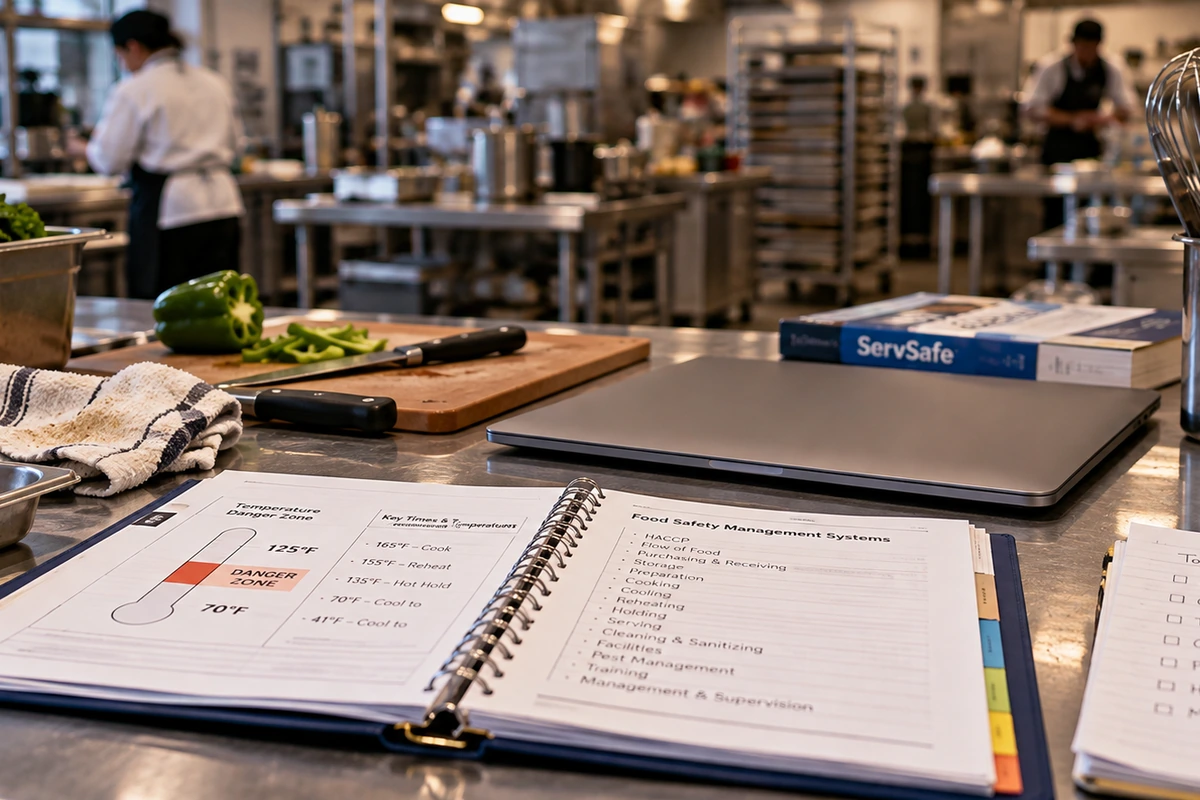
Why Stop Here?
You have reached the end of the first major block of the course. Everything so far has been about the foundation: how foodborne illness happens, the hazards that cause it, the people most likely to spread it, and the management decisions that keep those risks under control. From here, the course becomes more operational. We start moving through food, equipment, temperatures, cleaning, sanitizing, facilities, and management systems. If the foundation is shaky, the next part gets harder fast.
So before we pile more on top, this is the point to stop and prove you know enough to move on.
What We’re Studying
This review is both a diagnostic tool (what you NEED to study) and a confirmation tool (what you DON’T need to study). Use it wisely.
How We’re Going to Do It
You are not going to sit here and reread ten chapters in one giant block. You are going to work through four shorter study sessions that make you use the material in different ways.
This review is built around the same basic study habits ServSafe recommends: shorter study sessions, practice before the exam, and spending more review time on the areas you actually miss. Educational psychology backs the same approach.
Why We’re Doing It This Way
Here’s a bad study strategy I want you to avoid: rereading each chapter until it starts to feel familiar. Why? You’ll remember where a fact you need sat on a page. You’ll remember that the answer was C. You recognize the words. That probably feels a lot like knowing. It isn’t.
Here’s another bad preparation strategy I see all the time: the giant study marathon. You hammer information into short-term memory for three hours, feel brilliant for approximately twelve minutes, then somebody asks what you want in your morning vanilla latte macchiato monstrosity and half of it disappears. Short-term memory is a sneaky, sneaky lady.
The break I want you to take in-between study sessions is not wasted time. The break is part of the strategy. If you can walk away, come back later, and still pull the answer out of your head, you’re ready. Once you can do that reliably, move on. Your study time belongs to the stuff you still miss.

Know It Cold
This first study session is about the stuff you simply have to be able to pull out of your head. No stories. No multiple choice. Give yourself the answer before you check anything.
The following questions are from What Foodborne Illness Is — and the 6 Conditions Bacteria Need to Grow
Temperatures
FAT TOM
Fill in the condition represented by each letter, then give the most important number or rule attached to it.
| Letter | Condition | Key number or rule |
|---|---|---|
| F | ||
| A | ||
| T | ||
| T | Use the temperature answers above. | |
| O | ||
| M |
High-Risk Populations
| High-risk group | Example of an operation that may primarily serve this group |
|---|---|
The following questions are from Employee Health: When to Restrict, When to Exclude
Employee Health
When can that employee return to work?
Which Big 6 virus is strongly associated with jaundice, and what management action does recent jaundice require?
What is the normal management response to sore throat with fever?
How does that sore-throat-with-fever decision change in an operation that primarily serves a high-risk population?
The following questions are from Personal Hygiene & Handwashing: The Habit That Does the Most Work
Handwashing, Gloves, and Wounds
When may a hand antiseptic be used, and what can it never replace?
Name the situations that require single-use gloves to be changed.
| Wound location | Required protection |
|---|---|
| Hand or wrist | |
| Arm | |
| Elsewhere on the body |
The following questions are from The Big 6 Pathogens
Big 6
Name all six Big 6 pathogens.
The following question is from Allergy, Intolerance, or Celiac Disease — Why the Difference Isn’t Optional
Big 9 Allergens
Name all nine major food allergens.
The following questions are from Management in Action: Food Defense and Outbreak Response
Food Defense and Outbreaks
What circumstances should make management suspect a foodborne-illness outbreak and begin responding?
The following question is from Who’s In Charge of Your Food — and Why It’s the Law
The Cost of Foodborne Illness
Name the six major ways a foodborne-illness incident can cost an operation.
The following questions are from Three Kinds of Danger, Sorted
Toxic Metals
Which metals become a chemical hazard when they contact acidic food?
Stop here and don’t go on, even if you’re on a roll. Check your answers. Mark every miss. Practice saying the correct answer out loud. Then close your laptop. Come back in two hours—or even better, tomorrow.
The interruption is deliberate. Strong test prep is not about seeing how long you can grind. It is about making your brain come back and find the answer again.

Tell Them Apart
This study session is about ideas that are easy to understand separately and surprisingly easy to mix up when they appear next to each other.
The following questions are from Who’s In Charge of Your Food — and Why It’s the Law
FDA vs. USDA-FSIS vs. CDC / PHS vs. State or Local Regulatory Authority
| Agency / Authority | What does it stand for? | What does it regulate or do? |
|---|---|---|
| FDA | ||
| USDA-FSIS | ||
| CDC / PHS | ||
| State or Local Regulatory Authority |
FDA Food Code vs. Law
How is that different from the food-safety law actually enforced in a city, county, or state?
Why can food-safety requirements differ slightly from one jurisdiction to another?
The following questions are from What Foodborne Illness Is — and the 6 Conditions Bacteria Need to Grow
Infection vs. Intoxication vs. Toxin-Mediated Infection
| What did you eat? | What made you sick? | |
|---|---|---|
| Infection | ||
| Intoxication | ||
| Toxin-mediated infection |
Why can controlling FAT TOM help prevent some foodborne illnesses but not undo an intoxication after the toxin is already in the food?
The following comparison draws from What Foodborne Illness Is — and the 6 Conditions Bacteria Need to Grow and Four Dangers to Your Food That Are NOT Bacteria
Bacteria vs. Viruses vs. Parasites
| Bacteria | Viruses | Parasites | |
|---|---|---|---|
| Can they grow in food? | |||
| What do they need to reproduce or complete their life cycle? | |||
| Does ordinary time-temperature control stop them? Why or why not? | |||
| What prevention methods matter most? |
The following comparison is from The Big 6 Pathogens
Salmonella Typhi vs. Nontyphoidal Salmonella
| Salmonella Typhi | Nontyphoidal Salmonella | |
|---|---|---|
| Main source | ||
| Foods commonly linked | ||
| Important symptoms / clues | ||
| Important controls |
The following comparison is from Four Dangers to Your Food That Are NOT Bacteria
Histamine vs. Ciguatera
| Histamine | Ciguatera | |
|---|---|---|
| Fish commonly linked | ||
| How does the toxin get there or form? | ||
| What control actually prevents it? |
Why are cooking and freezing irrelevant once these toxins are present?
The following questions are from Allergy, Intolerance, or Celiac Disease — Why the Difference Isn’t Optional
Food Allergy vs. Intolerance vs. Celiac Disease
| Food Allergy | Food Intolerance | Celiac Disease | |
|---|---|---|---|
| What is happening in the body? | |||
| What food component causes the problem? | |||
| Can it become immediately life-threatening? | |||
| What does the kitchen need to prevent? |
Why should a kitchen take celiac disease seriously even though it is not a food allergy?
The following comparison is from Cross-Contact vs. Cross-Contamination: Two Different Dangers
Cross-Contamination vs. Cross-Contact vs. Cross-Connection
| What is moving or connecting? | What is the danger? | |
|---|---|---|
| Cross-contamination | ||
| Cross-contact | ||
| Cross-connection |
The following comparison is from Employee Health: When to Restrict, When to Exclude
Restrict vs. Exclude
| What does it mean? | When is it used? | |
|---|---|---|
| Restrict | ||
| Exclude |
A cook has a sore throat and fever. What changes if the operation is a nursing home?
Check your answers. Anything you could explain only vaguely gets marked just like a wrong answer. Correct the misses, then stop.
When you come back later, the goal is to see whether you can still separate these ideas without the comparison sitting directly in front of you.

Put It Together
You have already worked on what you can recall and what you can tell apart. Now put the pieces together.
The following exercise is from Who’s In Charge of Your Food — and Why It’s the Law
Active Managerial Control
A prep cook is making ready-to-eat sandwiches. His phone rings. He answers it, puts the phone back in his pocket, changes gloves, and immediately returns to making sandwiches.
| Management job | What would the manager do in this situation? |
|---|---|
| Identify the risk | |
| Build a procedure to control it | |
| Watch that the procedure is followed | |
| Correct the problem when it is not followed |
What food and food-contact surfaces could the cook contaminate after handling the phone?
The following exercise is from The Big 6 Pathogens
Use the Evidence: Which Big 6 Pathogen Fits?
| Evidence | Which pathogen? |
|---|---|
| Lives only in humans; linked to ready-to-eat food and beverages; high fever, weakness, abdominal pain, headache, loss of appetite | |
| Commonly carried by farm animals; linked to poultry and eggs; diarrhea, abdominal cramps, vomiting, fever | |
| Found in human feces and can be transferred by flies; linked to TCS salads and food contaminated by hands; severe or bloody diarrhea and abdominal cramps | |
| Associated with cattle; linked to undercooked ground beef and contaminated produce; bloody diarrhea and possible kidney failure | |
| Linked to ready-to-eat food and shellfish from contaminated water; jaundice is a major clue; symptoms can take weeks to appear | |
| Extremely contagious; linked to ready-to-eat food and shellfish; vomiting, diarrhea, nausea, abdominal cramps |
The following exercise is from Four Dangers to Your Food That Are NOT Bacteria
Biological Toxins: Match the Risk to the Control
| Situation | Likely hazard | What should the operation do? |
|---|---|---|
| Mahi-mahi has been held too warm. | ||
| Barracuda arrives from an unverified supplier. | ||
| Oysters arrive without a verifiable harvest source. | ||
| A cook brings in wild mushrooms gathered personally. |
The following scenario is from Management in Action: Food Defense and Outbreak Response
Reconstruct the Outbreak Response
Three guests from the same party contact the restaurant with similar vomiting and diarrhea. They ate at the restaurant two days ago. No one yet knows which food caused the illness.
Rebuild the seven-step response. Only the first step is supplied.
| Step | Outbreak Response Step | What should management do? |
|---|---|---|
| 1 | Gather information | |
| 2 | ||
| 3 | ||
| 4 | ||
| 5 | ||
| 6 | ||
| 7 |
The following scenario is from Allergy, Intolerance, or Celiac Disease — Why the Difference Isn’t Optional
Walk the Order Through the Kitchen
A guest tells the server that she has celiac disease and orders pasta. Walk that order through the kitchen using the six-step response below.
| Step | What does the kitchen do for this order? |
|---|---|
| LISTEN | |
| CHECK | |
| COMMUNICATE | |
| PROTECT | |
| STOP IF CONTAMINATED | |
| CONFIRM |
A different guest with a severe food allergy begins wheezing and develops facial swelling. What should staff do?
The following exercise is from Personal Hygiene & Handwashing: The Habit That Does the Most Work
Bare-Hand Contact: Apply the Rule
| Situation | Allowed | Prohibited | Why? |
|---|---|---|---|
| A cook handles washed lettuce with bare hands while assembling a finished sandwich. The sandwich receives no further cooking. | |||
| A cook uses bare hands to place cheese on a pizza that contains no raw meat, seafood, or poultry. The pizza will be cooked to at least 145°F. | |||
| A cook uses bare hands to season raw duck breasts with salt and pepper. The duck will then be cooked to its required minimum internal temperature. | |||
| The same cheese pizza is being prepared in an operation that primarily serves a high-risk population. |
What happens to both cooking exceptions in an operation that primarily serves a high-risk population?
Check your answers. At this point, knowing the vocabulary is not enough. You should be able to use the rule, rebuild the process, or explain why one response fits better than another.
Correct what you missed, then stop. Come back later. When you do, you are going to lose the headings, the tables, and the hints. The next study session is where you prove whether the material still holds together when the exam changes the wording.

Prove It
You have already recalled the facts, separated the ideas that look alike, and worked through the systems.
Now the help goes away. Do these cold. Do not look back through the earlier study sessions while you work. The wording will not always look like the wording you studied. That is intentional.
A catering operation is investigated after several guests become ill. The pathogen involved is carried only by humans and is strongly associated with ready-to-eat food and beverages. Which pathogen best fits?
- A. Nontyphoidal Salmonella
- B. Salmonella Typhi
- C. STEC
- D. Norovirus
Answer
B. Salmonella Typhi
Why
Salmonella Typhi lives only in humans and is strongly associated with ready-to-eat food and beverages.
Why You Might Have Missed It
Nontyphoidal Salmonella shares the Salmonella name, but its strongest source associations are farm animals, poultry, and eggs.
Go Back
A cook uses bare hands to rub herbs and salt onto raw turkey breasts. The turkey will then be cooked to its required minimum internal temperature. What is the correct decision?
- A. Bare-hand contact is prohibited because the herbs and salt are ready-to-eat.
- B. Bare-hand contact is allowed only if the turkey reaches 145°F.
- C. Bare-hand contact may be allowed because ready-to-eat ingredients are being added to raw animal food that will be cooked to its required minimum temperature.
- D. Bare-hand contact is allowed only if the operation does not serve poultry.
Answer
C.
Why
This is the cooking exception for ready-to-eat ingredients added to raw animal food that will later reach that raw food’s required minimum temperature.
Why You Might Have Missed It
The general no-bare-hand rule makes A attractive. B borrows the 145°F rule from the other cooking exception.
Go Back
A cook cuts raw chicken with a knife, then uses the same unwashed knife to slice ready-to-eat tomatoes. What has occurred?
- A. Cross-contact
- B. Cross-connection
- C. Cross-contamination
- D. Intoxication
Answer
C. Cross-contamination
Why
A biological hazard moved from raw chicken to ready-to-eat food through contaminated equipment.
Why You Might Have Missed It
Cross-contact sounds similar, but that term is used for allergen transfer.
Go Back
A cook uses bare hands to add shredded cheese to a baked pasta dish. The dish contains no raw meat, seafood, or poultry and will be cooked to at least 145°F. What is correct?
- A. Gloves are required because the cheese is ready-to-eat.
- B. Bare-hand contact may be allowed because the finished dish will be cooked to at least 145°F.
- C. Bare-hand contact is allowed only if the cheese is pasteurized.
- D. Bare-hand contact is allowed only if the dish reaches 165°F.
Answer
B.
Why
This is the cooking exception for a ready-to-eat ingredient added to a dish with no raw meat, seafood, or poultry when the dish will be cooked to at least 145°F.
Why You Might Have Missed It
The general no-bare-hand rule makes A tempting. D uses a familiar but incorrect temperature.
Go Back
A cook uses a knife to spread peanut butter, wipes the knife with a towel, then uses it to prepare a sandwich for a guest with a peanut allergy. What is the danger?
- A. Cross-contamination
- B. Cross-contact
- C. Cross-connection
- D. Toxin-mediated infection
Answer
B. Cross-contact
Why
Peanut protein moved from one food to another through the knife.
Why You Might Have Missed It
The transfer resembles contamination, but allergens use the specific term cross-contact.
Go Back
A guest develops severe abdominal cramps and bloody diarrhea after eating undercooked ground beef. Which Big 6 pathogen best fits?
- A. Shigella spp.
- B. Hepatitis A
- C. STEC
- D. Salmonella Typhi
Answer
C. STEC
Why
Bloody diarrhea plus undercooked ground beef is a strong STEC pattern.
Why You Might Have Missed It
Shigella can also cause bloody diarrhea. The food association separates them here.
Go Back
A case of tuna sits on the receiving dock too long before being refrigerated. Which hazard should management be most concerned about?
- A. Ciguatera toxin
- B. Histamine
- C. Hepatitis A
- D. STEC
Answer
B. Histamine
Why
Tuna is associated with histamine formation when time-temperature control fails.
Why You Might Have Missed It
Ciguatera is also a fish toxin, but its source and fish associations are different.
Go Back
A healthy food handler lives with someone who has been diagnosed with Hepatitis A. What should the employee do?
- A. Do nothing until symptoms appear.
- B. Report the household exposure to management.
- C. Stay home automatically for seven days.
- D. Report it only if the household member begins vomiting.
Answer
B.
Why
Household exposure to Hepatitis A is a reportable exposure.
Why You Might Have Missed It
The employee feels healthy, which makes waiting for symptoms sound reasonable. Certain exposure situations must be reported before symptoms appear.
Go Back
Two guests report similar vomiting and diarrhea after eating the same meal. No regulatory investigation or laboratory result exists yet. What should management do?
- A. Wait for a positive laboratory result before taking any action.
- B. Treat it as a suspected outbreak and begin the response now.
- C. Call it a confirmed foodborne-illness outbreak because two people became sick.
- D. Wait until at least three guests report illness.
Answer
B. Treat it as a suspected outbreak and begin the response now.
Why
Two people with similar illness after the same food are enough to suspect an outbreak and begin responding. For the ServSafe definition of a confirmed foodborne-illness outbreak, regulatory investigation and laboratory confirmation are also required.
Why You Might Have Missed It
The trap is confusing “suspected outbreak—respond now” with ServSafe’s formal definition of a confirmed outbreak.
Go Back
What Foodborne Illness Is — and the 6 Conditions Bacteria Need to Grow
Which federal agency regulates liquid pasteurized egg products?
- A. FDA
- B. USDA-FSIS
- C. CDC
- D. State health department
Answer
B. USDA-FSIS
Why
USDA-FSIS regulates processed egg products. FDA regulates shell eggs.
Why You Might Have Missed It
“Eggs = FDA” is incomplete. Shell eggs and processed egg products are split.
Go Back
A cooked food contains plenty of protein and moisture, has a nearly neutral pH, and is sitting at 90°F. Which two FAT TOM conditions can the operation most directly control right now?
- A. Food and acidity
- B. Oxygen and moisture
- C. Time and temperature
- D. Acidity and oxygen
Answer
C. Time and temperature
Why
Those are the two FAT TOM conditions a working operation most directly controls during normal food handling.
Why You Might Have Missed It
All six conditions matter. The question asks which two the operation controls most directly.
Go Back
What Foodborne Illness Is — and the 6 Conditions Bacteria Need to Grow
A manager identifies poor handwashing as a risk, writes a handwashing procedure, and watches employees during prep. A cook skips handwashing after taking out the trash, but the manager says nothing. Which part of active managerial control is missing?
- A. Identify the risk.
- B. Build a procedure to control the risk.
- C. Watch that the procedure is followed.
- D. Correct the problem when the procedure is not followed.
Answer
D.
Why
The manager identified the risk, created a procedure, and monitored the employee. The failure is allowing the unsafe behavior to continue without correcting it.
Why You Might Have Missed It
The manager did several things correctly. The question asks which part of the management cycle is still missing.
Go Back
A cook wearing gloves takes a bag of trash to the dumpster, removes the gloves, and reaches for a clean pair. What must happen before the new gloves go on?
- A. Nothing; changing gloves is enough.
- B. Apply hand antiseptic only.
- C. Wash hands.
- D. Put on two pairs of gloves.
Answer
C. Wash hands.
Why
Taking out the trash contaminates the employee’s hands. Gloves do not replace handwashing.
Why You Might Have Missed It
Hands do not need to be rewashed during every clean glove change on the same task. This is different because the hands became contaminated.
Go Back
A cook vomited twice overnight but says he feels fine this morning. What should the manager do?
- A. Allow him to work if he wears gloves.
- B. Restrict him from food preparation only.
- C. Exclude him from the operation.
- D. Allow him to work if he has no fever.
Answer
C.
Why
Vomiting is an exclusion symptom.
Why You Might Have Missed It
Feeling better does not erase the exclusion requirement.
Go Back
A food handler developed jaundice three days ago. What should the manager do?
- A. Restrict the employee from handling food.
- B. Exclude the employee and notify the regulatory authority.
- C. Allow the employee to work with gloves.
- D. Wait to see whether vomiting develops.
Answer
B.
Why
Jaundice that began within the previous seven days requires exclusion and notification of the regulatory authority.
Why You Might Have Missed It
Restrict and exclude are easy to blur together. Jaundice calls for the stronger response.
Go Back
A guest chips a tooth on a small piece of metal in food. What type of hazard is this?
- A. Biological
- B. Chemical
- C. Physical
- D. Allergen
Answer
C. Physical hazard
Why
A foreign object such as metal can physically injure a guest.
Why You Might Have Missed It
Metal can also appear in chemical-hazard questions when reactive metals contact acidic food. Here, the object itself caused the injury.
Go Back
A hose connected to a faucet is left submerged in a mop bucket while the water is running. What problem has been created?
- A. Cross-contact
- B. Cross-connection
- C. Cross-contamination
- D. Toxin formation
Answer
B. Cross-connection
Why
The hose creates a physical connection between the potable water supply and contaminated water.
Why You Might Have Missed It
Cross-contamination involves hazards moving between food, hands, equipment, or surfaces. Cross-connection is a plumbing and water-supply problem.
Go Back
A shipment of large reef snapper arrives from a supplier the operation cannot verify. What is the safest response?
- A. Freeze the fish before service.
- B. Cook the fish to 165°F.
- C. Reject it because approved sourcing is the control.
- D. Accept it if it smells fresh.
Answer
C.
Why
Large reef fish can be associated with ciguatera toxin. Approved sourcing is the control because cooking and freezing do not make the toxin safe once it is present.
Why You Might Have Missed It
Cooking and freezing solve many food-safety problems. Biological toxins are where that instinct can fail.
Go Back
Check the entire study session only after you finish it.
Anything you missed goes back onto your study list. Anything you knew only because one of the answer choices jogged your memory is not cold yet.
If you can answer it later without the choices helping you, then you own it.

Closing Side Work
You just worked this material four different ways: you pulled facts out of memory, separated ideas that are easy to confuse, rebuilt rules and systems, and then proved whether you could still recognize them once the wording changed.
Now use your misses. Do not reread the entire first part of the course because three questions gave you trouble. That is how people turn a useful review into another giant study marathon.
Go Back to What Beat You
In Study Sessions 1–3, the linked source line above each group tells you exactly which chapter the material came from. In Study Session 4, every answer card has a GO BACK link that takes you directly to the chapter behind the question.
Use those links. Go back to the rule, distinction, pathogen, number, or process you missed. Fix that piece instead of rereading everything around it.
Then leave it alone for a while and try it again cold. If you can explain the answer without the table, the chapter, or the multiple-choice options sitting in front of you, you probably own it. If the answer falls apart as soon as the clues disappear, it stays on the study list.
The goal is not to finish reviewing. The goal is to stop spending time on what you already know and put that time into what you still miss.
Cram Sheets
These two pages are your Foundations & People cram sheet: a compact reference for the major rules, distinctions, pathogens, people decisions, and management processes from the first part of the course. Use them after you have already studied the chapters—not instead of them. Cover a section, try to recall it from memory, then check yourself against the sheet. Circle or mark anything you miss, come back to those areas later, and keep repeating the process until the information is something you can explain without looking.

