
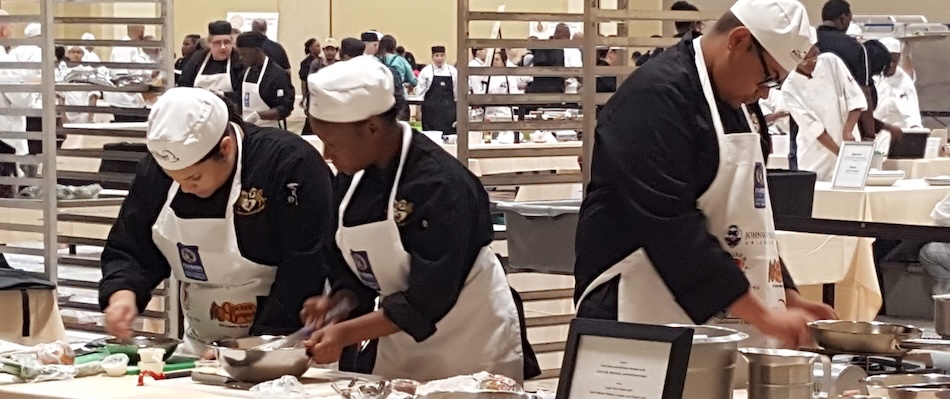
We Train Culinary Professionals.
I built Wekiva Culinary from a place of ignorance: back in 2017, I didn’t know students “couldn’t learn” what I was teaching and “couldn’t do” what I was asking of them. Nobody told me there was a ceiling, so I never built one. During my first decade running this place, in interviews and in conversations with industry partners, I’ve said the same thing — “I have yet to find something these kids can’t do.” I’ve only recently found the edge of that: cheesemaking. Making, pressing, and aging Gouda or Cheddar demands a kind of sustained, patient, multi-week effort that most teenagers can’t hold. Who knew? Aged cheese: the exception that proves the rule.
My core conviction isn’t anecdotal. It’s been tested against years of collaboration with other professionals — first locally, then with chefs and educators at top-tier culinary programs across the country. Those conversations confirmed what my students kept proving in the classroom, in competition, and while catering high-end events: they are capable of far more than they’re typically offered, they rise to challenges much harder than what they’re usually given, and they thrive — not despite pressure, but because of it — when the stakes are high, the challenge is real, the outcome is genuinely uncertain, and when their reputation, and mine, is on the line.
What follows is the mission, vision, and operating philosophy that conviction produced.

Two Pathways in the Kitchen: Life-Skills vs. Pre-Professional Mastery
Introductory culinary classes in most high schools serve an essential purpose: they teach fundamental life skills, foster nutritional independence, and give students a healthy appreciation for cooking at home. Every high schooler benefits from knowing how to safely handle a knife, follow a recipe, and prepare a wholesome meal.
I designed and built Wekiva Culinary for the next level. Preparing dinner at home is a wonderful skill, but it is not the goal here.
Wekiva Culinary operates as a high-rigor, pre-professional academy, a nationally recognized ProStart Premier School, and a working commercial kitchen internship. Secondary and post-secondary culinary education are not different disciplines — they can cover the same content, taught at the same rigor. In most schools and most programs, post-secondary Culinary Arts classes are not harder; they just come later. Students here are held to the identical technical and professional standard a post-secondary or industry kitchen would demand, starting on day one.
I started learning to cook professionally when I was 14. Who am I to deny that same opportunity to my students 40 years later?
This fundamental starting point drives the mission, shapes the vision, and defines the essential qualities built into every student who comes through this program.
MISSION STATEMENT
The Daily Operational Standard
Wekiva Culinary transforms ambitious students into technically disciplined, line-ready culinary professionals, pastry artisans, and hospitality business leaders.
Grounded in STEM food science, grams-first precision, ServSafe Manager certification, and live commercial enterprise, the program provides a pre-professional lab environment where students build the technical habits, cost-control knowledge, and composure required to thrive under real commercial kitchen conditions.
VISION STATEMENT
Innovation, Articulation & Industry Integration
Wekiva Culinary has already set the standard for secondary CTE education — proving that high school students can master technical food science, manage commercial enterprises, and execute at a professional line level.
The vision is to keep finding the next boundary to shatter.
Driven by modern kitchen technology, STEM biochemistry, elite classical technique, and the relentless pressure of national competition, the program builds adaptable, high-accountability leaders prepared to dominate in collegiate degree programs, elite commercial kitchens, and the modern culinary economy.
Three Operational Pillars
1. The Clockmaker Philosophy | STEM & Classical Rigor
Cooking at a professional level is applied physics and biochemistry. Volume-based guessing and intuition are replaced with thermal dynamics, protein coagulation mechanics, and exact baker’s math. Technical success isn’t measured merely by whether a dish tastes good; it’s measured by whether it meets exact technical specs and can be executed identically across 1 or 500 covers.
2. Live Commercial Enterprise | Verified Industry Mechanics
The best way to learn is to do. Wekiva Culinary runs multiple student-operated businesses, and all students participate in high-volume catering. By graduation, students have practiced managing real inventory, calculating raw prep yields versus waste, building labor schedules, and protecting real operating margins under live service clocks.
3. Accelerated Post-Secondary Articulation | College & Career Pipelines
High school graduation is a launchpad, not a finish line. Through the ProStart National Certificate of Achievement (COA) and 400 hours of mentored industry work experience, graduates enter higher education with verified line speed, executive credentials, and up to 12 direct college credits toward Culinary Arts and Hotel/Restaurant Management degrees at Valencia College, the Rosen College of Hospitality Management at UCF, and collegiate programs nationwide.

Core Professional Habits & 21st-Century Skill Architecture
Technical knife skills and recipe execution mean nothing without the professional habits that sustain a career. One of the more recent shifts in my teaching philosophy has been replacing multiple-choice exams with competency assessments. In this way of teaching and measuring learning, 21st-century soft skills aren’t abstract classroom lectures, group discussions, or written assignments — they are active, daily operational survival tools.
This is a key distinction: I define my success as an educator and leader by whether our graduates have internalized these five core qualities:
1. Critical Thinking & Adaptive Problem-Solving In a working kitchen, variables shift continuously — equipment temperatures fluctuate, raw ingredient yields vary, and service timelines compress. Students learn to diagnose root causes instantly, adjust technical execution on the fly, and solve complex operational problems under pressure without sacrificing quality or safety.
2. High-Stakes Verbal & Operational Communication Hesitant, ambiguous communication causes line failures. Students master clear, confident, and direct call-and-response. Every ticket call, line confirmation, and station handoff requires precise active listening and concise articulation so team operations move in total synchronization.
3. Personal Accountability & Station Stewardship Sanitation, tool care, and station upkeep are continuous professional habits, not chores saved for the end of the shift. Students take complete ownership of their workspace, respect commercial infrastructure, enforce ServSafe Manager standards, and hold themselves and their team accountable for every gram, degree, and detail.
4. Emotional Composure & Resilience Under Clocks Executing under service pressure tests character. Students train to maintain focus, poise, and professional grace when heat and ticket volume rise. Rather than reacting with frustration or panic, they build the mental resilience needed to channel high-stakes urgency into organized, quiet efficiency.
5. Collaborative Enterprise & Leadership Mechanics No kitchen succeeds as a collection of isolated individuals; it operates as a single brigade. Upper-level students delegate responsibility, manage financial metrics through student-operated micro-enterprise, mentor junior peers, and build the executive leadership habits required in modern business environments.
We Do Much More Than Teach Elective Cooking Courses. We build Culinary Professionals.