
WOULD YOU TRADE CANADA FOR SUGAR?
In 1763, France had lost a war and was negotiating which pieces of its empire it could keep. Étienne François, the Duke of Choiseul, decided to keep the Caribbean sugar islands and give Britain Canada. Look at a map. The man was clearly out of his mind. Then look at what those plantations grew, and the decision starts making sense.
Guadeloupe and Martinique were producing enormous quantities of sugar. And that was worth more than all the maple syrup in Canada.
BEFORE THE SUGAR BOWL
Before bags of refined sugar, cooks kept sweetness in their recipes pretty simple: honey, fruit, and concentrated juices. Honey was great! There were the bees, of course… but a few stings were worth a rare taste of sugar. Sugarcane offered something new: sweetness you could plant.
The breakthrough started in India. Sugar makers crushed the stalks, extracted the juice, and boiled away water until they could recover rough sugar crystals. The technology spread through trade and conquest, giving merchants something they could carry across oceans and sell: concentrated, storable sweetness.
And this is where the story takes a turn. European demand drove the expansion of sugar plantations across Brazil and the Caribbean. Who was going to work in that brutal environment? Enslaved Africans. Plantation owners also discovered another way to profit: refining cane juice into white sugar left behind a dark, rich syrup called molasses. Cheaper molasses became an important sweetener for poor white families and enslaved Black people. The difference between the sugar bowl and the molasses jug reflected who could afford what.
That cheaper molasses developed a culinary life of its own: spooned over cornbread, baked into gingerbread, or cooked into sweets. It also became foundational to the rum trade.
NAPOLEON HAD A SUGAR PROBLEM
The French kept fighting the British—as they were wont to do—and eventually Napoleon had a problem no amount of shouting at a map could solve: the British navy was blocking his supply of colonial sugar. So Napoleon went looking for a workaround.
Chemists had found sucrose in beets, but getting it out of a muddy root and into a usable form was another matter. In 1812, Napoleon visited Benjamin Delessert’s beet-sugar works near Paris, awarded him the Légion d’honneur, and threw his support behind more cultivation, training, and factories. France’s work on sugar beets helped break sugarcane’s hold on the business.
THIS STORY REACHES FLORIDA
After leaving Cuba, the Fanjul family set out to rebuild their sugar business. They dismantled Louisiana sugar mills, shipped them to Florida by barge, and put them back together near Lake Okeechobee. That operation grew into the mammoth Florida Crystals.
As someone who makes Florida his home, I’m especially concerned with how sugarcane has changed our landscape—and not for the better. Cane agriculture became part of a sprawling system of drainage, farming, and development, with agricultural runoff damaging the Everglades. Despite the environmental injury their company was causing, brothers Alfy and Pepe Fanjul kept growing sugar, making millions, and contaminating the Florida Everglades, protected from reprisal by their “generous” donations to both Republican and Democratic leaders. No great culinary revelation here. It just ticks me off.
WHY DOES THE SUGAR AISLE NEED SO MANY BAGS?
After centuries of empires, plantations, blockades, and chemistry, you’re on your way to Publix to buy some. And the sugar aisle makes you choose a type. Granulated. Superfine. Powdered. Light brown. Dark brown. A bag of something called muscovado. A pricey one with a sunset over a cane field on the front, as if the picture adds flavor.
It’s tempting to assume all these sugars are the same thing in different outfits. They aren’t. That kind of thinking ends with gritty meringue, cookies spread across the whole sheet tray, and a candy syrup that turns cloudy for no reason you can explain.
The differences come down to three simple elements:
How big the crystals are
How much molasses and moisture came along
Whether the manufacturer added starch
Those decide how fast the sugar dissolves, what it tastes like, and whether it crunches in your teeth or disappears into the batter.
| Sugar | What you’re actually buying | Where it earns its spot |
|---|---|---|
| Granulated | Small, dry sucrose crystals | The workhorse for baking and cooked syrups. If a recipe just says “sugar,” this is it. |
| Caster or superfine | Granulated sugar with smaller crystals | Dissolves fast in meringues, where undissolved crystals leave grit and can draw out syrupy beads. |
| Confectioners’ or powdered | Sugar ground to dust, usually with cornstarch to keep it from clumping | Smooth frostings, glazes, dusting. That starch is a stowaway; in a candy syrup it can cloud the batch or change the texture. |
| Light or dark brown | Sugar with molasses in it; dark brown has more | Molasses flavor, color, and moisture. Part of why some cookies stay chewy. Leave the bag open and it dries into a brick. |
| Muscovado | Moist cane sugar that kept a lot of its molasses | Deep, almost smoky flavor and sticky clumps. Brands vary a lot. |
| Turbinado or demerara | Big, dry, golden crystals with a little molasses | Crunchy tops on muffins and crème brûlée-style crusts. Those big grains take their time dissolving. |
| Sanding sugar | Large decorative crystals, often colored | Sparkle and crunch that survive the oven on cookies and pastries. |
| Pearl sugar | Compressed nuggets of sugar | Crunchy pieces on sweet buns; caramelized pockets of sweetness in Liège waffles. |

Hey! I’ve got some sad news about that “raw” sugar with the cane field on the bag you organic-only types love: it’s been processed. A lot. Somebody crushed the cane, boiled the juice, and spun out the crystals, so it isn’t nature’s gift arriving untouched. Sugar straight from the mill, before any cleanup, isn’t something you’d want in your coffee anyway. “Raw” is a marketing word, not a cooking instruction.
Color doesn’t tell you much either. Muscovado and demerara are both brown, and they behave like completely different ingredients. One is damp and clumpy; the other is dry and gravelly. Sprinkle muscovado on a pastry expecting a crunchy demerara crust and you’ll get sticky brown smears instead.
SWEET SCIENCE
Plain ol’ table sugar is sucrose, whether it started life in a cane field or a beet field. You’d think they’d taste different. Once they’re refined, they’re the same molecule and they taste exactly the same. Here’s some basic science that will help later on. Every sucrose molecule is a pair: one glucose unit and one fructose unit, chemically bonded together. Glucose and fructose are sugars in their own right, and we’ll meet both again later. For now, just get the picture: two buddies, bonded together, and you’ve got table sugar.

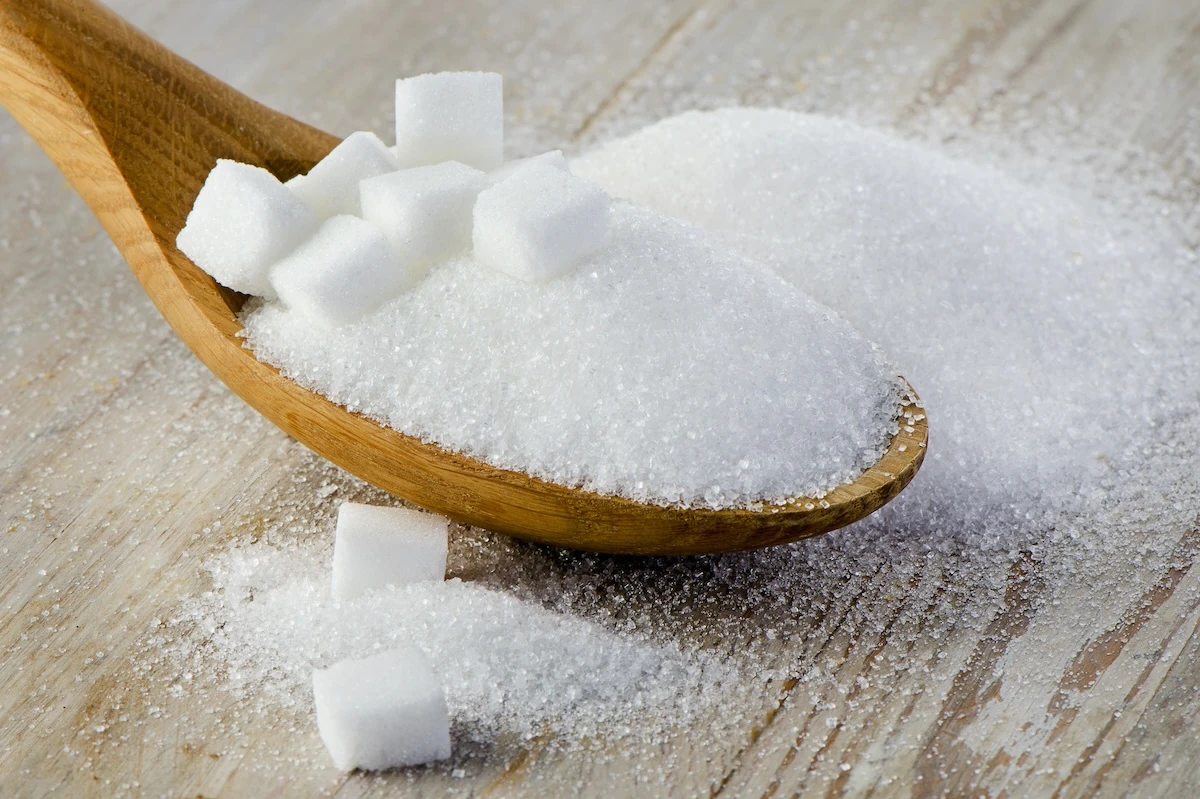
You won’t see those molecular pairs in an ordinary magnified picture of sugar. What you can see is what happens when trillions of them stack into an organized, repeating pattern: a crystal. Every single grain in that five pound bag you bought is a crystal. A tablespoon of sugar is thousands of them.
WHY DO BAKERS CALL SUGAR A WET INGREDIENT?
Grab a handful of granulated sugar. Does it feel wet? Of course not. But bakers group it with the wet ingredients anyway. Apparently baking needed one more way to confuse people.
Here’s why. Once sugar meets the water in ingredients like eggs and milk, it starts dissolving and becomes part of the liquid. In a lot of cake and muffin recipes, that’s exactly the plan: get the sugar dissolving in the wet bowl before the flour shows up. And sugar keeps grabbing water even after the bake is done, which is part of why a cake stays moist. That water-grabbing habit has a name, hygroscopic, and you’ll see it working in cake batter, on Florida hard candy, and in cotton candy at the fair.
THE SUGARS THAT ACTUALLY POUR
Then there are the sugars nobody would ever call dry: honey, maple syrup, molasses, and those big sticky tubs in the pastry storeroom. They show up with the sugar already dissolved in water. And no, they’re not interchangeable bottles of sweet.
Honey starts as flower nectar, and the bees do the rest. They split most of the nectar’s sucrose into glucose and fructose and fan off water until it’s thick and golden. What’s left is a little water and a lot of flavor from whatever flowers the bees visited. That flavor is the whole point. Florida orange blossom honey tastes light and floral; a dark wildflower or buckwheat honey tastes bold and almost earthy. Bake with one you actually want to taste. And because honey is loaded with glucose and fructose, it browns fast and keeps baked goods soft and moist.
Maple syrup is Canada getting the last laugh. It starts as tree sap that’s only about 2% sugar, and it takes roughly 40 gallons of sap boiled down for hours to make a single gallon of syrup. What’s left is mostly sucrose, the same sugar in your granulated bag, plus that unmistakable maple flavor and a good amount of water. It belongs on pancakes, sure, but also in glazes, fillings, candies, and baked goods.
Molasses is the dark syrup left over from refining, the same stuff from the plantation story, now earning its keep in gingerbread, spice cookies, and barbecue sauce. It brings moisture, deep color, and a flavor big enough to take over the whole recipe if you let it. Blackstrap molasses comes from the last round of boiling, after most of the sugar has been pulled out, and it’s intense and bitter. Not afraid of some big, BIG flavor? Use blackstrap in place of regular molasses in your next batch of gingerbread cookies. It tastes strong.
WHAT’S THAT CLEAR STUFF IN THE PASTRY KITCHEN?
Glucose syrup is the thick, clear, ridiculously sticky stuff pastry chefs keep in big tubs. It’s made by breaking starch down into smaller pieces. Despite the name, it isn’t just glucose in water. It’s a mix of glucose, other sugars, and longer chains of starch that didn’t get broken all the way down. Different brands have different mixes.
Why would a pastry chef want it? It adds body and chew without piling on sweetness, and it’s one of the best tools there is for keeping sugar from crystallizing. Those longer chains get in the way when sucrose tries to line up. It’s the secret behind clear lollipops and smooth candies that don’t turn to grit.
Corn syrup is glucose syrup made from corn starch. And no, the corn syrup in your pantry is not the same thing as high-fructose corn syrup. That’s a separate product made for soft drinks and processed foods. A supermarket bottle and a professional pastry tub won’t always behave the same way, either, so check what your recipe calls for.
Invert syrup starts somewhere else entirely: plain table sugar. Remember the sucrose buddies, glucose and fructose bonded together? Inversion splits every pair, the same trick the bees pull on nectar. The result is a syrup that’s sweeter than sucrose, holds on to moisture like crazy, and fights crystallization, which makes it great in soft fillings, ganache, and chewy candies. Glucose syrup and invert syrup can do some of the same jobs, but they’re not the same ingredient, and a recipe that calls for one is counting on what that one brings.

CAN I JUST SWAP ONE FOR ANOTHER?
Not without thinking about what comes along for the ride. Swap honey in for granulated sugar and you’ve changed the water, the flavor, the sweetness, and how fast it browns. You’ve also lost the dry crystals your creaming method was counting on.
A squeeze of honey in your tea? Swap away. A cake, a candy, or anything else where the balance matters? Pick the syrup for the job, then use a recipe built around it.
WHERE DID THE SUGAR GO?
Drop a spoonful of sugar into a glass of hot tea and stir. The grains shrink, then disappear. Water molecules latched onto sucrose molecules at the sugar crystal’s surface and pulled them away, one by one. Those whole sucrose molecules then spread out evenly through the tea, creating what chemistry teachers call a solution.

People love to say sugar “melts” into a drink. It doesn’t. Sugar isn’t a tiny snowman on Daytona Beach in July. In your tea, it dissolves. Sugar can melt: put it in a dry pan and heat it past roughly 320°F, and you’re on your way to caramel. A glass of tea never gets anywhere close.
Here’s the part cooks sometimes misunderstand: every sucrose molecule stays whole the entire time. The water pulls the pairs away from the crystal; it doesn’t split the glucose from the fructose.
WHY WON’T THAT LAST SPOONFUL DISSOLVE?
I’ve had students swear their Kool-Aid isn’t sweet until there’s a layer of sugar sitting on the bottom of the cup. These kids aren’t happy unless their last sip is crunchy.
Silly students. See, at room temperature (about 68°F), water can dissolve roughly twice its own weight in sugar. If they had made their Kool-Aid with room temperature water, they could have dissolved nearly 17 MORE cups of sugar into their two quarts of Kool-Aid. That’s why classic Southern sweet tea gets sweetened while it’s hot. Ice-cold liquid dissolves sugar slowly and ineffectively – as anyone who has added packets of sugar to unsweet iced tea knows.
Sweet tea and Kool-Aid are both sugar solutions. But if you followed the exact same process without any flavoring, you would have made a batch of simple syrup: sugar dissolved into water in a 1:1 ratio.
Make a simple syrup and brush it onto cake layers to add moisture. Flavor it with vanilla, citrus peel, herbs, or spices, and use it to poach fruit or glaze desserts. Sugar syrups also go into granitas and sorbets, where the amount of sugar helps determine how firmly they freeze. Simple syrups can be used for all kinds of things! Starbucks and Dunkin’ Donuts both use unflavored simple syrups to sweeten iced coffee. Yum.
Here’s what I want you to know: there’s a big difference between how FAST sugar dissolves in a cup of water and how much sugar WILL dissolve in a cup of water. Smaller grains, stirring, and heat help sugar dissolve faster. But keep adding sugar and eventually you’ll reach the water’s limit and it can’t take anymore. The solution is now saturated. More stirring won’t help. Heat the water, though, and it can dissolve more sugar. That limit—how much sugar can stay dissolved at a given temperature—is called solubility.
HOW CAN BOILING WATER GET HOTTER THAN BOILING WATER?
Plain water boils at about 212°F at sea level. Crank the burner all the way up and you get more steam, faster. You don’t get 240°F water. Yet a recipe will tell you, with a straight face, to cook a sugar syrup to 240°F. Or 300°F. Did we bully the water into ignoring its own boiling point?
Sort of. Dissolved sugar makes it harder for water molecules to escape as steam, so the syrup has to get hotter before it boils. As water boils off, the sugar gets more concentrated, and the boiling point climbs. The sugar stays in the pan. The water keeps leaving.

That’s why we use a thermometer. Within the same formula, a higher cooking temperature means less water remains—and generally a firmer finished preparation once it cools. A timer can’t tell you that. Your pan might be wider, your burner hotter, or your batch bigger than the recipe writer’s. “Boil for eight minutes” won’t necessarily leave you with the same amount of water. The clock tells you how long you’ve been cooking. The thermometer tells you what happened in the pot
THE SUGAR STAGES
Long before anybody owned a candy thermometer, cooks had a trick. Drop a little hot syrup into a cup of cold water, fish it out, and see what you’ve got. A squishy little ball? A thread that snaps like glass? That blob tells you how much water is left in the pot. The test worked so well that the names stuck. Recipes still use them today.
| Stage | Temperature | What it does when cool | Common uses |
|---|---|---|---|
| Thread | 223–235°F | Forms a thin, loose thread | Syrups and glazes |
| Soft ball | 235–245°F | Forms a soft ball that flattens when removed from the water | Fudge, fondant, pralines |
| Firm ball | 245–250°F | Forms a ball that holds its shape but squishes when pressed | Caramels |
| Hard ball | 250–265°F | Forms a firm ball that still gives when pressed | Nougat, marshmallows, divinity |
| Soft crack | 270–290°F | Forms threads that bend before breaking | Taffy and some butterscotch preparations |
| Hard crack | 300–310°F | Forms brittle threads that snap | Lollipops, brittle, toffee |
Read down the chart and you’re watching the water leave. Stop at soft ball and there’s still enough water in there for the candy to stay soft and chewy once it cools. Push to hard crack and there’s almost none left, so the candy cools hard enough to snap. Cooling, stirring, and the other ingredients still shape the final texture. But the cooking decides how much water you get to work with, and once it’s gone, it’s gone.
One warning: this chart helps you recognize a stage. It is not your target. The recipe is. If the recipe says 239°F, you stop at 239°F. “Eh, somewhere around soft ball” gives you a ten-degree window and a completely different fudge.
WHEN DOES SUGAR TURN INTO CARAMEL?
So far we’ve dissolved sugar in water and boiled the water away to concentrate it. But what if you skip the water entirely and dump sugar into a dry pan and heat it up?
Heat gives the sucrose molecules enough energy to shake loose from their tidy spots in the crystal. At the same time, some of them start breaking apart chemically. The physics and the chemistry happen at once, and scientists have spent years arguing about exactly where one ends and the other begins. We’re not settling that argument over a saucepan. For our purposes, the sugar is melting.
Melting is not the same thing as caramelization, even though they can happen together. Melting just turns the sugar liquid. Caramelization actually changes the sugar into new stuff. Past about 320°F, the sugar starts to brown, and you get the golden color, the toasty smell, and, the further you push it, more and more bitterness.
And here’s where the vocabulary gets annoying. “Make caramel” might mean browning some sugar for a flan. “Make caramel” can also mean adding butter and heavy cream to melted sugar to make a lovely chewy candy for old people. Same word, totally different things. For flan, we’re making plain caramelized sugar.
TWO WAYS TO GET THERE
Dry caramel is just sugar in a pan, no water. It melts and browns as it heats. The trick is getting it to cook evenly, because one corner can burn while another is still sitting there as dry crystals. Nudge the melted edges toward the middle with a heatproof spatula and keep it moving.
Wet caramel starts by dissolving the sugar in water. The syrup boils, the water leaves, and eventually the concentrated sugar gets hot enough to brown. The water makes the start easier to control, but it all has to boil off before anything browns. Along the way, stray crystals can make the whole syrup seize up and crystallize before it ever gets there. That’s exactly what washing down the pan walls prevents: a pastry brush dipped in water dissolves crystals on the inside walls. And once it’s boiling, swirl the pan; don’t stir it.
Either way gets you caramelized sugar. Now watch the color. Pale caramel tastes sweet and mild. Darker caramel tastes deeper and more bitter. Go too far and it’s burnt, and there’s no bringing it back. Have everything ready before you start, because caramel will not wait while you hunt for a mold.
WHY IS BRÛLÉE CRUNCHY BUT FLAN SAUCY?
For crème brûlée, you spread a thin layer of sugar over the custard and hit it with a torch or a screaming-hot broiler. Granulated works; turbinado gives you a crunchier crust. The sugar melts, caramelizes, and cools into a glassy shell you can crack with a spoon. Do it right before serving. Moisture from the custard slowly softens that crust, and a soggy brûlée is just pudding with a sunburn.
For flan, you pour caramelized sugar into the mold before the custard goes in. It hardens right away. But as the flan bakes and rests, moisture from the custard slowly dissolves that hard layer. Flip the chilled flan out of the mold and the caramel pours over the top as a sauce.
For caramel sauce, you add liquid, usually cream, to the caramelized sugar on purpose. The water in the cream keeps the caramel from cooling into a hard sheet, and how much you add decides how thick the sauce ends up. Warm the cream first and add it slowly. Cold cream hitting hot caramel makes it foam up hard and can seize the sugar into lumps.
Same caramelized sugar every time. Which is just…cool.
WHY IS ROCK CANDY CRUNCHY AND FUDGE CREAMY?
Pull a concentrated sugar syrup off the heat and let it cool. Think of that syrup as a school bus. While it’s hot, there are plenty of seats, and every sugar molecule has somewhere to sit. As it cools, the seats start disappearing, because cooler water can’t hold as much sugar. Pretty soon the bus is packed and kids are standing in the aisle, crammed together, backpacks on, staring at the door. Those standing kids are extra sugar that doesn’t really fit anymore. That’s supersaturation.
Nobody on that bus is relaxed. They’re not sitting back enjoying the ride. They want out. The second that door folds open, they’re gone, all at once, shoving and stumbling down the steps. In a syrup, the door can be a seed crystal dropping in, a spoon scraping the pot, or crusty sugar falling off the pan wall. Open it, and crystals start forming all over the place. What you do with that door decides what you get.
To build a crystal, sucrose molecules need somewhere organized to start. A few of them can lock together into a tiny cluster in a process called nucleation, creating a brand-new crystal. Or they could do something different: find a crystal that’s already there and sort of stack onto it in something called crystal growth. Sounds like two ways of saying the same thing. It isn’t. Lots of new crystals means lots of tiny ones, which feel creamy. A few crystals that keep growing get big enough to crunch.
BIG ENOUGH TO CRUNCH
For rock candy, we hang a stick or string coated in seed crystals into the syrup. That gives the dissolved sugar a ready-made place to land, and it piles on. The syrup cools, then gradually loses water through evaporation, which keeps squeezing more sugar out and onto the stick. Leave it alone for several days, no poking, no shaking, no checking every ten minutes, and the crystals get big enough to admire before you crunch them.

Now picture those same crystals inside a square of fudge. You bite in expecting rich, creamy chocolate. You get gravel. The sugar didn’t do anything wrong. It built crystals, which is what sugar does. It just built the wrong size for the dessert.
SMALL ENOUGH TO FEEL CREAMY
Here’s what surprises people: fudge and fondant are supposed to be full of sugar crystals. The trick is making millions of them and keeping every one so tiny your tongue can’t pick it out. Rock candy lets a few crystals grow huge over several days. Fudge does the opposite. We control the cooling, then work the mixture hard to build a huge crowd of tiny crystals all at once.
That’s why timing matters. Stirring a cooling syrup too early, dropping coarse crystals into it, or scraping crusty sugar off the pan walls can start crystallization before you’re ready. Later, deliberate beating or tabling (working it on a cool surface) builds the fine crystal structure you actually want. “Don’t stir” and “beat the mixture” can both be correct instructions, at different points in the same recipe.
The fondant and fudge lesson walks through that cooking, cooling, and working sequence. For now, remember the difference: rock candy gives a few crystals time to grow big; smooth fudge builds millions of tiny ones.
HOW DO YOU MAKE SUGAR LOOK LIKE GLASS?
Rock candy has big crystals. Fudge has tiny ones. Now hold a clear lollipop up to the light. Where are its crystals? There aren’t any large enough to scatter the light and make it cloudy. The sugar has formed a disordered, glassy solid instead of arranging itself into a crystal structure. We call that amorphous, which means it has no orderly crystalline pattern.
That’s exactly what we want for lollipops, clear sugar decorations, and the sugar holding a brittle together. Cook the syrup to hard crack so there’s almost no water left, then cool it before crystals get a chance to form. As it cools, the syrup gets so thick the molecules can’t move around to line up. They’re frozen in place, wherever they happened to be. That’s why hard candy snaps instead of bending.
Ingredients help us get there. Glucose syrup or corn syrup makes it harder for sucrose molecules to line up and build crystals. Invert sugar, the glucose and fructose made by splitting sucrose, also interferes with crystallization. But it attracts moisture, too, so too much can help turn a crisp candy sticky. We’re choosing sugars for what they do, not just how sweet they taste.
Then Florida gets involved. Hard candy can absorb moisture from the air, and that water makes the sugar more mobile. Your crisp decoration turns tacky, then sticky, then attaches itself permanently to the tray. Wrap it airtight and keep it dry. Leave it sitting out in a Florida kitchen and the air will undo all your work.
We’ve already met this problem on crème brûlée: the crust starts crisp, then moisture from the custard softens it. Whether the water comes from the dessert underneath or the air around it, a sugar glass won’t stay crisp just because you cooked it correctly.
SUGAR ART: GLASS YOU CAN SCULPT
You’ve already eaten sugar art. You probably ate it at the fair, off a paper cone.
Cotton candy is sugar glass. The machine melts plain sugar, with no water added, in a spinning head and flings it out through tiny holes. Each thread cools so fast it hardens into glass before it ever reaches the bowl. There’s no time to crystallize. What you’re twirling onto that cone is the same amorphous sugar as a lollipop, stretched into thousands of hair-thin strands with a lot of air in between. And here’s the best part: one of the two men who invented the machine, back in the 1890s, was a dentist. He knew exactly what he was doing.
Pastry chefs take that same sugar glass a lot further. Watch any big pastry competition and you’ll see towering showpieces built entirely from sugar: glossy ribbons, flowers with petals thin enough to see through, birds that look ready to fly off the table. The trick is catching the sugar before it sets.
Hot sugar glass doesn’t go hard all at once. As it cools, there’s a window where it’s thick and soft, like warm taffy. Keep it in that window, usually under a heat lamp, and you can shape it:
- Poured (cast) sugar goes into molds or spreads into thin sheets, then cools into flat, glassy pieces for bases and backdrops.
- Pulled sugar gets stretched and folded over and over. All that pulling traps tiny air pockets that catch the light and turn clear glass into a satiny, pearly sheen. That’s how you get ribbons, bows, and flower petals.
- Blown sugar works like glassblowing. A chef shapes a ball of warm sugar around a hand pump and inflates it into hollow fruit, swans, and spheres.
- Spun sugar is cotton candy’s handmade cousin: syrup flung off a fork or whisk in hair-thin threads that harden instantly into a golden nest.
Every one of them has the same enemy: water. A showpiece that took hours to build can slump or go sticky in humid air. That’s why many pastry chefs now work with isomalt, a sugar substitute made from sucrose that stands up better to moisture and resists crystallizing. Real sugar still works, and plenty of chefs swear by it. It just doesn’t forgive a humid room.
If you want proof, go back to the fair. Hold a cone of cotton candy out in the Florida air and watch. All that surface area is pulling in water, and in a few minutes that big pink cloud shrinks into a sticky little wad. Same glass. Same problem. Just faster.
WHAT IS SUGAR DOING IN A MERINGUE?
Whip egg whites with no sugar and you’ll get a foam. Walk away for ten minutes and come back to a sad puddle at the bottom of the bowl. Sugar is what turns that flimsy foam into a glossy meringue that holds a peak, survives a piping bag, and makes it into the oven still looking like something.
Here’s what’s happening. Whipping unfolds the proteins in the egg white, and those proteins wrap around the air bubbles like tiny bodyguards, keeping them from popping. That’s your foam. Now add sugar. It dissolves into the liquid between the bubbles and thickens it, so the liquid drains away much more slowly. Slower draining means the bubbles last longer. That’s your stable foam.
There’s a catch. Sugar makes the whites slower to whip. Dump all the sugar in at the start and you’ll be standing at the mixer for a long time, wondering why nothing’s happening. That’s why every meringue method is really just a different answer to one question: how do we get the sugar in without wrecking the foam?
THREE WAYS TO GET THE SUGAR IN
- French meringue: Whip the whites until they’re foamy, then add the sugar a little at a time while the mixer keeps running. Small crystals dissolve faster, which is where superfine sugar earns its spot. To check your work, rub a bit of meringue between your fingers. If it feels gritty, there’s undissolved sugar in there, and you’re not done.
- Swiss meringue: Whisk the whites and sugar together over a pot of simmering water until the sugar dissolves and the mixture hits the temperature in your recipe. Then whip it. The heat does the dissolving up front, so you’re not fighting grit later.
- Italian meringue: Cook a sugar syrup to the temperature in your recipe, usually somewhere around soft ball, and pour it into the whites while they whip. Pour in a thin stream down the side of the bowl, not onto the whisk. Hit the whisk and it flings the syrup onto the bowl walls, where it hardens into sugar threads instead of going into the whites. This is the sugar-stage chart doing a job outside the candy station.
WHY DOES MERINGUE GET STICKY?
Remember that cotton candy shrinking in the Florida air? Meringue is a cousin. A baked meringue cookie starts out crisp, but leave it sitting out and the sugar pulls moisture right out of the air. Crisp turns chewy, then sticky. Set it on a wet filling and you’ve given the water a second way in.
And then there’s the queen: lemon meringue pie. Tart lemon filling, flaky pastry, and a crown of sweet, toasted meringue. Beautiful when it works. But now we’re asking that foam to sit on a moist filling, brown on top, and hold together long enough to slice. This is where two classic problems show up:
- Beading is little amber droplets sitting on top of the meringue. That usually means it was overbaked, or the sugar never fully dissolved.
- Weeping is a watery puddle between the meringue and the filling. That usually means the bottom of the meringue never cooked through, often because it went onto a cold filling instead of a hot one.
Different problems, different fixes. Look at where the liquid is before you decide what went wrong.
A crisp meringue cookie and a soft pie topping start with the same two ingredients. The cookie bakes low and slow until it dries throughout. The pie topping stays soft inside while its surface browns. The sugar ratio and cooking method help decide which one you get.
HOW DO YOU PUT AIR IN A CANDY BAR?
You’ve watched sugar hold up a meringue. Now take that trick to the candy aisle. The fluffy middle of a 3 Musketeers? The chewy layer under the peanuts in a Snickers? The marshmallow bobbing in your hot chocolate? All foams. Somebody trapped air inside something sweet and made it stay put.
Sugar can’t pull that off by itself, though. Air bubbles need walls, and sugar needs a partner to build them. In meringue, that partner is egg-white protein. In nougat, it’s usually egg white again. In most marshmallows today, it’s gelatin.
NOUGAT: MERINGUE WITH SOME MUSCLE
Traditional nougat starts out a lot like Italian meringue. Cook a sugar syrup, then pour it into egg whites while they whip. The proteins wrap around the bubbles, and the thick, hot syrup slows down the liquid trying to drain away between them. As it cools, the whole thing stiffens until it holds its shape as candy.
And here’s the sugar-stage chart showing up for work again. How far did you cook that syrup? Stop lower and there’s more water left, so you get softer nougat. Push it higher and there’s less water, so you get firmer nougat. How much air you whip in changes things, too.
Honey is a big part of the story. In the classic nougats of Europe, like Italian torrone, Spanish turrón, and the famous nougat of Montélimar in France, honey isn’t a background player. It’s a signature flavor, right alongside the almonds and pistachios. It also helps keep the sugar from crystallizing, along with glucose syrup in a lot of modern recipes, so the nougat stays smooth instead of turning gritty.
That’s how you get a whole family of nougats from the same basic idea. Some are light and fluffy enough to be candy-bar centers. Others are dense, chewy, and loaded with nuts. Same question every time: how much air can we trap, and how hard do we want to hold on to it?
MARSHMALLOWS: THE BOUNCE COMES FROM GELATIN
Ever wonder where the “marsh” in marshmallow comes from? It’s a plant. The marsh mallow grows in wet, swampy ground, and its root is full of a gooey sap. Confectioners in France once whipped that sap with sugar and egg whites to make the original marshmallows. Eventually gelatin took over the job, and the plant got left out of the recipe. It kept the name, though.
Today’s marshmallow goes like this. Soften gelatin in water, pour in hot sugar syrup, and whip the daylights out of it. As it cools, the gelatin links up into a flexible net that traps both the syrup and the air.
That net is the bounce. Squeeze a marshmallow and it squishes. Let go and it springs back. You’re squeezing a foam held together by a soft gel.
Every ingredient in there has a job, and they don’t cover for each other:
- Sugar syrup brings the sweetness and the body.
- Glucose or corn syrup keeps the sugar from crystallizing. Nobody wants a sandy marshmallow.
- Gelatin builds the walls.
- The mixer brings the air.
And when you hold one over a campfire? That golden-brown, toasty outside is caramelization and the Maillard reaction working at the same time. The sugar browns on its own, and it also reacts with the protein in the gelatin. We’ll meet these same browning reactions again in cookies. For now, they’re happening on a stick.
WHY IS THERE POWDER ALL OVER EVERYTHING?
Cut a fresh slab of marshmallow and every new surface is sticky. A dusting of powdered sugar and cornstarch keeps the pieces from gluing themselves to the knife, the tray, and each other.
But that powder isn’t armor. Not in Florida. Leave marshmallows out in humid air and the surfaces turn tacky. Leave them out in dry air and they lose moisture and go tough and stale. Once they’re cut and coated, seal them up airtight.
Rock candy crunches. Fudge melts on your tongue. A lollipop snaps. Sugar doesn’t always have to crunch, though. Sometimes it needs to squish.
WHY CAN’T I JUST USE LESS SUGAR?
You make a cake, decide the recipe is way too sweet, and cut the sugar in half. The cake comes out less sweet. Success! Except it’s also tough, dry, and dense enough to prop a door open. What happened? You pulled out an ingredient that was doing five jobs and only thought about one of them.
Cakes, cookies, brownies, muffins, and pound cakes (plus about a million others!) start pretty much the same: butter, sugar, flour, and eggs. In all of them, sugar is doing a bunch of things, not just making the treat sweet. First, it’s a water hog. It grabs water the flour would otherwise use to build gluten, and less gluten means a more tender bite. Sugar also slows things down in the oven. With sugar around, starch thickens and egg proteins set at higher temperatures, which buys the batter or dough extra time to rise and spread before its structure locks in. Cut the sugar and everything sets too early. Cakes come out tough, short, and heavy. Cookies stay thick and puffy instead of spreading. Brownies turn cakey and dry.
THOSE CRYSTALS PUT AIR IN THE CAKE
When a recipe says to cream butter and sugar, it isn’t asking you to stir until the butter tastes sweet. As the mixer runs, those sharp little sugar crystals cut thousands of tiny air pockets into the butter. In the oven, steam and gas from the leavening expand into those pockets and lift the cake. Butter that’s too cold won’t hold the air, and melted butter can’t. Crystal size matters, and so does how long you cream. Rush it and you get a flat cake.
Pour honey into the mixer instead and there are no crystals to cut anything. You’ve also added water and swapped in different sugars. Honey can make a fantastic cake, as long as the recipe was built for it.
WHY DO SOME COOKIES SNAP AND OTHERS BEND?
Sugar decides a lot of that too. In the oven, sugar dissolves into the water in the dough, and the dough spreads before it sets. Then the cookie cools, and that sugar either sets up hard like the sugar glass in a lollipop, giving you a snap, or stays soft and syrupy, giving you a bend.
Brown sugar brings molasses, and molasses grabs and holds onto water. That’s a big part of why brown-sugar cookies stay chewy. White sugar tends to bake up crisper. But flour, fat, eggs, and baking time all get a vote, so swapping one sugar won’t guarantee the cookie you’re picturing. The recipe works as a whole.
BROWN DOESN’T ALWAYS MEAN CARAMELIZED
Sugar can turn brown in two different ways, and they’re easy to mix up.
Caramelization is what we did in the saucepan: sugar by itself, heated until it starts breaking down. No help from any other ingredient. Just sugar and serious heat, past about 320°F.
The Maillard reaction is sugar teaming up with protein. In a cake or cookie, there’s protein everywhere: eggs, flour, milk. When sugar and protein heat up together, they react and build new colors, smells, and flavors. It’s the same reaction that browns a steak and turns bread into toast, and it gets going at lower temperatures than caramelization. That golden crust on your cookie? Mostly Maillard.
Here’s the twist: not every sugar can jump into the Maillard reaction right away. Glucose and fructose go straight in. Sucrose, plain table sugar, can’t participate directly unless it breaks down into simpler sugars. Honey already contains plenty of glucose and fructose, which helps explain why it can brown so readily.
SUGAR KEEPS WORKING AFTER THE OVEN
Sugar’s job doesn’t end when the timer goes off. It holds on to water, which keeps the crumb soft for days. Cut a big chunk of sugar and your cake goes stale faster.
So yes, you can make a less-sweet recipe. But that means rebuilding the recipe around everything sugar was doing, not crossing out half the sugar and hoping the oven figures it out.
WHY DOES ICE CREAM NEED SUGAR?
Put a tray of water in the freezer and you get ice cubes. Put a well-balanced ice cream base in there and you get something you can actually scoop. Fat, air, and churning all help. But sugar does one job nothing else in the bowl can do: it lowers the freezing point of the water.
Water molecules line up in an organized pattern to form ice crystals. Dissolved sugar makes it harder for that ice to form. With sugar in the mix, the water has to get colder before it can start freezing. And it gets harder from there. As some of the water turns to ice, the sugar gets left behind in whatever’s still liquid. That leftover liquid gets more and more concentrated, which makes it even harder to freeze. So finished ice cream is never frozen solid. It’s millions of tiny ice crystals floating in a thick, sweet syrup that never froze at all.
That syrup is what lets your scoop sink in. Cut the sugar and more of the water freezes at the same temperature. Your healthier, less-sweet ice cream now requires a chisel. Go too far the other way and it never firms up. You get sweet soup.
Sound familiar? It’s the cake problem all over again. Sugar was never just there to make it sweet.
SWEETNESS AND SOFTNESS ARE DIFFERENT DECISIONS
Here’s the part that surprises people: water doesn’t care how big a dissolved molecule is. It only cares how many there are. Every dissolved molecule gets in the way of ice, big or small.
That’s where dextrose, another name for glucose, earns its spot. A glucose molecule is about half the size of a sucrose molecule, so the same weight of dextrose packs in nearly twice as many molecules. More molecules means more softening. And dextrose tastes noticeably less sweet than table sugar. A pastry chef can swap some of the sucrose for dextrose and get a softer, more scoopable ice cream that isn’t any sweeter. That’s two separate dials, sweetness and softness, and now you can turn them independently. Just don’t swap it all by guesswork, or you’ll end up with a tub that refuses to firm up.
Invert sugar works the same trick. Remember the sucrose buddies, glucose and fructose bonded together? Invert sugar has split every pair. Each sucrose molecule becomes two, so the same weight puts twice as many molecules in the water, and the ice cream comes out softer. That’s why a professional ice cream formula can list three or four different sugars. Each one is there to tune sweetness and texture separately.
FRUIT DOESN’T SHOW UP UNSWEETENED
Sorbet makes this really obvious. Without cream, getting the sugar balance right becomes especially important. And the fruit already brings its own sugar and water to the party. A super-ripe mango and a sour lemon are not bringing the same amount. Pour the same simple syrup into both and you’ll get two very different sorbets, one icy and one mushy.
AN EGG IN YOUR SORBET?
Old-school pastry cooks had a trick for this: float a clean, raw egg in the sorbet base. If a patch of shell about the size of a quarter pokes above the surface, the sugar’s in the right range. Too little sugar and the egg sinks; too much and it bobs up high. Today’s pros use a tool that reads sugar concentration directly, but the egg is the same idea. Sugar balance is something you measure, not something you guess.
GRANITA: THIS TIME WE WANT ICE
Granita runs on the same rules, but this time we want ice. We scrape the mixture with a fork as it freezes to build big, loose, crunchy crystals on purpose.
Ice cream, sorbet, and granita all finish differently, but they’re all doing the same thing: deciding how much of the water gets to freeze. Sugar decides whether your spoon slides right in, scrapes across the top, or bends in half.
WHY ARE MY STRAWBERRIES SWIMMING?
Head an hour west to Plant City in February and you’re in the winter strawberry capital of the world. Bring a flat home, slice a few, sprinkle them with sugar, and walk away. Come back later and they’re sitting in a pool of bright red syrup. Nobody added water. The berries brought their own.
Here’s what’s happening. The sugar dissolves in the juice on the cut surfaces and makes a super-concentrated syrup on the outside of the fruit. Water inside the berry’s cells doesn’t like that imbalance, so it moves out of the fruit and toward the sugar to even things up in a process called osmosis. More juice comes out. More sugar dissolves. More juice comes out. Chefs call this macerating and use that sugar-created juice as a sauce they spoon over shortcake, ice cream, or anything else that needs strawberries. Which is most things.
It also means timing matters. Sugar your sliced fruit hours ahead and you’ve started something that keeps going while you’re busy doing something else. Want firm, fresh-looking berries? Sugar them close to serving.
HOW DOES THAT BECOME JAM?
Put that fruit and sugar on the stove and a lot starts happening at once. The fruit breaks down, water boils off, and the mixture gets thicker and more concentrated. But thick fruit syrup still isn’t jam. For that spreadable, holds-its-shape gel, you need pectin, a natural fiber that helps glue plant cell walls together.
Picture pectin as long, stringy chains floating around in the fruit juice. On their own, they don’t want to touch each other. They’re surrounded by water and they push each other away. Sugar grabs a lot of that water. Acid calms down the pushing. Now the chains can finally link up into a net, and that net traps the juice. That’s your gel. Pectin, sugar, and acid all have to show up for it to work.
And fruits don’t bring the same amount of pectin or acid. Tart apples and citrus peels bring plenty of pectin. Strawberries? Not so much. That’s why strawberry jam often gets help, from added pectin, lemon juice, or a few pectin-rich apples cooked in with the berries.
Cut the sugar way down and that classic jam won’t set. There’s not enough sugar to pull the water away from the pectin. Low-sugar jams exist, but they use a different kind of pectin that sets with calcium instead of a mountain of sugar. Sound familiar? It’s the cake lesson and the ice cream lesson all over again. Take out the sweetness and you take out something the recipe was counting on.
WHY DOES SUGAR HELP PRESERVE FOOD?
Food can be full of water, and not all of that water is up for grabs. Remember how sugar hogs water in a cake batter? It does the same thing to the bacteria, yeast, and mold trying to live in your jam. The more water the sugar ties up, the less there is for anything else to use. Scientists measure this as water activity: not how much water is in a food, but how much is actually available. Pack in enough sugar and most of those microbes can’t grow.
That’s why sugar shows up in jams, preserves, and candied fruit. But sweet doesn’t automatically mean shelf-stable. Acid, heat, and how the jar is sealed all matter too, so a jam meant to sit in the pantry needs a tested recipe, not a guess.
On fresh strawberries, sugar pulls out juice. In jam, it helps the gel set. In preserves, it starves the microbes. Three different jobs, one idea behind all of them: sugar changes what water can do.
WHAT IS SUGAR DOING IN MY DINNER?
When the waiter comes by to ask who would like dessert, nobody says “Absolutely. Ribs, please.” But look at what’s in the sauce: a surprising amount of brown sugar, molasses, or honey—maybe all three. The sugar didn’t wander over from the pastry station by accident. Somebody put it there because the ribs needed it.
SWEET DOESN’T HAVE TO MEAN SWEET
Taste a sharp vinaigrette. Now whisk in a little honey and taste again. The vinegar is still there, but it doesn’t grab you by the throat so enthusiastically. A little sweetness can bring the dressing into balance—and does it without making your salad taste like candy.
The same thing happens in a tart marinara sauce, a mustard sauce, or a pickle brine. Sugar rounds out sharp flavors. It doesn’t remove the acid or make the food chemically less acidic. Your tongue just gets something else to consider. That distinction matters. If your tomato sauce tastes too sharp, a little sugar might help. Keep adding it without tasting and eventually you’ve made spaghetti jam.
Sometimes, though, we want the sweetness right up front. Think sweet-and-sour sauce, honey mustard, or a sticky orange glaze. The sweet and sour are supposed to push against each other. Neither one does the whole job alone.
SUGAR IN THE CURE
Long before refrigerators, cooks kept meat and fish from spoiling by burying them in salt. Salt pulls water out of the flesh and ties up what’s left, so bacteria have a hard time moving in. Sound familiar? It’s the strawberry trick and the jam trick all over again. But salt alone makes food harsh, tough, and very salty. So cooks started adding sugar to the cure.
Sugar contributes to that water-grabbing work, and it softens the salt’s bite so the finished product actually tastes good. Salt is still doing most of the preserving. Sugar is what makes you want a second piece.
Bacon is pork belly cured with salt, sugar, and seasonings, then usually smoked. Maple syrup and brown sugar make bacon delicious—and help explain why those varieties scorch so quickly in the pan.
Gravlax is salmon cured under a blanket of salt, sugar, and fresh dill. As it cures, the fish ends up sitting in a puddle of liquid. Nobody added water. The salmon brought its own, just like the strawberries. What’s left is firm, silky, and sliceable. The name comes from Scandinavia, where fishermen once buried salmon in the sand to cure it. Grav means grave. Dinner, anyone?
WHY DOES THE SAUCE STICK TO THE RIBS?
Remember what happened when we boiled a sugar syrup? Water left, the sugar became more concentrated, and the syrup got thicker. That same idea works in a saucepan of barbecue sauce or a honey-soy glaze.
As the sauce reduces, its dissolved sugars help give it body and a coating that clings to food. Other ingredients can thicken a sauce too, but sugar contributes that familiar sticky finish. Brush it over ribs and it stays with the meat instead of immediately running onto the plate.
Keep cooking and you’ve changed the balance again. A glaze that looked perfect in the saucepan can turn thick and tacky as it cools. Plus… sugary glazes burn.
BEAUTIFUL GLAZE. SHAME ABOUT THE FIRE.
Sugar helps build the browned surface we want on dinner. A honey glaze or a sugary barbecue sauce brings sugars that can participate in the browning reactions we’ve already met. Used well, you get deeper color, roasted flavors, and a glossy finish.
Used badly, you get a black chicken breast that’s still raw in the middle. A sugary coating can scorch long before the food underneath finishes cooking. That’s why barbecue sauce often goes on toward the end, especially over direct heat. Give it enough time to cling and develop color. Don’t give it twenty minutes over a flame and expect the honey to remain polite.
BACK TO THE BAG
Remember the Duke of Choiseul? In 1763 he looked at a map, handed Britain all of Canada, and kept a couple of sugar islands instead. We called him crazy. We were wrong. The world practically runs on sugar.
Just look at what you can get out of one paper bag. Sugar dissolves into sweet tea and lets a syrup boil hotter than plain water. It browns into caramel for a flan and forms a crackly crust on a brûlée. It grows into rock candy, packs itself into creamy fudge, cools into glass in a lollipop, and spins into a pink cloud at the fair. It holds up a meringue, puts air in a cake, keeps a brownie fudgy, and keeps ice cream scoopable. It pulls the juice out of strawberries, helps jam set, joins the cure for bacon and salmon, balances the vinaigrette, and glazes the ribs.
Look back over that list and almost every job comes down to the same partnership: sugar and water. Sugar dissolves in it, grabs it, holds on to it, boils it away, freezes around it, or shoves it out of a strawberry, a slice of salmon, or some bacon. Change how much water the sugar gets to work with and you change what ends up on the plate.
So the next time a recipe calls for sugar, don’t stop at “How sweet will this make it?” That’s the least interesting thing it does. Ask what it’s there for. Is it supposed to dissolve or crunch? Hold air or hold water? Brown, balance, soften, set, or preserve? Answer that and you’ll know whether you can cut it, swap it, stir it, or leave it alone.
SUGAR: KNOW THE LANGUAGE
You don’t have to memorize every word before picking up a saucepan. Use this section when a recipe, demonstration, or explanation sends you back looking for a term.
THE SUGARS THEMSELVES
- Sucrose
- Ordinary table sugar. Each molecule contains one glucose unit bonded to one fructose unit. Refined cane sugar and beet sugar contain the same sucrose.
- Glucose
- A simple sugar that is less sweet than sucrose. It contributes sweetness, browning, and texture. In frozen desserts, it helps chefs adjust softness without adding as much sweetness.
- Dextrose
- Another name for glucose. In pastry recipes, this usually means a crystalline glucose powder. It is not interchangeable with a tub of glucose syrup.
- Fructose
- A simple sugar found in honey and fruit, and one half of sucrose. It tastes sweeter than sucrose and attracts moisture strongly.
- Glucose syrup
- A thick syrup made by breaking starch into smaller sugars and chains. It adds body and helps control sucrose crystallization. It is not simply pure glucose dissolved in water.
- Corn syrup
- Glucose syrup made from corn starch. Its mixture of sugars helps keep candies smooth. It is different from high-fructose corn syrup.
- High-fructose corn syrup
- Corn syrup processed to convert some of its glucose into fructose. It is a different product from the corn syrup commonly used in candy recipes.
- Invert sugar
- A mixture of glucose and fructose produced by splitting sucrose. It helps retain moisture and interfere with sucrose crystallization.
- Inversion
- The process that splits sucrose into glucose and fructose. Dissolving table sugar in water does not, by itself, perform that split.
- Honey
- A concentrated mixture of sugars and water made by bees from nectar. Its sugars are mostly glucose and fructose. It brings flavor, encourages browning, and helps baked goods retain moisture.
- Maple syrup
- Maple sap concentrated by removing water. Its sugar is mostly sucrose, but it also brings water and maple flavor to a recipe.
- Molasses
- The dark syrup remaining after sugar crystals are separated during refining. It contributes moisture, color, and a strong flavor.
- Blackstrap molasses
- An especially dark, strong, often bitter molasses remaining after repeated sugar extraction. Its flavor can dominate a recipe.
WHAT’S DIFFERENT ABOUT THE BAGS?
- Granulated sugar
- Small, dry sucrose crystals. The everyday choice for baking and cooked sugar syrups.
- Caster or superfine sugar
- Granulated sugar with smaller crystals. It dissolves faster, making it useful in preparations such as meringue.
- Confectioners’ or powdered sugar
- Finely ground sugar, usually containing starch to discourage clumping. Useful for frostings, glazes, and dusting.
- Brown sugar
- Sugar containing molasses. It brings flavor and moisture; dark brown sugar contains more molasses than light brown.
- Muscovado
- Moist cane sugar with a pronounced molasses flavor. Its sticky texture makes it behave differently from dry, coarse brown sugars.
- Turbinado and demerara
- Coarse, golden sugars with some molasses remaining. Their large crystals provide crunch and take longer to dissolve.
- Sanding sugar
- Decorative sugar crystals used for sparkle and crunch on baked goods.
- Pearl sugar
- Compressed sugar nuggets that provide crunchy pieces on pastries and caramelized pockets in Liège waffles.
SUGAR AND WATER
- Crystal
- A solid whose particles form an organized, repeating pattern. Each grain of granulated sugar is a crystal.
- Dissolving
- The separation and dispersal of sugar molecules among water molecules. The crystals disappear, but the sucrose molecules remain intact.
- Melting
- A solid becoming liquid through heating. Sugar dissolving into tea is not melting.
- Solution
- A uniform mixture in which one substance is dissolved in another. Sugar evenly dissolved in water makes a sugar solution.
- Solubility
- How much of a substance can dissolve in a given amount of liquid at a particular temperature. Hot water can dissolve more sucrose than cold water.
- Saturated solution
- A solution holding as much dissolved sugar as it can at that temperature. Additional sugar will remain undissolved.
- Supersaturated solution
- A solution containing more dissolved sugar than would normally remain dissolved under those conditions. It can stay that way until crystallization begins.
- Concentration
- How much sugar is present compared with the amount of solution. Boiling away water makes a sugar syrup more concentrated.
- Evaporation
- Liquid water escaping as vapor. Removing water concentrates a syrup.
- Boiling-point elevation
- The increase in water’s boiling temperature caused by dissolved substances. As a sugar syrup becomes more concentrated, its boiling temperature rises.
- Hygroscopic
- Able to attract and hold moisture. This helps explain both a soft cake and a sticky sugar decoration.
- Water activity
- A measure of how available water is for microbial growth and other processes. It is different from the total amount of water in a food.
- Osmosis
- Water moving across a selectively permeable membrane toward a more concentrated solution. It helps explain why sugared fruit releases juice.
- Freezing-point depression
- The lowering of a liquid’s freezing temperature by dissolved substances. Sugar helps keep some water unfrozen in ice cream, making it scoopable.
BUILDING CRYSTALS—OR PREVENTING THEM
- Crystallization
- Sugar molecules arranging themselves into crystals. We encourage it for rock candy and fudge, but control the size of the crystals differently.
- Nucleation
- The formation of tiny starting clusters from which new crystals can grow.
- Seed crystal
- An existing crystal that gives dissolved sugar an organized surface to join. Useful in rock candy; troublesome when it starts crystallization in a syrup too soon.
- Crystal growth
- Dissolved sugar molecules joining an existing crystal and making it larger.
- Tabling
- Working a cooked preparation on a cool surface by spreading and gathering it. In fondant and fudge, controlled cooling and working help develop fine crystals.
- Amorphous
- Without an orderly crystalline structure. Sugar glass is amorphous.
- Sugar glass
- A rigid, noncrystalline sugar solid. Lollipops, brittle, and many sugar decorations depend on this structure.
READING THE SYRUP
- Sugar stages
- Traditional names for syrup concentrations identified by how a sample behaves after cooling. The recipe’s exact target temperature takes priority over the general stage range.
- Thread
- Approximately 223–235°F at sea level. The cooled sample forms a thin, loose thread.
- Soft ball
- Approximately 235–245°F at sea level. The cooled sample forms a soft ball that flattens outside the water. Used for fudge and fondant.
- Firm ball
- Approximately 245–250°F at sea level. The cooled sample holds its shape but squishes when pressed. Used for caramels.
- Hard ball
- Approximately 250–265°F at sea level. The cooled sample forms a firm ball that still gives under pressure. Used in preparations such as nougat and marshmallows.
- Soft crack
- Approximately 270–290°F at sea level. The cooled sample forms threads that bend before breaking.
- Hard crack
- Approximately 300–310°F at sea level. The cooled sample forms brittle threads that snap. Used for hard candies, brittle, and toffee.
BROWNING AND SHAPING
- Caramelization
- Chemical changes caused by heating sugars that produce new colors, aromas, and flavors. It does not require protein.
- Maillard reaction
- Browning reactions between certain sugars and amino groups in proteins or other compounds. These reactions help create the flavor and color of toasted, baked, and roasted foods.
- Dry caramel
- Caramel made by heating sugar without adding water at the start.
- Wet caramel
- Caramel started by dissolving sugar in water, then boiling the syrup until it becomes concentrated enough to brown.
- Washing down
- Using a pastry brush dipped in water to dissolve sugar crystals on the inside walls of a saucepan.
- Poured or cast sugar
- Cooked sugar poured into molds or sheets and allowed to harden.
- Pulled sugar
- Warm sugar repeatedly stretched and folded to incorporate tiny air pockets and create a satiny appearance.
- Blown sugar
- Warm sugar inflated with air to create hollow shapes.
- Spun sugar
- Thin strands of cooked sugar drawn or flung from a tool and allowed to harden.
- Isomalt
- A sugar substitute used for decorations because it resists moisture better than sucrose and is less prone to crystallization during sugar work.
AIR, BATTER, AND BOUNCE
- Foam
- Air bubbles dispersed through a liquid or solid. Meringue, nougat, and marshmallows are different examples.
- Meringue
- A foam made from egg whites and sugar. Egg-white proteins support the bubbles; dissolved sugar helps slow liquid drainage.
- French meringue
- Meringue made by gradually adding sugar to whipping egg whites.
- Swiss meringue
- Meringue made by warming egg whites and sugar together before whipping.
- Italian meringue
- Meringue made by adding cooked sugar syrup to whipping egg whites.
- Beading
- Droplets appearing on the surface of meringue. Undissolved sugar or overbaking can contribute.
- Weeping
- Liquid collecting beneath a meringue topping. Insufficient cooking at the filling-and-meringue boundary can contribute.
- Nougat
- An aerated candy commonly made with cooked sugar syrup and egg whites, often including honey and nuts.
- Gelatin
- A protein that forms a flexible gel as it cools. In most modern marshmallows, it helps stabilize the foam and gives the candy its bounce.
- Gel
- A network that holds liquid in place. Gelatin gives marshmallows structure; pectin helps fruit preparations set.
- Creaming
- Beating solid, softened fat with crystalline sugar to incorporate small air pockets. Those pockets help support expansion during baking.
FRUIT, PRESERVATION, AND DINNER
- Maceration
- Softening fruit and encouraging it to release juice. Sprinkling sliced strawberries with sugar is one example.
- Pectin
- A naturally occurring plant substance that can form a gel. Traditional jam depends on the right balance of pectin, sugar, and acid.
- Reduction
- Concentrating a liquid by cooking away water. In a sugary sauce, reduction can build body and a sticky coating.
- Glaze
- A coating that adds flavor and finish to food. Sugar-rich glazes can cling, brown, and scorch quickly.
- Curing
- Treating food with salt and, depending on the preparation, sugar and other curing ingredients to change its flavor, texture, and keeping qualities.
- Gravlax
- Salmon cured with salt, sugar, and usually dill. The cure draws out moisture and changes the fish’s texture.
- Flavor balance
- Adjusting tastes so they work together. Sugar can soften the perceived sharpness of an acidic sauce without removing its acid.