My first commercial kitchen job was at Gooding’s Bakery and Patisserie in Dr. Phillips, Florida. I was fourteen years old, stocky, pimply, riding my beat-up bike the three miles to work after school, feeling like I had somehow been handed the keys to an industrial kingdom. The bakery was enormous to me—speed racks, proofers, jacuzzi-sized mixers, ovens as big as my mom’s station wagon, sheet pans stacked to the ceiling—and every small job I was trusted with felt real. They expected me to get it done. I felt very important.
One of my earliest jobs was rolling speed racks of proofing baguettes into a huge proof-and-steam room. I had never seen that much bread in my life, and moving that much product felt monumental. There was the rich smell of yeast, the steady whir of motors pushing warm, humid air through the room, and rack after rack of pale dough sitting there looking like absolutely nothing was happening. I was just a kid wandering around this giant bakery after school, but somebody had trusted me to move those racks, watch those loaves, and be part of what happened next. That felt enormous.
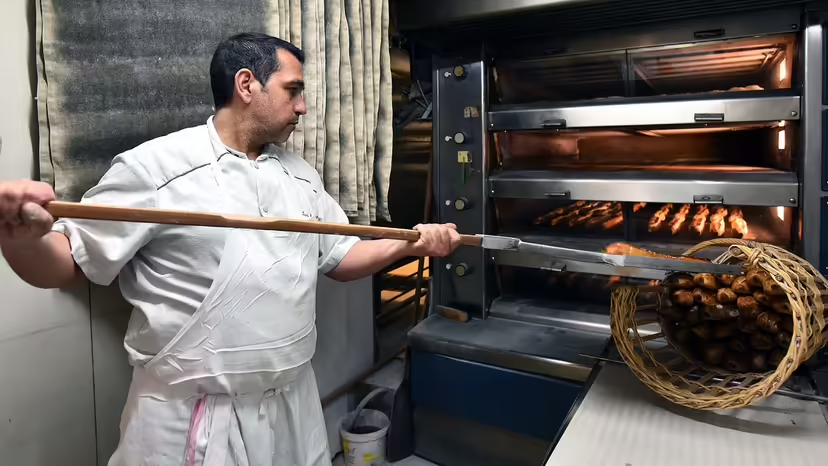
Over an hour or so, I’d watch the dough change. The loaves swelled, their surfaces tightened, and something that had looked completely inert twenty minutes earlier was suddenly very much alive. Later, I’d roll the racks back out and help load them into a giant rotating deck oven. To me, the whole thing was basically Disneyland: motors, steam, enormous ovens, hot racks, and raw dough turning into something I could eat.
Whatever professional discipline I’d develop later on had clearly not arrived yet. I ate an embarrassing amount of them—not slices, mind you: loaves. They were so hot I burned my mouth, which apparently did nothing to slow me down, and when no one was around, I would tear off pieces and dip them into five-pound buckets of butter topping. I’m pretty sure I violated several bakery rules and a handful of health codes. I am equally certain fourteen-year-old me did not care.
At the time, the whole thing felt like magic. It still does a little, but now I know enough to understand that the magic has mechanics. Flour, water, salt, and yeast are not particularly interesting sitting separately on a worktable. Fermentation, gluten, time, steam, heat, and the baker’s hands turn them into something people have spent generations trying to perfect.
A baguette is simple to make and challenging to make well. Mastering one is something else entirely: mindbendingly, nerve-rattlingly, anxiety-makingly difficult.
That is exactly why we are making it.
Simple to Make. Brutally Hard to Master.
A beginner can make a baguette. That is part of what makes this bread so deceptive. The ingredient list is short, the shape is recognizable, and the basic directions can fit comfortably on a sheet of paper. If your standard is simply “produce a long loaf of French-style bread,” you can probably get there surprisingly quickly.
Then you try to make a truly great baguette, and the entire game changes. Once the ingredients stop being the challenge, every tiny decision becomes exposed. Fermentation matters. Dough temperature matters. The strength developed during mixing matters. The way you handle the dough matters. Bench rest matters. Shaping pressure matters. Proofing matters. The angle of the blade matters. Steam matters. Three extra minutes in the oven matter.
It reminds me of a Mozart piano sonata. The notes themselves can be simple enough for an 8 year old piano student to learn, but that does not make it easy. Concert pianist spend a lifetime worrying about details a beginner can’t even hear yet: touch, timing, restraint, control, phrasing, consistency, interpretation.
Baguettes are the same way. Two bakers can use the same flour, water, salt, and yeast and create loaves that technically qualify as the same bread while being nowhere near the same quality. One baker understands fermentation better. One creates stronger but more extensible dough. One shapes without destroying the interior. One sees the exact moment the final proof is ready. One scores at the right angle, gets steam into the oven immediately, and waits long enough for the crust to become properly dark.
There is no sauce to hide behind, no filling, no frosting, no garnish, and no expensive ingredient distracting you from mediocre technique. The loaf is the technique, which is why baguettes are one of the clearest things bakers make for separating good from great.
The Baguette Has a Surprisingly Messy History
You would think one of the most famous breads in the world would have a clean origin story. It does not. What it has instead is a pile of good legends, a few pieces of solid history, and several generations of people confidently repeating stories that may or may not be true.
One version gives Napoleon credit and claims his bakers developed a long loaf soldiers could carry more easily. Another says the baguette came out of construction of the Paris Métro because workers from different regions kept fighting with the knives they used to cut their bread, so somebody supposedly came up with a loaf that could simply be torn apart by hand. They are great stories, which is probably why they have lasted so long. The problem is that historians have never found much evidence for either of them.
Long breads existed before those legends really work, and the modern baguette seems to have evolved gradually rather than appearing because one brilliant baker had a lightning-bolt moment. One important development came from Viennese baking in the nineteenth century, when steam ovens and new bread-making techniques began influencing Parisian bakeries. Steam turned out to matter enormously because it let bread expand longer before the crust hardened, producing thinner, crisper, shinier crusts.
Then came a labor problem. In 1919, France restricted overnight bakery work, cutting into the hours bakers traditionally used to produce fresh bread for the morning. Customers, being customers, did not stop expecting fresh bread just because the government changed labor law. Long, narrow loaves made with commercial yeast could ferment and bake more quickly than some of the massive traditional breads that had been common before.
Did one law invent the baguette? Probably not. Did changing bakery hours help push bakers toward bread that could be produced more efficiently in the morning? Very likely. By the 1920s, something recognizably close to the modern baguette had clearly taken hold.
The real history is therefore less tidy than the legends and far more interesting. The baguette grew out of changing technology, commercial yeast, labor law, flour, steam ovens, customer habits, and thousands of bakers gradually refining the same basic idea.
France Has Laws About Bread. Of Course It Does.
This is where the baguette gets extremely French, because France does not merely have opinions about bread. It has laws about bread.
There are rules about what bakers can call certain loaves, what ingredients may go into them, whether the dough can be frozen during production, and whether a bread can legally be described as maison, meaning house-made. Apparently civilization was not going to survive leaving all of this to chance.
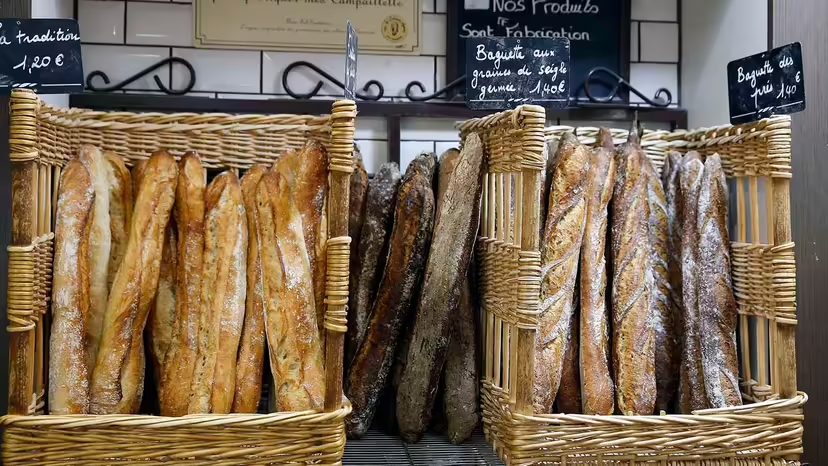
The important term for us is pain de tradition française, or traditional French bread. This is a legal category created by France’s 1993 bread decree, and it is not a shape. A traditional French bread can be formed in several ways. When dough made to that standard is shaped into the familiar long loaf, you get what is commonly called a baguette de tradition.
That means not every baguette sold in France is automatically a baguette de tradition. A regular baguette may use ingredients or processing aids that make commercial production easier, while bread sold as tradition française is much more tightly controlled. It cannot be frozen during production or loaded with ordinary additives, and the dough is fundamentally built from breadmaking wheat flour, water, salt, and yeast and/or levain, with only a few narrowly defined flour additions permitted.
Think about how wonderfully ridiculous that is for a second. The French government looked at bread—flour, water, salt, yeast—and effectively said, “No. We need rules.”
Underneath the joke, though, is something worth respecting. If you take away conditioners, shortcuts, and extra ingredients, the baker has to make the bread good through fermentation, handling, shaping, proofing, scoring, steam, and baking. You cannot hide mediocre technique behind a chemistry set.
There is another French bread term that gets mixed into this discussion and causes unnecessary confusion. Pain maison, or house-made bread, answers a different question. That designation is about where the bread is produced; maison tells you about location, while tradition française tells you about ingredients and process.
So the language is actually pretty logical once you sort it out. Baguette tells you the general kind of loaf you are looking at. Baguette de tradition tells you it follows the traditional French-bread standard. Pain de tradition française is the legal category behind that standard, while pain maison tells you the bread was produced on-site.
Yes, French bread has enough legal vocabulary to require a glossary. I respect the commitment.
UNESCO Did Not Protect a Stick of Bread
In 2022, UNESCO added “Artisanal know-how and culture of baguette bread” to its Representative List of the Intangible Cultural Heritage of Humanity. The wording matters because UNESCO did not simply declare a long loaf of bread historically important. It recognized the knowledge, technique, training, judgment, and culture required to make baguettes properly.
That distinction gets directly to the reason we are studying this bread. UNESCO’s description includes weighing, mixing, fermentation, dividing, resting, hand shaping, scoring, baking, and even adjusting the process according to temperature and humidity. In other words, it recognized all the parts of breadmaking that a recipe cannot completely capture.
“250 grams of magic and perfection in our everyday lives. A truly French way of life. For years, together with bakers and the culinary world, we have campaigned for its recognition. The baguette is now part of UNESCO’s Intangible Cultural Heritage.” – Emmanuel Macron
A recipe can tell you to ferment for a certain amount of time, but the baker has to know whether the dough is actually ready. A formula can tell you to bench rest for twenty minutes, but the baker has to know whether the gluten has relaxed enough to shape. Instructions can tell you to score the loaf, but the baker has to know where to cut, how deep to go, what angle to hold the blade, and whether the dough was properly proofed in the first place.
That is the craft, and UNESCO essentially said the skill itself was worth protecting. Four ingredients are not the remarkable part. Knowing exactly what to do with them is.
Which brings us right back to Mozart. The notes are not the masterpiece. The mastery is what happens between them.
Paris Turns Bread Into a Competition
If you need any more proof that the French take this seriously, Paris runs an annual competition to decide who makes the best baguette in the city. Not the best bakery, not the best pastry chef, and not the fanciest laminated dough. The best baguette.
A loaf made from a brutally short ingredient list gets judged on appearance, bake, flavor, crumb, and internal structure. That sounds almost absurd until you understand how many places there are for the baker to screw it up. A loaf can taste great but have weak shaping. It can look impressive and still have mediocre fermentation. It can have enormous dramatic holes that photograph beautifully while showing terrible gas distribution inside the crumb.
The Grand Prix matters to us because it proves how far the gap can stretch between “good bread” and “great bread.” When the ingredients become this simple, tiny differences in technique suddenly become the whole product. That is exactly why a baguette belongs in an advanced baking class rather than being treated as just another yeast-bread recipe.
GRAND PRIX — THE POINT Paris judges baguettes on the whole loaf: appearance, bake, flavor, crumb, and internal structure. The point is not that we need to copy a competition formula. The point is that once the ingredient list gets simple enough, every tiny technical decision becomes visible.
After finishing eighth in 2015 and narrowly missing victory in 2016, Sami Bouattour came first at the Grand Prix de la Baguette de Paris 2017 on May 4. This victory opens the doors of the Élysée to him, as he is now the official supplier of bread and pastries for Emmanuel Macron for one year
All These Parts: What Makes This Damn Thing So Difficult?
Almost everything about baguette production is a balancing act. The dough needs enough strength to hold gas, but it also has to be relaxed enough to stretch. It needs enough fermentation to build flavor and an open crumb, but not so much that the structure begins falling apart. You need enough pressure during shaping to organize the loaf and create surface tension without crushing the interior you spent two days developing.
Proofing creates the same problem. An underproofed baguette can explode violently in the oven, burst along the side, or create a tight crumb. An overproofed baguette may spread, score badly, and have almost no oven spring left. Somewhere between those two failures is the moment when the loaf is full of gas but still has enough strength to make one final push in the oven.
Even the bake changes jobs halfway through. Early in the bake, we want steam so the surface stays flexible and the baguette can expand. Later, we want that moisture gone so the crust can dry, darken, and become crisp. The bread needs almost opposite conditions within a matter of minutes.
That is why baguettes can be maddening. You can make a loaf that tastes fantastic and still be staring at weak scoring, ugly shaping, poor ears, or disappointing crumb. That does not make the bake useless. It means the baguette just handed you an extremely detailed report card.
Poolish: Start Tomorrow’s Bread Today
Our baguette begins with a poolish, a liquid preferment made from equal weights of flour and water plus a tiny amount of commercial yeast. Because the flour and water weigh the same amount, the poolish is described as 100% hydration.
That sounds more technical than it is. If you use 300 grams of flour, you use 300 grams of water. The useful part is what happens after you mix them.
The poolish gives part of our flour a long head start on fermentation before the final dough exists. Yeast begins working slowly, fermentation aromas develop, enzymes begin changing the flour, and the mixture matures overnight. When that ripe poolish enters the final dough, it brings more flavor and different handling characteristics than we would get by simply dumping everything into the mixer at once.
It also gives you your first chance to stop relying entirely on the clock. A ripe poolish should be expanded, bubbling heavily, aromatic, and near its maximum rise. If it has barely moved, it is not ready. If it peaked hours ago and has collapsed into a sad puddle, you waited too long.
The clock tells you when to start checking. The poolish tells you whether it is ready.
Yeast Makes Gas. The Dough Has to Keep It.
Yeast gets most of the credit for making bread rise, but yeast only produces the gas. The dough still has to hold onto it.
That distinction sounds small until you see a loaf made from weak dough. Plenty of fermentation can be happening inside, but if the gluten structure cannot contain the carbon dioxide being produced, the dough simply spreads. Gas production without gas retention does not give you a beautiful open baguette; it gives you a disappointing puddle.
This is why mixing, fermentation, folding, and handling all matter. Fermentation creates pressure from inside the dough, while gluten provides the structure that contains that pressure. The goal is not to create the strongest dough humanly possible because extremely tight dough gives us a different set of problems. We want enough strength to hold gas while keeping enough flexibility for the loaf to stretch and expand.
Temperature drives the whole process. Warmer dough ferments faster, while cooler dough moves more slowly. A batch finishing the mixer at 82°F is not going to follow the same schedule as one finishing at 74°F, even if every ingredient weighed exactly the same.
That is why dough temperature is not nerd trivia. It tells you how fast the clock is actually moving.
Strong Dough Can Still Be Terrible Dough
People love saying gluten makes bread stretchy, but that explanation is not useful enough for baguettes. What we actually care about is the balance between elasticity and extensibility.
Elasticity is the dough’s urge to spring back after you stretch it, while extensibility is its ability to stretch without tearing. A good baguette dough needs both. If it lacks strength, the loaf spreads. If it is extremely elastic and refuses to lengthen, shaping becomes a wrestling match.
Mixing develops gluten, fermentation continues organizing it, and rest lets some of that tension relax. That last part is why bench rest matters so much. When dough keeps shrinking back during shaping, the answer is not always “roll harder.”
Sometimes the smartest thing the baker can do is cover the dough, walk away, and give it ten more minutes. That is not laziness; that is understanding what the dough is telling you.
Why We Put the Dough in the Refrigerator
Our baguette is a three-day bread, and the refrigerator is part of the process just as surely as the mixer or oven.
On Day One, we build the poolish. On Day Two, we mix the final dough, give it a short start at room temperature, and then refrigerate the entire dough overnight for a long cold bulk fermentation.
Cold does not stop fermentation. It slows it dramatically, which gives the dough many more hours to mature without racing past the point we want while nobody is standing beside it. Flavor continues developing, the flour continues hydrating, and the dough changes gradually while the lower temperature keeps the process under control.
The cold also changes how the dough feels on Day Three. Chilled dough is firmer and easier to divide cleanly, but the gluten still needs time to relax before final shaping. Refrigeration controls time; it does not eliminate the need to read the dough.
Calling this stage cold bulk fermentation matters because the dough is still one large mass. The final proof, or apprêt, happens later after the baguettes have been shaped.
Big Holes Are Not Automatically Good
Somewhere along the way, the internet decided that the biggest possible holes inside a loaf must be proof of great bread. They are not.
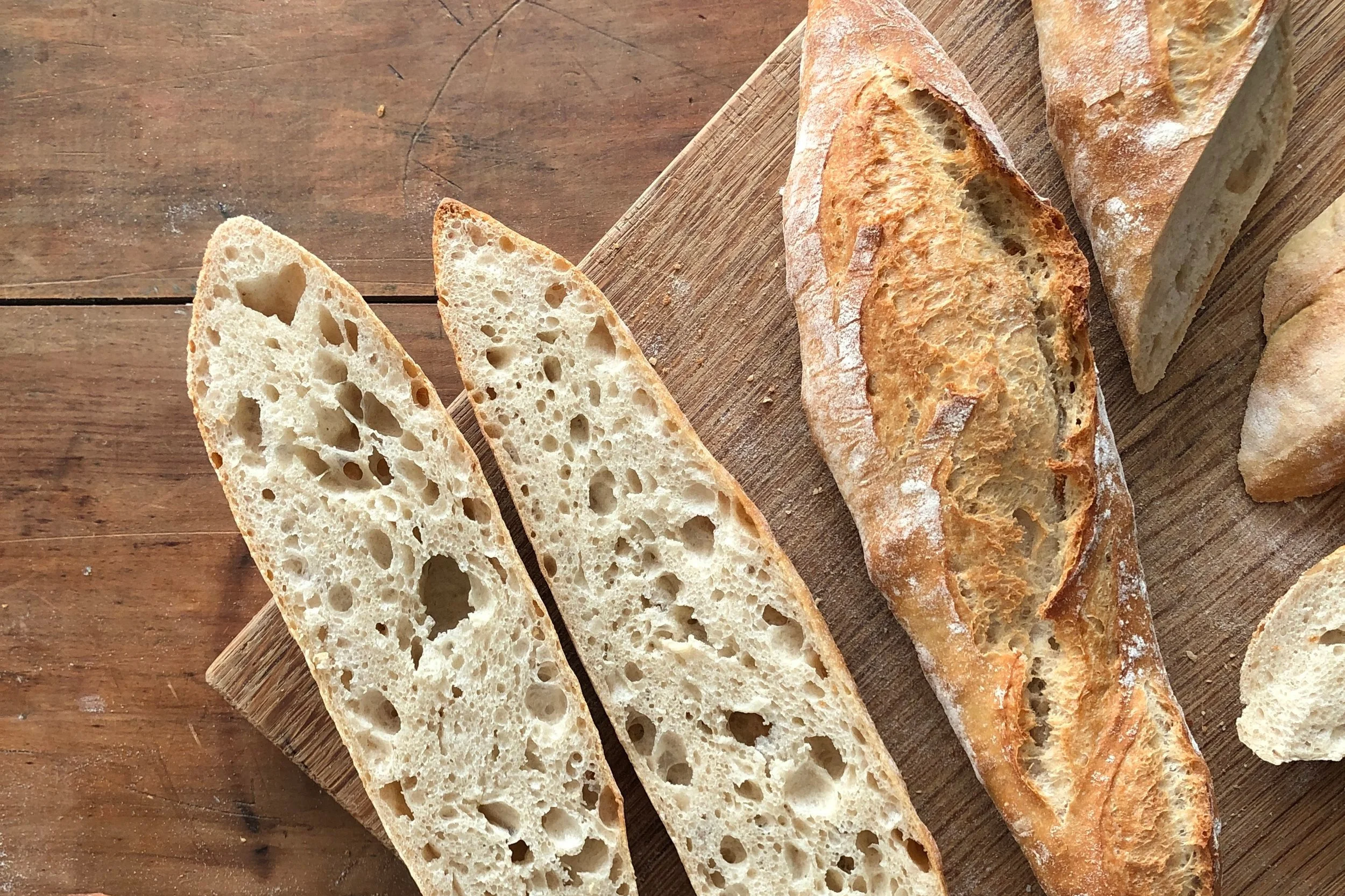
A good baguette should have an irregular, aerated crumb, but the holes still need to make sense. Huge isolated tunnels surrounded by dense dough usually tell you that gas was distributed badly, trapped during shaping, or mishandled during proofing.
The crumb is basically a fossil record of everything that happened to the dough. Tight crumb may point toward weak fermentation, rough handling, or poor oven spring. Giant caves may show careless shaping. A gummy interior may tell you the loaf was underbaked or cut before the crumb had stabilized.
Instead of asking whether the holes are huge, ask whether the crumb looks alive, irregular, and controlled. Those are much better signs of skilled fermentation.
Oven Spring: The Loaf’s Last Chance to Get Bigger
The first few minutes in the oven are violent. Gases already trapped in the dough expand as they heat, fermentation briefly speeds up while the loaf warms, and water begins turning into vapor. The baguette swells rapidly while the dough is still flexible enough to move.
That final burst is oven spring, and it is the loaf’s last big chance to gain volume. The problem is that the outside of the baguette is sitting in a brutally hot oven at the same time. The surface wants to dry and become crust, and once that crust becomes rigid, the loaf cannot keep expanding freely.
That is where steam comes in.
Steam Buys the Loaf Time
Steam is not a bakery party trick. It buys the baguette time.
During the first part of the bake, steam keeps the surface moist and flexible long enough for the loaf to continue expanding before the crust locks everything in place. The moisture also changes the starch at the surface, helping create the thin, crisp, slightly glossy crust we associate with great baguettes.
Later in the bake, though, steam stops helping. Once oven spring is largely finished, the crust needs to dry, darken, and crisp. At that point, we want moisture leaving the oven rather than hanging around.
So one loaf needs two almost opposite oven environments. Early in the bake, keep the surface flexible. Later, dry the hell out of it.
Professional bakeries may use deck ovens, steam-injection ovens, rack ovens, combis, or dedicated bread ovens that control humidity more precisely. We are using commercial convection ovens, so we will create the same basic sequence manually.
Teach the equipment you have. Know what the rest of the industry uses.
Scoring Is Structural, Not Decorative
The cuts on top of a baguette are not there because somebody decided bread needed racing stripes. The loaf is about to expand quickly in the oven, and scoring gives that pressure somewhere controlled to go.
The beginner instinct is usually to make deep diagonal slashes straight across the loaf because that looks vaguely baguette-ish. Real baguette scoring runs much more along the long axis than most people expect. The scores overlap, and the lame is held at a shallow angle so the blade creates a flap instead of cutting straight down.
When the score opens properly during oven spring, that flap lifts and forms the raised ridge called the grigne, or ear. A beautiful ear is not simply proof that somebody handled a razor correctly. It tells you that dough strength, shaping tension, final proof, scoring, steam, and oven spring all cooperated.
If the ear is terrible, do not automatically blame the blade. The loaf may be telling you the problem started several hours earlier.
Crust: Stop Being Afraid of Color
Beginner bread is almost always too pale because people read “golden brown” and somehow hear “beige.”
A baguette needs real crust development. The surface should move beyond pale blond and into deep golden brown, even chestnut in places. That color is not decoration. It brings roasted, nutty, deeply baked flavors that simply do not exist in an underdeveloped crust. This is also why an internal thermometer cannot tell you the whole loaf is finished. The crumb may already be structurally cooked while the crust still lacks color, crispness, and flavor.
The center being done does not mean the baguette is done. Bake the bread until the bread is finished.
Troubleshooting
Most baguette problems begin long before they become visible. A loaf that spreads in the oven may have been too weak after mixing, poorly fermented, badly shaped, or pushed too far during final proof. The easiest defect to fix is the one you notice while there is still time to change something.
Take dough temperature after mixing because it tells you how quickly fermentation is likely to move. Do not throw flour at every sticky-dough problem, because every handful changes the formula and teaches you nothing about handling hydrated dough. Fold because the dough actually needs more strength, not because the timer decided folding is now required.
Do not become terrified of degassing, either. Baguettes require real shaping, which means you will press, fold, seal, and roll the dough. Some gas will move and some will escape. The goal is not to preserve every bubble created during fermentation; the goal is to organize the dough while preserving enough aeration for the finished crumb.
If the dough fights you during shaping, stop fighting back. Cover it and give it more time to relax. If the final proof seems slow, judge the loaf instead of trying to bully the clock. If the oven is not ready, do not score the bread yet. Once the baguettes are scored, the oven, boiling water, and steam system should already be waiting.
And when the bread is baking, let it get dark enough. A pale baguette is not elegant restraint. It is usually just underbaked bread.
Read the Dough Before You Read the Recipe
A baker should be checking the dough from the first night. The poolish should be active and near its peak rather than young or collapsed. The mixed dough should feel strong enough to hold itself but not so tight that it behaves like rubber. After its short room-temperature start and overnight cold fermentation, it should show clear evidence that fermentation continued even while chilled.
On Day Three, the cold dough should divide cleanly and feel organized rather than loose and exhausted. After pre-shaping, it should gradually relax. If the dough immediately shrinks every time you try to lengthen it, it needs more rest rather than more force.
During final proof, the shaped baguette should become lighter and more aerated while keeping enough strength for oven spring. A gentle fingertip press can help you judge readiness, but the poke is only one clue. Surface condition, volume, feel, temperature, and experience all belong in the same decision.
These are not separate tricks. They are one long conversation with the same dough over three days. The better you become at listening, the less mysterious the finished baguette becomes.
The Three-Day Build
Before you get to the actual formula, understand the rhythm.
Day One is about building the poolish and preparing the ingredients for the next day. The poolish ferments overnight, giving part of the flour a long head start before the final dough exists.
Day Two is about mixing the final dough, developing enough gluten to hold fermentation gases, checking the dough temperature, giving fermentation a short start at room temperature, and then deliberately slowing everything down with an overnight cold bulk fermentation.
Day Three is where the dough becomes baguettes. The cold dough is divided, pre-shaped, rested, shaped, final-proofed, scored, steamed, baked, cooled, and finally evaluated.
That sequence matters because each stage solves a problem for the stage that follows. The poolish builds character. Mixing builds structure. Cold bulk builds time. Détente relaxes the dough. Shaping creates tension. Proofing builds pressure. Scoring controls expansion. Steam buys oven spring. Dry heat builds crust.
Once you understand that chain, the recipe stops looking like a random list of instructions.
[IMAGE BLOCK — THREE-DAY PROCESS] Placement: After the three-day overview. Suggested format: Simple horizontal timeline. Day One: Poolish. Day Two: Mix → short bench start → cold bulk overnight. Day Three: Divide → pre-shape → détente → shape → apprêt → score → steam → bake. Purpose: Give students a fast visual map of the entire production schedule before the evaluation/troubleshooting sections.
Read the Finished Loaf
A finished baguette gives you evidence from almost every stage of production. Start with the overall shape. A well-shaped baguette should look intentional from one end to the other, with reasonably even diameter, clean tapering, and no bizarre swollen sections caused by inconsistent rolling pressure.
Then look at the scoring. Did the cuts open cleanly? Did you develop a good grigne? Did the loaf burst somewhere else instead? Those marks tell you something about shaping tension, final proof, score angle, steam, and oven spring.
The crust should have real color and feel crisp after cooling. It should smell toasted and deeply baked rather than merely like hot flour. When you cut the loaf, the crumb should be irregular and aerated without turning into a collection of giant random caves surrounded by dense dough.
Finally, taste it. A beautiful baguette that tastes flat is incomplete work, while an ugly loaf that tastes fantastic is not a failure. Each result tells you which parts of the process worked and which ones still need attention.
A good baker does not merely grade the loaf. A good baker reads it.
[IMAGE BLOCK — REQUIRED INSTRUCTIONAL IMAGE: CRUMB] Placement: After finished-loaf evaluation. Format: Three cross-sections side by side. Labels: WELL DEVELOPED / TOO TIGHT / RANDOM TUNNELING. Purpose: Teach students that “big holes” are not automatically better.
Troubleshooting
Symptom
Most likely cause
What to change next time
Dough keeps shrinking during shaping
Not enough bench rest
Cover it and give it more détente
Dough tears while shaping
Weak development or too much force
Recheck mixing, fermentation, and shaping pressure
Baguette spreads sideways
Weak dough or overproofing
Build more strength and check final proof earlier
Weak oven spring
Overproofing, weak dough, poor steam, or low oven heat
Check proof, oven recovery, and steam timing
Loaf bursts along side or bottom
Underproofing or poor scoring
Proof further and improve score placement
Scores barely open
Overproofing, bad blade angle, or weak steam
Recheck proof, lame angle, and early steam
No grigne
Score too vertical, weak tension, or poor oven spring
Fix the whole chain, not just the blade
Pale crust
Underbaked
Bake longer and stop being afraid of color
Thick, hard crust
Not enough early steam or excessive drying
Improve initial steam and rebalance the bake
Tight crumb
Underfermentation or rough handling
Ferment further and shape with more control
Giant tunnels
Trapped gas during shaping
Press out obvious large pockets and shape evenly
Gummy crumb
Underbaked or cut too soon
Bake fully and cool before cutting
The table gives you somewhere to start, not a magical diagnosis from across the room. Use what you saw during production. If you already know the dough overfermented overnight, do not blame the flour because the baguettes spread.
Terms You Should Know
Alveolation — The pattern and distribution of holes inside the crumb.
Apprêt — The final proof after shaping and before baking.
Baker’s percentage — A formula system where flour equals 100% and every other ingredient is measured against flour weight.
Cold bulk fermentation — Slow fermentation of the entire dough mass under refrigeration before dividing and shaping.
Couche — Heavy linen used to support long loaves during proofing.
Détente — The rest after pre-shaping that allows tight gluten to relax before final shaping.
Elasticity — Dough’s tendency to spring back after being stretched.
Extensibility — Dough’s ability to stretch without tearing.
Grigne — The raised ear that develops along a properly opened score.
Hydration — Water weight expressed as a percentage of flour weight.
Lame — The razor-style baker’s blade used for scoring bread.
Levain — A naturally fermented sourdough culture or preferment.
Pain de tradition française — The French legal category for traditional bread made under tightly controlled ingredient and processing rules.
Pointage — The bulk fermentation period after mixing and before dividing.
Poolish — A commercial-yeast preferment made with equal flour and water by weight.
Scoring — Cutting the dough before baking to control where the loaf expands.
Oven spring — Rapid loaf expansion during the first stage of baking.
TL;DR — The Least You Need to Know
A baguette is simple to make and challenging to make well, but mastering one is mindbendingly, nerve-rattlingly, anxiety-makingly difficult because there is almost nowhere for weak technique to hide. Four basic ingredients mean fermentation, dough strength, shaping, proofing, scoring, steam, and baking have to do nearly all the work.
Our baguette is a three-day bread. Build the poolish on Day One, mix the dough and begin the cold bulk on Day Two, then divide, pre-shape, relax, shape, proof, score, steam, and bake on Day Three. Watch the dough instead of blindly obeying the clock, and learn the difference between strength and extensibility so you know when the dough needs work and when it simply needs to be left alone.
Score with a shallow blade angle and overlapping cuts that run mostly along the length of the baguette. Steam belongs at the beginning of the bake so the loaf can expand, while a drier oven belongs later so the crust can darken and crisp. Bake darker than your beginner instincts want, then cool the bread before judging the crumb.
France wrote laws about this bread. UNESCO recognized the know-how required to make it. Paris runs competitions over tiny differences in crust and crumb. None of that happened because flour and water are complicated ingredients.
RECIPE — FIVE-BAGUETTE PRODUCTION FORMULA
TEST-BATCH FORMULA This is the production version we are using for the first student bake. The lesson above is stable; this recipe section is intentionally modular so we can replace it easily if the test bake tells us something needs to change.
Yield and Formula
Yield: 5 baguettes Total flour: 1000 g Hydration: 68% Salt: 2.2% Prefermented flour: 30% Expected dough weight: approximately 1703.5 g Expected divide: approximately 341 g each
Ingredient
Weight
Baker’s %
Unbleached all-purpose flour
1000 g
100%
Water
680 g
68%
Salt
22 g
2.2%
Instant yeast
1.5 g (approximately ½ tsp)
0.15%
For quantities of 5 grams or less, grams remain the production standard, but an approximate volume measurement is included because classroom scales are sometimes just a teeny bit unreliable at low weights.
Day One — Poolish
Ingredient
Weight
Unbleached AP flour
300 g
Cool water
300 g
Instant yeast
0.5 g (approximately ⅛ tsp)
Mix until no dry flour remains, cover, and ferment approximately 12–16 hours around 68–72°F. Judge the poolish by condition rather than time alone. It should be expanded, heavily bubbled, aromatic, and near peak activity without having fully collapsed.
While the poolish ferments, scale and organize the remaining Day Two ingredients.
Day Two — Final Dough
Ingredient
Weight
Ripe poolish
all
Unbleached AP flour
700 g
Water
380 g
Salt
22 g
Instant yeast
1 g (approximately ⅓ tsp)
Place the ripe poolish in the mixer bowl and add approximately 340 g of the final water, holding back roughly 40 g. Add the flour and mix on low speed until a rough dough forms and no obvious dry flour remains, then stop and allow the dough to rest approximately 20 minutes.
Add the salt and yeast, restart the mixer, and add the remaining water gradually as the dough accepts it. The target is still 680 g total water, but do not destroy good dough just to force in the final few grams. Record the actual amount used if the flour clearly needs less.
Mix to moderate gluten development. The dough should be cohesive, slightly tacky, strong enough to hold itself, and still extensible rather than rubbery.
Check the finished dough temperature.
Target: approximately 74–76°F.
Transfer the dough to a covered container and leave it at room temperature for approximately 30 minutes to get fermentation moving. Record the room temperature and the time the dough enters refrigeration.
Cover securely and refrigerate overnight for the cold bulk fermentation.
Day Three — Divide and Pre-Shape
Inspect the cold dough before touching it. Look for visible expansion, bubbles, strength, and signs of fermentation, and record what you see.
Weigh the actual dough mass and divide by five. The expected scaling weight is approximately 341 g per piece, but use the weight you actually have rather than forcing the theoretical number.
Pre-shape each piece into a short cylinder and cover immediately.
Détente
Allow the pre-shaped pieces to rest approximately 20–30 minutes, or until the gluten has relaxed enough to lengthen without immediately snapping back.
If the dough fights you, give it more time. Do not turn shaping into a wrestling match.
Final Shape
Gently flatten each piece into an elongated shape and progressively fold and seal it into a tight cylinder. Build surface tension without crushing the entire interior.
Seal the seam firmly, then roll from the center outward with even pressure until the baguette fits the usable length of the pan. Taper the ends slightly and place the loaf seam-side down.
The exact finished length will be locked after the new baguette pans are physically measured.
[IMAGE BLOCK — REQUIRED INSTRUCTIONAL IMAGE: SHAPING] Placement: Inside the recipe, immediately after final-shaping instructions. Format: Step-by-step sequence. Show: Rested pre-shape → flatten/fold → seal → roll from center outward → finished loaf. Purpose: This is the most important technique image in the recipe.
Final Proof — Apprêt
Cover the shaped baguettes and begin checking them around 45 minutes. Do not treat 45 minutes as an automatic finish line.
The loaves should visibly increase in volume and feel lighter and more aerated. A gentle fingertip indentation should recover slowly and partially. Immediate recovery usually means the dough needs more time, while almost no recovery may mean it has gone too far.
Record the actual proof time.
Prepare the Oven
Preheat the commercial convection oven to 450°F.
Place a heavy metal steam pan on a lower rack while the oven preheats. Have approximately 240 mL / 1 cup boiling water ready before scoring begins.
Do not pour water onto oven glass, lights, heating elements, or surfaces the manufacturer did not design to receive water.
Score
Use a lame and hold the blade at approximately 30° to the surface of the loaf.
Make four or five scores depending on final loaf length. The cuts should run mostly along the length of the baguette and overlap the previous score by roughly 25–30%.
Use approximately ¼ inch / 6 mm as the starting depth. Cut quickly and confidently rather than dragging or sawing through the dough.
Steam and Bake
Load the baguettes immediately after scoring.
Carefully pour approximately 1 cup / 240 mL boiling water into the preheated metal steam pan and close the oven quickly.
Bake at 450°F convection for approximately 8 minutes with the initial steam environment. After that point, remove the steam pan only if it can be done safely and quickly; otherwise allow the convection oven to vent naturally and record what was done.
Continue baking approximately another 10–14 minutes.
Expected total working bake:
approximately 18–22 minutes
These are test values, not commandments. Judge the finished baguette by opened scores, strong oven spring, developed grigne, deep golden-brown to chestnut crust, properly colored sides and bottom, crisp exterior, and strong roasted-wheat aroma.
Do not pull the baguettes pale because the timer says they have been in the oven long enough.
Cool
Transfer the baguettes to cooling racks and allow at least 30 minutes before cutting any loaf being evaluated for crumb.
Fresh baguettes smell ridiculous. This is where fourteen-year-old me would have ignored every word of that instruction.