
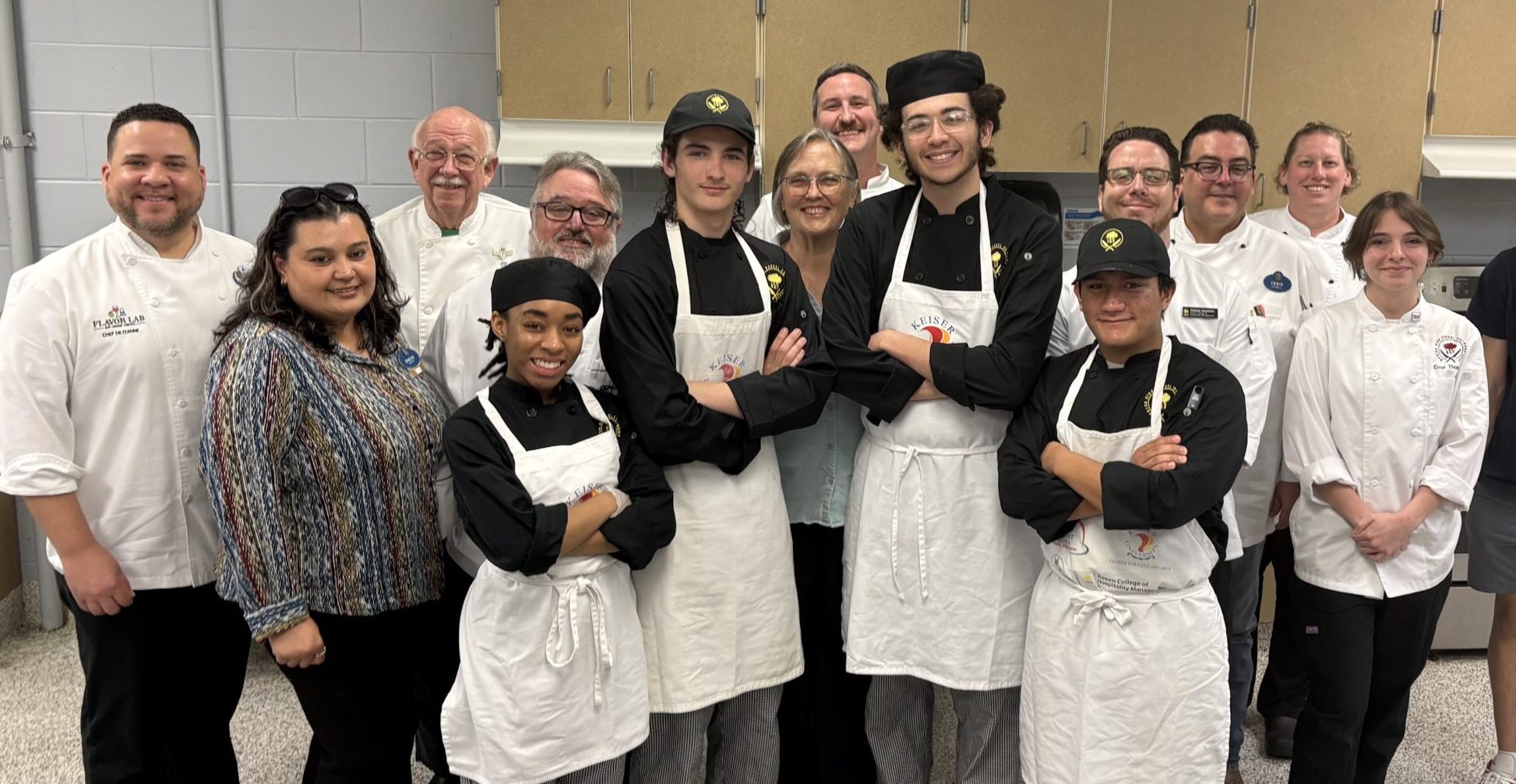
In 2017, Chef Bates transformed an existing culinary course at Wekiva High School into the Magnet Academy of Culinary Arts.
Back then, he had a single mission: provide ambitious culinary students a fast-pass into the hospitality industry, prepare them for higher education, and jumpstart their path into real-world kitchen management. The road to where we are today from where we came has been a long and twisting one, but Chef Bates’ goals have never changed.
We aren’t a casual home-cooking elective, and our students don’t spend four years practicing making mom’s mac and cheese (no matter how delicious her recipe may be). We treat our kitchen as a food laboratory built on product knowledge, cooking science, classical cuisine, and genuine brigade discipline. We produce line cooks, chefs-in-training, shift supervisors, and banquet cooks who can solve problems on their feet when the line gets slammed. We’re much more than an elective. We’re a powerhouse.
1. How We Train
In some kitchens, the instructor hands over a recipe with a few mumbled instructions and an unspoken “follow the instructions as best you can and cross your fingers.” We don’t do that. Our curriculum focuses on the fundamentals and much more; things like formulaic baking, heat-transfer physics, emulsion mechanics, and understanding WHY a dish works or fails.
Whether a student is prepping for a high-stakes national cooking competition or batch-cooking a 500-seat banquet, our standard never changes: master the science, respect the process, and serve great-tasting food.
2. The Facility
Most culinary programs run out of a single teaching kitchen. Wekiva Culinary is lucky—we have a whole hallway and operate across a four-room production complex outfitted almost entirely with heavy-duty commercial gear:
- Main Teaching Kitchen: This is our primary learning space—a station-based lab where students spend four years practicing the basics before moving on to advanced work: line cooking, protein fabrication, primary and secondary sauce work, and heat control. This year, we become one of the few culinary programs in the country with a complete RATIONAL lab in our teaching kitchen, featuring $140K in new, cutting-edge cooking tech: the iCombi Pro and iVario Pro.
- Demonstration & Food Lab: Built specifically for technical lectures, culinary demos, menu engineering, and hands-on food chemistry testing. The Demo and Food lab also contains our cheese and sausage aging cabinet, freeze-drying machine, ARC coffee roaster, and indoor, aquaponic tower garden.
- Commercial Bakery & Pastry Lab: Only one other high school in Florida has a dedicated bakery classroom and we’re proud our students get to study in this space. Here advanced students learn about artisanal bread, laminated doughs, and enriched specialty products — equipped with a commercial gelato machine, a dedicated blast chiller, and a complete chocolate lab where students learn to make fancy chocolate treats from scratch.
- In-School Café & Pizza Restaurant: A working lab where students might execute short-order tickets (like making fresh crepes or grilled paninis), make professional pizzas using our TurboChef Fire or Bullet ovens, make Boba tea or specialty cappuccinos, or treat our customers to a fancy rolled ice cream, made right in front of them. This flexible space is ready-made so our students can practice the skills future employers are hunting for.
Having an active Food Lab, specialized Bakery, and working Café alongside our state-of-the art teaching kitchen gives our students hands-on preparation that typical culinary programs simply can’t match.
3. Catering & Aggressive Competition
Another thing that sets our program apart is that we don’t simulate real-world experience—we do it.
- Real-World Catering & Events: Through Mustang Catering, our kitchen functions as a live commercial enterprise capable of running multi-course banquets for 50 to 500+ guests. Students learn the hard realities of industrial batching, speed-rack organization, hot-box temperature control, sous vide prep, and multi-day prep lists.
- Competition Culture: We train students to compete against the best in the country in high-stakes arenas like the ProStart Invitational, SkillsUSA, NASA HUNCH Culinary Challenge, and Universal Orlando’s Handheld Competition. It’s fast, unforgiving, and forces students to solve complex culinary problems under strict clock pressure.
4. What This Site Is For
Wekivaculinary.org exists as an open technical reference and digital field manual for every student in our kitchen—regardless of where they are in their training.
Inside, you’ll find:
- Deep-Dive Technical Guides: Direct breakdowns of culinary science, visual sensory cues, and practical troubleshooting for when things go sideways.
- Standardized Recipes: Grams-first formulas formatted for commercial scaling and clean kitchen execution.
- Study & Operational Prep: Exam prep, key terminology, and real-world banquet standards built to support culinary students at every stage of their craft.
Come and join us – we’re growing fast!
