
Bacteria get most of the attention in food safety, but they aren’t the only threat on your prep line. This page covers the other biological hazards you need to understand: viruses, parasites, fungi, and biological toxins.
Don’t treat these as four versions of the same problem. They’re not. What matters is understanding what makes each one different — and which control actually works against it.
The One Idea That Ties This Whole Page Together
Bacteria grow in food. Give them the right FATTOM conditions, and their numbers explode. That’s why time and temperature control is such a huge part of food safety — it’s directly attacking how bacteria multiply.
Viruses and parasites don’t work that way. They can’t grow in food at all. Viruses and parasites treat food like an Uber: it’s just a ride from one host to the next. That means controlling time and temperature to stop growth — one of your biggest weapons against bacteria — doesn’t work the same way here. Prevention has to focus on keeping these hazards from reaching the guest in the first place, mainly through personal hygiene, safe sourcing, and proper preparation.
Hold onto that distinction. It explains almost everything else on this page.
For viruses, prevention is mostly about people and personal hygiene. For parasites, it’s mostly about sourcing, cooking, and — for certain fish served raw — parasite-destruction freezing. In the kitchen, fungi are mainly a spoilage problem, not an infection problem. And some toxins survive cooking entirely.
So there isn’t one prevention rule for this page. There are four.
Viruses
A virus needs a living host — a person or an animal — to reproduce. It never grows inside food. But it can still ride along on food, water, or a contaminated surface and stay fully capable of making someone sick. Worse, it cannot be destroyed by normal cooking temperatures.
Most foodborne viruses spread through the fecal-oral route — meaning a person doesn’t wash their hands properly after using the restroom, then touches food that someone else eats. It sounds blunt, but that’s the actual mechanism behind most viral foodborne illness, including Norovirus and Hepatitis A, both covered in The Big 6 Pathogens.
Norovirus has another unpleasant trick: vomit itself can spread viral particles onto nearby surfaces and food. That’s why a vomiting incident in a restaurant isn’t something you just mop up and forget about. It’s a contamination event that needs a real cleanup response.
Manager decision: don’t build your virus-control plan around trying to fix contaminated food later. Viruses don’t grow in food, so the time-and-temperature controls you use to stop bacterial growth aren’t your main weapon here.
Keep the virus off the food in the first place:
- Enforce proper handwashing
- Follow employee illness reporting, restriction, and exclusion rules
- Prevent bare-hand contact with ready-to-eat food
- Clean and disinfect correctly after any vomiting or diarrheal event
- Buy food from approved, reputable suppliers
The full hygiene procedures are covered in Personal Hygiene & Handwashing. The idea to hold onto here is simpler: bacteria can multiply in food. Viruses can’t. With viruses, preventing contamination in the first place is the whole fight.
Parasites
A parasite also needs a living host to survive and reproduce, and it cannot grow in food. Parasites show up most often in seafood, wild game, and produce or water contaminated by an infected source — for example, vegetables irrigated with contaminated water.
Manager decisions that actually prevent parasites:
- Buy from approved, reputable suppliers who know their sourcing
- Cook food to the required minimum internal temperature
- Make sure fish intended to be served raw or undercooked meets applicable parasite-destruction requirements
That last one deserves its own explanation.
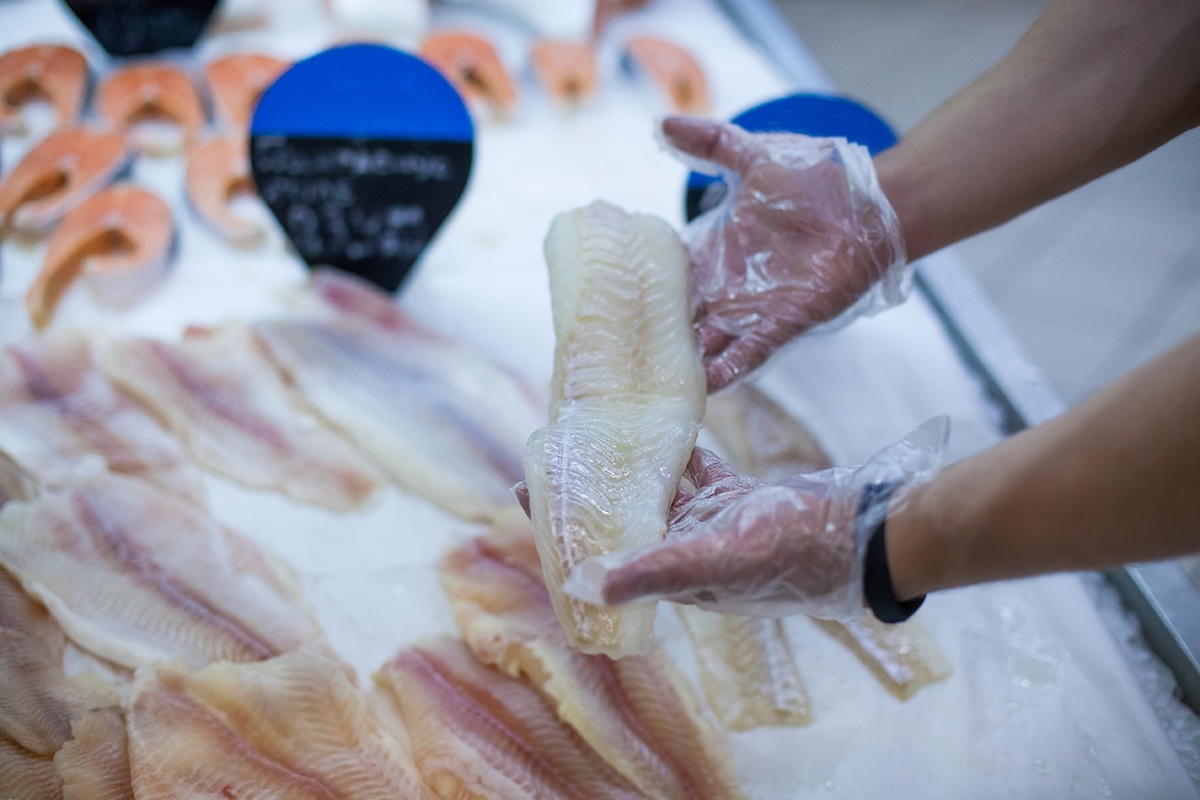
For most fish served raw, raw-marinated, or undercooked, parasites are controlled by freezing the fish under specific time-and-temperature conditions before service. That freezing can be done by the supplier, or by your own operation if you keep the required freezing records. A supplier’s written statement that they already froze it can substitute for those records.
Not every fish needs this. Certain tuna species, aquacultured fish raised on formulated feed with no wild-prey exposure, molluscan shellfish, and a few other categories are exempt under the FDA Food Code.
You don’t need to memorize every exception. You need to understand the rule behind them:
“It looks fresh” is not a parasite-control plan.
Know the source, know whether parasite destruction applies to what you’re serving, and keep the documentation your operation is required to have.
Fungi: Molds and Yeasts
Molds and yeasts are different from viruses and parasites. In the kitchen, they’re mainly a spoilage problem — but some molds come with an additional risk.
- Mold causes visible spoilage. Some molds go further and produce mycotoxins — poisonous substances that can cause foodborne illness. Aflatoxin is the one you’ll see named most often, associated with crops like corn, peanuts, other nuts, and some grains. If you see mold on food, discard it — unless the mold is a natural, intended part of that product, as it is with certain cheeses.
- Yeast also causes spoilage. If yeast growth isn’t supposed to be there, the spoiled product gets discarded.
COMMON CONFUSION — “It’s just a little mold. I can cut it off.”
That instinct may work in some situations at home, but a foodservice operation isn’t the place to start making judgment calls about how far unwanted mold has spread. Little mold on the edge of a loaf of bread, on some cottage cheese, on a few strawberries? That’s a judgment call most of us are nervous about making.
If it’s moldy and mold isn’t supposed to be there, throw it out.
Biological Toxins: When the Danger Was Never Alive
This is the category most people haven’t heard much about before this course, and it’s worth slowing down for.
Some fish and shellfish carry toxins that have nothing to do with bacteria, viruses, or parasites infecting the guest — and critically, these toxins are not destroyed by cooking or freezing. Once they’re there, they’re staying there through your kitchen.
Histamine: the toxin tied to time-temperature abuse. Certain fish — including tuna, bonito, mackerel, and mahi-mahi — carry bacteria that, if the fish is time-temperature abused, can produce a toxin called histamine. The resulting illness is formally called scombrotoxin fish poisoning, though it’s usually just called scombroid poisoning.
This is one of the rare biological toxins where your prevention tool is one you already know: control time and temperature. Once enough histamine has formed, cooking the fish isn’t going to undo the damage.
Ciguatera: the toxin was already there. Some fish become toxic by eating smaller organisms carrying ciguatera toxin. It’s associated with fish including barracuda, snapper, grouper, and amberjack.
The fish can look, smell, and taste completely normal. Neither cooking nor freezing reliably destroys the toxin, and it isn’t caused by anything your kitchen did — the toxin was already present when the fish arrived.
Your control here is upstream: approved suppliers and safe harvest sources.
Shellfish toxins work the same basic way. Shellfish like oysters can accumulate toxins produced by certain marine algae. Again, the shellfish doesn’t have to look spoiled, and cooking isn’t a reliable way to eliminate the toxin.
That’s exactly why shellfish sourcing and identification get taken so seriously. You’re relying on a regulated supply chain that starts long before that shellfish reaches your kitchen.
Mushroom and plant toxins: Most mushroom-related foodborne illness involves toxic wild mushrooms, not the mushrooms coming in from your normal produce supplier. Other plants can carry naturally occurring toxins too.
The restaurant rule is considerably simpler than the botany: don’t play amateur botanist. Use approved, reputable sources.
What Does Toxin Illness Look Like?
It depends on the toxin.
Some symptoms can appear within minutes; others can take several hours. They can include diarrhea, vomiting, tingling in the hands and feet, strange hot-and-cold sensations, facial flushing, trouble breathing, a burning feeling in the mouth, heart palpitations, or hives.
There’s no single symptom pattern or timeline across all of them — which is exactly why a restaurant shouldn’t try to diagnose the problem itself.
If several guests report unusual symptoms after eating the same food, treat it as a potential foodborne-illness incident and follow your operation’s reporting procedures.
The Prevention Answer
For most of these toxins, the damage is done before the food ever reaches your kitchen. Cooking and freezing won’t make them disappear.
Your main defense is sourcing: buy fish, shellfish, mushrooms, and plants only from approved, reputable suppliers.
Histamine is the important exception to remember. Time and temperature control matters because proper handling can prevent dangerous levels of histamine from forming in the first place.
What You Actually Need to Remember
- Viruses and parasites cannot grow in food — they ride along on it. That’s why controlling bacterial growth doesn’t solve these hazards; hygiene, sourcing, cooking, and other appropriate controls do.
- Norovirus can spread through vomit itself, not just food. A vomiting incident needs a real cleanup response, not just a mop.
- Parasite-destruction freezing can be done by your supplier or your own operation with the required records. Real exemptions exist, so know what applies before assuming every fish needs it.
- Molds and yeasts cause spoilage; some molds also produce mycotoxins like aflatoxin. When unwanted fungal growth appears, discard the food.
- Histamine, ciguatera, shellfish toxins, and mushroom or plant toxins are not reliably eliminated by cooking or freezing.
- Histamine is the odd one out: time-temperature control can prevent dangerous levels from forming in the first place.
Glossary additions: virus, parasite, mold, yeast, mycotoxin, aflatoxin, histamine, scombrotoxin fish poisoning, scombroid poisoning, ciguatera toxin