
A food handler at a busy salad bar cuts her finger while prepping lettuce. She bandages it right away — good instinct — but skips the glove that’s supposed to go over it.
A few minutes later, she’s refilling the iceberg lettuce. The bandage comes loose and ends up in the bowl.
A guest finds it.

The manager apologizes. The meal gets comped. Everyone is embarrassed. And none of that puts the bandage back on the cook’s finger.
That’s what this lesson is really about. Not the dramatic stuff. It’s the quiet, easy-to-skip habits that decide whether a shift goes fine or goes very, very, VERY wrong.
Most food-safety failures don’t announce themselves. Nobody rings a bell when you touch your phone and go back to plating. The tomatoes don’t change color because you didn’t wash your hands. After all, a dirty glove looks almost exactly like a clean one.
That’s why personal hygiene matters.
How Food Handlers Contaminate Food
You don’t have to look sick to spread pathogens. In fact, some of the most ordinary things we do without thinking can contaminate our hands:
- Scratching your scalp or running your fingers through your hair
- Wiping or touching your nose or rubbing an ear
- Touching a pimple or infected wound
- Wearing or touching a dirty uniform
- Coughing or sneezing into your hand
- Spitting in the operation
- Using the restroom and not washing your hands — this one has a name: the fecal-oral route, and it’s exactly what it sounds like
Worth knowing: some illnesses spread before symptoms show. Hepatitis A, for example, can spread before a person feels sick at all. Others can continue spreading after someone starts feeling better.
So “he looks fine” and “she says she’s better” aren’t food-safety controls.
The habits below are.
Handwashing
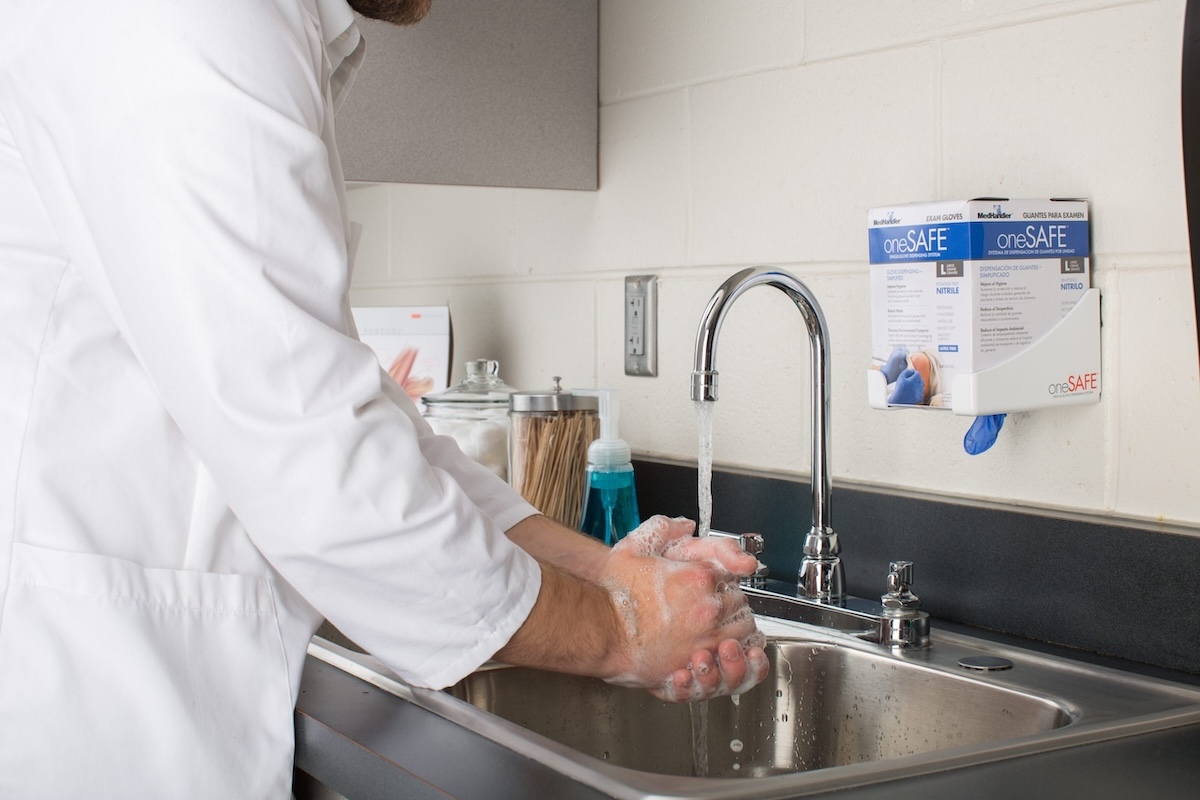
Putting a bit of soap on your hands, then letting water run over your fingers for 20 seconds is NOT washing. That’s rinsing. The scrubbing is where the work happens. A five-second rinse-and-go isn’t abbreviated sanitation. It’s just wet hands.
FYI: the same washing requirements apply food service workers with prosthetic devices.

And wash your hands at a designated handwashing sink — never a prep sink, dishwashing sink, or sink used for dumping wastewater. Using the wrong sink doesn’t solve a contamination problem. It just moves it somewhere else.
FUN NEW HABIT: if the faucet requires you to touch it, use a paper towel to turn it off after washing. The same idea applies to a restroom door. Don’t spend 20 seconds cleaning your hands and then immediately grab the same dirty surface you touched on the way in.
When to Wash Your Hands
Some situations are obvious. Others are exactly where people get lazy.
Here are three that are easy to forget:
- After handling money. Cash changes hands all day and touches just about everything. You’ve seen those videos that put a dollar under a blacklight? Yew.
- After using an electronic device. Your phone doesn’t magically become sanitary because you carried it into a kitchen. Most people do a lot of scrolling while they’re doing a lot of…. sitting. That cubicle? It’s NOT a clean environment.
- When changing tasks. You don’t need visible dirt on your hands for a task change to require a reset. If you change what you’re doing, your hands need a scrub-a-dub-dub.
Corrective Action
Suppose you catch a food handler who didn’t wash their hands correctly — but they’ve already touched food or a food-contact surface.
Now what?
- Dispose of the contaminated food,
- Clean the equipment or utensils involved, and
- Retrain or coach the employee as needed.
Three steps.
Remember: correcting/ yelling at the employee who made the mistake doesn’t magically correct the food they already touched. The food doesn’t get a pass just because the error gets fixed afterward.
Hand Antiseptics: Never a Substitute for Washing
In the regular, everyday world, you see that little pump next to the sink and think to yourself “that right there is a bottle of hand sanitizer.” You’re just a little bit wrong.
ServSafe, the National Registry of Food Safety Professionals, and other food-safety certification exams call that bottle of goo by its official name: hand antiseptic. You need to know both terms. But the rule that actually matters is very simple: Hand antiseptic does not replace handwashing.
Hand antiseptics are liquids or gels that reduce the number of pathogens on the skin. If your operation uses one, it must meet the appropriate standards and be used after correct handwashing, never instead of it. NOTE TO SELF: Let the antiseptic dry before touching food or equipment.
You can flap your hands around a bit if it makes you feel better.

Gloves and Other Barriers
Here’s the rule people sometimes oversimplify as “wear gloves”:
Ready-to-eat food generally can’t be handled with bare hands.
Gloves are one way to keep your hands off it, but they’re not the only way. Tongs, deli tissue, spatulas, and dispensing equipment can do the same job. There are exceptions, including washing produce and certain situations where a ready-to-eat ingredient is still going through a required cooking step. We’ll get to those in a minute.

As a working rule: don’t handle ready-to-eat food with bare hands. — use gloves or a suitable utensil instead.
There are exactly two situations where bare hands are otherwise allowed: the specific cooking exceptions covered just below, or a bare-hand procedure your local regulatory authority has specifically reviewed and pre-approved for your operation.
One hard limit on this exception: none of this is true in an operation that primarily serves a high-risk population — there, the “cooking step coming later” thing? It doesn’t matter. Bare hands are out, full stop.
If your operation primarily serves a high-risk population, gloves or utensils are the only option, under any circumstances. Period.
Which gloves should you buy? Foodservice-approved, single-use gloves in multiple sizes, with latex alternatives available for employees or guests with latex sensitivities.
BUT WHAT IF the ingredient is technically ready-to-eat, but you’re about to cook it anyway?
There are two important situations where bare-hand contact is allowed:
- If the food is going into a dish with no raw meat, seafood, or poultry, the finished dish must be cooked to at least 145°F (63°C). Adding cheese to pizza dough before baking is a good example.
- If the food is going into a dish with raw meat, seafood, or poultry, the finished dish must be cooked to that raw ingredient’s required minimum internal temperature. Seasoning a raw duck breast by hand is an example.
The logic is the same in both cases: a real cooking step is still coming that will bring the food to its required temperature.
That’s a narrow exception — not a general “eh, it’ll get cooked eventually” excuse.
A Couple More Glove Rules
Putting on gloves correctly starts before the gloves go on. Wash and dry your hands first, choose the right size, and handle the gloves by the edge as you put them on. Try not to touch the glove any more than necessary.
Normally, when your gloves become contaminated or you change tasks, wash your hands before putting on a new pair. There is one small exception: if you’re changing gloves while continuing the same task and the gloves have not become contaminated, you do not have to wash your hands again just because you’re putting on a fresh pair.
And one weird little ServSafe rule worth knowing: cut-resistant gloves used with food must be made of material that is smooth, durable, and nonabsorbent. They’re protection for your hands, but they’re still working around food, so they can’t become their own sanitation problem.
I’ve got a cut on my hand – what now?
Impermeable means liquid can’t pass through it. Use a bandage, finger cot, or other covering designed to provide that barrier. Don’t assume every ordinary bandage qualifies.
And remember the salad from the beginning of this lesson: the glove over a bandaged hand isn’t some fussy extra step. It’s what keeps that bandage attached to you instead of becoming the guest’s surprise garnish.
Attire and Behavior
This Isn’t a Dress Code
Every rule in this section can sound like it’s about looking put-together. It isn’t — or at least, that’s not why it’s mandatory.
A fake nail or a coat of polish doesn’t just look different from a bare, trimmed nail. Polish can flake off into food, and both can hide dirt and make it harder to get your hands completely clean.
A loose hair accessory, a false eyelash, a dangling earring — none of that is a style call. It’s an object riding a few inches above every plate that leaves your station, with nothing stopping it from eventually ending up on one.
Rings, bracelets, and watches create the same problem from another angle. They give dirt and pathogens places to collect and interfere with effective handwashing. Some can also come loose and end up in food.
None of this is really a dress code.
It’s the exact same contamination logic you’ve already learned — physical contaminants and hiding places for pathogens — just showing up in what you’re wearing instead of what you’re doing.
That’s also why these aren’t “best practices” you get to let slide because you’re slammed. They’re requirements for the same reason handwashing is a requirement:
The hazard doesn’t become less real just because nobody can see it.
Never eat, drink, vape, chew gum or tobacco while prepping or serving food, or while working in prep or cleaning areas. Never, ever, ever. This isn’t about looking professional. It’s about keeping what’s in your mouth — and what’s been near your mouth — out of somebody else’s food.
Eating gets your hands involved. You grab a bite, touch your lips, lick something off a finger, wipe your mouth, then reach right back toward the cutting board. Whatever was around your mouth is now on your hands, and your hands are back in the food.
Chewing gum does the same thing. People touch it, adjust it, take it out, put it back in, or cover their mouth while they’re chewing. Chewing also produces more saliva. Now you’ve created two contamination routes: your hands and your mouth.
Drinking creates the same basic problem. An open cup can spill, and the rim is touching your mouth every time you take a drink. That’s why drinks aren’t completely forbidden — a properly covered container is allowed when it’s handled in a way that doesn’t contaminate your hands, food, utensils, or equipment.
Smoking or vaping adds another hand-to-mouth cycle. Fingers go to the mouth over and over again, then those same hands come back toward food and equipment.
The common thread isn’t that cooks aren’t allowed to have mouths.
It’s that your mouth is a contamination source, and anything that keeps moving between your mouth, your hands, and your station creates a route for that contamination to reach the food.
That’s why you step away, eat or smoke where you’re supposed to, wash your hands when you come back, and get back to work.

WHAT IF you just want some water during a hot shift?
Of course you do. Kitchens are hot.
You can drink from a covered container — something with a lid and straw or a sip-lid — as long as you handle it without contaminating your hands, the container, exposed food, utensils, or equipment.
Your water bottle isn’t the problem. An open cup sitting on the prep rail is.
Here are the basic rules you’ll need to follow if you plan on making a career in the crazy world of food service:
Somebody Has to Manage All This
We’ve spent this lesson talking about what food handlers are supposed to do, but none of this works if management’s entire personal-hygiene program is “We told them during orientation.”
Managers have to create clear personal-hygiene policies, train employees on them, retrain people when necessary, and supervise what’s actually happening in the kitchen. And here’s the part managers occasionally forget: you have to follow the rules yourself. If the chef walks onto the line, grabs food with bare hands, wipes his hands on his apron, and then tells everybody else to follow the hygiene policy, congratulations — you don’t have a hygiene policy anymore. You have a “suggestion”do as I say, not as I do” scenario. And we all know how well THOSE work.
Management also has to keep those policies current. When regulations change or new food-safety information changes the way something should be done, the policy and the training have to change with it.
That’s the manager’s job: set the standard, teach the standard, model the standard, watch the standard, and update the standard when necessary.
REAL-WORLD APPLICATION: Develop the Reset Instinct
Here’s what personal hygiene actually looks like during a shift.
You’ve just broken down raw chicken. Your phone buzzes in your pocket. You check the message. On the way back to your station, you grab the walk-in handle. Then you notice the sauté cook needs help plating a salad.
None of those things feels dramatic.
That’s the problem.
Young cooks do it. Experienced cooks do it. Old hands who’ve been in the business for twenty years do it. Kids working their very first restaurant job do it. We see somebody who needs help and jump in before stopping to ask, What did I touch last?
And if you’re about to work with ready-to-eat food, the better question is usually even simpler:
It doesn’t matter what I touched last. I’ve got to go wash my damn hands before I start something new.
You don’t need to become paranoid about touching things. You need to develop a reset instinct:
Raw chicken? Reset. Phone? Reset. Garbage? Reset. Change tasks? Reset. Restroom? Absolutely reset.
Wash your hands. Put on fresh gloves if the next job needs them. Move on.
It takes seconds.
The cooks I trust aren’t the ones who can recite the longest list of handwashing rules. They’re the ones I don’t have to chase to the sink because they’ve learned to recognize the moment when their hands stopped being clean.
That’s the habit we’re actually trying to build.
What You Actually Need to Remember
- Wet, soap, scrub 10–15 seconds, rinse, dry. The complete handwashing process takes at least 20 seconds, at a designated handwashing sink.
- Looking healthy doesn’t mean someone can’t spread pathogens.
- Hand antiseptic — usually called hand sanitizer — can supplement handwashing. It never replaces it.
- Ready-to-eat food generally stays away from bare hands. Gloves and suitable utensils can both provide that barrier.
- Gloves don’t make dirty hands clean. They also have to be changed when they’re contaminated, torn, interrupted, used for a different task, or worn continuously for 4 hours.
- There are narrow exceptions for handling ready-to-eat ingredients that will still receive the appropriate cooking step. “It’ll get cooked eventually” isn’t the rule.
- Keep fingernails and hands clean, cover wounds correctly, wear appropriate restraints and clothing, and keep things that don’t belong in food away from food.
- Most important: learn to recognize the reset. The moment your hands become contaminated, wash them before the next job.