
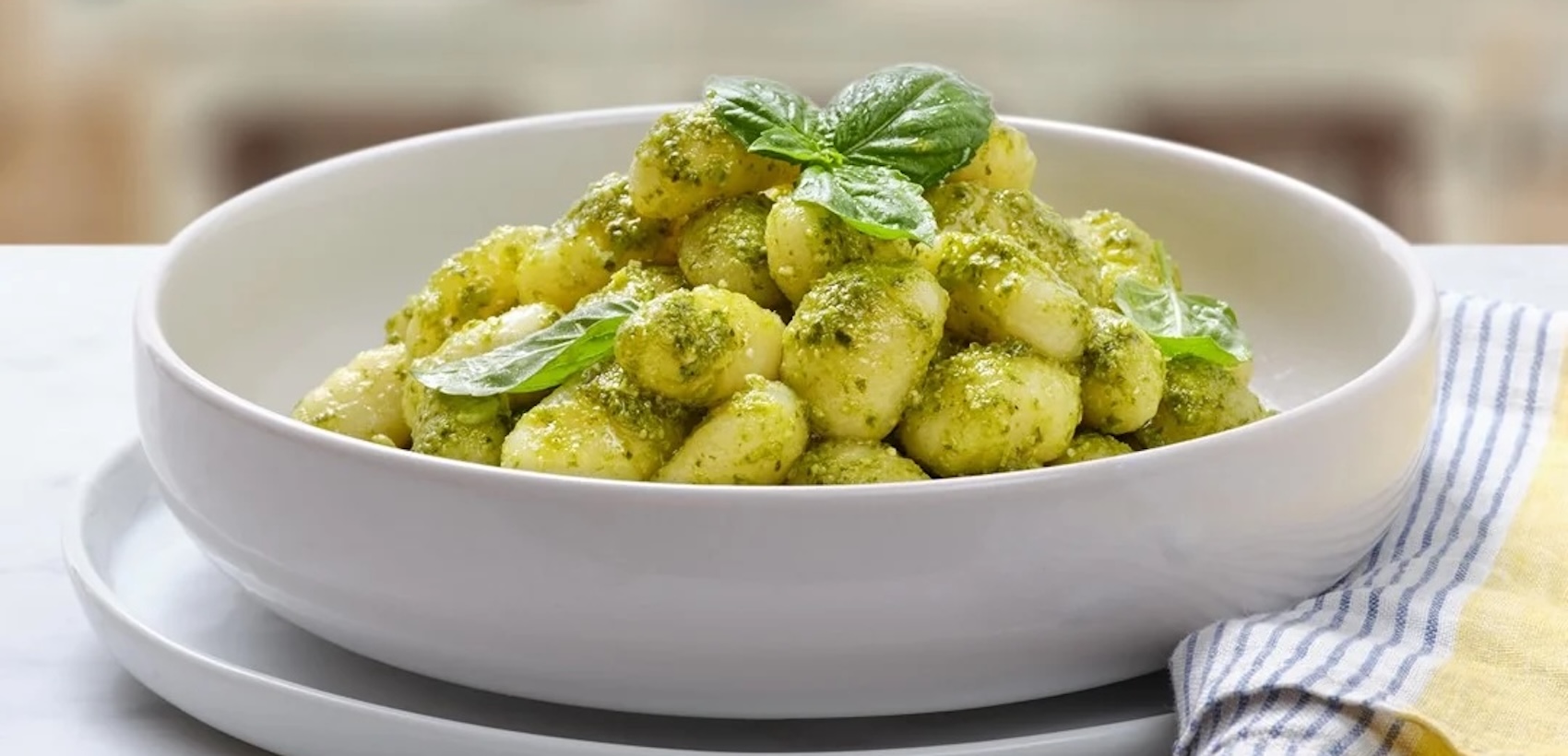
Time to take on a classic: gnocchi al pesto. To do it well, you have to turn two humble ingredients — potatoes and basil — into pure culinary artistry. Anyone can boil pasta, but creating pillowy, cloud-like potato gnocchi requires precise moisture control, light handling, and sharp instinct. When paired with a vibrant basil pesto that relies on exact emulsification rather than heat, this dish becomes a masterclass in texture and fresh flavor balance. Skip the heavy sauces and gummy potato bites; this technique shows you how to execute a light, pristine classic that belongs on any fine-dining menu.
Two skills, taught separately before they meet: gnocchi first, built entirely on its own. Then pesto, built entirely on its own. Then the two come together at the end into gnocchi al pesto, a genuine classic of Ligurian cooking.
PART ONE: GNOCCHI
Gnocchi has a reputation problem: people think it’s the easy one. No sauce timing to nail, no dough to laminate, no filling to seal — just potato, flour, an egg. How hard can it be? Here’s the truth nobody tells beginners: gnocchi is the least forgiving thing in this entire pasta unit. Rolled pasta has gluten holding it together even when you get sloppy. Gnocchi has almost none — which means every mistake you make with the potato shows up immediately, with nowhere to hide.
Dumpling or pasta? The real answer. By strict culinary classification, gnocchi is a dumpling, not a pasta. Pasta gets its identity from wheat gluten — a rolled, stretched dough held together by a protein network. Gnocchi is a starch-based dumpling, built primarily on potato with just enough flour to bind it, and the entire technique is built around avoiding gluten development instead of encouraging it. That’s not a minor detail — it’s a fundamentally different mechanism holding the two together. So why does it still live on pasta menus, in pasta cookbooks, and in pasta units like this one? Because it’s boiled the same way, sauced the same way, served in the same course, and the rest of the food world has treated it that way for so long that the distinction stopped mattering to anyone but us. Technically a dumpling. Functionally, culturally, and on every menu you’ll ever read: pasta.
Let’s get to it.
Where Gnocchi Actually Comes From
Most people assume gnocchi’s story starts with the potato. It doesn’t — potato gnocchi didn’t show up until the 1500s, when potatoes arrived from South America, and it’s actually the newest branch on a much older family tree.
Roman legions are widely credited with spreading an early ancestor, a simple porridge-like dough of semolina and water or egg, prized for being portable and easy to cook over a campfire. But that wasn’t gnocchi. There are a couple of classic recipes – baked gnocchi alla romana and Sardinian malloreddus – that trace their roots straight back to that original, potato-free version.
Centuries later, cooks started adding egg to similar doughs, and the result picked up a new name: malfatti, literally “badly made.” Tuscans still use that exact word today, for a completely different dish: gnudi. You can read more about the naked cheese-and-herb dumplings that turned out to be ravioli’s own ancestor here — two dishes in this series of recipe, two separate stories, one shared word.
Cool, huh?
The word “gnocchi” itself most likely comes from nocca, meaning knuckle, or from a Lombard word for a knot in wood — both describing the same small, rounded shape.

It wasn’t until the 1800s that gnocchi looked like the recipe in this post. The Italian cookbook writer Pellegrino Artusi — often called the grandfather of Italian cuisine — published a potato gnocchi recipe made essentially the same way it’s made today, and he included a cautionary story right alongside it: a woman whose gnocchi completely dissolved in the pot, because she hadn’t used enough flour to hold the dough together. Artusi told that story on purpose. It’s the exact same failure you’re about to learn to avoid, told by a 19th-century food writer to make sure nobody skipped the lesson.
Once the potato showed up, every region in Italy that adopted it built its own version — different flours, different shapes, different sauces.
Regional Variations You Should Know
Gnocchi’s family tree branches through Italy’s regions (with as much breadth and variety as ravioli):
- Gnocchi alla Piemontese/Lombarda (including Gnocchi alla Bava) — the simplest versions, tossed in butter and Parmesan, or Piedmont’s own Gnocchi alla Bava, baked under melted fontina and butter until rich and gooey.
- Gnocchi alla Veronese — served in tomato sauce, tied to a centuries-old Carnival tradition in Verona.
- Gnocchi alla Romana — a completely different technique: semolina cooked into a thick paste, cooled and cut into discs, then baked rather than boiled.
- Gnocchi alla Sorrentina — arguably the ultimate expression of Italian comfort food, and worth knowing in more detail than the others here. Boiled gnocchi gets tossed with a quick fresh tomato sauce, then transferred to a baking dish, topped with diced mozzarella and more Parmesan, and finished under the oven’s heat until bubbly and golden — a boil-then-bake combination none of the other regional versions use. The sauce itself relies on a trick worth remembering: whole, unpeeled garlic cloves fried gently in olive oil until golden, then pulled out before they burn. That infuses the oil with real garlic flavor without the harsh bite or bitterness raw, chopped garlic can bring — the same bitterness problem covered in the pomodoro sauce science, just solved a different way here.
Worth knowing on top of all that: “gnocchi” isn’t even always savory. Some regional versions wrap potato-and-semolina dough around a whole plum or apricot with the pit swapped out for a lump of sugar, boiled, then finished with butter and cinnamon breadcrumbs — dessert, not dinner. Others skip potato entirely and pipe a pâte à choux-style batter directly into simmering broth, the same base dough used in pastry work, just poached instead of baked.
“Gnocchi” turns out to be less one dish than an entire category of small, shaped dough — savory, sweet, boiled, baked, or fried, depending on which region you’re standing in.
International Variations
Gnocchi-like dumplings aren’t isolated to northern Italy, or even to Italy at all — they’re all over the globe, wherever a culture had flour, potato, or both, and a reason to boil dough. You could hand someone in Poland or Slovakia this exact lesson on moisture control and overworking, swap the specific dish name, and they’d nod along — they’ve been fighting the same battle for centuries. Here’s a sampling.
Central and Eastern Europe
- Kopytka (Poland) — starchy, diamond-shaped potato and flour dumplings, traditionally tossed with melted butter, crispy bacon, or caramelized onions.
- Schupfnudeln (Germany/Austria) — thick, finger-shaped potato noodles rolled by hand and pan-fried until golden, often paired with sauerkraut and bacon.
- Knödel/Gomboce (the Balkans) — potato dough wrapped around a whole plum, coated in toasted, sweet cinnamon breadcrumbs — a dessert dumpling, the same idea covered earlier with Italy’s own fruit-stuffed gnocchi.

Fine Dining Spotlight — The Dish That Doesn’t Need a “Frilly Dress”

At Arcane in Hong Kong — a Michelin-starred restaurant — chef Shane Osborn built his signature dish around potato gnocchi, and he’s been explicit about why he refuses to dress it up. His approach avoids what he calls “tuiles and towers” — the architectural plating and showy garnishes common in fine dining. The dish gets small seasonal tweaks (wild garlic, toasted pine nuts, or broad beans depending on the time of year), but the gnocchi itself stays humble on purpose.
In his words, it doesn’t need a frilly dress, because it’s already a statement on its own. It’s popular enough that Osborn periodically pulls it from the menu just to keep the kitchen from getting bored making it — and guests keep asking for it back.
The Science Behind Bad Gnocchi: Two Paths Towards an Unpleasant Dinner
The thing that makes gnocchi turn out bad is fairly simple: don’t be mean to your potatoes. When potatoes are abused, they get angry at the cook, spill out their starch, and become gummy. Sticky. Gluelike. Before we can get into why you have to process potatoes when they’re blazing hot, right out of the oven (and you do), let’s talk about how some potatoes turn into a gluey mess in the first place.
How Do Potatoes Get Ruined?
Imagine this: inside every potato are millions and millions of tiny bubble-wrap cells. Now picture each one of those cells containing thousands of little starch granules. Inside those granules are amylose and amylopectin — the two major components of potato starch.
When the potato is raw, those starch granules are tightly organized inside the potato’s cells. When we cook the potato, heat and moisture cause the starch granules to swell and gelatinize. The starch becomes soft, hydrated, and much more capable of creating that sticky, thick texture we associate with cooked starch.
Here’s where things get interesting.
Handle the cooked potato gently and you’re mostly keeping the potato’s cellular structure intact while breaking it down into a workable texture. Mash it aggressively, beat it with a mixer, or otherwise overwork it, and you’re tearing apart more of those potato cells and releasing more of the gelatinized starch into the surrounding mixture.
And that released starch is sticky. Amylose, in particular, can leach out of damaged starch granules and contribute to the thick, gluey texture that develops when starch is heavily worked. The more you damage the potato’s structure and manipulate the released starch, the more likely you are to end up with a dense, sticky mess instead of light, fluffy potato.

That’s the basic mechanism behind gummy mashed potatoes, and it’s the exact same failure mode threatening your gnocchi dough if you handle the potato like it said something mean about your momma.
Overworking doesn’t just risk developing too much gluten once the flour enters the picture — you’re also aggressively breaking down the potato’s cellular structure and releasing more starch into the mix. Now you’ve got two potential sources of trouble working against you: too much manipulated potato starch and too much-developed gluten.
Now you’ve got a gummy, sticky, white little turd that you’re going to try and pass off as the real deal.
This is exactly why tool choice matters so much.

A ricer — it looks like an oversized garlic press, loaded with a whole cooked potato and squeezed through a perforated plate — breaks the potato down by forcing it through small holes with relatively little repeated mechanical agitation. It gives you a fluffy, even texture without aggressively beating the potato.
A food mill does the same basic job a different way, with a hand-cranked blade pushing food through a perforated disc. It also breaks the potato down efficiently without the repeated beating and mixing that can make potatoes gluey.

Both accomplish the same basic goal here: break the potato down while minimizing unnecessary mechanical potato abuse.
The choice between them mostly comes down to what’s in your kitchen. A ricer is fast and convenient for one potato at a time. A food mill handles bigger batches and does double duty for things like tomato sauce later in this program. Neither is the “correct” one over the other.
The important thing is what you don’t do: Don’t beat the living hell out of the potato.
How Do Cold Baked Potatoes Ruin Gnocchi?
Ruined dough isn’t only about which tool released the amylose. It’s also about temperature — specifically, whether you riced the potato while it was still hot, or let it sit and cool first.
Heat does something very important here: it keeps the cooked potato starch soft and workable. Heat also lets steam escape as you rice, and that escaping moisture is exactly what lets you use less flour to bring the dough together.
And here’s the important connection: the less flour you need, the less gluten you develop. Less gluten development means shorter, gentler strands instead of the tight, tough network you get when you work a flour-heavy dough too aggressively.
REMEMBER: water is the enemy of fluffy gnocchi.
A potato’s starch is gelatinized by the time the potato is fully cooked. It doesn’t stay that way long.
Ever cut into a cold, leftover baked potato? Remember how all the “meat” inside was clumped into chunks of chewy goo? When the gelatinized interior of a potato is left to cool, the starch molecules begin to reorganize in a process called retrogradation. Think of it like warm wax versus cooled wax: hot, it’s soft and takes whatever shape you press it into; let it cool and it hardens back up, resisting the same shaping it accepted easily a minute earlier.

On a molecular level, the starch molecules that were loosened and disrupted during cooking begin to reassociate and form a more ordered structure as the potato cools. Amylose does this relatively quickly; amylopectin continues reorganizing more slowly. The result is a firmer, less flexible starch structure.
So… you’ve GOT to rice the potato while it’s still hot and that starch is still soft. Let it cool first and you’re fighting a stiffer, already-reorganized structure instead of shaping it while it’s still easy to work with.
Put those effects together: a cooled potato has a firmer starch structure, doesn’t release steam as effectively during ricing, and can require more flour to bring the dough together — and you suddenly realize the entire reason your gnocchi is about as light as gravel is you started with a potato that had been allowed to cool before you riced it.

In The Kitchen: Making the Gnocchi
Every year, I teach students to make gnocchi, and the thing that ALWAYS goes wrong is also the most basic: they overwork it. They treat the finished dough like it’s a playdough snake instead of a delicate structure that will turn tough in a moment’s notice. They boil the shaped gnocchi too hard for too long. They smoosh in the pesto. Gnocchi is wonderful, but it’s fragile, it’s delicate, and it’s easily overworked into a pile of vaguely green mashed potatoes. Everything in this section exists to keep that from happening to you.
Bake, don’t boil
Some recipes call for boiling the potatoes as a first step. That’s a rookie mistake. If your goal is the driest possible potato for gnocchi, and it’s worth knowing exactly why before you make it: boiling puts the potato in direct contact with water throughout the cooking process, which can increase the amount of water the cooked potato retains. Every bit of extra water you bring into the potato now is water you’ll have to account for later, potentially with extra flour, to bring the dough back into balance.
Baking does the opposite — it drives moisture out of the potato instead of adding water through direct contact.
Here’s our first step: prick the skin all over with a fork — this gives built-up steam somewhere to escape as the potato bakes, instead of pressuring up inside a sealed skin. Bake at 400°F for 45 to 60 minutes, until the internal temperature reads about 210°F.
The moment they’re out of the oven, slice them open right away and scoop the steaming flesh straight into a ricer or food mill — working fast, since the goal is to let as much steam escape as possible while the potato is still hot.
This is one of the main reasons behind using Russets. Waxy varieties such as Yukon Gold and red potatoes generally have a denser, waxier texture and can retain more moisture than high-starch Russets. Russets are better suited to this job because their cooked flesh is drier and fluffier, meaning they generally require less flour to form the dough.
And less flour means less gluten development, which in turn helps give you a soft, delicate gnocchi — not a tough, disgusting, gummy ball of sadness.
Rice or Mill, don’t process
Rice or mill the hot potato directly onto your work surface — a ricer or food mill specifically, not a masher.
Whichever tool you use, don’t let the potato sit and cool before ricing.
Spread, combine, and shape (don’t knead)
Spread the riced potato out evenly across your work surface rather than leaving it in a mound — a thin, even layer lets the egg and flour work in evenly instead of getting compressed into a dense pile. Beat your egg yolks with the salt, pepper, and nutmeg, then drizzle that mixture evenly over the spread potato — yolks only, no whites. That swap is deliberate: egg whites are mostly water, and the flour science in Intro to Pasta covers exactly how directly water content drives how much flour a dough ends up needing. Yolks bring fat and binding power without that extra water — less flour to compensate, a lighter, more tender result.
Sprinkle the Tipo 00 flour evenly over the top and, using a plastic bowl scraper, combine gently — folding and gathering the mixture together rather than kneading it hard. Your goal is to work in just enough flour to form a dough that’s smooth but still slightly sticky. The moment it holds together, stop. This is not a dish that rewards extra effort, and it doesn’t need to be beaten or slapped into shape either — some techniques call for forcefully working the dough to knock the air out of it, but that’s extra handling this delicate a dough doesn’t need and isn’t a step you’ll find consistently recommended anywhere.
Roll portions of dough into long ropes on a floured surface, cut into half-inch pieces, and roll each piece off the tines of a fork to create ridges. Some chefs skip this step entirely, arguing it’s unnecessary handling for a delicate dough — but it stays in this program on purpose: ridging is the traditional method, and it reinforces the same sauce-grip principle explained in Intro to Pasta’s guide to matching sauce and shape. Cook in gently salted boiling water, usually 3 to 4 minutes. It’s done the moment it rises to the surface — see the float test below for exactly what’s happening when that happens.
Gnocchi Troubleshooting
- Falling apart in the water? Not enough flour holding the dough together — this is exactly the failure the Grandfather of Italian cuisine Artusi wrote about. Hundreds of years of culinary students not paying attention must have him spinning in his grave.
- Dense and heavy instead of light? Overmixed, or the potatoes weren’t hot enough when riced. This is exactly the failure I’ve spent many, many hours writing about. But I’m not dead yet, so no spinning.
- Gummy even after it’s fully cooked? The potatoes were undercooked, or too much moisture got trapped in before the flour ever went in. Remember the rule? WATER IS THE ENEMY OF FLUFFY GNOCCHI.
Gnocchi Sensory & Visual Indicators
- Visual: Gnocchi should look pale and slightly ridged, holding a defined shape without looking dense or waterlogged.
- Tactile: Should feel light and pillowy when pressed gently, not heavy or gummy.
- The float test: Gnocchi cooks fast — usually 3 to 4 minutes — and tells you it’s done the same way fresh pasta does, but for its own specific reason. As the potato starch inside fully gelatinizes and the interior heats through, tiny trapped air bubbles in the dough expand, and the gnocchi’s overall density drops below that of the surrounding water. Once that happens, it floats. That’s not a rough guideline — it’s a real physical signal that the interior has actually finished cooking, not just the outside.

PART TWO: PESTO
All of the sauces we’ve built studying pasta have one thing in common: they all get hot… at least a little bit. Pesto breaks that rule completely — and if you forget that, even for a second, you’ll ruin it. This is a sauce built entirely on patience and restraint with a food processor, where the difference between “bright, herbal, and alive” and “bitter, gray-green sludge” comes down to how long you hold down a button.
Where Pesto Actually Comes From
Pesto’s name tells you exactly how it’s made: it comes from the Italian verb pestare — to pound or crush — which traces back to the Latin pistare, the same root that gives us the word “pestle.” Before there was a name for the sauce, there was a name for the motion that makes it.
That idea — pound herbs and cheese into a paste, eat it — is old. Ancient Romans made something called moretum: cheese pounded together with garlic and whatever herbs were on hand, eaten with bread. It’s mentioned in a first-century poem about a farmer making his own lunch. (I found the poem. I’m not putting any of it here, because I love you and don’t wish you to suffer. Trust me — it’s terrible.) Centuries later, medieval Genoese cooks were doing something similar with garlic and walnuts, a paste called agliata. Legend credits a friar from a convent near Genoa with eventually swapping in fresh herbs and turning that into something closer to what we know as pesto today — though that’s exactly the kind of charming, unverifiable legend that keeps turning up the deeper you dig into this history.
Here’s where it actually gets messy, and it’s worth knowing why: sources genuinely disagree on when pesto as we’d recognize it first got written down. Some credit Emanuele Rossi’s 1852 recipe in La Cuciniera Genovese. Others point to Giovanni Battista Ratto’s version of the same title — some dating it 1836, others 1863 — and even that recipe, when it shows up, reportedly called for marjoram, parsley, Dutch cheese, and butter, not the basil-pine-nut-garlic combination that’s standard today. Three different dates, three different ingredient lists, one famous sauce. Treat this the way you’ve treated every other disputed food history in this program: the broad story is solid, the exact footnote isn’t settled, and that’s fine. Live with the uncertainty.

What’s not in dispute: basil itself isn’t Italian at all, originally. It comes from India and Southeast Asia, and it migrated west via ancient spice routes long before it ever reached the Ligurian hillsides that made it famous. That’s the third time in this pasta series we’ve hit the exact pattern — spinach came from Persia, tomatoes came from Mesoamerica, and now basil comes from South Asia. The most “essentially Italian” ingredients in Italian cooking keep turning out to be recent arrivals from somewhere else entirely. Worth remembering next time someone tells you a food is “authentically” anything.
Genuinely can’t-believe-this-happened trivia: in 2001, Genoa hosted the G8 Summit, and Italy’s prime minister at the time, Silvio Berlusconi, decided the official lunch needed adjusting — he ordered garlic left out of the pesto served to world leaders, and demanded it be relabeled “basil sauce” instead of pesto genovese. Genoese citizens were furious enough that they staged a public protest and threw garlic at him. A government leader tried to edit a national dish for an international lunch, and the people who actually own that dish showed up with garlic in hand to disagree. That’s how seriously this sauce is taken in its home city.
Spotlight — There’s a World Championship for This

Genoa hosts an actual competitive event called the World Championship of Pesto al Mortaio — mortaio meaning the mortar itself — founded in 2007 by Genoa native and self-styled pesto ambassador Roberto Panizza. Held every two years, competitors are judged specifically on making pesto the traditional way, crushed by hand with a mortar and pestle, no food processor allowed. Panizza himself still makes his own pesto entirely by hand in famously small batches — around 2 kilograms a week, by choice, not by necessity.
Food Science — A Different Kind of Emulsion
Pesto is an emulsified sauce — a mixture of two ingredients that don’t naturally combine. Most emulsions are a combination of fat and a liquid, held together in a stable, evenly distributed state instead of separating back apart. Mayonnaise, hot chocolate, and the Alfredo sauce from another pasta study are all built on that same basic water-and-fat idea. Pesto works a little differently, since there’s barely any water in it at all. Instead of fat suspended in water, the olive oil gets suspended and stabilized by the ground-up solids — fragments of basil, proteins from the cheese, fats from the pine nuts — all working together to trap the oil in place and turn it into a thick, stable paste instead of a liquid sauce.
That chunks-in-oil mechanism is exactly why technique matters so much here — and there are three real ways to get it wrong, all tied to how you run the food processor, and all tied to the same root cause: impatience.
Challenge 1: Pulse the garlic — don’t run the machine continuously. Whole garlic doesn’t smell or taste like much on its own — the sharp, pungent bite you know only shows up once the cell walls get physically broken open. Rupturing those cells releases allicin, an enzyme that reacts with a separate compound also stored inside the cell, and that reaction is what actually produces the sharp-tasting compound responsible for garlic’s acrid bite. Chop garlic and you rupture some cells. Blend it hard and continuously in a food processor and you rupture far more of them, all at once, which is exactly why over-processed garlic turns harsh and bitter instead of staying sharp.
Short pulses limit how many cells get broken open in one go — exactly why this recipe pulses instead of running the machine continuously, and exactly why whole cloves fried gently in oil (the Sorrentina trick from earlier) barely register at all: an unbroken clove never triggers that reaction in the first place. Hold the pulse button down because you’re in a hurry, and you’ll turn a bright, sharp pesto into something that tastes like it’s holding a grudge.
Challenge 2: Add the oil slowly — never all at once. Dump the oil in fast and the basil and nut particles never get the time they need to actually coat and trap it as it goes in — you end up with a looser, more separated result instead of a cohesive paste. Drizzle it in slowly while the machine runs instead, giving those particles time to do their job. It’s not so different from how egg yolk does the same task, more slowly, when you’re making mayonnaise or aioli. Dump the whole bottle in because you didn’t feel like drizzling, and you haven’t made pesto — you’ve made expensive, herb-flecked salad dressing.
Challenge 3: Stop the machine once the Parmesan is in — don’t keep running it. Cheese that gets processed past “just combined” turns gummy or stringy instead of staying smooth, since its proteins break down structurally the more they’re worked. Add the cheese last, and pulse only briefly — just enough to combine, then stop. Keep going because you weren’t paying attention, and you’ve turned good Parmesan into a texture nobody ordered.
Regional Dishes Built Around Pesto
Pesto’s home turf is Liguria — also known as the Italian Riviera. It’s a narrow strip of coastline in northwestern Italy, curving along the Mediterranean between France and Tuscany. It’s breathtakingly beautiful. The people who live in this region didn’t stop at inventing pesto; they built an entire menu around what to put it on.

Start with Trofie al Pesto, the pairing everyone in Liguria will tell you is the correct one: short, hand-rolled twists of pasta with just enough texture to grab a thick sauce and hold on. Then there’s Trenette al Pesto — long, flat noodles somewhere between linguine and fettuccine — and this is where things get genuinely strange if you’ve never seen it done: the potatoes and green beans aren’t a side dish. They go into the same pot as the pasta, boiled together, then everything gets tossed with pesto at once. One pot, one sauce, a full meal. It sounds like a mistake the first time you hear it. It isn’t.
Pesto shows up outside pasta entirely, too. Ravioli alla Genovese takes filled pasta — the same sealing technique covered in the ravioli deep dive — and finishes it with a drizzle of pesto instead of a tossed sauce, letting the filling stay the star. And then there’s Mandilli de Sea, “silk handkerchiefs”: pasta rolled thin enough to genuinely look and drape like fabric, coated rather than tossed, because anything thicker would fight the sauce instead of carrying it.


Here’s a detail that surprises most people: real Pesto alla Genovese carries DOP status — the same Protected Designation of Origin system that governs true Parmigiano-Reggiano and San Marzano tomatoes, covered in the ravioli and pomodoro deep dive. To legally use the name, a producer needs basil grown in specific areas around Genoa, Ligurian olive oil, and a specific cheese blend — full stop.
Everything you’ve ever eaten labeled “pesto” outside of Italy, however good it tastes, legally isn’t the real thing. That’s not snobbery. It’s the law.
And the agliata I mentioned earlier — garlic and walnuts, pounded together, medieval Genoa’s original paste — didn’t just turn into pesto. It split. Two hundred miles south, in Sicily, that same basic technique forked into pesto alla Trapanese: basil and pine nuts swapped for tomatoes and almonds, the green sauce turning red, sweeter, and entirely its own thing. Same ancestor, same motion of the pestle, completely different sauce standing at the other end of the country.

Know Your Bowl: The Five Ingredients Doing All the Work
Every other sauce in this pasta unit gets a break. Heat forgives things — it melts fat, softens sharp edges, and gives a mediocre ingredient somewhere to hide for twenty minutes. Pesto never touches heat. That means every ingredient that goes into the food processor comes out the other side completely exposed, with nowhere to hide and nothing cooking off. Buy the wrong basil, the cheap oil, or the bargain-bin cheese, and you won’t taste it in twenty minutes — you’ll taste it in the first bite. Here’s what you’re actually working with, and where you can (and can’t) cut corners.
Basil: The One Ingredient You Can’t Swap
Not all basil is the same plant doing the same job. Walk past a “Thai basil” or “holy basil” plant at a nursery and you’re looking at a genuinely different herb — sturdier leaves, a spicier, almost licorice-forward flavor built to survive a hot wok, not get pounded raw into a paste. Great basil. Wrong basil. What this recipe — and pretty much every Italian recipe that just says “basil” — actually wants is Genovese basil: sweet, tender, big-leafed, mild anise notes. It’s what’s sitting under the plain “basil” label at most grocery stores.
Here’s the part that actually changes how you shop: basil’s flavor doesn’t hold. Whatever makes it smell bright and sweet starts breaking down the moment the leaf gets cut, which is why a bunch that’s been sitting in a plastic clamshell for a week tastes like grass instead of basil. Buy it as close to the day you’re making pesto as you can, and don’t rinse it until right before you use it.
Garlic: Real vs. Fake, and a Debate Worth Having
First, a myth to bust: that giant garlic at the farmers market labeled “elephant garlic”? Not garlic. It’s a member of the leek family, mild enough to eat raw, wearing a name it doesn’t deserve. Skip it here — this recipe wants real garlic, sharp enough to survive going in raw.
Real garlic splits into two camps: hardneck and softneck. Softneck is what shows up in most grocery stores — lots of small cloves, mild flavor, stores well for months. Hardneck grows a stiff central stalk, produces fewer but larger cloves, and carries a deeper, more complex heat that softneck can’t match — exactly why it’s the better pick for a raw application like this one, where nothing mellows out over heat. (Bonus: hardneck plants also grow scapes, the curly green shoots some cooks blend straight into pesto in early summer for an even greener, milder garlic flavor.)
Then there’s the argument every culinary student eventually has with their own cutting board: do you dig out the green sprout — the “germ” — hiding in the center of an older clove? Tradition says yes, it’s bitter. Cook’s Illustrated actually put this to the test and found the sprout itself tastes mild and grassy — it’s the aging clove around it that’s gotten sharper, not the sprout. Their revised advice: don’t bother removing it for most cooked dishes, but reach for younger, sprout-free cloves for anything raw and garlic-forward — which, notably, describes this exact recipe.
(For the actual chemistry behind why raw garlic bites — and why the technique section has you pulsing instead of running the processor straight through — see Food Science above.)
Pine Nuts (and Friends): The Most Expensive Thing in the Bowl
Pine nuts aren’t technically nuts — they’re seeds, harvested by hand from inside pine cones, which is exactly why a small bag costs more than the rest of your ingredient list combined. They bring a mild, buttery flavor and real fat content that does structural work in the emulsion, not just flavor.
Here’s a fact worth knowing before you go too hard on them: a small number of people who eat pine nuts develop something doctors actually call “pine mouth” — a bitter, metallic taste that shows up a day or two later and can stick around for up to two weeks. It’s harmless, rare, and tied to one specific pine species, not something to panic over — but it’s a genuinely wild piece of food trivia, and it’s part of why some cooks quietly reach for the substitute instead.
Walnuts are the standard substitute, and a completely legitimate one — less buttery, more assertive, but they still make the emulsion work the same way. Almonds show up in some regional versions too. So do pistachios, especially further south in Sicily. None of these are cheating; they’re just a different, often cheaper, branch of the same family tree.
Olive Oil: Why “Extra Virgin” Isn’t a Sticker, It’s a Grade
“Extra virgin” isn’t marketing language — it’s a legal grade, based on actual lab numbers. To earn the label, olive oil has to be extracted mechanically (no heat, no chemical solvents) and come in under a strict acidity limit, along with passing a taste panel with zero defects. Fall short of that and the oil gets bumped down to “virgin”; fall further and you’re into “pure” or “light” olive oil, both of which are refined — meaning heat- or chemically-processed in a way that strips out most of the flavor and most of the compounds responsible for a good olive oil’s peppery bite.
Here’s why that matters more in this recipe than almost anywhere else in this program: olive oil in pesto never touches a pan. In a sauté, a mediocre oil’s flaws get masked by heat and garlic. In pesto, that oil is roughly half of what you’re eating raw. This is exactly the dish where spending a little more on a genuinely good extra virgin actually shows up in the final result — you don’t need the $40 bottle from the specialty shop, but the plastic jug labeled “pure olive oil” is going to leave your pesto tasting flat no matter how good your technique is.
Cheese: Parmesan, Pecorino, or Something Else?
Most people default straight to Parmesan here, and that’s not wrong — but it’s not the whole traditional story. Real pesto alla Genovese is often built on two cheeses, not one: Parmigiano-Reggiano and Pecorino Romano together. They’re not the same thing wearing different labels. Parmigiano-Reggiano is made from cow’s milk, aged a minimum of twelve months, and brings a nutty, fruity depth that deepens the longer it ages. Pecorino Romano is made from sheep’s milk, aged a minimum of eight months, and comes in noticeably sharper, saltier, and tangier — it’s the cheese that gives traditional pesto its backbone instead of just its richness.
Can’t get real Parmigiano-Reggiano or Pecorino Romano? Grana Padano is a legitimate, milder cow’s-milk stand-in. A well-aged Asiago works too, bringing its own sweet, nutty character. What you actually want to avoid is the pre-shredded stuff in the shelf-stable can — it’s cut with anti-caking agents and cellulose, it doesn’t melt or emulsify the way real aged cheese does, and in a sauce with nothing to hide behind, that difference shows up fast.
Getting It Right the First Time
Pesto punishes hesitation. Every mistake below traces back to the same root cause: taking too long, or moving too fast, at exactly the wrong moment. A few things to know before you start the food processor, not after.
If you’re not serving this within the hour, blanch the basil first. The reason pesto turns from bright green to drab army-green sitting in the fridge is an enzyme in the leaf — polyphenol oxidase — that activates the second you cut, bruise, or process it, and starts converting the leaf’s compounds into brown pigment. Dunk the leaves in boiling water for 20 to 30 seconds, then straight into an ice bath, then pat them fully dry before they go anywhere near the blade. That kills the enzyme before it can do any damage. You’ll trade off a small amount of raw basil punch for a pesto that still looks alive a week later — worth it if you’re making a big batch, skippable if it’s hitting a plate in the next twenty minutes.
Taste before you add all the salt. How much salt this needs depends entirely on which cheese you used — Pecorino Romano runs noticeably saltier than Parmigiano-Reggiano, so a pesto built on the traditional two-cheese blend needs less added salt than one made with Parmesan alone. Add salt last, taste, then decide.
Making a big batch to freeze for later? Leave the nuts and cheese out of what you freeze. Add them fresh after it thaws. Frozen nuts turn gritty and cheese doesn’t come back to its original texture — freeze the basil-garlic-oil base only, and finish it properly when you’re ready to actually use it.
Troubleshooting
- Pesto separated into oil and a dry, broken paste? This one’s actually fixable. Keep the machine running and stream in a small splash of ice water — a tablespoon at a time — while it processes. The added liquid gives the basil and nut solids something to grab onto again, and the sauce re-binds into a cohesive paste. This is the same rescue move that saves a broken vinaigrette or a split mayonnaise: you didn’t lose the emulsion, you just need to coax it back together.
- Tastes bitter, and you’ve already blended it? You can’t undo the over-processing — the cell damage that caused it already happened. But you can cover for it: a squeeze of fresh lemon juice cuts straight through bitterness and pulls the basil’s brightness back to the front. It’s not traditional Genovese pesto, and it won’t fix the next batch, but it’ll save this one.
Want to Know You Made it Right? Check the Sensory Quality Indicators
- Visual: Bright, vivid green — a dull or brownish tint signals oxidation or over-processing.
- Tactile: A thick, cohesive paste, not runny or visibly separated.
- Aroma: Bright and herbal. A harsh, bitter smell usually means it was over-blended.
Bringing the Dish Together
Pesto sauce is the outlier in this entire pasta unit for one specific reason: it never touches direct heat. Every other sauce you’ve built so far gets finished in a hot pan. Pesto doesn’t — heat dulls its bright green color, splits the emulsion you just built (the oil separates back out, the same failure mode as a broken Alfredo, just built differently), and cooks off exactly the fresh, herbal brightness that makes the sauce worth making in the first place.
So the sauce stays off heat entirely — but that creates a second problem you have to solve at the same time: gnocchi is fragile. It doesn’t have the elastic gluten network that holds a rolled noodle together under a hard toss. Sauce fresh pasta the way you’ve been taught elsewhere in this unit — vigorous tossing over heat — and gnocchi doesn’t survive it. It breaks apart into mush instead of staying whole.
The fix for both problems is the same motion: fold, don’t toss. Combine hot, freshly cooked gnocchi with room-temperature pesto in a bowl, off the heat entirely, and turn it over on itself gently with a spatula or spoon rather than tossing it in a pan. The gnocchi’s own residual heat is enough to loosen the sauce and help it coat evenly — add a small splash of the gnocchi’s starchy cooking water if it needs loosening further, the same tool you’ve relied on throughout this program, just used off-heat here instead of in a pan. Use it sparingly rather than drowning the gnocchi in it: about ½ cup of pesto per pound of pasta is the standard ratio in Liguria, where the sauce is meant to coat, not smother.
Serve immediately — same rule as everything else in this unit, sauced pasta (or in this case, sauced gnocchi) doesn’t hold.
Finishing the Plate
A few last touches make the difference between “sauced” and “finished.” Scatter a small handful of toasted pine nuts over the top right before serving — they add real crunch against the soft gnocchi, and toasting them briefly in a dry pan first brings out more flavor than raw ones would. A few torn fresh basil leaves on top do the same job pesto itself does, just brighter and more immediate, since they haven’t been through the food processor. Extra shaved or grated Parmesan never hurts either.
One optional variation worth knowing: some versions burst cherry tomatoes in a hot pan with a little olive oil until they soften and release their juice but still mostly hold their shape, then fold those in alongside the gnocchi before the pesto goes on. It adds a juicy, slightly sweet contrast to the sauce — not traditional Ligurian pesto, but a legitimate modern twist if you want one.
Recipes

Gnocchi
Ingredients
- 3 russet potatoes
- 1 -1.5 cups Tipo 00 flour
- 2 egg yolks
- 1 tsp kosher salt
- ¼ tsp freshly ground white pepper
- Pinch of freshly grated nutmeg
- ¼ cup freshly grated Parmigiano-Reggiano cheese
Instructions
- Preheat oven to 400°F. Prick each potato all over with a fork, then bake directly on the oven rack for 45 to 60 minutes, until the internal temperature reads about 210°F.
- The moment the potatoes come out of the oven, slice them open and scoop the hot flesh straight into a ricer or food mill onto your work surface. Work quickly — the steam that escapes now is what keeps the dough light.
- Spread the riced potato out in an even layer rather than leaving it in a mound.
- Beat the egg yolks with the salt, pepper, and nutmeg. Drizzle evenly over the spread potato.
- Sprinkle the flour and Parmigiano-Reggiano over the top. Using a bowl scraper, gently fold and gather the mixture together — do not knead. Stop the moment it holds together as a smooth, slightly sticky dough.
- Roll portions into long ropes on a floured surface. Cut into half-inch pieces and roll each off the tines of a fork to create ridges.
- Bring a pot of gently salted water to a boil. Cook in batches for 3 to 4 minutes, until the gnocchi rise to the surface. Serve immediately, or freeze the shaped, uncooked gnocchi in a single layer before bagging.
Notes

Pesto
Ingredients
- 1.5 oz fresh basil leaves packed, no stems (about 2 cups)
- 2 large cloves garlic
- 1.25 oz pine nuts or walnuts about ¼ cup
- 4 fl oz extra-virgin olive oil
- 1.5 oz freshly grated Parmesan cheese
Instructions
- Combine the basil, pine nuts (or walnuts), and garlic in a food processor. Pulse in short bursts rather than running the machine continuously — this keeps the garlic from turning harsh and bitter.
- With the machine running, slowly drizzle in the olive oil in a thin stream, letting it fully incorporate as it goes. Don’t add it all at once.
- Add the cheese and pulse just a few times, only long enough to combine. Stop as soon as it’s incorporated.
Notes
For pesto that needs to hold its color for more than an hour or two, blanch the basil for 20–30 seconds in boiling water, then shock in ice water and pat fully dry before processing.