
I started the management stage of my career when I was working in steakhouses. Back then, nobody needed to remind me to cook burgers to 155 or steaks to 145 because I cooked them every day. I never got a little laminated card with every cooking temperature printed on it. Nobody did. I learned the temperatures I needed for the food I was cooking the same way everyone else did: do something a few thousand times and it gets burned into you. To this day, I can put a finger on a ribeye and know it’s medium-rare before I ever stick a thermometer in it.
Then I went to work at Legal Sea Foods and suddenly I had fish and shellfish to worry about. Different products, different rules, different temperatures. I had some learning to do. Later, when I started running a solo operation, the job changed again. Now I wasn’t responsible for one station or one category of food. I was responsible for everything.
That’s how cooks really learn this stuff: in the trenches or in command. In the trenches, you learn through repetition. You cook the same foods over and over until their temperatures, procedures, and doneness become part of the job. In command, you learn because you’re responsible for everybody else’s work. Now you need to know what temperature the chicken cook needs, what the burger needs, what the fish needs, what the roast needs — because you’re the one checking that the whole kitchen is doing it correctly.
A certification exam doesn’t give you either luxury. It can ask about chicken, burgers, fish, eggs, roasts, vegetables, or something you’ve barely cooked in your life, and suddenly you’re expected to know a whole chart of temperatures and hold times at once. Memorizing that list is a pain in the ass. Worse, the rules occasionally change — not enough to throw everything out, just enough to make you want to rip somebody’s hair out.
So we’re not going to attack this lesson as one giant list of numbers. Yes, there are temperatures you need to know. You’re going to see them on the exam, and if you’re responsible for food safety in a professional kitchen, eventually you’re responsible for them there too. But there’s a pattern underneath the numbers.
If you understand why poultry lands where it does, why grinding changes the rule for meat, why an intact steak is treated differently from a hamburger, and why a roast can cook safely at a lower temperature if you give it enough time, you don’t have to rely entirely on memory. You have a way to reason your way toward the right answer when memory fails. And when you’re staring at four answers on a certification exam and none of them looks familiar, a strong educated guess beats a blank stare every time.
By the end of this chapter, you should be able to:
- identify the correct cooking requirement for common food categories;
- explain why processing changes the required temperature;
- recognize when time changes along with temperature;
- determine when how you’re going to SERVE the food changes how you COOK the food;
- verify that food actually reached the required temperature.
Four Temperatures — That’s the Map
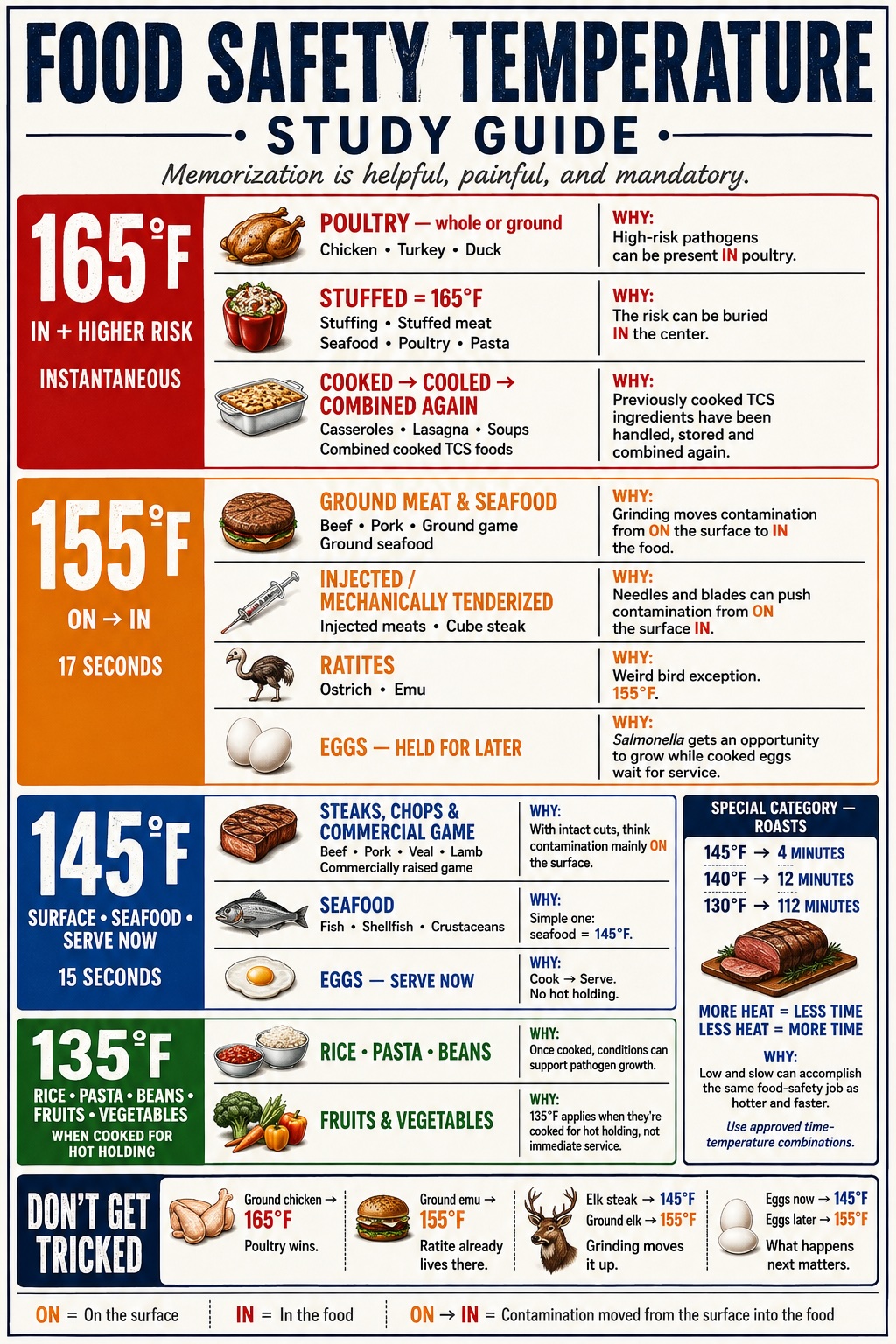
Before we get buried in individual foods, let’s make the problem smaller. For most of what you’re going to see on the certification exam, you’re working with four basic cooking temperatures: 165°F. 155°F. 145°F. 135°F.
That’s the map. The real job is figuring out which foods belong at which temperature and why. Once you understand that, the chart starts looking less like a random collection of numbers. There is one more piece: time. Some foods have to remain at their minimum temperature for a specific number of seconds or minutes. We’ll get there. First, let’s figure out where the foods belong.

Why Foods Land Where They Do
Meat and Poultry: The ON vs. IN Shortcut
Here’s the shortcut for remembering why an intact steak, a hamburger, and a chicken breast don’t all have the same cooking temperature.
Intact beef → ON → 145°F for 15 seconds. With an intact steak or chop, think of the contamination we’re mainly worried about as being ON the outside surface. Cook that surface and you’ve dealt with the primary contamination risk, which is why the center can safely finish at a lower temperature.
Ground beef → ON becomes IN → 155°F for 17 seconds. Put that beef through a grinder and whatever was on the surface can get mixed IN throughout the meat. What used to be an outside problem can now be sitting in the middle of your hamburger, so the required internal cooking temperature goes up.

Another way that ON becomes IN
Injected and mechanically tenderized meat are two specialized meat products (and I know — their names sound complicated, but trust me, you’ve probably eaten both). Here’s the thing: both injected and mechanically tenderized meats have the same problem as ground beef.

Ever had sliced ham? You’ve had injected meat. A liquid solution — usually water, salt, seasonings, or other ingredients — is pumped into the meat through needles. You can often spot it on the package because the label will say something about the product containing added water or a solution. The food-safety problem is pretty easy to see: those needles go from the outside of the meat into the middle, and they can carry surface contamination with them.
Ever had country-fried steak? If the answer is yes, you’ve eaten mechanically tenderized meat. And mechanically tenderized is a fancy way of saying somebody beat the hell out of a tough piece of meat with a machine, blades, needles, or a meat mallet until it got tender. Cube steak is the classic example. The process breaks up the muscle fibers, but blades, needles, or that meat mallet can also push contamination from the surface deeper into the meat.

Different process, same problem: pathogens ON the meat have moved IN the meat. That’s why injected and mechanically tenderized meats join ground meat at 155°F for 17 seconds.

VERY IMPORTANT: Ground chicken does NOT follow this pattern. The reason is simple: the pathogens we’re concerned about with chicken don’t live on the surface — they’re all over the place. Chicken is always cooked to 165°F, regardless of how it gets to the plate: whole, ground, shredded, BBQed, steamed… it doesn’t matter.
Chicken is chicken no matter what. And we cook all poultry to 165°F.
A BRIEF DISCLAIMER: ON vs. IN IS A MEMORY TOOL
A microbiologist would have an absolute field day with this explanation. They would sputter and protest and say, “Chef didn’t get it exactly right!” Okay, nerd. ON versus IN is not a literal scientific rule. But for cooks like us, it’s an accurate (and really handy!) way to remember the food-safety logic behind the numbers.
Stuffed Foods: You Buried the Problem in the Middle
Grinding can move contamination from the outside into the food. Stuffing creates a different version of the same basic problem: you’ve deliberately buried the risk in the part that’s hardest to heat.
Say you stuff a turkey. You’ve taken stuffing and packed it into the middle of a raw bird. Or maybe you’re making a stuffed chicken breast, stuffed pork chop, stuffed fish, or stuffed pasta with a TCS filling.
Now heat has to work its way through layers of food. The stuffing can absorb juices from the raw meat around it, and the middle is exactly where the heat takes the longest to arrive. So ServSafe gives you a simple rule: stuffing made with meat, seafood, or poultry, and foods stuffed with those ingredients, go to 165°F.

Previously Cooked TCS Ingredients: A New Dish Gets a New Cooking Rule
This one catches people because the cook’s argument sounds reasonable: “But the chicken was already cooked.” Sure. Yesterday.
Now you’ve handled it, cooled it, stored it, pulled it back out, combined it with other ingredients, and turned it into something new. Maybe it’s a chicken casserole. Maybe it’s soup. Maybe it’s some glorious use-everything-in-the-walk-in special we’re never going to admit was invented at 4:30.
For certification purposes, a dish combining previously cooked TCS ingredients goes to 165°F. Period. Don’t overthink the microbiology. The useful cook’s rule is: Old cooked TCS food becomes part of a new dish → new dish gets 165°F. “But what about my leftover pizza,” you ask. We’ll get to that at the end.

Eggs: What Happens Next Matters
Eggs introduce another useful idea: sometimes the requirement depends not only on what the food is, but on what you’re going to do with it next. Cook an egg and serve it immediately — fried eggs, scrambled eggs, an omelet going straight to the guest — and you’re looking at 145°F for 15 seconds. Cook eggs that are going to sit in hot holding for service — like a big hotel pan of scrambled eggs on the Holiday Inn Express breakfast buffet — and now they need 155°F for 17 seconds.
The first egg gets cooked and eaten. The second batch gets cooked and then waits. Why the difference? A lower temperature would give the Salmonella associated with shell eggs more opportunity to grow. We don’t want that to happen, so we cook them a little further than required for immediate service.
Here’s a useful exam shortcut:
EGGS SERVED NOW — 145°F / 15 sec
EGGS SERVED LATER — 155°F / 17 sec

Seafood: Keep This One Simple
All whole seafood is cooked to 145°F for 15 seconds — the same minimum temperature and hold time as intact steaks and chops. And just like hamburgers, if you grind your seafood and make a crab cake or salmon patty, you’ve got to raise the temperature and cook it to 155°F for 17 seconds.
For seafood, learn the category: fish, shellfish, and crustaceans — 145°F for 15 seconds. Salmon, shrimp, lobster, mahi, grouper, scallops — all of it. Cut it up, grind it, turn it into a fishy paste and make a shrimp soufflé… 155°F. Verify it with a thermometer.
Rice, Pasta, Beans, Fruits & Vegetables: What Happens Next Matters Here Too
Eggs showed us that what happens after cooking can change the requirement. Rice, pasta, beans, fruits, and vegetables make that distinction even clearer.
Say I want broccoli that’s still bright green and crisp. I’m not necessarily steaming the heck out of it until every piece reaches 135°F. If I’m cooking it and serving it immediately, that’s fine. Broccoli can be eaten raw. It doesn’t suddenly become unsafe because I lightly cooked it.
The rule changes when I cook that broccoli and then plan to hold it hot for service. Maybe it’s going into a steam table, onto a buffet, or into a hotel pan. If that’s the case — I’m not serving it immediately — ServSafe says those fruits and vegetables need to reach 135°F.
Notice those last four words: cooked for hot holding. Don’t turn this into “all vegetables must be cooked to 135°F.” They don’t.
And cooked rice, pasta, and beans give you the other half of the reason this category matters. Remember our stir-fried-rice problem? Dry rice can sit happily on a shelf. Add water and cook it, and now you’ve created a TCS food. If that cooked rice hangs around in the Temperature Danger Zone, bacteria such as Bacillus cereus can take advantage of it. The problem wasn’t that somebody failed to cook the rice correctly. The problem was what happened after the rice was cooked.
So think about what happens next:
Broccoli cooked and served immediately: no 135°F cooking requirement.
Broccoli cooked for hot holding: 135°F.
Rice, pasta, or beans cooked for hot holding: 135°F.
135°F isn’t the “vegetable cooking temperature.” It’s the cooking temperature for rice, pasta, beans, fruits, and vegetables that are being cooked for hot holding.
SERVE NOW — No minimum temperature
COOKED FOR HOT HOLDING — 135°F

Now the Chart Should Look a Lot Less Random
We’ve walked through the major categories. Here’s the same information put back into the form you’re likely to see while studying for the exam:
| Minimum Temperature | Hold Time | Food |
|---|---|---|
| 165°F (74°C) | Instantaneous | Poultry — whole or ground chicken, turkey, duck; stuffing made with meat, fish, or poultry; stuffed meat, seafood, poultry, or pasta; dishes combining previously cooked TCS ingredients |
| 155°F (68°C) | 17 seconds | Ground meat; injected or mechanically tenderized meat; ratites; ground seafood; shell eggs that will be hot-held for later service |
| 145°F (63°C) | 15 seconds | Seafood; pork, beef, veal, and lamb steaks or chops; commercially raised game; shell eggs cooked to order for immediate service |
| 145°F (63°C) | 4 minutes | Roasts — pork, beef, veal, lamb |
| 135°F (57°C) | No minimum hold time | Rice, pasta, beans, fruits, and vegetables that will be hot-held for service |
“But wait!” you say. “If I cook my shrimp to 145, they’ll be tough. If I cook my hamburger to 155, it’ll be dried out and disgusting!”
I get it. These temperatures are significantly higher than some of the temperatures you will learn in culinary school. REMEMBER: the FDA Food Code gives us minimum temperatures to make food safe, not recipes. Food safety and food quality are different things.
A steak may meet its minimum food-safety requirement and be severely overcooked according to the guest who ordered it — especially if they are civilized and ordered it medium-rare. Chicken can be perfectly safe and dry enough to use as a doorstop. Food safety and food quality are related jobs, but they aren’t the same job.
Consumer Warnings and Advisories
Yes, restaurants can serve some animal foods raw or undercooked. That’s why you can order that medium-rare steak, a rare burger, raw oysters, sushi, or eggs with a runny yolk. But if an operation serves raw or undercooked animal food, the customer has to be told what they’re ordering and warned about the risk. ServSafe calls this a consumer advisory, and it has two parts:
Identify which foods are served raw or undercooked, or contain raw or undercooked animal ingredients. You’ve probably seen the little asterisk next to certain menu items. That’s one way to do it.
Warn the customer that consuming raw or undercooked meat, poultry, seafood, shellfish, or eggs can increase the risk of foodborne illness. That’s usually the statement connected to that little asterisk at the bottom of the menu.
For example:
Together, those make the consumer advisory. The point isn’t to make every menu look like it was written by a lawyer. The customer needs to know which food carries the risk and what that risk is before they order it.
And remember what we learned about high-risk populations: a warning on the menu doesn’t magically make an undercooked hamburger safe for everybody. Operations that primarily serve high-risk populations have stricter rules about what they can serve in the first place. The FDA also advises against offering raw or undercooked meat, poultry, seafood, or eggs on a children’s menu.
That matters especially with ground beef. Grinding can take contamination that started ON the surface and move it IN throughout the burger, and young children are more vulnerable to serious illness from Shiga toxin-producing E. coli. A consumer advisory warns customers about risk; it isn’t a permission slip to put an undercooked burger on the kids’ menu.
Temperature and Time Work Together
There’s one last thing we need to cover, an odd little quirk of food safety that has to do with cooking big chunks of meat. Look back at the chart and you’ll see it: 15 seconds, 17 seconds, 4 minutes, and instantaneous. Those aren’t fine-print details somebody threw in to make the chart harder to memorize. Temperature and time work together.
Heat destroys pathogens, but it doesn’t happen like flipping a light switch. The hotter the food gets, the less time it generally needs at that temperature to do the job. At lower temperatures, it takes longer. That’s why a steak isn’t just 145°F. It’s 145°F for 15 seconds. Ground beef isn’t just 155°F. It’s 155°F for 17 seconds. Poultry gets 165°F instantaneous — once it reaches that higher temperature, there’s no additional hold time required. Roasts are where this relationship becomes impossible to ignore.
Roasts Make the Relationship Obvious
An intact steak and a beef roast can both have 145°F in their cooking requirements, but the roast needs to stay there for 4 minutes instead of 15 seconds. Here’s the thing: cooking a roast to 145°F and holding it there for 4 minutes isn’t the only safe way to cook it. There is a whole TABLE of approved roast temperature/time combinations. It can get confusing, so I want you to understand the pattern before you look at all the numbers: More heat buys you less time. Less heat costs you more time.
| Roast temperature | Hold time |
|---|---|
| 130°F | 112 minutes |
| 135°F | 36 minutes |
| 140°F | 12 minutes |
| 145°F | 4 minutes |
| 151°F | 54 seconds |
| 158°F | instantaneous |
Look at the table and the pattern becomes obvious. At 145°F, a roast needs 4 minutes. Drop just five degrees to 140°F, and now you’re at 12 minutes. Drop to 135°F, and you’re at 36 minutes. Go all the way down to 130°F, and you’re looking at 112 minutes. That’s not a nice, even trade. As the temperature gets lower, the required time starts climbing fast.
That’s the part I want you to remember for the exam. If a certification question gives you several possible ways to cook a beef roast and you don’t remember the exact table, use the pattern. A lower cooking temperature should come with a substantially longer time. If an answer drops the temperature way down but barely increases the time, be suspicious. If the temperature goes up, you should expect the required time to come down. It won’t guarantee the answer when you don’t know the approved combination, but it gives you something far better than randomly picking a number. That’s the logic behind low-and-slow cooking: you’re letting time do some of the work that higher heat would otherwise do.

Getting a Reading You Can Trust
Now we know what temperature, why that temperature, and how long.
None of it does you any good if you stick the thermometer in the wrong place.
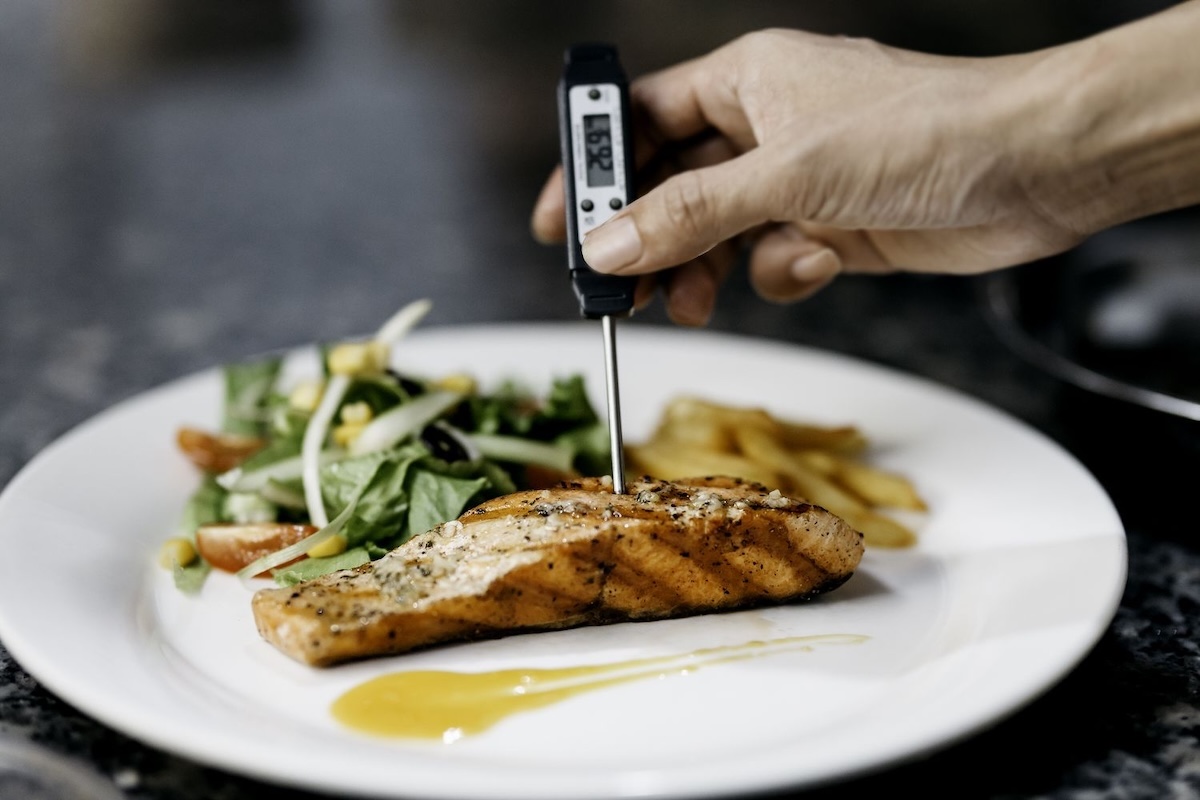
Check the food with a calibrated thermometer in its thickest part — the area that’s usually going to heat the slowest and finish last. Take at least two readings in different locations. You’re looking for the coldest part, not hunting around until you find a number you like.
And yes, an experienced cook can learn an incredible amount from touch, appearance, timing, smell, sound, and repetition. That’s part of learning the craft. But when we’re making a food-safety decision, we verify with the thermometer. If you need a refresher on calibration, probe placement, or taking a good reading, go back to Temperature Measurement & Calibration.
And Then There Are the Weird Ones
By now, you have a pretty useful system for sorting cooking temperatures. Naturally, there are a couple of foods that refuse to cooperate.
Ratites are large flightless birds such as ostrich and emu. They may be birds, but as far as food-safety rules go, they’re their own special unicorn. If you’re cooking emu or ostrich, cook them to 155°F for 17 seconds. What if you grind the meat and make an emu burger? No change. Ratites are ALWAYS cooked to 155°F for 17 seconds — unless you stuff them with something else. But then they’ve become a stuffed food, and you already know that means we’re getting them up to 165°F.
Commercially raised game? That’s something different altogether. An intact cut — think an elk steak — needs to reach 145°F for 15 seconds, just like a regular steak. Grind that elk steak and make yourself an elk burger, and the requirement changes to 155°F for 17 seconds, just like a regular burger.
MEMORIZE THIS
ALL poultry must be cooked to 165°F. ALL ratites must be cooked to 155°F for 17 seconds. Treat commercially raised game like you would regular meat: WHOLE is cooked to 145°F for 15 seconds; GROUND is cooked to 155°F for 17 seconds.

Closing Side Work

What Do You Do?
Put the lasagna back in the oven. Obviously.
The 185°F reading at the edge doesn’t save the 155°F center. Meat lasagna falls into the 165°F stuffed-pasta category, so it needs to reach 165°F regardless of how many people are waiting or what the server thinks of you. When different parts of a food give you different readings, the coldest part is the one that matters. And for food safety, in this scenario, temperature is all that matters.
And don’t hand it to the server thinking the steam table can finish the job. Hot-holding equipment is designed to hold hot food, not finish cooking food that hasn’t reached its required minimum temperature. The guests at the buffet are just going to have to wait a few minutes if they want lasagna.
Sure, it’s inconvenient. Sure, there may be some blowback. A guest may write an angry letter. A FOH manager may come into the kitchen and give you grief. But serving food that hasn’t reached its required cooking temperature isn’t the fix. Pretty much ever.
Three Last Tidbits Before You Go (They Matter, So Read On)
1. Cold Pizza Is Legal
Earlier I told you that a dish combining previously cooked TCS ingredients needs to reach 165°F. Don’t turn that into “anything that has ever been cooked has to go back to 165°F before I can eat it.”
Say you properly cooked a pizza last night, cooled it correctly, and put it in the cooler. This morning, you pull out a slice and eat it cold. Fine. Want to warm it up and eat it right away? Also fine. Heat it to whatever temperature makes you happy. But put that same leftover pizza on a hot buffet line, and the rules change. Now you’re reheating previously cooked TCS food for hot holding, and it needs to reach 165°F for 15 seconds within 2 hours. Same pizza. Three different situations: eat it cold → fine; reheat it and eat it right away → whatever temperature you want; reheat it for hot holding → 165°F for 15 seconds within 2 hours. Why? Because the food didn’t change. What you’re doing with it next did.

We’ll deal with reheating in more detail later. For now, remember the leftover-pizza rule. It’ll save you from getting suckered by an exam question that makes it sound like every previously cooked food has to go back to 165°F before anybody can eat it. Fried chicken is great cold. So are pancakes. And Chinese orange chicken. You know… the kind that come in the little white box?
Pizza, chicken, pancakes… all those foods are fine cold if they were cooked and cooled safely. And if you’re reheating a portion to serve immediately, you can warm it to whatever temperature you want. But if you’re reheating previously cooked and cooled TCS food for hot holding, then you better get it to 165°F for 15 seconds within 2 hours. We’ll talk about hot holding later on in the course. For right now, bank the idea and hold onto it for when we come back.
2. New Bug: Campylobacter
While we’re talking about why poultry gets special treatment, add another bacterium to your roster of dangerous little buggies: Campylobacter. It is strongly associated with raw and undercooked poultry, especially chicken. People can also pick it up from unpasteurized milk, contaminated water, and contact with infected animals.
If it makes somebody sick, the usual result is a pretty miserable intestinal illness: diarrhea, stomach cramps, fever, nausea, and sometimes vomiting. Some infections become more serious, but that’s more detail than we need here.
In the kitchen, prevention should already sound familiar: cook poultry correctly, prevent raw poultry and its juices from cross-contaminating other food and surfaces, wash your hands after handling it, and don’t serve unpasteurized milk. For now, hold on to this shorthand: Raw poultry → Salmonella and Campylobacter → think 165°F.

3. Partially Cooking Food
Sometimes a kitchen will partially cook food now and finish cooking it later. We usually call that parcooking.
You can do it, but you can’t just cook something halfway, throw it in the walk-in, and hope everybody remembers what the hell is going on tomorrow. ServSafe puts some very specific controls around the process:
- The initial cooking step cannot last longer than 60 minutes.
- Cool the food immediately after that first cooking step.
- Refrigerate or freeze it after cooling.
- Keep it separate from ready-to-eat food.
- Before serving or selling it, finish cooking it to the minimum internal temperature required for that food.
- The operation needs written procedures explaining how the food will be monitored, how it will be marked so employees know it still needs cooking, how it will be kept separate from ready-to-eat food, and what corrective action will be taken if something goes wrong.
The big idea is simple: parcooked does not mean cooked. Until that second cooking step is finished, treat that food like something that still needs to be cooked for safety.

TL;DR — The Least You Need to Know
MEMORIZE
Use the temperature map: 165°F / 155°F / 145°F / 135°F, with the correct hold time and food category.
Previously cooked TCS food being reheated for hot holding must reach 165°F within 2 hours and be held there for 15 seconds.
DISTINGUISH
- Poultry vs. ratites: Chicken, turkey, and duck are poultry. Ostrich and emu are ratites. They do not share the same cooking requirement.
- Intact vs. ground / injected / mechanically tenderized meat: Processing changes the category.
- Immediate service vs. hot holding: Eggs, rice, pasta, beans, fruits, and vegetables have different requirements depending on whether they’re served immediately or cooked for hot holding.
- Steaks and chops vs. roasts: Both are intact cuts; roasts have their own time-and-temperature requirements.
- Stuffed foods vs. individual ingredients: Once meat, seafood, poultry, or pasta is stuffed, the stuffed-food requirement controls the final cooking temperature.
- Cooking vs. reheating for hot holding: Reheating for hot holding is a new safety step; previously cooked TCS food meets the reheating rule, not its old cooking rule.
APPLY
Identify the food and process first: strip steak or ground burger? roast or injected ham? immediate or later? stuffed or reheated? The food and process determine the cooking requirement.
The FDA Food Code pairs time and internal temperature together. You can get a question wrong by picking the right temperature with the wrong time.
Verify correctly: use a calibrated thermometer, take readings in at least two locations, and let the coldest reading control the decision.
Terms from This Chapter
Minimum internal cooking temperature
The minimum temperature food must reach, along with any required hold time, to be safely cooked.
Hold time
How long food must remain at or above its required minimum internal cooking temperature.
Instantaneous
Reaching the required temperature is enough; no additional hold time is required.
Mechanically tenderized meat
Meat pierced, pounded, or otherwise worked in a way that can move surface contamination deeper into the meat.
Injected meat
Meat injected with a solution; injection needles can carry surface contamination into the interior.
Ratite
A large flightless bird such as ostrich or emu.
Commercially raised game
Game animals raised commercially for food rather than harvested from the wild.
Time/temperature equivalency
The principle that lower approved cooking temperatures require longer approved cooking times.
Consumer advisory
Required information provided when certain raw or undercooked animal foods are served.
Disclosure
The part of a consumer advisory that identifies which food is raw or undercooked.
Reminder
The part of a consumer advisory that warns about increased foodborne-illness risk.
Campylobacter
A bacterium strongly associated with raw and undercooked poultry.
Hack the Exam
Don’t memorize the question. Learn the move.
QUESTION 1 A restaurant receives pork loins labeled “contains up to 5% added solution of water and salt.” What minimum internal cooking requirement applies? A. 145°F for 15 seconds B. 145°F for 4 minutes C. 155°F for 17 seconds D. 165°F instantaneous Flip for answer
Correct answer: C — 155°F for 17 seconds
The label is the clue. Added solution tells you this is injected meat, so it does not use the intact pork-loin rule.
Exam move
When the obvious food name points one direction, look for a processing clue that changes the category.
QUESTION 2 A catering crew finishes several hotel pans of scrambled eggs at 6:30 a.m. The ballroom buffet opens at 7:00 and service will continue until 9:00. The eggs will be transferred to chafing dishes as they are finished. What minimum internal cooking requirement applies? A. 135°F B. 145°F for 15 seconds C. 155°F for 17 seconds D. 165°F instantaneous Flip for answer
Correct answer: C — 155°F for 17 seconds
The eggs are not being cooked and served immediately. They are being cooked for hot holding. How they are going to be served changes how they must be cooked.
Exam move
Don’t stop at “eggs.” Find out what happens to them after cooking.
QUESTION 3 Yesterday afternoon, a prep cook made 20 pounds of ground beef meatballs, smothered them in tomato sauce, and cooked them for dinner. The remaining meatballs were cooled and refrigerated correctly. Today they will be reheated for the lunch steam table. What requirement must they meet before hot holding? A. 135°F B. 145°F for 15 seconds C. 155°F for 17 seconds D. 165°F for 15 seconds within 2 hours Flip for answer
Correct answer: D — 165°F for 15 seconds within 2 hours
Ground beef points toward 155°F for 17 seconds. The steam table points toward 135°F. Both are real rules — and both are the wrong rule for the process happening now. These meatballs were cooked, cooled, and are now being reheated for hot holding.
Exam move
When several real rules appear in the same question, identify the food’s current process before choosing a number.
QUESTION 4 A cook removes a beef roast after its coldest point reaches 149°F and remains there for 85 seconds. Another cook says it must go back into the oven because a roast has to be held at 145°F for 4 minutes. What should the manager do? A. Return it to the oven until it reaches 145°F for 4 minutes B. Continue cooking to 155°F for 17 seconds C. Continue cooking to 165°F instantaneous D. Nothing; the cook used an approved roast time-temperature combination Flip for answer
Correct answer: D — Nothing; the cook used an approved roast time-temperature combination
145°F for 4 minutes is one approved combination, not the only one. Roasts can be cooked safely using other approved temperature-and-time pairs. The unfamiliar number is there to see whether you understand the relationship instead of treating one memorized pair as the only possible answer.
Exam move
With roasts, temperature and time travel together. Don’t reject a valid pair just because it is not the one you memorized first.
QUESTION 5 A cook pulls a slice of lasagna from the cooler for a guest order. It gets 45 seconds in the microwave to heat the center and then 4 minutes under the broiler to melt and brown the cheese. What minimum internal temperature must the lasagna reach for food safety? A. 135°F B. 145°F for 15 seconds C. 165°F for 15 seconds within 2 hours D. No specific minimum internal temperature Flip for answer
Correct answer: D — No specific minimum internal temperature
The controlling clue is for a guest order. This food is being reheated for immediate service, not reheated for hot holding. The microwave, the broiler, the four minutes, and the fact that it is lasagna are all trying to pull your attention toward other real rules.
Exam move
Don’t answer the loudest clue. Figure out where the food is going next.