
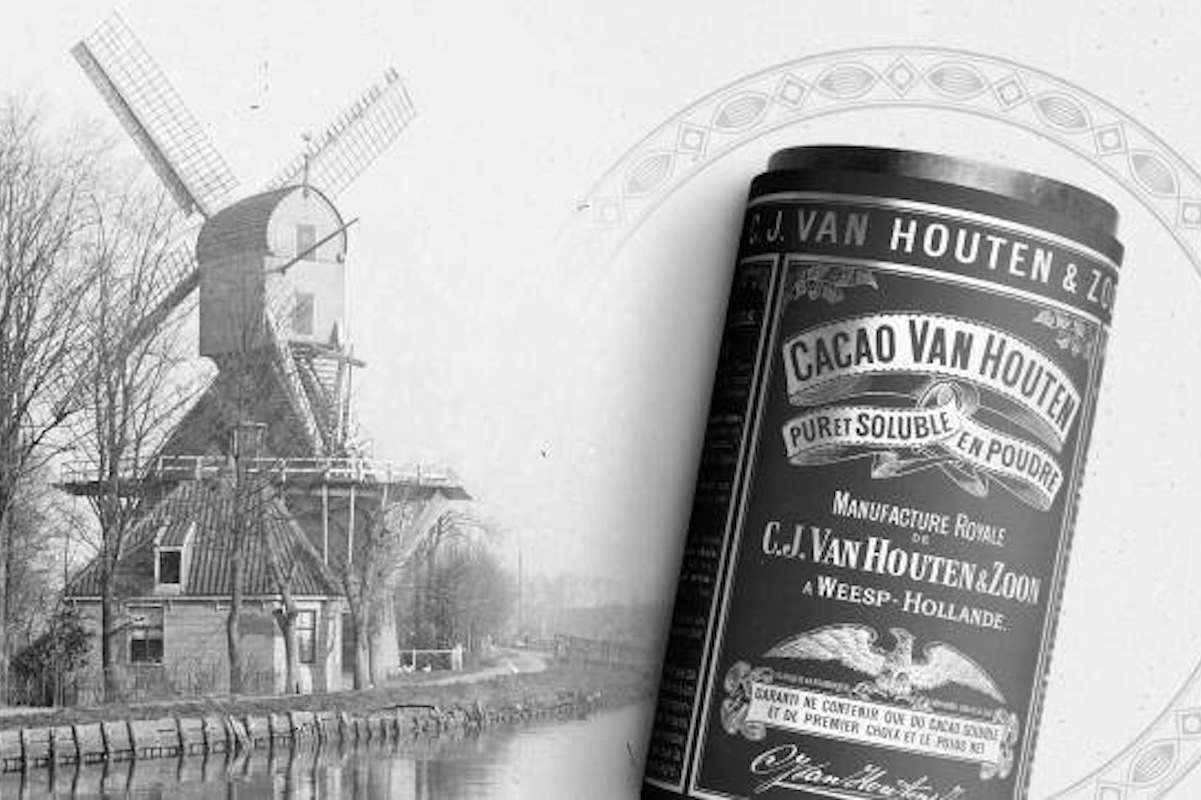
THE FATHER, THE SON, AND THE CHOCOLATE REVOLUTION
Casparus van Houten, the son of a man who carried barrels of beer for a living, opened a little shop in Amsterdam in 1806. He sold coffee, tea, and groceries and was doing fairly well. His wife, Arnoldina, was a bit more ambitious and talked Casparus into selling chocolate. He did some research, made preparations, and bought the equipment he needed—a mill with two pairs of grinding stones, powered not by steam, but by muscle. In 1815, he opened a chocolate shop on Amsterdam’s Leliegracht canal.
What came out of those stones wasn’t the chocolate we’re accustomed to eating. Or drinking. It was a thick paste made from ground cacao, which Van Houten would mix with sugar and spices, allow to harden, and eventually turn into a drink.
Like everyone else’s chocolate at the time, Van Houten’s had a problem. It was delicious, sure, but it was also gritty, bitter, and greasy, with cocoa butter floating on the surface. Casparus started looking for a way to squeeze the fat out.
SQUEEZING THE FAT OUT OF CHOCOLATE
It took Casparus more than a decade to find his answer. In 1828, he patented a machine that could squeeze much of the cocoa butter out of ground cacao. It was a hydraulic press, and it changed chocolate making forever.
The clever part was that he wasn’t trying to squeeze oil out of whole cacao beans. He was working with cocoa liquor, the thick, flowing paste produced by grinding roasted cacao nibs. More than half of a typical nib is fat, and when the nibs are ground, that cocoa butter becomes part of the flowing mixture.
Casparus needed to separate the liquid fat from the solid cocoa particles. And he needed considerably more force than a person could produce by squeezing something between two boards.
He settled on a hydraulic press, a machine that would compress warm cocoa liquor inside a heavy metal chamber. The cocoa liquor was kept warm enough for the cocoa butter to remain liquid, and filters provided a place for the oil to escape while the solid cocoa particles stayed behind.
Casparus’s machine gave him two very different products: liquid cocoa butter that could be collected and saved, and a hard, dense mass of compressed cocoa solids. The hard, hockey-puck-looking thing that came out wasn’t powder. Not yet, anyway. Workers had to break it apart and grind it into fine cocoa powder.
What’s more, the press didn’t remove every last bit of cocoa butter, and it wasn’t supposed to. Cocoa powder still contains some fat. But removing a substantial portion made it possible to produce a lighter drinking chocolate without so much of the grease that had been giving him trouble.
The basic idea worked so well that we’re still using it almost two centuries later. Modern cocoa presses are enormous steel machines, often with several chambers operating together. Some develop pressures exceeding 12,000 pounds per square inch. They squeeze out cocoa butter, release the compressed cakes, and send those cakes off to be crushed and milled. The machinery is faster, stronger, and much more precisely controlled, but Casparus would recognize what it was doing.
COENRAAD MAKES THE POWDER BETTER
Casparus had figured out how to squeeze the fat out of chocolate, and he and his family were doing pretty well off the proceeds of his invention. But that’s not CLOSE to the end of the story. His son, Coenraad, enters the scene, and interestingly, he’s the name that’s much more famous. In fact, Coenraad often gets credit for the hydraulic press his father invented.
Here’s the thing: Dad had figured out how to make drinking chocolate less greasy, but it was still pretty acidic, bitter, and astringent. Astringency is that dry, puckering sensation you get from strong black tea or an underripe persimmon. It isn’t quite the same as bitterness, and cocoa can have plenty of both.
Coenraad began experimenting with treating cocoa powder with different alkaline substances. An alkali is the opposite of an acid. Treat cocoa with something like potassium carbonate, and its pH rises, reducing some of its acidity. The flavor becomes smoother and mellower, and the color can change dramatically. Eventually, the son developed a process that worked. It became known as Dutch-processed cocoa, and that same process is still used today.
The treatment also helped cocoa disperse more easily in liquid, making it more convenient for preparing drinking chocolate. Depending on how much alkaline treatment the cocoa receives, the powder might turn reddish brown, dark chocolate brown, or almost black.
But darker doesn’t automatically mean better. Natural cocoa can have bright, fruity flavors that a pastry chef might want to preserve. Heavy Dutch processing can soften or even eliminate some of those characteristics. Coenraad’s innovation gave chocolate makers exactly what they wanted: more control over flavor and color.
THE GRANDSON WHO SOLD CHOCOLATE TO THE WORLD
By the time the third generation of Van Houtens entered the business, the family had come a long way from Casparus’s little Amsterdam shop. They had factories, a successful product, and a name that was becoming familiar well beyond the Netherlands.
But making good cocoa powder and convincing the rest of the world to buy it were two different things.
Enter Casparus Johannes van Houten, Coenraad’s son and the original Casparus’s grandson.
His grandfather had invented a better way to make cocoa powder. His dad made it taste better. He had a new mission: make sure everyone in the world KNEW it.
He understood something modern advertising agencies charge enormous amounts of money to explain: people don’t buy the best product. They buy the product they’ve heard of.
Under the grandson’s guidance, Van Houten became an international brand. The company’s name appeared on colorful posters, decorative tins, and advertisements designed to make cocoa seem fashionable, sophisticated, and worth paying for. Chocolate was no longer simply something a neighborhood shopkeeper made and sold. It was a product that could travel around the world with the family name printed on the package.
And Casparus Johannes? He liked being rich.
In 1899, he spent four months traveling through Europe with the Dutch painter Simon Maris. They visited France, Italy, and Switzerland, spending time in restaurants, opera houses, and museums. It seems the grandson had developed tastes considerably more expensive than those of his beer-carrying grandfather.
And then there was the famous house. Casparus Johannes commissioned an enormous mansion in Weesp, the Dutch town where the family had established its factory. It was an extraordinary residence, with approximately 99 rooms. Ninety-nine.
For a man whose grandfather had started with a little shop selling coffee, tea, and groceries, that’s quite an upgrade. Unfortunately, Casparus Johannes died in 1901, before he ever got to move into his enormous new home. He had spent a fortune building a house with nearly a hundred rooms. And never got to sleep in a single one.
There’s a lesson there.
THE CHOCOLATE BAR: PUTTING THE FAT BACK
While three generations of Van Houtens were building their chocolate empire, other chocolate makers had noticed something interesting about Casparus’s invention.
His press didn’t just produce cocoa powder. It also produced cocoa butter, and that pale yellow fat turned out to be extraordinarily useful.
In 1847, less than twenty years after Casparus patented his press, the English chocolate company J. S. Fry & Sons developed an eating chocolate by combining cocoa ingredients with sugar and additional cocoa butter. The extra fat helped create a mixture that could be shaped into a solid bar, rather than prepared as a drink.
Think about that for a moment. Casparus had spent years figuring out how to remove cocoa butter because it made drinking chocolate difficult to prepare. Now another chocolate maker was putting that same fat back in to create something entirely different. The chocolate bar. And this wasn’t the last time cocoa butter would change the chocolate business.
THE FAT THAT MAKES CHOCOLATE POSSIBLE
Cocoa butter is the natural fat found inside cacao beans. Despite the name, it contains no dairy butter. It’s a pale yellow vegetable fat with a mild chocolate aroma, and its melting behavior makes it particularly useful to chocolate makers.
Olive oil is liquid at room temperature. Dairy butter softens gradually as it warms. Cocoa butter is relatively hard and brittle at ordinary room temperatures, but melts rapidly in the low-to-mid 90s°F, just below body temperature. That’s part of the reason a properly made chocolate bar can snap when you break it, then melt smoothly on your tongue. Cocoa butter also helps chocolate contract as it cools in a mold, develop an attractive shine, and hold its shape at room temperature.
It accomplishes these things because cocoa butter can form different kinds of fat crystals as it cools. Some arrangements produce chocolate that’s soft, dull, or unstable. Others produce the firm texture and glossy surface we want. We’ll investigate those crystals when we learn to temper chocolate.
Cocoa butter also gives chocolatiers control over how their chocolate flows. A little additional cocoa butter can make a thick chocolate mixture more fluid, which is useful when coating candies, filling molds, or making thin chocolate shells. There’s a limit to how much you can add before changing the finished chocolate, but the principle is simple: the amount of fat matters. And cocoa butter has another unusual advantage. It contains none of the dark cocoa solids responsible for chocolate’s brown color and much of its roasted flavor.
CHOCOLATE WITHOUT THE CHOCOLATE
Now consider what happens when chocolate makers keep the cocoa butter but leave out the brown cocoa solids. Combine that fat with sugar and milk ingredients, and the result is white chocolate. It lacks the roasted cocoa flavor of dark chocolate, but the cocoa butter still gives it chocolate’s characteristic melting behavior. Milk fat changes that behavior, too, which is one reason white chocolate is softer and requires different tempering temperatures.
The ingredient Casparus van Houten worked so hard to remove from a chocolate drink is about to become the foundation of a different kind of chocolate.
WHITE CHOCOLATE
THE CANDY BAR THAT STARTED AS MEDICINE
White chocolate’s origin story sounds like a trick question: what do you get when you try to make vitamins for sick kids?
In 1936, the Swiss company Nestlé was making Nestrovit, a vitamin-enriched milk preparation intended to improve nutrition for sick children. Anyone who has tried to get a sick kid to take something that’s “good for you” already understands the challenge. According to Nestlé’s own account, workers discovered that adding cocoa butter turned the milky mixture into a solid tablet. Suddenly, they had a vitamin they could hand to a child, who might actually be happy to eat it.
Someone eventually noticed that if you left out the vitamins, you had something worth selling in the candy aisle. Nestlé marketed its white chocolate as Galak in continental Europe and Milkybar in Britain, offering customers something pale, sweet, and creamy, without the brown color or roasted bitterness they associated with chocolate.
White chocolate didn’t appear out of nowhere, of course. Recipes and references to similar pale confections existed decades earlier. Nestlé wasn’t the first to think of combining cocoa butter, milk, and sugar, but it helped turn the idea into a commercially successful product.
IS WHITE CHOCOLATE REALLY CHOCOLATE?
For decades, the United States government had an answer to that question, and the answer was no. Federal standards defined chocolate around chocolate liquor, the ground cacao material that contains both cocoa butter and the brown cacao solids. White chocolate had the cocoa butter but none of the brown stuff, so despite coming from the same bean and melting like chocolate, it didn’t qualify.
That left white chocolate in a peculiar position. It contained one of the most valuable parts of the cacao bean, yet legally it belonged with confectionery coatings rather than chocolate. The distinction might sound ridiculous, but food standards determine what manufacturers can put on their labels, and those labels matter when you’re buying ingredients.
In 2002, following petitions from Hershey and the Chocolate Manufacturers Association, the Food and Drug Administration established a standard of identity for white chocolate. The rule took effect in 2004, finally giving white chocolate legal recognition in the United States. The government didn’t simply declare that anything pale and sweet could join the chocolate family, though. Manufacturers had to meet specific requirements:
- At least 20% cocoa butter
- At least 14% total milk solids
- At least 3.5% milk fat
- No more than 55% nutritive carbohydrate sweeteners
Those numbers become useful the moment you go shopping. Browse the baking aisle or a restaurant supply catalog and you’ll find white candy coating, compound coating, and melting wafers that look almost identical to white chocolate. Many replace some or all of the cocoa butter with other vegetable fats, such as palm kernel oil. They’re generally cheaper, and some are easier to work with because they don’t require tempering, but they’re different products. Their flavor, melting behavior, and finished texture aren’t the same, and they shouldn’t be treated as interchangeable with genuine white chocolate.
THREE INGREDIENTS AND A LOT OF SCIENCE
Making white chocolate sounds simple enough. Take cocoa butter, sugar, and milk powder, combine them, and you’ve got chocolate. Unfortunately, putting three ingredients in the same bowl doesn’t mean they’ll behave the way you want them to.
The problem starts with sugar. Stir a spoonful into a glass of warm water and it dissolves, its molecules spreading throughout the liquid until the crystals disappear. Now try the same thing with melted cocoa butter. You can stir all afternoon, but the sugar won’t dissolve because sugar doesn’t dissolve in fat. Neither do the solid particles in milk powder.
Instead, chocolate makers have to grind those ingredients into particles so small that our tongues can no longer distinguish them individually. The cocoa butter surrounds and carries the particles, allowing the finished chocolate to feel smooth even though the sugar and milk solids are still there.
Food scientists call this a fat-continuous suspension. That’s a fancy way of saying the cocoa butter forms the liquid surrounding millions of tiny solid particles. The chocolate isn’t a solution like sugar dissolved in water; it’s a suspension of solids in fat.
Remember what happened when we refined cacao too far? White chocolate faces the same problem: finer particles can feel smoother while making the mixture thicker. The formula still needs enough cocoa butter to keep those particles moving.
WHY WE USE MILK POWDER
Fresh milk seems like an obvious ingredient for milk or white chocolate, but it introduces something chocolatiers work hard to control: water. Milk contains a great deal of it, and even a small, accidental addition of water can cause trouble when it enters melted chocolate.
Chocolate contains countless tiny sugar particles suspended in fat. When a little water gets into that mixture, it can wet the surfaces of the sugar particles and cause them to stick together. Chocolate that was flowing smoothly can suddenly become thick, pasty, and difficult to work with. Chocolatiers call this seizing, and it’s one of the reasons moisture control matters so much.
That doesn’t mean chocolate can never be combined with milk or water. We deliberately add liquids when making ganache, creating a different kind of mixture. But a splash of water in chocolate we’re trying to refine is another matter entirely.
Milk powder provides the milk ingredients without bringing along all the water found in fresh milk. It also allows chocolatiers to control the formula more precisely, although there’s an important distinction between the different kinds of milk powder.
Whole milk powder contains milk fat, milk proteins, lactose (milk sugar), and minerals. Nonfat dry milk supplies many of those same milk solids but very little milk fat. Both have their uses, but they aren’t interchangeable because milk fat changes the flavor, texture, and melting behavior of chocolate. It also matters when calculating whether a formula meets the requirement of at least 3.5% milk fat.
That’s why milk powder isn’t a complete ingredient specification for a professional chocolatier. The type matters, the quantity matters, and the milk fat content matters. Getting those details right is part of making actual white chocolate rather than something that merely looks like it.
HOW WHITE CHOCOLATE COMES TOGETHER
Making white chocolate in a stone melanger is a little like watching a machine turn sand into silk. At the beginning, we have melted fat and gritty powders. By the end, if everything goes well, we have something smooth enough to melt across the tongue without leaving a trace of graininess.
The process begins by melting the cocoa butter. At room temperature, it’s hard and brittle, but gentle heat turns it into a clear, pale yellow liquid. Once it’s melted, the cocoa butter goes into the melanger, where the rotating bowl and granite rollers begin moving it through the machine.
Before adding the sugar, there’s a useful trick. Grinding granulated sugar briefly in a food processor or blender reduces the size of the crystals and gives the rollers a head start. Ordinary store-bought powdered sugar isn’t necessarily a good substitute because it usually contains cornstarch to prevent clumping, and that starch isn’t something we want in our chocolate.
The sugar and milk powder are added gradually while the machine runs. As the dry ingredients enter the cocoa butter, the mixture thickens and may develop the consistency of heavy peanut butter. That’s normal at this stage, provided the material continues moving beneath the rollers. Adding everything at once can overwhelm a small machine, as we discovered when we overloaded our Premier melanger with cacao nibs and sugar during our Mexican hot chocolate experiment.
The most important thing to watch is whether the chocolate keeps circulating. The rollers must pull the mixture underneath them, crush the particles against the stone, and release the material back into the rotating bowl. The same chocolate passes beneath those rollers thousands of times, gradually becoming finer.
If a thick mass simply rides around the bowl, or material accumulates along the sides without returning beneath the rollers, the motor may still be running while very little useful refining takes place. A chocolatier may need to slow the addition of ingredients, scrape material back into circulation, or adjust the roller pressure. Forcing the rollers down against a mixture that’s already struggling to move can make matters worse.
As the particles become finer, the chocolate gradually loses its gritty texture, although it may not become thinner. Smooth and fluid aren’t the same thing. Additional cocoa butter can help a chocolate that’s smooth but too thick, while commercial formulas sometimes use a small amount of lecithin to improve flow without adding as much extra fat.
Temperature matters, too. Cocoa butter needs to remain liquid during refining, but excessive heat can change the flavor of the milk ingredients. Professional chocolate makers manage temperature alongside particle size and viscosity, often working with relatively gentle heat to preserve the clean, milky flavor of white chocolate. Around 100–110°F is a useful target for our discussion, although the appropriate operating conditions depend on the equipment and formulation.
Our Premier melanger doesn’t have a thermostat. Friction between the granite rollers and the chocolate generates heat, and the machine may run considerably warmer during extended refining. We can measure that temperature and understand what it means, but we can’t simply dial in a setting and expect the machine to maintain it. That distinction matters: knowing the ideal conditions and understanding the limitations of a particular machine are both part of learning to make chocolate.
The continuous movement also exposes the mixture to air, allowing some unwanted aromas to escape as the flavor develops. This contributes to the limited conching action of a stone melanger, although it isn’t the same as using an industrial conche designed to control mixing, aeration, and temperature.
Refining may take many hours, perhaps overnight or longer, depending on the batch size, formula, equipment, and desired texture. The clock can tell us how long the machine has been running, but it can’t tell us whether the chocolate is ready. We need to evaluate how it feels on the tongue, how it flows, and how its flavor has changed. A batch can be smooth but stubbornly thick, or fluid enough to pour while still feeling unpleasantly gritty.
What we’re trying to produce is white chocolate that has the fine texture, balanced sweetness, creamy milk flavor, and melting quality that make it worth producing from scratch. Getting there means understanding what the machine is doing to the ingredients, not simply waiting for a particular number of hours to pass.
THE PASTRY CHEF WHO FORGOT HIS CHOCOLATE
Imagine you’re a highly respected French pastry chef working for one of the world’s great chocolate companies. You’ve traveled all the way to Japan to demonstrate your expertise, a crowd has gathered to watch you work, and somewhere along the way, you forget your chocolate on the stove. That’s essentially what happened to Frédéric Bau of Valrhona, the famous French chocolate manufacturer. During a demonstration in Japan, he left a batch of white chocolate warming in a bain-marie, a container heated gently over hot water, then got distracted and forgot about it.
If you’ve ever burned something in a kitchen, you know the routine: you survey the damage, hope nobody noticed, and decide whether anything can be saved. But when Bau finally came back to his chocolate, it wasn’t ruined. It wasn’t even white anymore. The ivory color had turned golden, and the sweet, milky aroma had become something closer to toasted shortbread, caramel, and cooked milk. Instead of throwing it out, he tasted it, and he liked what he’d made.
What happened in that bowl is chemistry you’ve already met. White chocolate contains milk powder, and milk powder provides two ingredients the Maillard reaction needs: lactose, the natural sugar in milk, and milk proteins, which supply amino acids. When those sugars and amino acids react during heating, they create new flavor compounds and brown pigments. It’s the same family of reactions we’ve encountered when roasting cacao beans, browning bread, or cooking other foods until they develop a rich, toasted flavor.
Despite all the talk of caramel, Bau’s chocolate didn’t need to reach the temperatures associated with true caramelization. A bain-marie provides gentler heat, but it can hold food warm for a long time. Maillard reactions generally happen faster at higher temperatures, yet they can also develop slowly under milder conditions. Bau didn’t cook his chocolate hot. He cooked it long.
That’s particularly interesting when we think about refining white chocolate. A stone melanger generates frictional heat while it works, and chocolate can spend many hours moving beneath its rollers. Measuring the temperature tells us how much heat the mixture is experiencing, while changes in aroma, color, and flavor can reveal what that heat is doing to the ingredients. The same milk components that give white chocolate its creamy flavor can also develop toasted notes under prolonged heating, whether those changes are desirable or not.
Of course, accidentally producing something delicious is quite different from manufacturing it consistently. Valrhona spent approximately eight years developing Bau’s discovery into a commercial product, eventually introducing Dulcey in 2012. Its golden color and flavors of caramelized milk, toasted biscuits, and shortbread made it distinctive enough to earn the name blond chocolate, adding another flavor and color to the chocolatier’s collection.
After all that effort, there’s one final joke. Despite the golden color, distinctive flavor, and fancy new name, French law never recognized blond chocolate as its own separate category. Bau had managed to cook his way into an entirely new product, but legally, it was still white chocolate.