
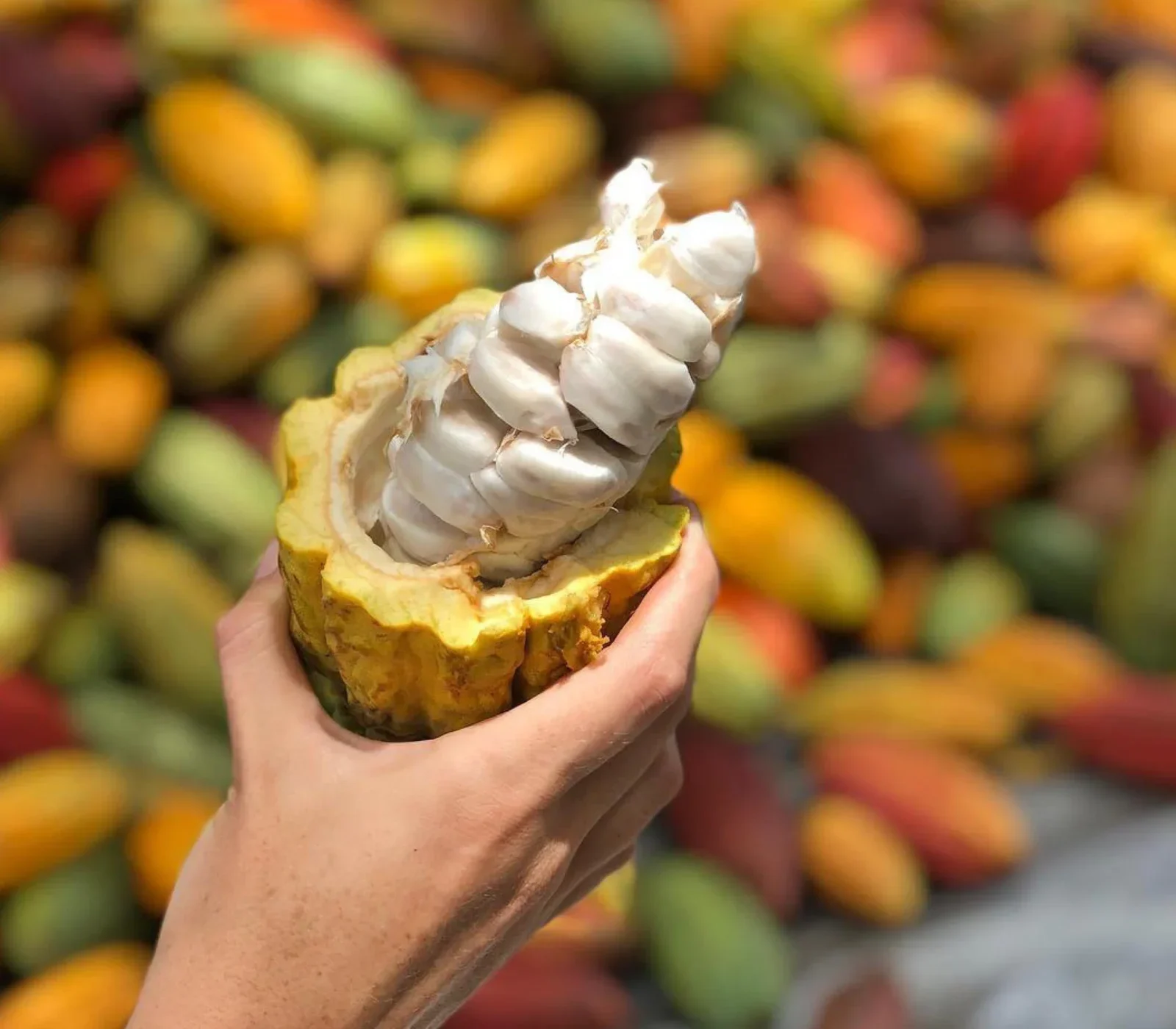
You’re pushing your way through a humid tropical forest. You might be in southern Mexico, Ecuador, Ghana, Indonesia, Papua New Guinea, or one of many other countries along the equator. The scene before you is the same: bizarre trees, their trunks sprouting enormous, lumpy cantaloupe-looking fruit, more football shaped than round. The colors range from bright yellow to olive green to reddish-brown. And the fruit isn’t dangling from branches like apples or oranges. It’s growing straight out of the trunks, clinging to the bark like giant, brightly colored ticks.
Nearby, a woman moves from tree to tree, carefully cutting the tree-pods loose with a machete, collecting them in a basket. You follow as she stops in a clearing. People are splitting the fruit open. You hear the sharp crack as a thick husk breaks apart, revealing rows of large seeds buried in a glistening mass of white, slimy pulp, like oversized beans covered in thick, translucent snot. The workers dump the slippery mess into a growing pile, then cover it up with broad banana leaves. And they just leave it there. Nobody cooks it. Nobody washes off the slime. They just leave the goo-covered beans wrapped in their banana-leaf blankets to ferment in the tropical heat.

You return a couple of days later and the pile smells different. There’s a strong, fruity smell mixed with something sour and alcoholic. Fluid is draining from the bottom of the pile and when you get close enough, you can feel heat radiating off. The woman returns, gives the whole mess a good stir with a shovel, and covers it again. Over the next several days, you watch as the process is repeated. Each time, there is less of the white slime, and all that remains is a heap of damp, darkening seeds. The woman spreads them out in the sun, using nothing more fancy than a garden rake to move them around as they dry. Eventually, the beans are gathered into sacks, loaded onto a truck, and the woman returns to harvesting more pods. The process starts all over again.
You’ve guessed they’re making chocolate, I’m sure. But why like this? And how did they figure out how to do it this way?
Nobody knows where or when this bizarre process began or what inspired them to try it. But people have been fermenting cacao for thousands of years, and without that strange first step, we wouldn’t have chocolate. When those beans are fermenting, still slick with the white goo from their pods, hundreds of chemical reactions are taking place. This process is integral to creating flavor precursors, the chemical building blocks that roasting will transform into the aromas and flavors of chocolate.
That is the origin story of the world’s favorite candy—and the weird fruit that it comes from.
THE WORLD’S STRANGEST FRUIT
The strange fruit you’ve just watched being harvested is called cacao, and it grows on a tree with a rather impressive scientific name: Theobroma cacao.

The name means “food of the gods,” which seems appropriate considering what we eventually make from it. Imagine a papaya crossed with a miniature football, covered in thick ridges and filled with slimy white pulp surrounding dozens of seeds. For all its strange appearance, cacao is botanically a berry, just like grapes, tomatoes, and bananas.
And those things we call cocoa beans? They’re not beans at all. They’re seeds. The sweet, slippery pulp surrounding them is edible, and people in cacao-growing countries eat it fresh or turn it into juice and other drinks. Its flavor is fruity and tart, sometimes compared to lychee or citrus.
CHOCOLATE HAS A VERY SMALL WORLD
For something eaten almost everywhere on Earth, chocolate comes from a surprisingly small part of it. Cacao trees need year-round warmth, abundant rainfall, and high humidity. That’s basically a belt around the middle of the globe: Central and South America, tropical Africa, Southeast Asia, and a few Pacific islands. Florida’s too far north for commercial cacao, and most of Europe is completely out of the question.
Cacao originated in tropical South America, and people in the Americas were cultivating and using it thousands of years before Europeans encountered it. As European demand for chocolate increased, colonial powers introduced cacao cultivation into other tropical regions, including West Africa. Today, Côte d’Ivoire and Ghana are the two leading producers, and West Africa supplies most of the world’s cocoa. Ecuador, Peru, and Brazil remain important producers in South America, while Indonesia and Papua New Guinea contribute significant harvests from Asia and the Pacific.
Here’s the interesting part: Some of the world’s most famous chocolate companies are headquartered thousands of miles from the farms that supply them. Switzerland and Belgium are famous for making chocolate, but neither grows cacao on any meaningful scale. The countries that grow chocolate’s most important ingredient are often very different from the countries that turn it into expensive candy.

NOT EVERY CHOCOLATE FARM IS A PLANTATION
When you hear the word plantation, you might imagine an enormous agricultural operation stretching for miles, with hundreds of workers tending the crops. Those kinds of cacao estates exist, but much of the world’s cacao comes from smallholder farms, where families work a few acres of land and grow cacao alongside bananas, plantains, cassava, and other crops.
Forget the orderly rows of trees in a pecan orchard. A cacao farm can look like a tangled, overgrown patch of tropical forest, with cacao trees scattered among bananas, plantains, and taller shade trees. The different plants aren’t there for decoration. Some protect the cacao from harsh sunlight, while others provide food for the family or crops they can sell when cacao isn’t bringing in enough money. The banana plants serve another purpose, too. Their broad leaves can be used to cover fermenting cacao, so the same plants that sheltered the young trees may help process their harvest.
Harvesting cacao takes more judgment than simply picking everything in sight. Pods on the same tree ripen at different times, so farmers return repeatedly, looking for changes in color and other signs that a pod is ready. Depending on the variety, a ripe pod might be yellow, orange, or reddish rather than green. The pods must also be cut away carefully, without damaging the small flowering structures that will produce future crops.
Imagine spending the morning moving through that tangled growth, carrying a machete and a basket, searching for ripe pods. You cut them free, haul them back, and split them open, only to discover that harvesting was the easy part. Now you’ve got heaps of slippery seeds that need to be fermented, turned, dried, and protected from the next tropical downpour. A sudden rainstorm can interrupt drying. Ferment the beans poorly, and a buyer may reject them or pay less. Dry them badly, and mold can ruin days of work.
And tomorrow, there are more pods to harvest, other crops to tend, and a family to support. The farmer isn’t simply picking an ingredient for someone else’s chocolate. Every decision, from choosing a ripe pod to judging when the beans are dry enough to sell, affects the quality of the crop and how much money the family brings home.

THE ROTTEN BEGINNING OF GREAT CHOCOLATE
Remember that pile of slimy cacao seeds covered in banana leaves? The one we left sitting in the tropical heat? It’s time to find out what’s happening underneath those leaves.
The farmer hasn’t added anything to the pile other than what came out of the pods – she doesn’t need to. The microorganisms responsible for fermentation are already living on the fruit, on the machete, the gathering basket, the tools… even on her hands. Once the pods are opened and the seeds and their sugary white pulp are piled together, those microorganisms find themselves sitting in an enormous buffet. And they get to work. Eating.

The first guests at the buffet are mostly yeasts, which begin consuming the sugar in the pulp and producing alcohol and carbon dioxide. Sound familiar? It’s the same basic process that turns grape juice into wine and makes bread dough rise. But unlike winemakers and bakers, cacao farmers aren’t particularly interested in the alcohol or the gas. They’re interested in what happens next.
As the pulp breaks down and drains away, more oxygen reaches the pile. Different microorganisms become active, including bacteria that turn alcohol into acetic acid, the same acid that gives vinegar its sharp smell. The reactions also generate heat, and the temperature deep inside the pile can climb toward 120°F (about 50°C).
Imagine pulling back those banana leaves after a couple of days. The pile is hot, wet, and sticky, and the air is filled with the smell of overripe fruit, alcohol, and vinegar. It’s hard to believe that this steaming, sour-smelling mess is going to become something people pay a fortune to eat.
THE SEEDS ARE CHANGING, TOO
Here’s the strange part. Most of the microorganisms are busy eating the sugary pulp outside the seeds, but the heat and acids they produce are changing what’s happening inside them.
As the temperature rises and acids penetrate, the seeds die. Their internal chemistry transforms. Proteins break apart into smaller pieces, including amino acids, while other compounds are transformed into substances that will help create chocolate’s familiar aromas and flavors when the beans are roasted.
Food scientists call these substances flavor precursors. It’s a fancy name for ingredients that aren’t quite ready to do their job. Think of them as the flour, sugar, eggs, and butter sitting on a pastry chef’s worktable. You have the ingredients for a cake, but you don’t have a cake yet. Fermentation prepares the ingredients for chocolate’s flavor; roasting is where much of that flavor finally develops.
That’s why you can’t simply scoop fresh cacao seeds out of a pod, toss them into an oven, and expect wonderful chocolate. The farmer has to guide the seeds through the chemical reactions that will produce wonderful chocolate. And if they mess this step up, the cocoa will drop in quality and may become unusable altogether.

FARMER AS SCIENTIST?
Fermentation generally takes several days, and the farmer has to manage it carefully. Leave the beans fermenting for too little time and the finished chocolate may taste harsh, bitter, or flat. Let the process go too far and unpleasant flavors can develop. The farmer must decide when to turn the pile, when to leave it alone, and when fermentation is finished.
There’s no laboratory underneath the banana trees, few expensive instruments to test doneness, and nobody is standing nearby wearing a white lab coat, ready to say “Okay, it’s done!” Instead, there’s a farmer watching the temperature, smelling the changes in the pile, checking the beans, and drawing on years of experience. She understands how the process behaves because she’s done it hundreds of times, taught by her predecessors how to know what to do next.
At this stage in cocoa production, all we’ve got is a farmer, standing in a tropical clearing, managing a complicated biological and chemical process with little more than experience, observation, and a shovel.
THE SUN HAS ONE MORE JOB TO DO
Our farmer has spent several days tending a hot, sour-smelling pile of fermenting cacao. The white pulp has mostly disappeared, the seeds have darkened, and the fermentation is finished. You might think it’s time to put everything into sacks and send it off to the chocolate factory.
Not quite. Those beans are still wet, and stuffing them into sacks now would be a terrific way to grow mold instead of making chocolate. Before the cacao can leave the farm, it needs to dry.
SUNSHINE, RAINSTORMS, AND A VERY EXPENSIVE MISTAKE
Early the next morning, the farmer hauls baskets of fermented cacao to a long wooden platform raised above the ground. She tips the beans onto the slatted surface, sending hundreds of damp, reddish-brown seeds tumbling into a heap. With a long wooden rake, she spreads them across the platform until they form a broad, uneven carpet beneath the tropical sun.
The beans are still sticky, clinging to one another in little clusters. As she drags the rake across the platform, they tumble and roll, exposing their damp surfaces to the warm air. Around her, other platforms are already covered with cacao, row after row of drying beans stretching across the clearing.
By midday, the sun is blazing. The beans are warming, the moisture is evaporating, and everything seems to be going beautifully. Then the breeze changes. The leaves overhead begin to rustle, and the brilliant tropical sunlight fades as dark clouds gather above the trees. Somewhere in the distance, thunder rumbles.
The farmer knows what’s coming. She’s spent days harvesting pods, fermenting the seeds, and carefully tending the pile. Now she’s got minutes to protect the harvest before the rain arrives.
She and the other workers scramble to cover the beans, pulling protective sheets across the drying platforms before the first heavy drops begin hammering against the protective sheets and surrounding vegetation. The rain passes, the covers come off, and the beans are spread out again. Tomorrow, she may have to repeat the whole performance.
Drying can take several days, sometimes longer, depending on the weather, the thickness of the layer, and how often the beans are turned. Freshly fermented cacao contains far too much water to store safely. The farmer needs to reduce its moisture content to roughly 6–8 percent, dry enough for storage and transportation without making the beans unnecessarily brittle.

DON’T LET THE BEANS GET COMFORTABLE
While the beans are drying, the farmer keeps moving them around. Her rake spreads them into a more even layer, exposes damp surfaces to the air, and prevents wet pockets from forming underneath.
If the beans stay damp for too long, mold can begin growing among them. That can introduce musty, unpleasant flavors, ruin the harvest, or make the cacao unsafe to use. Roasting won’t magically repair mold-damaged beans, and some molds can produce toxins that normal chocolate-making temperatures won’t reliably destroy.
But drying too quickly can cause problems, too. Even after fermentation ends, chemical changes continue inside the beans as moisture escapes. Excessive heat or overly rapid drying can interfere with those changes and leave the cacao with undesirable flavors. The farmer isn’t simply trying to remove water as quickly as possible. She’s trying to finish the job without undoing the work of fermentation.
In regions where the weather makes sun drying difficult, farmers and cooperatives sometimes use mechanical dryers. These can protect a harvest during prolonged rainy periods, but they bring their own problems. Poorly managed equipment can overheat the beans, and smoke or combustion fumes can leave unwanted flavors that follow the cacao all the way into the finished chocolate.

READY FOR THE ROAD?
Eventually, the beans are dry enough to store and transport. Remember those enormous seeds we watched tumble out of a freshly opened pod, slick with translucent white pulp? Look at them now. They’re smaller, wrinkled, and hard, ranging from reddish-brown to dark brown, with thin, papery shells surrounding the material that will eventually become chocolate.
The farmer tips the dried beans into a coarse burlap sack. They tumble against one another with a dry rattle, filling the bag until its sides bulge. She pulls the rough fabric together and ties it shut. Nearby, other sacks stand upright in a row, each packed with the results of days of harvesting, fermenting, and drying. The farmer waits beside the sacks for the buyer to inspect her harvest.
THE PRICE OF CHOCOLATE
This is where the story of chocolate gets considerably less sweet.
A truck rumbles into the clearing, and a buyer climbs out to inspect the cacao. He opens a sack, scoops up a handful of beans, and rolls them between his fingers. He checks their condition, examines their color, and decides what he’s willing to pay.
Imagine you’re the farmer standing beside him. Maybe the buyer works for a cooperative, a group of farmers who join together to sell their harvest. Maybe he’s a local purchasing agent who collects cacao from dozens of farms and sells it to somebody else. Either way, he’s buying a crop: the price he’s offering is never going to be based on how hard you worked to produce it.
And you don’t have the luxury of waiting for a better offer. Cacao trees don’t stop needing attention because prices are low. Families still need food, children need school supplies, and workers expect to be paid. You’ve got bills to pay and a dozen burlap bags of cacao ready for collection. Even when your beans are excellent, you don’t have much bargaining power.

A CHOCOLATE BAR HAS A LOT OF HANDS IN IT
The buyer loads your sacks onto his truck and drives away. Your cacao might be sold to an exporter, loaded into a shipping container, carried across an ocean, and delivered to a factory. There, somebody will roast the beans, grind them, and eventually turn them into chocolate. Other people will package it, advertise it, ship it to stores, and sell it.
Everybody along the way has expenses, and everybody expects to make some money. But how much of the money somebody spends on that chocolate bar ever finds its way back to you?
The difference between what farmers receive for raw cacao and what consumers pay for finished chocolate can be enormous. And this isn’t just a chocolate problem. Around the world, the people growing the food we eat are often the ones with the least control over what they’re paid for it.
For years, researchers have been documenting just how little many cocoa farmers earn. A 2025 study of Fairtrade-certified cocoa farmers in Côte d’Ivoire (Ivory Coast), in West Africa, found that higher cacao prices were finally improving farmers’ incomes. That’s good news. But even with those improvements, roughly 75% of the farmers studied were still expected to earn less than they needed to support a decent standard of living. And the people who worked somebody else’s land were doing considerably worse than the people who owned it. Most of those sharecroppers were living in extreme poverty.
CHOCOLATE GOT EXPENSIVE. WHO GOT RICH?
You’ve probably noticed that chocolate costs more than it used to. In 2024, the world price of cocoa went absolutely crazy. Chocolate manufacturers raised prices, candy bars got smaller, and shoppers complained. You might assume the people growing all that expensive cacao were finally making some serious money. Not necessarily.
In Ghana and Côte d’Ivoire, disease and terrible weather damaged harvests just as cocoa prices soared. Many farmers were still receiving prices established before the boom. Imagine being told that the crop you’ve spent your life growing is suddenly worth a fortune. Unfortunately, half your trees are dying, your harvest is ruined, and the people buying your beans aren’t paying anything close to that headline price.
CAN A LABEL MAKE THINGS FAIR?
You’ve probably seen chocolate bars covered in promises about ethical sourcing, sustainability, or fair treatment of farmers. Some carry a Fairtrade certification mark. Others advertise special programs run by chocolate companies or boast about buying directly from farmers.
They’re not all the same thing. Fairtrade isn’t just a company slapping a feel-good sticker on its wrapper. Producers and businesses participating in the certification system have to meet standards, keep records, and undergo independent audits. The program includes minimum prices intended to benefit participating farmers.
Other chocolate companies run their own programs, offering training, extra payments, or improvements to farming communities. Some chocolatiers buy directly from growers, cutting out parts of the usual supply chain. That can be good for farmers, but the words direct trade aren’t a guarantee of higher pay, and there’s no single independent certification behind the term.
All of these approaches might help. Some undoubtedly do. But a cute sticker doesn’t answer the important questions: Did the farmer actually get more money? Was it enough to cover the cost of growing the cacao? Did the person doing the work get the benefit, or did the guy who owns the farm keep it all? And if we’re paying extra for a chocolate bar because somebody promises it’s better for the farmer, how do we know that promise is being kept?
In short… the sticker doesn’t tell us.
Go ahead and buy the chocolate with the pretty Fairtrade sticker if you want. The certification has rules, inspections, and paperwork, and some farmers actually do benefit. But don’t confuse paying more for a candy bar with making sure the farmer earns a decent living. For all the promises printed on that wrapper, the system isn’t doing nearly enough for the person who got your chocolate off the tree and onto the truck.

THE ROASTER CHANGES EVERYTHING
While the farmer waits for the next harvest, her dried cacao begins a different journey. The beans travel through buyers and exporters, sometimes across an ocean, before reaching a chocolate factory. They’re fermented, dried, and packed with the chemical building blocks of chocolate flavor. But open a sack and take a sniff. You might smell vinegar, dried fruit, earth, or something a little funky. What you probably won’t smell is the rich, familiar aroma of a chocolate bar.
The beans are loaded into a roaster, where carefully controlled heat begins transforming them. Sharp, acidic aromas soften, and the beans develop the familiar roasted flavors we associate with chocolate. Depending on the beans and how they’re roasted, the finished chocolate might have notes of nuts, caramel, fruit, coffee, or toasted bread.
Roasting cacao isn’t simply a matter of setting a temperature and waiting for a timer to ring. A craft chocolate maker might roast beans somewhere around 250–300°F for 15–40 minutes, but the right combination depends on the beans and the equipment. Roast too lightly and the beans may retain harsh, acidic flavors. Roast too aggressively and you can destroy the delicate fruit notes that made those particular beans interesting in the first place. Push the heat far enough and everything starts tasting like burnt toast. The chocolate maker has to decide which flavors to bring forward and which ones to protect.

THE MAILLARD REACTION GETS TO WORK
Think about the smell of bread baking in the oven, the crust forming on a steak, or the aroma of freshly roasted coffee. Different foods, but some of the same chemistry is at work. It’s called the Maillard reaction, and it’s one of the reasons cooked food tastes so good.
When certain sugars and amino acids—the building blocks of proteins—are heated together, they begin reacting with one another. The sugars combine with the amino acids, forming unstable compounds that break apart, rearrange, and react again. This creates hundreds of new molecules, including many responsible for the aromas and flavors of roasted foods. Some of those reactions also produce melanoidins, the brown pigments that help give roasted cacao its darker color.
Remember the coffee and the bread crust? Pyrazines are part of why those foods share some of their roasted, nutty aromas with chocolate. They’re a family of aroma compounds formed during roasting, and they help give roasted cacao its characteristic smell.
CRACK IT OPEN. KEEP THE GOOD STUFF.
Each bean is wrapped in a thin, papery shell that doesn’t belong in the finished chocolate. In many craft chocolate operations, the beans are roasted whole and allowed to cool, then cracked into pieces. Moving air separates the lighter shells from the heavier fragments inside. That process is called winnowing.
The pieces left behind are cacao nibs—the same ingredient behind the Mexican hot chocolate from our chocolate history lesson. The nibs are roasted, intensely flavored, and full of cocoa butter. Crunch through one and you’ll notice that it never turns smooth. You’re left with gritty little bits on your tongue.
Turning those crunchy fragments into chocolate that melts smoothly in your mouth is the next challenge.
FROM CRUNCHY NIBS TO LIQUID CHOCOLATE
Here’s something strange about cacao nibs: they look dry, they feel dry, and they crunch like little pieces of gravel. But put them under the granite rollers of a chocolate grinder and, given enough time, they turn into a thick, flowing brown liquid. No water has been added. No milk, either. So where did the liquid come from?
The answer is hiding inside the nibs. Cacao naturally contains a large amount of cocoa butter, the fat that eventually gives chocolate its remarkable melting behavior. As the grinder crushes the nibs, it breaks open the cells holding that fat. Friction warms the mixture, the cocoa butter melts, and the increasingly fine cocoa particles become suspended in it.
At first, the machine produces coarse rubble. Then the rubble becomes a thick paste. As grinding continues, the paste begins to flow. Chocolate makers call this material cocoa mass, or chocolate liquor. Despite the name, chocolate liquor contains no alcohol. It’s simply ground cacao: cocoa solids and cocoa butter together.
GRINDING, REFINING, AND CONCHING ARE THREE DIFFERENT JOBS
Making cocoa mass is only the beginning. A mixture can look like liquid chocolate and still feel like sandpaper on your tongue. That’s because your mouth is remarkably good at detecting tiny solid particles, even when they’re floating in melted fat.

In conventional large-scale chocolate manufacturing, three distinct operations take place in sequence. Grinding breaks the nibs apart and releases their cocoa butter. Refining reduces the size of the solid particles until the chocolate feels smooth. Chocolate makers often aim to reduce particles to roughly 20–30 microns or finer, although the ideal size depends on the product. A micron is one-thousandth of a millimeter, so we’re talking about particles a fraction of the thickness of a human hair.
And it isn’t just cacao that needs refining. When sugar is added to make chocolate, its crystals must also be reduced to tiny particles. Milk chocolate introduces milk powder, which needs to be incorporated and refined as well. Otherwise, even beautifully ground cacao can produce gritty chocolate.
Then comes conching, which works the refined chocolate through mixing, movement, and controlled heat. Conching helps distribute cocoa butter around the particles, changes how the chocolate flows, and drives off some of the sharp, volatile compounds left from fermentation. Remember that vinegar smell? Some of those acidic compounds can persist through roasting and grinding, and conching helps remove them.
ONE MACHINE. THREE JOBS. THREE LIMITATIONS
Factories use specialized, ridiculously expensive equipment for each of these stages because each requires different conditions and has a different endpoint. I’m teaching you how to make chocolate like they do in small chocolate workshops, using just one machine to do all the work: a stone melanger. This kind of grinder uses heavy granite rollers to refine chocolate while simultaneously mixing, warming, and aerating it. This produces some of the effects of conching without requiring a separate machine. It’s an ingenious solution for small-scale production, but combining the processes creates three limitations.
1. Refining and conching can’t be controlled independently.
Imagine that after twelve hours, our chocolate feels beautifully smooth but still has an unpleasant acidic aroma. We’d like to continue conching to improve the flavor, but the melanger’s rollers keep refining the particles whether we want them to or not.
The opposite can happen, too. Our chocolate might taste wonderful but still feel gritty. We need more refining, but we can’t do that without continuing to heat, mix, and aerate the chocolate. In either case, one process needs more time than the other, and the machine won’t let us separate them.
2. Smaller particles can actually make chocolate thicker.
Every time a particle breaks into smaller pieces, its total surface area increases. Those new surfaces need cocoa butter to surround them. Depending on the formula, excessive refining can leave the chocolate thicker and harder to pour, even though it feels perfectly smooth on the tongue. More grinding doesn’t necessarily mean better chocolate.
3. Longer processing can strip away flavors we wanted to keep.
Conching can help remove harsh acidic aromas, but not every volatile compound is something we want to lose. Some contribute the fruity, floral, and other delicate notes that make one chocolate taste different from another. Extended processing, particularly with heat and exposure to air, can reduce those desirable aromas along with the unpleasant ones.
That’s the advantage of separating the processes in a factory. Once the refiner has achieved the desired particle size, the chocolate moves to a conche, where the chocolate maker can concentrate on flavor development and flow without continuing the same intensive grinding.
A melanger makes chocolate production possible on a much smaller scale, but it asks the chocolate maker to make compromises. The goal isn’t to run the machine for the greatest number of hours. It’s to recognize when the chocolate has reached the best balance of texture, flavor, and flow.

THE LAST DECISION
Remember the farmer standing beside that steaming pile of cacao, watching, smelling, and deciding when to turn it? She couldn’t make the beans ferment faster just by working harder. She had to understand what was happening and know when to intervene—and when to leave things alone.
Now imagine standing beside your melanger. The granite rollers have been turning for hours. The gritty nibs have become a smooth, flowing chocolate, but the machine can’t tell you whether it’s finished. You have to taste it, feel its texture, notice how it moves, and decide whether another hour will improve it or make it worse.
The equipment has changed. The decisions haven’t.
Back on the farm, fermentation prepared the flavor that roasting would develop. In the kitchen, grinding released the cocoa butter, refining smoothed the particles, and conching changed the flavor and flow. At every stage, somebody had to know what they were looking for – and when you’re making chocolate, that somebody is you.
TERMS
Theobroma cacao
The scientific name of the tropical tree that produces cocoa. Its name means “food of the gods.”
Cocoa Belt
The tropical region around the Equator where cacao trees grow, generally within 20 degrees north and south.
Cocoa Pod
The fruit of the cacao tree. Inside are seeds surrounded by sweet, sticky white pulp.
Mucilage
The sweet, sticky pulp surrounding fresh cocoa seeds. Its sugars provide food for fermentation.
Cacao Nibs
Small pieces of cocoa seed left after roasting, cracking, and removing the shell. Nibs contain cocoa solids and cocoa butter.
Acetic Acid
The acid responsible for vinegar’s sharp smell. Bacteria produce it during cocoa fermentation, helping trigger changes inside the seeds.
Flavor Precursors
Compounds formed or released during fermentation that later react during roasting to produce chocolate’s characteristic flavors and aromas.
Cooperative
A group of farmers who work together to sell their crops, purchase supplies, or negotiate better prices.
Sharecropper
A farmer who works land owned by someone else and pays for its use by giving the owner an agreed share of the harvest.
Fairtrade
A certification system with standards for participating producers and businesses, including minimum-price protections and additional payments for eligible producer organizations. Certification does not guarantee that every farmer earns a living income.
Maillard Reaction
A group of chemical reactions between amino compounds and reducing sugars during heating. These reactions create many roasted flavors, aromas, and brown colors in foods.
Amino Acids
Small molecules that are the building blocks of proteins. Some react with sugars during roasting to help create chocolate flavor.
Pyrazines
A family of aroma compounds associated with roasted, nutty, and toasted flavors. Many form during the Maillard reaction when cocoa beans are roasted.
Winnowing
The process of separating broken cocoa shells from the nibs, often using moving air.
Cocoa Butter
The natural fat found inside cocoa seeds. It allows ground cocoa to flow and gives chocolate much of its characteristic melting behavior.
Cocoa Solids
The nonfat material in cocoa beans. These particles contribute chocolate flavor, color, and body.
Cocoa Mass
A thick, flowing paste made by grinding cocoa nibs. It contains both cocoa butter and nonfat cocoa solids.
Chocolate Liquor
Another name for cocoa mass. Despite the word “liquor,” it contains no alcohol.
Grinding
Breaking cocoa nibs into smaller pieces and releasing their cocoa butter until they form a paste.
Refining
Reducing the size of solid particles in chocolate, including cocoa and sugar, until the mixture feels smooth instead of gritty.
Conching
Mixing and working chocolate with controlled heat and movement to improve its flavor, aroma, and flow. Conching can help remove unwanted acidic compounds.
Melanger
A chocolate-making machine that uses heavy stone rollers to grind and refine ingredients. It also mixes and warms chocolate, producing some of the effects of conching.