
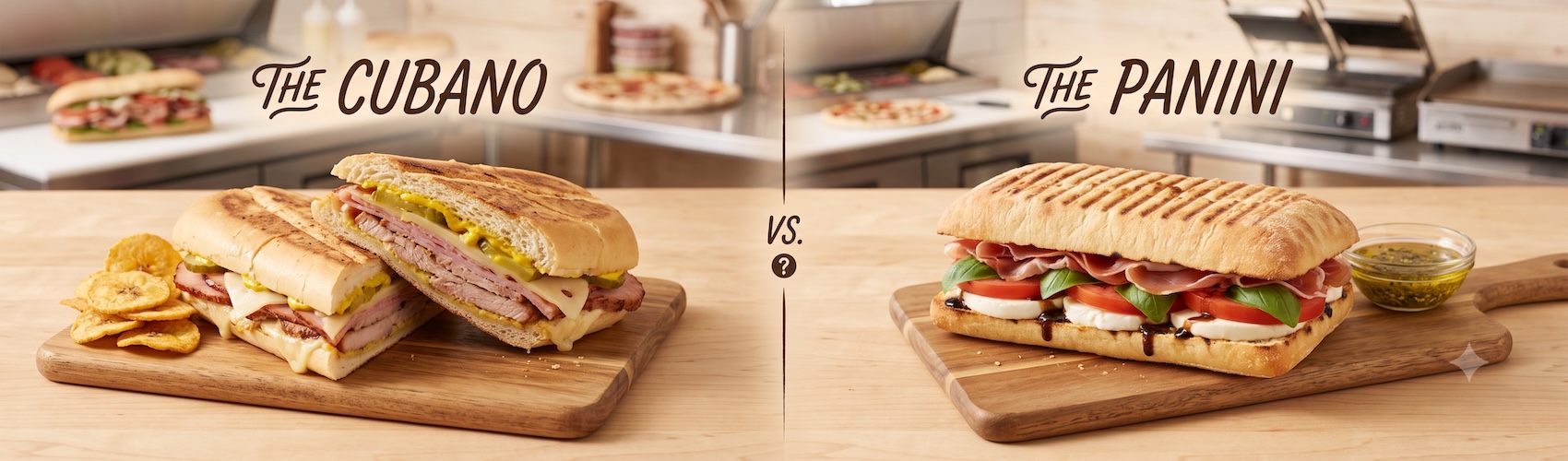
Two sandwiches. Two working-class origin stories. Two completely different machines. Are they easy to make? Not really. They both require some specialized equipment, techniques, and ingredients. That plus a little skill and understanding what you’re doing, and this CAN be a piece of cake.
Ready?
The Italian panino and the Florida Cubano both start from the same basic idea: warm filling, pressed bread. That’s where the resemblance ends. One is built to survive a light touch and come out with its airy crumb intact. The other is built to get flattened within an inch of its life and come out shattering like glass. Get the two confused — grab a grooved press for a Cubano, or smash a panino flat — and you haven’t made a lesser version of the sandwich. You’ve made a different, worse sandwich entirely.
By the time you’re done here, you’ll know where both of these came from, why their bread is built the way it is, and how to run both stations without turning a $6 sandwich into a $6 mistake.
1. Heritage on the Line: History & Regional Roots
The Italian Panino
In Italian, panino just means “small bread roll” — so ordering “a panini” is technically ordering “a rolls.” Nobody in Italy will correct you, but now you know. The modern pressed panino took off in Milanese cafés in the 1970s as fast, high-quality lunch for office workers on the clock. Instead of piling on sauce and cheap cold cuts, Milanese shop owners leaned on the ingredients doing the work themselves: artisan breads like ciabatta or focaccia, delicate cured meats like prosciutto di Parma or mortadella, young cheeses like fontina or fresh mozzarella. The press was never meant to flatten the sandwich — just warm the meat and soften the cheese while the bread’s open, airy crumb stayed exactly as baked.
By the early 1980s, the panino had outgrown lunch entirely. A group of wealthy Milanese teenagers started treating panini bars like a clubhouse — first at a spot called Il Panino, then a Burghy outpost in Piazza San Babila — and built an entire identity around it: Moncler puffer jackets, Timberland boots, Levi’s 501s rolled at the ankle. They called themselves the Paninari — literally “the sandwich people” — and by 1986 they were famous enough that the British pop duo Pet Shop Boys wrote a song about them, filmed partly on the streets of Milan. The movement burned out by the end of the decade, but it’s a real reminder that this “simple” sandwich once drove actual youth culture, not just lunch orders.
Ask ten Italian delis for “the” panino and you’ll get ten different builds, but a few combinations show up again and again: prosciutto and fontina, fresh mozzarella with tomato and arugula, speck with arugula and cheese. None of them are drowning in sauce or piled three inches high — the whole philosophy is a handful of excellent ingredients doing real work, not volume.
A quick note before you move on: Genoa salami, prosciutto, and mortadella are the common meats used in this sandwich. Prosciutto is a dry-cured, unsmoked ham — sliced paper-thin and eaten as-is, never cooked, more like an aged ham than the roasted or smoked kind you may be used to. Mortadella is something else entirely: a large, smooth Italian cold cut studded with visible cubes of fat (sometimes pistachios too), closer in texture to a fine-grained bologna than to sliced ham.
The Florida Cubano
The Cuban sandwich has a rougher origin story: pure working-class necessity in the late 1800s and early 1900s, feeding cigar factory workers who moved constantly between Cuba, Key West, and Tampa. It had to be cheap, portable, and sturdy enough to carry a worker through a 12-hour shift — and that history is still fueling a real rivalry across Florida today. Tampa’s Ybor City set the original 6-ingredient benchmark: mojo roast pork, sweet ham, Swiss cheese, pickles, mustard, and Genoa salami — the salami’s there because Italian cigar rollers worked the same factory floors as Cuban and Spanish rollers, and the food cultures blended into one sandwich. When Cuban exiles brought the sandwich to mid-century Miami, they dropped the salami and pressed a leaner 5-ingredient build dead-flat on a plancha. Key West’s dockside version, meanwhile, often adds mayo, lettuce, and tomato.
Whatever the regional build, the bread (pan cubano) is the real secret. Traditional bakeries lay a wet palmetto palm leaf down the center of the dough before baking — as steam expands in the oven, the leaf scores a split down the top, creating a paper-thin crust that shatters like a cracker under pressure.
Names get slippery here too. Order a “Cubano” on Calle Ocho in Miami’s Little Havana and you’ll be understood just fine — but plenty of the cafés on that same street still call it a sandwich mixto, and that’s not a modern rebrand. “Mixto” was already showing up on Cuban restaurant menus back in the 1930s, before Tampa or Miami had staked their own claim on the sandwich — the name just rode north with the people who brought the sandwich with them. Don’t confuse it with its sweeter cousin sitting on the same menu, either: a medianoche — “midnight” — swaps the pan cubano for a soft, slightly sweet egg-dough roll around the exact same pork-ham-Swiss-pickle filling, originally sold to late-night crowds heading home from a shift or a night out.
Tampa still throws an annual Cuban Sandwich Festival in Ybor City, where chefs fly in from as far as South Korea and France to compete for the title — and every year, they try to break the world record for longest Cuban sandwich (last attempt: 370 feet). This isn’t a sleepy regional tradition. It’s a sandwich people build entire careers and international rivalries around.
At-a-Glance Comparison
| Feature | The Italian Panino | The Florida Cubano |
|---|---|---|
| Origin | Milan, Italy (1970s café culture) | Ybor City / Miami / Key West (late 19th-century cigar workers) |
| Bread Structure | Ciabatta or focaccia — open, airy, lean crumb | Pan cubano — enriched with lard, paper-thin crust, soft interior |
| Core Fillings | Prosciutto, mortadella, fresh cheeses, pestos | Mojo pork, sweet ham, Genoa salami (Tampa), Swiss, dill pickles, yellow mustard |
| Primary Equipment | Heated hinged press, grooved plates (Star Pro-Max 2.0 or Vollrath Cayenne) | Heated hinged press, smooth plates (Waring WFG250) |
2. Using the Equipment: Same Basic Tool, Three Real Differences
Before you touch either station, it helps to know what’s actually different between the tools — this is the one piece of science in this whole comparison worth understanding, because it’s the reason the techniques can’t be swapped.
Here’s the part that surprises people: a panini press and a plancha press are, underneath, the same basic machine. Every one is a hinged press with a heated plate on top and a heated plate on the bottom, closing down on the sandwich from both sides at once. Some plancha-style setups use a separate sandwich weight that heats up by resting on the surface — but plenty of modern equipment builds the heat straight into the hinged lid instead, so there’s no loose piece to manage at all. It’s a one-stop shop to Cubano goodness.
Plate shape is the real answer to “why can’t I swap these.” Grooved plates leave raised ridges that only touch part of the bread’s surface, with open valleys between them that let steam escape and encourage a crispier crust — exactly what an open-crumb bread like ciabatta or focaccia wants: enough contact to crisp the outside without crushing the structure underneath. Smooth plates do the opposite: full, edge-to-edge contact across the entire surface. That’s what a Cubano needs — the pan cubano crust is thin and enriched with lard, and it only shatters properly if it gets compressed evenly across its whole surface. Grooved ridges don’t compress evenly. They tear straight through that delicate crust instead. And that’s bad.
Two smaller differences matter too, mostly for how you run the station rather than what the sandwich turns out like:
- Plate metal: Aluminum plates are lighter and come up to temperature fast. Cast iron is heavier and slower to preheat, but holds its heat far more steadily once you’re running sandwich after sandwich back-to-back. On a slow single order, that difference barely matters. On a busy stretch, it’s the difference between every sandwich cooking the same and the fifth one running cooler than the first.
- Controls: Not every press tells you it’s ready the same way. Some give you a temperature range on a dial with no clear signal. Some have a pilot light that goes dark once the plates hit temperature. Some have a dedicated READY light. Know how your specific machine signals “ready” before you rely on it — read the manual, because there are a lot of these out there and no two behave exactly alike.
Both stations pull their fillings from cold storage — mise en place for either sandwich starts at the cold station before anything hits a press.
How We Do It: Panini
In this kitchen, we run two panini presses: a Star Pro-Max 2.0 (PGT14) and a Vollrath Cayenne. They’re not interchangeable. The Star’s plates are aluminum, on a torsion-spring hinge, with no ready signal beyond the dial. The Vollrath’s plates are cast iron, on a pivot hinge, with a pilot light that goes dark once the plates hit temperature.
- Preheat & calibrate: Set the thermostat to 375°F (190°C) before you build a single sandwich — a cold plate makes steam instead of a sear. On the Vollrath, watch the pilot light rather than the clock: it goes dark the moment the plates hit your set temperature, and that’s your real “ready” signal, not a guess at minutes. Budget at least 20-30 minutes either way, since cast iron takes longer to fully saturate with heat than the light alone suggests. The Star has no equivalent cue, so lean on the timing estimate and confirm with a test sandwich if you’re unsure.
- Tension adjustment: Let the hinge settle into place on its own rather than forcing it down. You want contact heat and light pressure, not force.
Seasoning and post-service cleaning are covered in Equipment Maintenance, below the recipe.
How We Do It: Cubano
In this kitchen, the Cubano station runs on a Waring WFG250 — a heated hinged press with smooth plates and a dedicated READY light, the clearest “ready” signal of any machine here.
- Preheat both plates: Set the thermostat to 350°F (177°C) before you build a single sandwich, and wait for the READY light. Don’t rush this — a cold top plate pulls heat straight out of the sandwich as fast as the bottom plate can put it in, leaving you with melted cheese on the bottom and cold ham on top.
- Close it fully: Once the sandwich is loaded, lower the hinged lid all the way down — the flat, smooth plates need full, even contact across the whole crust to get the shatter. A half-closed lid gives you a soggy stripe down the middle instead of an even crackle.
Surface clearance before service and full cleanup after are covered in Equipment Maintenance, below the recipe.
3. Quality: How You Know You Got It Right
A line cook checks a thermometer. A chef reads the sandwich in front of them. Here’s what to look for on the board.
Panino Quality Indicators
- Crust & mark: High-contrast, golden-mahogany grill lines. The valleys between ridges stay light golden, slightly springy, crisp to the touch.
- Crumb integrity: Sliced open, the ciabatta or focaccia still shows its open, holey structure. It should never look crushed into a flat disc.
- Melt & fillings: Fresh mozzarella or fontina should be soft, warm, and stringy — not separated into an oily pool. Delicate cured meats like prosciutto should be gently warmed, never dried out or curled from direct heat.
Cubano Quality Indicators
- The shatter test: Run a serrated bread knife diagonally across the finished crust — you should hear a loud, distinct crackle. If the blade sinks in like the bread’s a sponge, the press wasn’t hot enough or wasn’t closed all the way down.
- Uniform flat compression: The sandwich should be pressed flat, roughly half to two-thirds its original height, with clean, straight horizontal layers visible in the cross-section.
- The cheese ribbon: Swiss should be fully melted, binding pork, ham, salami, and pickles into one unified core — without leaking grease out onto the plates.
4. Rookie Mistakes to Avoid
- Forgetting to make sure your equipment is cleaned, oiled, and preheated – at least 30 minutes before you want to cook. Skip any one of those three and you’re fighting your machine instead of using it — a dirty plate scorches unevenly (or leaves charred cheese from the last time it was used, sticking to the bread and making everyone who sees it sort of sick to their stomach). A dry plate sticks and tears the crust. A cold plate never gets you the sear or the shatter you’re after. Prep your equipment at least 30 minutes before you want to make your FIRST sandwich, every time.
- Skipping the fat barrier. Wet items — tomato, pickles, damp meat — placed directly on bare bread crumb let moisture soak in during pressing. Spread a fat barrier (butter, oil, pesto) edge-to-edge on the crumb first. And it wouldn’t hurt to pat those pickles dry with a paper towel, buddy. Be smart.
- Skipping gloves because “it’s getting cooked anyway.” A press doesn’t guarantee every part of the filling actually hits 165°F all the way through — that’s the number that would let you skip gloves, and a pressed sandwich doesn’t reliably get there. Wear gloves for all sandwich assembly, cooked or not. (Same rule applies to pizza.)
- Building a grilled sandwich with thick, cold ingredients. Let’s say you’re making a cubano and pull Pork straight out of the cooler (41°F). That delicious meat will NEVER get hot on the press — by the time the center’s hot, the crust is burnt black. Pre-warm thick ingredients like mojo pork on the hot line (135°F or above) before building.
NOTE: while the cubano gets pressed within an inch of its life, that is NOT true of the panini:
- Don’t get carried away squishing your panini. A heavy press crushes ciabatta’s open crumb into dense, gummy paste. Ease the hinge down, don’t force it. You’re not the Hulk. Stop acting like you are.
5. Recipe
Classic Tampa-Style Cuban Sandwich (Cubano)
Equipment
- Plancha
Ingredients
Option A — Mojo-Warmed Ham
- 1.5 lbs thick-sliced ham ¼-inch slices
- 1 cup chicken broth
- ½ cup fresh sour orange juice or ⅓ cup fresh orange juice + ⅓ cup fresh lime juice
- 4 garlic cloves minced
- 1 tablespoon dried oregano
- 1 teaspoon ground cumin
- 2 tablespoons olive oil
- ½ teaspoon kosher salt
- ¼ teaspoon black pepper
Option B — Authentic Mojo Roast Pork
- 3 lbs boneless pork shoulder
- 1 cup fresh sour orange juice or ⅔ cup fresh orange juice + ⅓ cup fresh lime juice
- 8 garlic cloves minced
- 2 tablespoons dried oregano
- 1 tablespoon ground cumin
- ¼ cup olive oil
- 2 teaspoons kosher salt
- 1 teaspoon black pepper
Sandwich Build (per sandwich, either option)
- 1 piece Cuban bread pan cubano, about 8 inches, split lengthwise
- 1 tablespoon yellow mustard
- 3 oz thinly sliced Swiss cheese
- 3 oz thinly sliced sweet or boiled ham cold
- 3 oz mojo pork or mojo-warmed ham
- 1.5 oz thinly sliced Genoa salami Tampa-style —omit for a Miami-style build
- dill pickle chips, enough to evenly spread over sandwich patted dry
- 1 tablespoon softened butter for the crust
Instructions
Option A: Mojo-Warm the Ham
- Combine the chicken broth, sour orange juice, garlic, oregano, cumin, olive oil, salt, and pepper in a saucepan. Bring to a gentle simmer over medium heat.
- Add the thick-sliced ham and warm through, spooning the broth over occasionally, until the ham reaches at least 135°F and has visibly picked up color and aroma from the marinade — about 5–8 minutes. Don’t let it boil hard; you’re warming and flavoring the ham, not cooking it.
- Remove ham from the broth and hold at or above 135°F on the line until service.
Option B: Roast the Mojo Pork
- Whisk the sour orange juice, garlic, oregano, cumin, olive oil, salt, and pepper together in a bowl or resealable bag. Add the pork shoulder, turning to coat fully. Refrigerate at least 4 hours, preferably overnight.
- Preheat oven to 325°F. Transfer the pork and all the marinade to a covered roasting pan. Roast until the pork pulls apart easily with a fork and reaches at least 195°F internally, about 3–3½ hours.
- Rest the pork 15 minutes, then slice thin against the grain. Hold at or above 135°F on the line until service.
Build and Press (either option)
- Split the Cuban bread and spread mustard edge-to-edge on both cut sides — get it all the way to the corners on the bottom half especially, since that’s where it’s doing the most work as a moisture barrier.
- Layer on the bottom half: Swiss cheese, the cold sweet ham, the warm mojo pork or mojo ham, and salami if using. Top with dill pickles, then close the sandwich.
- Butter the outside of both crusts lightly. Preheat the smooth press to 350°F and wait for the READY light before loading the sandwich.
- Close the press fully and hold until the crust is deep golden and audibly crisp, 4–5 minutes.
- Rest 1 minute, then slice on a sharp diagonal and serve.
Classic Panino: Salami, Mozzarella & Basil
Equipment
- panini press
Ingredients
- 4 ciabatta or focaccia rolls or 1 long loaf, cut into 4 portions, split lengthwise
- 16-20 slices Genoa salami or mortadella/ prosciutto di Parma, thinly sliced
- 8-12 oz fresh mozzarella sliced thin
- 2 ripe plum tomatoes thinly sliced and patted dry
- 1 cup fresh basil leaves
- ½ cup basil pesto or ¼ cup extra virgin olive oil
- Kosher salt and black pepper to taste
- 2 tablespoons olive oil for brushing the crust
Instructions
- Split the ciabatta rolls lengthwise. Spread pesto — or brush olive oil — edge-to-edge on both cut sides.
- Layer the bottom half with mozzarella, the patted-dry tomato slices, and salami.
- Top with fresh basil leaves and a light pinch of salt and pepper. Close the sandwich.
- Brush the outside of both crusts lightly with olive oil.
- Preheat your press to 375°F
- Load the sandwich and let the hinge settle into place on its own. Ease it down — don’t force it.
- Press lightly until the crust shows deep golden grill lines and the mozzarella is fully melted and soft, about 3–4 minutes.
- Rest 1 minute, slice on the diagonal, and serve.
Panini Grilled Cheese
Ingredients
- ½ cup good mayonnaise
- 1 T dijon mustard
- 1.5 T freshly grated parmesan cheese
- Kosher salt and freshly ground black pepper to taste
- 4 slices sourdough bread
- 2 tablespoons salted butter at room temperature
- 3 ounces swiss grated
- 3 ounces extra-sharp cheddar grated
Instructions
- Combine the mayonnaise, mustard, and parmesan. Season with salt and pepper to taste. Spread one side of bread slices lightly with butter. Flip the slices and spread the other side generously with the mayonnaise mixture. Don’t neglect the corners!
- Pile 1/3 cup grated cheese evenly on top of the mayonnaise blend. Top with a second slice of bread, mayonnaise blend down.
- Meanwhile, heat an electric panini press. When the press is hot, cook the sandwiches for 3 to 5 minutes in batches until the bread is toasted and the cheese is melted. Allow to cool for 2 minutes. Cut in half and serve warm.
6. Equipment Maintenance
One thing worth understanding before you touch either machine: you’re not going to see a sanitizer step in here. That’s not an oversight — while a press or plancha is in regular use, it’s running far hotter than any microorganism can survive. The heat itself is doing the job a chemical sanitizer does on a cold surface like a cutting board or prep table. What actually needs your attention is clearing food debris and grease so it doesn’t build up, burn, and taint the next order — not killing anything, since the heat already handled that.
Panino Press (Star & Vollrath)
- Seasoning: Lightly oil the grooved ridges with a high-smoke-point oil (canola or clarified butter) using a folded paper towel or grill brush before service.
- Between orders: While the unit is still warm (around 150°F), scuff burned cheese or crumb out of the grooves with a wire groove brush or high-temp nylon scraper. Empty the drip tray before it overflows.
- No Water, ever: Never pour cold water on a hot press, period — this isn’t a Vollrath-specific rule or a Star-specific rule, it’s a rule for any piece of electrical equipment still plugged into an outlet, especially one where customers are standing on the other side of the counter. It splashes, it steams, and it can burn you or someone nearby before you’ve even registered what happened. Plus, electrocution. Which is bad. Also …the Vollrath’s cast-iron plates can crack from the thermal shock of 70°F water pouring over a 400°F plate— one more reason, not the main one. And you don’t want to be responsible for buying a new $2500 panini press, do you?
- End of service: Once the unit is fully cooled, wipe it down, empty and rinse the drip tray, scrape and clean the cooking surface, and apply a micro-thin coat of oil to the cooking plates to prevent rust. Don’t forget to lift the machine and make sure no food bits are hiding underneath. Clean the hinges and exterior of the machine with a grease–fighting gentle detergent, then polish the stainless (without getting the polish on ANY of the food contact surfaces – that stuff is toxic).
Waring WFG250 (Smooth Press)
The after-use maintenance for the plancha is the same as the panini presses with only two exceptions:
- Before service: Scrape both plates clean with a grill scraper so leftover grease or char doesn’t discolor the buttered Cuban crust.
- Between orders: Scrape the plates clean with a bench scraper while they’re still warm. Smooth plates clean up faster than grooved ones — no ridges to dig crumb out of. Empty the drip tray before it overflows.
7. Study Guide
Technical Vocabulary
- Panino Imbottito — The traditional Italian term for a stuffed bread roll.
- Plancha — In most modern commercial kitchens, a heated, hinged press with smooth, flat plates rather than grooved ones — providing full, even contact instead of ridged grill marks. (Traditionally the term refers to an open flat-top griddle used with a separate weight. You can still see this kind of setup in some Street vendors in Tampa… but that’s about it. Most everyone serving cubanos these days are using the modern version).
- Mojo — A citrus-garlic Cuban marinade (sour orange juice, garlic, oregano, cumin, oil) used for roast pork.
- Palmetto Seam — The natural split line down Cuban bread, created by baking with a palm frond laid across the dough.
- Fat Barrier — A thin layer of butter, oil, or pesto spread on bread crumb to block moisture from wet fillings.
Big Ideas to Take Away
- Plate shape decides the outcome. A grooved press protects an open crumb by only touching part of it; a smooth press compresses a delicate crust evenly across its whole surface. Same basic machine, opposite job — that’s the real reason these two sandwiches can’t swap equipment.
- Regional history is baked into the ingredient list. Tampa’s salami, Miami’s streamlined build, Key West’s produce — every regional variation on the Cubano traces back to a real economic or cultural cause, not personal taste. That’s true of most food history, not just this sandwich.
- Every rookie mistake in this piece has a mechanism behind it, not just a rule. Wet pickles ruin a crust because of moisture and starch, not because “that’s how it’s done” — and the same goes for cold fillings, ungroomed equipment, and grooved plates on a Cubano. Understanding the mechanism is what lets you adapt when something’s slightly different than the recipe.
- A condiment can do more than one job. Yellow mustard isn’t just flavor on a Cubano — its acid cuts through the pork fat, and its texture works as a light moisture barrier on the bottom crumb, same principle as the fat barrier under any pressed sandwich.
- “Clean, oiled, preheated” isn’t specific to these two stations. It’s the baseline for any piece of hot equipment in this kitchen — panini press, plancha, flat-top, doesn’t matter.
Going Deeper
If you’re looking to be great, you’ll probably want to see what a real Cuban sandwich rivalry looks like at full scale. Every year, Ybor City’s Cuban Sandwich Festival pulls in chefs from across the world to compete for the title — and to attempt the world record for longest Cuban sandwich ever built. Here’s a closer look: cubansandwichfestival.com