
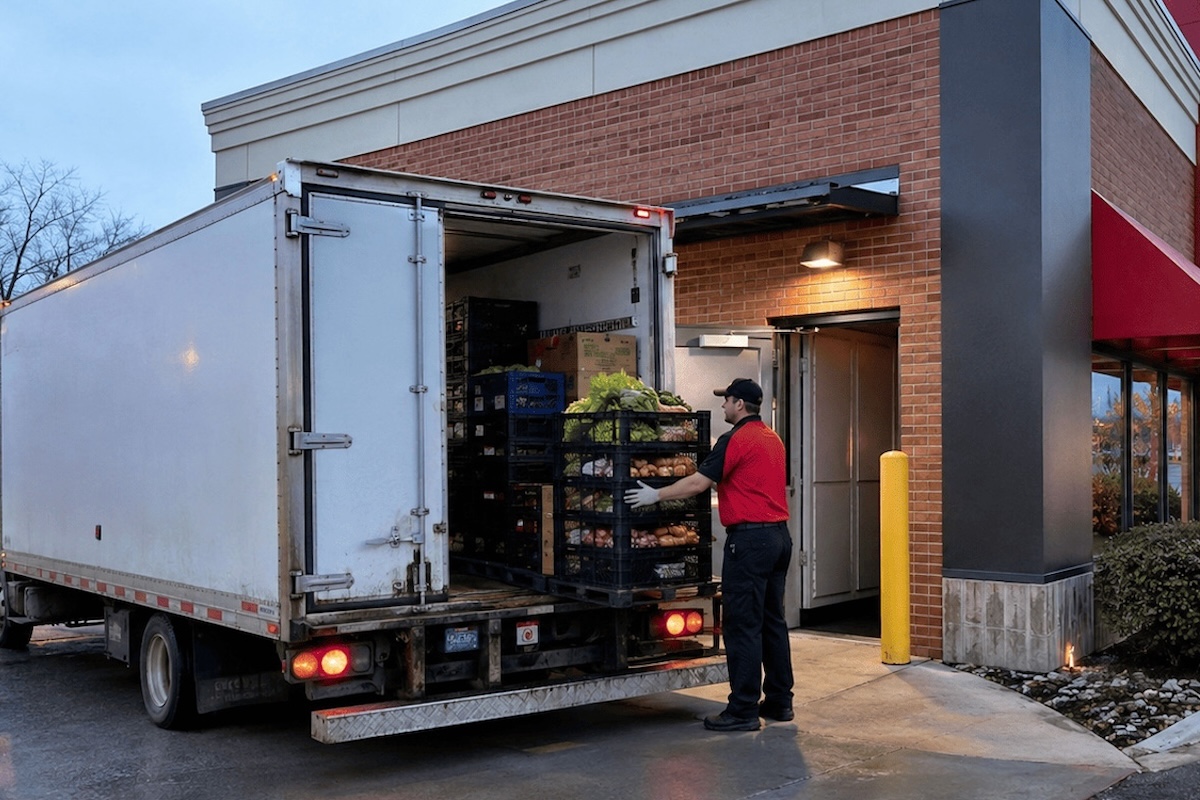
The truck backs up to the door at the worst possible time. It’s the middle of a lunch rush, you’re two prep cooks short, and the driver needs a signature now. Everyone in the kitchen wants that delivery off the dock and out of the way.
This is exactly when ordering and receiving decisions get made badly — not because anyone doesn’t know the rules, but because the rules feel like they’re standing between you and getting back to the line. A manager’s job is to make sure that pressure never wins.
Food safety doesn’t start when an ingredient hits the cutting board. It starts at the loading dock — and really, it starts even before that, with who you agreed to buy from in the first place. A delivery that’s already been mishandled can arrive with problems you can’t fix by putting it in the walk-in.

SUPPLIERS
Approved, Reputable Suppliers
Buying decisions are food safety decisions. Think of choosing a supplier the way you’d think of hiring a new cook: you don’t just take someone’s word that they know what they’re doing. You check.
An approved supplier has been inspected and follows local, state, and federal food-safety law. A supplier should be able to show you evidence that they meet the standards they’re supposed to meet, such as inspection reports, HACCP documentation, or food-safety certification.
Depending on the supplier, inspections may come from the USDA, FDA, or a third-party inspector. Those inspections may look at Good Manufacturing Practices (GMP) or Good Agricultural Practices (GAP) — basically, whether processors and growers are handling food safely before it ever gets to you.
That matters because there’s only so much you can learn from a case of chicken sitting on your loading dock. You can check its temperature, packaging, and condition. You can’t look at it and tell whether the processing plant had a sanitation problem three days ago. That’s why choosing the supplier is part of food safety too.
“The Supplier” Is Usually a Chain, Not One Company
It’s easy to picture “the supplier” as whoever owns the delivery truck. In practice, an ingredient may pass through growers, shippers, packers, manufacturers, distributors, and sometimes local markets before it ever reaches your kitchen.
Every link in that chain is another place a problem could start, which is why an inspection report matters more than a handshake.
What an Inspection Report Should Actually Cover
A useful supplier inspection should review things like:
- Receiving and storage
- Processing
- Shipping
- Cleaning and sanitizing
- Personal hygiene
- Staff training
- Recall program
- HACCP program or another food-safety system
You don’t need to become a supplier auditor. You do need to understand what that inspection actually tells you. They’re inspected doesn’t mean much if you have no idea what was inspected.
Approval Isn’t a One-Time Check
Choosing an approved supplier isn’t something you verify once and forget. Build a relationship with suppliers, know their food-safety practices, and review their inspection reports periodically.
Many operations maintain an approved supplier list based on their own specifications and standards. Purchasing shouldn’t become a daily game of I think these people are probably okay. Know who you’re buying from before the order gets placed.
Who Can’t You Buy Food From?
Knowing what an approved supplier looks like also means knowing what doesn’t count. A good price, a familiar seller, or food that looks perfectly fine doesn’t make an unapproved source acceptable.
Food for a foodservice operation must come from an approved source that follows applicable food-safety laws. That means you cannot buy or accept food from sources that haven’t been approved or inspected as required.
That includes:
- Food prepared in a private home when that food is not allowed for use in a foodservice operation. Somebody’s grandmother may make incredible tamales; that doesn’t make her kitchen an approved commercial source.
- Meat, poultry, or eggs from an unapproved or uninspected source. These products have inspection requirements that don’t disappear because you know the farmer or butcher.
- Wild mushrooms picked by an unapproved individual or source. Unless your regulatory authority allows them under its requirements, somebody showing up with a basket of mushrooms they picked in the woods is not your new produce vendor.
- Recreationally caught fish or game. A cook’s weekend fishing trip doesn’t become Monday’s seafood special just because the fish was handled carefully.
- Any food from a supplier that cannot demonstrate it meets the required food-safety standards.
The common thread is source, not appearance. Food can look fresh, smell fine, arrive cold, and still be unacceptable because you have no reliable way to know how it was produced, processed, or handled before it reached you.
COMMON CONFUSION: What about farmers markets and local farms?
Local doesn’t mean unapproved. A local farm, producer, or market vendor can absolutely be an acceptable source if they meet the applicable requirements and are approved to sell that product to your operation. The problem isn’t buying local; it’s buying from a source that isn’t approved.
Don’t confuse “I know where this came from” with “this is an approved source.” Those are not the same thing.


RECEIVING WHAT YOU ORDERED
The easiest way to screw up receiving is to make it somebody’s side job while they’re already doing three other things. If you expect deliveries to be inspected properly, set the operation up so that’s actually possible.
Skipping the system is how receiving turns into signing an invoice and hoping everything on the truck is okay.
What About Deliveries After Hours?
Some operations allow suppliers to deliver when nobody is there to receive the order. The supplier gets a key or access code, puts the products into the appropriate storage areas, and leaves. That’s a key drop delivery, and it still has to pass receiving inspection. The difference is that the inspection happens when staff arrive.
Check that:
- The food came from an approved source
- It was placed in the correct storage location to maintain the required temperature
- It was protected from contamination while stored
- It has not been contaminated
- It is honestly presented
A key drop delivery isn’t automatically safe because somebody put it in the walk-in for you. The inspection still has to happen when staff arrive.
What “Safe to Accept” Actually Looks Like
When a delivery arrives, you’re checking it against known standards — not whether the driver seems trustworthy or whether the product looks okay from here. Start with the vehicle, then work your way to the food.
Start With the Delivery Vehicle
Before you inspect a single case, look at what it arrived in. Check the delivery vehicle for signs of contamination, its overall condition, and evidence of pests.
If the back of the truck is filthy, there are signs of pests, or something about the load tells you the food may have been contaminated or mishandled, don’t start unloading cases just because the driver is in a hurry. Figure out what you’re dealing with first.
Then compare what showed up with what you actually ordered. Count cases, spot-check weights, and watch for substitutions, repackaging, or signs somebody has tampered with the product.
How to Check a Delivery’s Temperature
Knowing the correct receiving temperature doesn’t help much if you take the temperature incorrectly. How you check it depends on what you’re receiving.
Meat, Poultry, and Fish
Insert the thermometer stem or probe into the thickest part of the food, usually the center. You’re trying to measure the temperature of the food itself — not the truck, the outside of the case, or the air around it.
Reduced-Oxygen Packaged Food
For food in reduced-oxygen packaging (ROP), including vacuum packaging, place the thermometer stem or probe between two packages. If the package is flexible enough, fold it around the probe to get better contact.
Do not puncture the package. Putting a thermometer through it destroys the seal you’re supposed to be inspecting.
Other Packaged Food
For other packaged foods, open the package and insert the thermometer stem or probe into the food. Make sure the thermometer’s sensing area is fully immersed in the product without touching the package.
Receiving Temperatures
Every category of TCS food has a receiving temperature standard. These numbers matter enough that you should know them cold — literally.
NOTE: All of the temperatures in the table above are separate receiving standards — not variations of the standard, big ol’ 41°F rule.
COMMON CONFUSION: Why do some foods get 45°F instead of 41°F?
It’s easy to see 45°F and assume it’s just a looser version of the 41°F rule. It isn’t, and the foods that get it don’t all work the same way.
Live shellfish, shucked shellfish, and milk can be received at 45°F and then must be cooled to 41°F within four hours. Shell eggs are different: 45°F air temperature is the receiving standard, without that same four-hour cool-down requirement. Learn them as separate rules instead of trying to turn them into one.
Packaging
Temperature can be perfect and a delivery can still be unacceptable. Food and nonfood items should arrive in their original manufacturer’s packaging, and that packaging should be intact and clean.
Reject items with problems such as:
- Tears, holes, or punctures
- Severe dents along can seams
- Deep dents in cans
- Swollen or bulging can ends
- Holes or visible leaking
- Rust
- Leaks, dampness, or water stains
- Missing or altered labels
- Evidence of pests or pest damage
- Missing or expired use-by or expiration dates
Food in reduced-oxygen packaging has to arrive with that packaging intact. If the package is bloated or leaking, you don’t need to talk yourself into an explanation for why it’s probably fine. Reject it.
COMMON CONFUSION: The dates printed on labels don’t all mean the same thing.
Check the dates required for the product you’re receiving. Food with a required use-by or expiration date that has passed should be rejected. A sell-by date is primarily used by retailers to manage how long a product is displayed for sale, while a best-by date generally relates to quality rather than food safety.
The receiving rule is simple: know which date matters for the product you’re inspecting, and don’t accept food past a required use-by or expiration date. Sell-by and Best-by dates are a LOT more flexible in their application.
Food Quality
Good temperature and intact packaging still aren’t the end of the inspection. Poor quality can be a sign that food has already experienced time-temperature abuse.
Look at three things:
- Appearance — Reject food that’s moldy, has an abnormal color, or has abnormal moisture. Food that’s supposed to be dry shouldn’t arrive wet.
- Texture — Reject meat, fish, or poultry that’s slimy, sticky, unusually dry, or leaves an imprint when touched.
- Odor — Reject food with an abnormal or unpleasant odor.
Food safety also isn’t the only standard you’re buying against. Your operation may have its own specifications for size, grade, appearance, brand, or quality. Something can be safe to eat and still not be what you ordered.
BE CAREFUL: A frozen item that “looks fine” can still fail.
Frozen food should arrive frozen solid. Large ice crystals, frozen liquids, fluid stains, or water stains can indicate that a product thawed and was refrozen. That’s evidence of possible time-temperature abuse, not a cosmetic problem.

Some Deliveries Come With Paperwork You Have to Check Too
For certain foods, temperature, packaging, and quality aren’t enough. The documentation is part of the receiving inspection.
Live Shellfish

Live shellfish in the shell — shellstock — must arrive with a shellstock identification tag showing when and where the shellfish were harvested.
Don’t throw that tag away with the box. Keep the shellfish in their original container until the last one is used. When that last shellfish comes out, write the date on the tag and keep it for 90 days.
Why all the paperwork? If those shellfish are connected to an illness later, somebody needs to be able to trace them back to where and when they were harvested.
Farm-Raised Fish
Farm-raised fish must have documentation showing that it was raised according to required standards. Keep that documentation for 90 days from the date the fish is sold or served.


Fish Served Raw or Partially Cooked
If you’re buying fish that will be served raw or partially cooked, you’re taking away the cooking step that might otherwise protect the guest. The fish must have documentation showing that it was correctly frozen for parasite destruction, and those records must be kept for 90 days from the date the fish is sold or served.
Accept or Reject: Don’t Talk Yourself Into a Bad Delivery
Once you’ve checked the vehicle, temperature, packaging, food quality, and any required documentation, the decision should be simple: the food either meets the receiving standard or it doesn’t.
If it meets the requirements, accept it. If it fails a required check, reject the affected product.
The hard part usually isn’t knowing that rule. It’s what happens next. The driver tells you it was fine when it left the warehouse. You’re short on what you ordered. Prep needs it. Someone reminds you that you’ve accepted deliveries like this before.
That’s when having a standard matters: you inspect first and decide from the standard — not from how badly you need what’s on the truck.
How to Actually Reject Something
Rejecting food doesn’t mean shoving the case back toward the driver and walking away. When an item is rejected:
- Set it aside from the products you’re accepting so it can’t accidentally get mixed back in.
- Tell the delivery person exactly what’s wrong. Identify the specific temperature, damage, label, documentation, or other problem.
- Get a signed adjustment or credit slip before returning the item.
- Record what happened on the invoice or receiving document.
That gives you a record of what was rejected and why.
COMMON CONFUSION: Rejecting an item and reconditioning an item aren’t always the same decision.
Reconditioning doesn’t mean you get to rescue bad food. It means some very specific problems can be corrected. If an otherwise sound can has contamination on the outside, for example, that surface may be cleaned and sanitized.
That’s very different from a damaged can. Cleaning the outside doesn’t fix a swollen end, a puncture, a bad seam, or structural damage. You can clean a surface; you can’t sanitize a busted can back into being safe. Dairy products that came in a banged up cardboard box are still usable. Dairy products that have broken seals or leaking their contents onto the floor? Not so much.

The driver is giving you a fact that sounds important: the truck is at 36°F. But you aren’t accepting the truck. You’re accepting the chicken.
Cold TCS food must be received at 41°F or lower, and the chicken you checked is 44°F. The clean cases, intact packaging, cold truck, and driver’s explanation don’t change that. Reject the chicken.
Putting it in your walk-in doesn’t fix the problem either. You don’t know when the chicken rose above 41°F, how warm it got, or how long it stayed there. Cooling it back down only tells you what temperature it is now; it doesn’t erase what happened before it reached your door.
That’s the trap. The driver’s 36°F reading tells you the refrigeration system is working now. It does not prove the chicken stayed at a safe temperature throughout the trip. The driver may be telling the truth, the truck may really be 36°F, and you may desperately need twenty cases of chicken for tonight. None of that changes the receiving temperature: 44°F.
IF IT’S NOT SAFE AT THE DOOR, IT DOESN’T GET TO WALK THROUGH THE DOOR.
What You Actually Need to Remember
- Buy food only from approved, reputable suppliers. Food from unapproved sources — including private-home food, recreationally caught fish or game, and other sources that don’t meet applicable requirements — isn’t acceptable just because it looks good or comes from someone you trust.
- Receiving requires trained employees, the right tools, good scheduling, and an actual inspection — not just a signature.
- Key drop deliveries still have to pass receiving inspection when staff arrive.
- Inspect the delivery vehicle before moving on to the food.
- Take temperatures correctly: thickest part for meat, poultry, and fish; between packages for ROP food; inside the product for other packaged food.
- General cold TCS food arrives at 41°F or lower. Hot TCS food arrives at 135°F or higher. Frozen food arrives frozen solid.
- Live shellfish, shucked shellfish, milk, and shell eggs have special 45°F receiving rules. Know the differences.
- Inspect packaging and food quality, not just temperature.
- Large ice crystals, frozen liquids, and water or fluid stains can indicate thawing and refreezing.
- Some foods require documentation: shellstock identification tags, parasite-destruction records for fish served raw or partially cooked, and farm-raised fish documentation. Know the 90-day recordkeeping rules.
- Reject products that fail receiving standards, separate them from accepted food, explain the problem, document the rejection, and get the appropriate adjustment or credit.
- Some specific problems can be reconditioned, but reconditioning doesn’t turn damaged food or packaging back into acceptable product.
- Inspect first and decide from the standard — not from how badly the kitchen needs what’s on the truck.
Key Terms to Know
- Approved supplier — A food supplier that has been inspected and follows applicable food-safety laws and requirements.
- Approved supplier list — A list an operation maintains of suppliers that have been vetted against its purchasing specifications and standards.
- Good Agricultural Practices (GAP) — Food-safety practices used in agricultural production and growing operations.
- Good Manufacturing Practices (GMP) — Food-safety practices used in processing and manufacturing operations.
- Key drop delivery — A delivery made after hours when employees are not present. The supplier is given access to place products into appropriate storage, and staff inspect the delivery when they arrive.
- Reconditioning — Correcting certain specific problems so an otherwise acceptable item can still be used, such as cleaning and sanitizing the contaminated exterior of an undamaged can.
- Reduced-oxygen packaging (ROP) — Packaging that reduces the amount of oxygen around food. Vacuum packaging is one example.
- Shellstock — Live shellfish that are still in their shells.
- Shellstock identification tag — A tag identifying when and where shellstock was harvested. Record the date when the last shellfish is removed and retain the tag for 90 days.
- Signed adjustment or credit slip — Documentation showing that rejected product was returned or adjusted so the operation is not incorrectly billed for it.
- Use-by / expiration date — The manufacturer’s last recommended date for the product at peak quality. Food missing a required date or received after that date has passed should be rejected.