
The soup was made at 8:30 that morning. By 11, it’s in the soup well on the line, hot and ready for lunch. Then service starts. Nobody’s really watching the soup anymore. It’s hot. It’s in the steam table. It’s fine.

Around noon, the pan gets low. A cook grabs the backup soup from the walk-in, dumps some in, gives it a stir, and walks away. The temperature drops, then slowly works its way back up. At 1:30, somebody does it again.
By dinner, that same soup has been sitting there all day — served from, topped off, heated back up, served from again.
Nobody left it on the counter overnight. Nobody served a bowl of cold soup. There was no single, spectacular screwup. Just a bunch of small ones. That’s how time-temperature abuse usually happens. A series of cascading mistakes that end with a soup swimming with bacteria.
Quick Recall: You Already Know Part of This
FAT TOM already introduced you to two numbers: bacteria grow rapidly between 41°F and 135°F — the Temperature Danger Zone — and even faster between 70°F and 125°F.
That part isn’t new.
What’s new is what happens once time gets involved.
How long is too long? What happens when food moves in and out of the danger zone more than once? Where does time-temperature abuse actually happen during a normal shift? And what happens when an operation deliberately decides to use time, instead of temperature, to keep food safe?
That’s where this gets more interesting.
The 4-Hour Rule Is Cumulative — and That’s the Part People Miss
TCS food has a maximum of 4 hours total in the danger zone before it has to be cooked, served, sold, or thrown out. The important word there is total, because the clock doesn’t start over every time the food goes back under temperature control.
And four hours isn’t some number the FDA pulled out of a hat.
The FDA actually studied what happens as food moves through temperatures where bacteria can grow. They looked at worst-case conditions — including laboratory studies using Clostridium perfringens, a spore-forming bacterium that can survive cooking and multiply very quickly as food cools — and used that research to establish a limit that keeps bacterial growth under control with a margin of safety built in.
That’s where the clock comes from. When temperature isn’t controlling bacterial growth, time has to.
Think about how easily time can accumulate during a normal shift. Fifteen minutes during receiving, another twenty during prep, a couple of hours drifting below temperature during holding, then ten more minutes waiting to be plated. None of those moments seems particularly dramatic on its own, but they all draw from the same 4-hour balance. Once that time is gone, the food is done.
That doesn’t mean cooks should treat those four hours like time they’re allowed to spend. Four hours is a backstop, not a budget. In a correctly run kitchen, uncontrolled time in the danger zone should be kept to an absolute minimum. Food moves through it as quickly as the required process allows, and once it’s supposed to be held hot or cold, it stays there.
You don’t want cooks doing mental subtraction halfway through a shift — “We’ve only used 45 minutes, so we’ve still got 3 hours and 15 minutes.” That’s missing the point. The four-hour limit tells you when you’ve reached the safety limit. It isn’t permission to run the kitchen badly for four hours.
And there isn’t anything magical about 4:00:01. Bacteria don’t own stopwatches. The four-hour limit is the food-safety boundary we’ve been given based on how pathogens can grow as food spends time at unsafe temperatures. Time-temperature abuse usually shows up at one of four points in a food’s life — and you’ve already seen all four in the Flow of Food. Each gets its own full lesson later, including the temperatures, times, and procedures you actually need to know.
For now, lock in the bigger pattern: Time-temperature abuse isn’t one mistake. It’s the same underlying failure showing up at four different points in a food’s life.
Two Ways to Hold Food Safely
Before comparing them, both of these deserve a plain, standalone definition — not just “the normal way” and “the other way.”
Temperature-controlled holding is what almost every operation does almost all the time: keep hot food at 135°F or above, keep cold food at 41°F or below, and check it with a thermometer to confirm. As long as the food actually stays at the required temperature, there’s no clock running and no fixed discard deadline — the temperature itself is doing the work of keeping the food safe. This is the default. Everything you’ve read so far in this lesson assumes this is how food is normally being held.
Time as a Public Health Control (TPHC) is a deliberate, planned alternative to that default. Instead of keeping food at a safe temperature, an operation uses time itself — tracked and documented — as the safety control.
Picture the two, and this gets a lot easier to remember.
Temperature-controlled holding is a cruise ship buffet — a hundred feet of trays, each sitting in equipment that’s actively working: real heating elements under the hot dishes, real refrigeration under the cold ones, constantly holding everything exactly where it’s supposed to be. Someone can walk down that line with a thermometer at any moment and confirm every pan is still correct. The equipment does the work; the thermometer proves it.
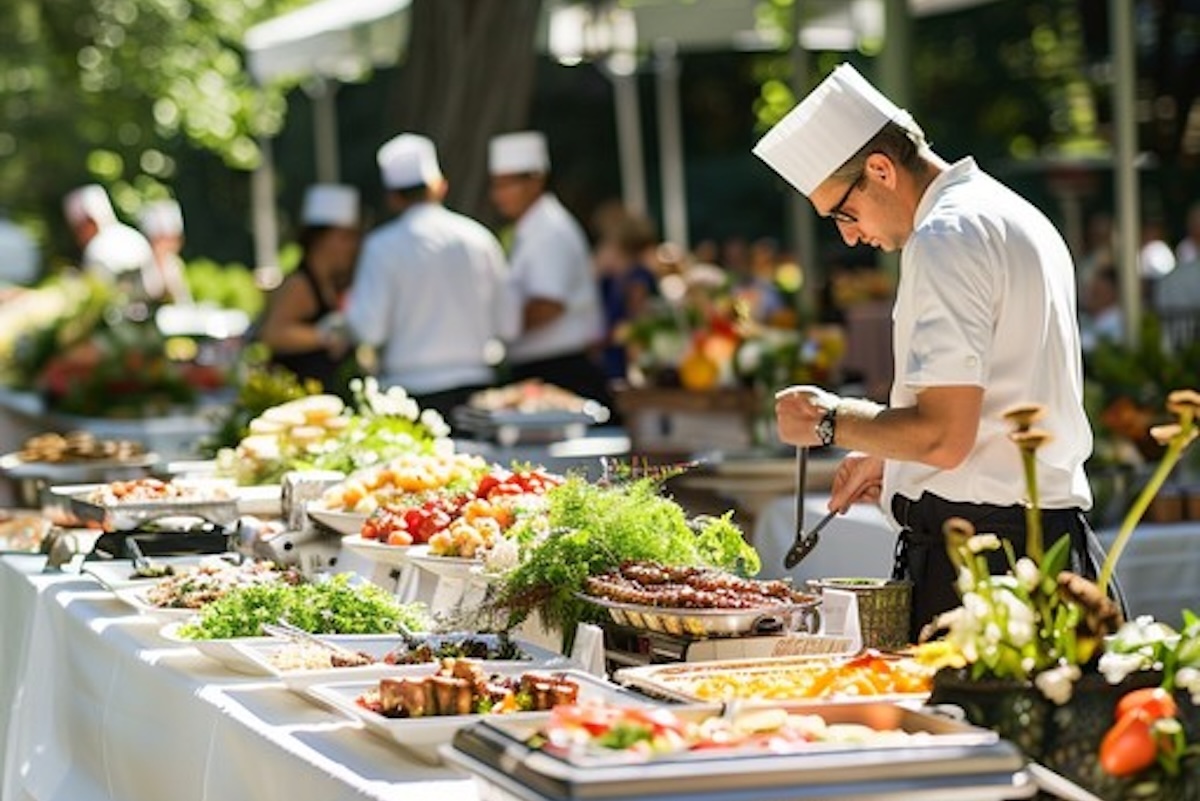
TPHC is an outdoor wedding reception. The chilled shrimp cocktail sits in a bed of ice, not a powered cooling well — it went out at 41°F or below, and from that moment it’s on a six-hour cap, as long as it never climbs above 70°F along the way. The hot food sits in chafing dishes, kept warm by cans of Sterno, not an electric warmer — it went out at 135°F or above, and it’s got a hard four-hour window. Unlike the six-hour cold option, there’s no temperature ceiling to monitor along the way. The clock is the control.
Both trays get time-stamped the moment the operation begins using time instead of temperature as the safety control, because that stamp is what determines when each one is done. Nobody on that lawn can guarantee those temperatures will hold steady for hours in the sun — so instead of gambling on it, the caterer plans for that ahead of time and lets the clock, not a thermometer reading, determine when the food has to go.
One thing that analogy can make easy to miss: ice and chafing dishes don’t automatically mean TPHC. If the ice is actually keeping the shrimp at 41°F or below, or the chafing dish is keeping the hot food at 135°F or above, that’s still ordinary temperature-controlled holding. Neither one needs an electrical cord to count.
TPHC begins when the operation deliberately stops relying on those normal holding temperatures and puts the food on a planned, documented clock instead. The wedding is a natural place to picture that because maintaining normal holding temperatures can be harder outdoors — but the equipment doesn’t define TPHC. The control being used does.
This isn’t something an operation can just start doing informally. TPHC requires:
- Written procedures, prepared in advance and kept on-site, available to the regulatory authority on request.
- Hot food has a maximum 4-hour window. Cold food can also use that same 4-hour window, or it can use a longer 6-hour window instead — but only if it starts at 41°F or below and never rises above 70°F for the entire six hours.
- Clearly time-marking the food, including the required discard time, so anyone looking at it — not just the person who put it out — can tell at a glance whether it’s still good.
And you can’t declare TPHC after the fact. If food accidentally falls out of temperature control — the walk-in door gets left open, the steam table breaks — you don’t get to decide halfway through that you’re “using time instead” to save it.
TPHC is a planned procedure, written down before the food ever leaves temperature control. It’s not a rescue operation for a mistake that already happened.
BUT WHAT IF an operation primarily serves a high-risk population? The rules get stricter. One important example: raw shell eggs can’t be handled under TPHC the same way when an operation primarily serves a high-risk population. We’ll flag additional rules for these operations as they come up throughout the course.

And that’s the problem.
The cook was checking the temperature after it comes back up. Nobody knows how low it dropped, how long it stayed there, or how many times they’ve done this since service started. And you’re in the middle of brunch.
Dump it and you’re probably twenty minutes without soup. Keep serving it and you’re serving something nobody can actually vouch for. You’ve only got one solution: Dump it. The server isn’t happy. The cook isn’t happy. Table 32 definitely isn’t going to be happy. None of that changes the answer.
“IT’S FINE” ISN’T A FOOD-SAFETY CATEGORY.
Why the Soup Got Dumped
There are two separate problems hiding in that pan.
First, hot TCS food is supposed to stay at 135°F or above. Every time refrigerated soup gets dumped into the pan, the temperature of the whole batch drops. Nobody tracked how low it went or how long it stayed there — and bringing it back above 135°F doesn’t erase the time it already spent in the danger zone.
Second, the steam table is holding equipment, not reheating equipment. Cold soup shouldn’t be dumped into a hot-held batch and slowly warmed back up on the line. Reheating food for hot holding has its own time-and-temperature requirements, which we’ll cover later.
The problem isn’t that we know this soup will make somebody sick. We don’t. The problem is that nobody can show that it was handled safely.
What You Actually Need to Remember
- The Temperature Danger Zone is 41°F–135°F, with especially rapid bacterial growth between 70°F and 125°F.
- The 4-hour danger-zone rule is cumulative, not per incident. Putting food back under temperature control doesn’t automatically erase the time it already spent in the danger zone.
- Four hours is a backstop, not a budget. Correct operations minimize uncontrolled time in the danger zone rather than planning around how much of the four hours they have left.
- Time-temperature abuse commonly shows up during cooking, holding, cooling, and reheating.
- TPHC is a deliberate alternative to temperature control, requiring written procedures, time-marking, and strict limits. The 6-hour cold option also has a 70°F ceiling.
- TPHC can’t be declared after the fact to rescue food that’s already fallen out of temperature control.
- “It’s probably fine” isn’t a food-safety standard. A number you can point to is.
Terms Introduced in This Lesson
- Temperature Danger Zone — the range, 41°F–135°F, where bacteria grow rapidly on TCS food.
- Time as a Public Health Control (TPHC) — a planned approach that uses tracked, documented time instead of normal temperature control, under specific written procedures and time limits.