
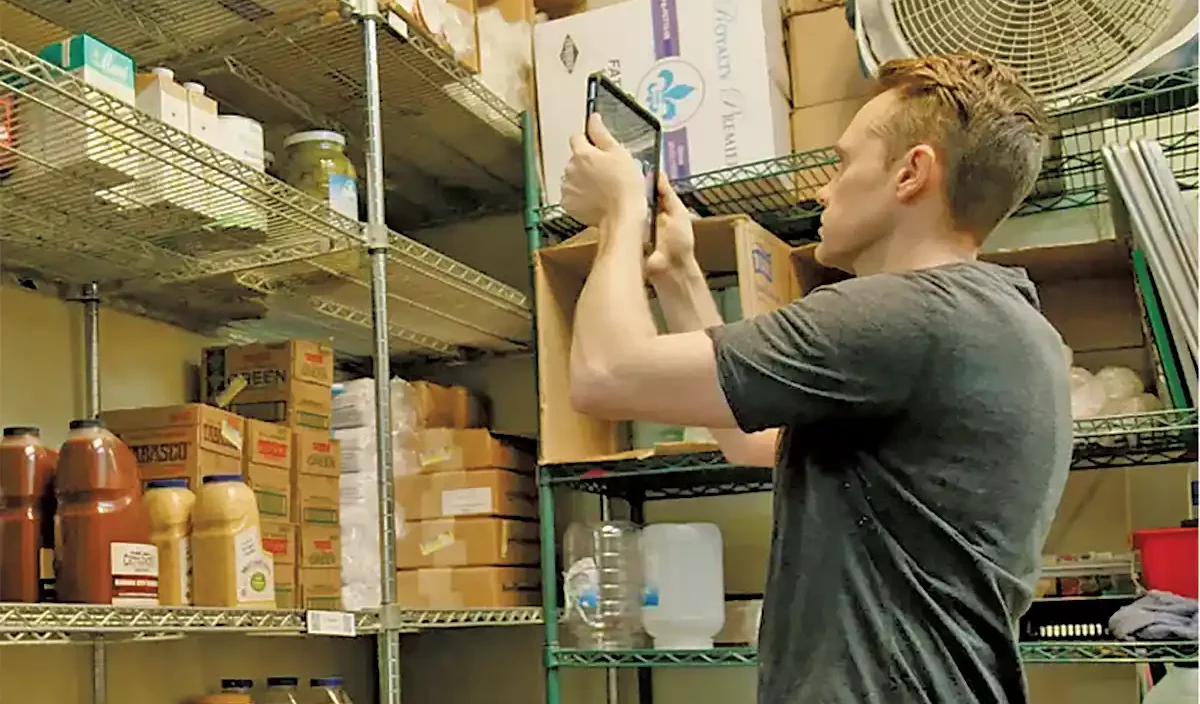
A case of chicken is pulled from refrigeration, carted through a refrigerated warehouse onto a refrigerated loading dock, and stacked inside a refrigerated truck. It’s at exactly the right temperature: 38°F. It’s in perfect condition.
Then the delivery gets delayed. The truck’s insulated door stays open way too long at the third stop of the day. Or the driver brings the order to the receiving entrance and has to wait under the hot sun for someone to check everything in. Or the kitchen is understaffed and the chicken sits in its case on the floor for a while. Or the walk-in has to be reorganized to make space. Or one of a million other delays happens—none of them all that long, none of them all that serious.
Then maybe the chicken isn’t grilled quite long enough or hot enough. Maybe it isn’t cooled quite right. Maybe it’s reheated badly or contaminated five minutes before it hits the plate.
All of these small errors can happen during that chicken breast’s journey from warehouse to plate, and every one of them is another opportunity for a pathogen to creep in, multiply, and make someone’s auntie really unhappy.
- Explain what the Flow of Food is and identify its nine stages.
- Recognize that different foods—and different ingredients in the same dish—do not always follow the same path.
- Identify cross-contamination and time-temperature abuse as hazards that can occur throughout the Flow of Food.
- Explain how separation, dedicated equipment, cleaning and sanitizing, and organized prep help prevent cross-contamination.
- Use the Flow of Food as a framework for organizing food-safety rules and identifying where problems occur in an operation.
The Flow of Food, Defined
Every item on your menu moves through some version of the same path: Purchasing → Receiving → Storing → Preparing → Cooking → Holding → Cooling → Reheating → Serving. Not every dish hits all nine stages—a bag of chips only goes through four: purchasing, receiving, storing, and serving—but anything cooked from scratch touches most or all of them. You’re responsible for food safety at every stage, because every moment on this path creates another opportunity for contamination or time-temperature abuse.

Cross-contamination is the transfer of pathogens from one food or surface to another. It does not require a visible mess, and it becomes especially dangerous when pathogens reach ready-to-eat food that has no cooking step left to destroy them.
Time-temperature abuse happens when food spends too much time at temperatures that allow pathogens to grow.
Those two problems do not belong to one station or one moment. They can show up almost anywhere along the flow of food—from purchasing and receiving through storage, preparation, cooking, holding, cooling, reheating, and serving.
Preventing Cross-Contamination Across the Whole Flow
Preventing cross-contamination comes down to keeping raw food, ready-to-eat food, equipment, and work surfaces from carrying pathogens from one job to the next:
- Keep raw and ready-to-eat food separated during storage and preparation.
- Use separate equipment for raw and ready-to-eat food whenever possible. Dedicated cutting boards, utensils, and prep containers make it much harder for contamination to travel from one job to the next.
- Clean and sanitize food-contact surfaces, equipment, and utensils between tasks—especially after working with raw meat, poultry, seafood, or eggs and before switching to ready-to-eat food.
- If separate equipment is not available, prep at different times: ready-to-eat food first, then raw meat, poultry, seafood, or eggs after the equipment has been cleaned and sanitized.
- Buy food that requires less handling when it helps reduce unnecessary prep. Pre-washed greens and pre-portioned proteins mean fewer handling steps and fewer opportunities for contamination.
One system a lot of kitchens use to make separation easier is color-coded cutting boards: yellow for raw poultry, red for raw meat, green for produce, for example. The color gives everyone in the kitchen an immediate visual cue about what that board is used for.

How Things Go Wrong
Our primary concern is keeping pathogens out of food where they could do some serious damage, right? Let’s take the whole Flow of Food process out of the restaurant and into your house. I want you to see how it works in a simple environment before I throw you into a commercial kitchen and start attaching formal names and definitions to each stage.
Pretend you’re home from college for the weekend and decide to make grilled cheese sandwiches for the family. [1] You start with a loaf of homemade bread from the lady down the street who is thinking about opening a bakery… one day. It looks tasty and besides, it was free! You take it home and start inventorying the fridge for supplies. No cheese. [2] You order an emergency cheese delivery. The package has a little tear in it, and is a slice missing? Maybe the delivery guy helped himself to a snack. Whatever. You’re making lunch.
[3] You open the refrigerator and grab the butter, sitting on its little plate beneath a package of thawing chicken. [4] Then you start putting sandwiches together. You don’t wash your hands because the first one is probably going to your brother. He doesn’t deserve that much effort. The kitchen is cleaner than normal, and you plop the bread on the counter, then go to town, smearing butter on both sides. [5] The sandwiches hit the pan. You cook them until they look done because you have absolutely no idea whether there is a temperature you’re supposed to be checking, and you aren’t about to look it up.
[6] By now, almost everyone is home, and there is a twenty-minute rock-paper-scissors match between your brother and your sister’s husband over who gets the first sandwich. During negotiations, the dog wanders over and licks the plate. You decide on the spot: that is your sister’s plate. She made fun of your shirt. [7] You made extras for the nieces and nephews, who are wandering around the kitchen and generally getting in the way. Those sandwiches are cooling on the counter, ’cause little kids don’t like super hot food, right?
[8] Your dad’s sandwich goes into the fridge, and a few hours later you pop it into the microwave, proud of yourself for being thoughtful. Then a TikTok dance-off breaks out. Your dad refuses to do anything—he just stares at you, your siblings, and the little kids with eyebrows of judgment. Thirty minutes later, you remember his dinner and warm it up again. [9] You slide it onto your sister’s plate after a quick paper-towel polish and… clean enough. Dad is moderately grateful. The dog looks disappointed. You are a hero.
Nothing in that story feels like one giant catastrophic mistake. It is a bunch of ordinary decisions made by a moderately thoughtful young adult, unaware of how the risk of getting his entire family sick keeps multiplying as food moves from one place to another. Now let’s put the actual names on those stages.
Closing Side Work
TL;DR — The Least You Need To Know
- Flow of Food: Purchasing → Receiving → Storing → Preparing → Cooking → Holding → Cooling → Reheating → Serving.
- The two recurring hazards are cross-contamination and time-temperature abuse.
- Purchase food from approved, reputable suppliers.
- Not every food travels through all nine stages.
- Different foods—and even different ingredients in the same dish—can follow different paths.
- The same two hazards, cross-contamination and time-temperature abuse, can appear at multiple stages in different ways.
As you learn new food-safety rules, attach them to the Flow of Food instead of memorizing them as isolated facts.
You are building onto this map for the rest of the course.
Key Terms to Know
The path that food takes through your operation.
Purchasing food from approved, reputable suppliers.
Inspecting food when it arrives and deciding whether it meets receiving standards.
Keeping food protected from contamination and under proper time-temperature control until it is needed.
Handling and preparing food while preventing cross-contamination and controlling time and temperature.
Cooking food to the required minimum internal temperature for the required amount of time.
Keeping food at the correct temperature and protected from contamination while it waits for service.
Cooling cooked food quickly enough to control pathogen growth.
Heating previously cooked food correctly before service or hot holding.
Protecting food from contamination as it is served.
The transfer of pathogens from one food or surface to another.
Food being handled in a way that allows it to remain too long at temperatures where pathogens can grow.
A supplier that has been inspected and meets applicable local, state, and federal laws.
Hack the Exam
ServSafe Manager questions often build a situation where the employee or manager does something that sounds reasonable. That is what makes the question difficult: reasonable is not always correct.
Read past the surface reaction. Follow what happened, in what order, identify the actual hazard, and then decide what the manager should correct. Exam writers use believable details to make the wrong answer feel responsible.
Question 1 — Right Reaction or Over Correction?
A cook slices tomatoes on a cutting board, then uses the same board to prep raw chicken without first cleaning and sanitizing it. Realizing the mistake, the cook throws out the chicken, gets a clean board, and starts over.
What should the manager do?
- Approve the correction because raw chicken should never touch a surface used for ready-to-eat food.
- Explain that discarding the chicken was unnecessary and review why raw and ready-to-eat foods are kept separate.
- Throw out the tomatoes because the board was later used for raw chicken.
- Require the cook to discard both foods whenever raw and ready-to-eat food use the same equipment.
B — Explain that discarding the chicken was unnecessary and review why raw and ready-to-eat foods are kept separate.
The cook correctly recognized that the board should have been cleaned and sanitized between tasks. The unnecessary step was throwing away the chicken. The tomatoes were already off the board before the raw chicken was placed there, so the later use of that board did not contaminate the tomatoes.
Giving you an employee who recognizes a real procedural mistake but overcorrects by throwing away food unnecessarily.
The tomatoes were sliced and removed before the raw chicken went onto the board.
Seeing “raw chicken + ready-to-eat food + same cutting board” and assuming food automatically has to be discarded.
Trace the sequence. Ask what touched what, in what order, and whether the food you are worried about was actually exposed to the hazard.
Question 2 — Straight Off the Boat
The seafood supplier shorts the grouper order. The chef’s longtime friend, a retired professional fisherman, offers several fish he caught that morning, iced and in beautiful condition, and the chef decides to run them as a special in place of the grouper.
What should the manager do?
- Use the fish if their temperature and condition are acceptable.
- Use the fish if the chef records who caught them and when.
- Do not use the fish because they were not purchased from an approved, reputable supplier.
- Cook the fish thoroughly before serving them.
C — Do not use the fish.
The fish may be fresh, cold, beautiful, and caught by someone who spent years fishing professionally. None of those facts makes the source approved. Food must be purchased from an approved, reputable supplier.
Surrounding the actual purchasing failure with several details that make the food sound trustworthy.
“Retired professional fisherman” sounds impressive. It does not mean approved supplier.
Letting freshness, experience, good condition, temperature, or later cooking substitute for approved sourcing.
Ask which rule controls the stage you are in. A later step in the Flow of Food cannot fix food that should never have entered the operation in the first place.