
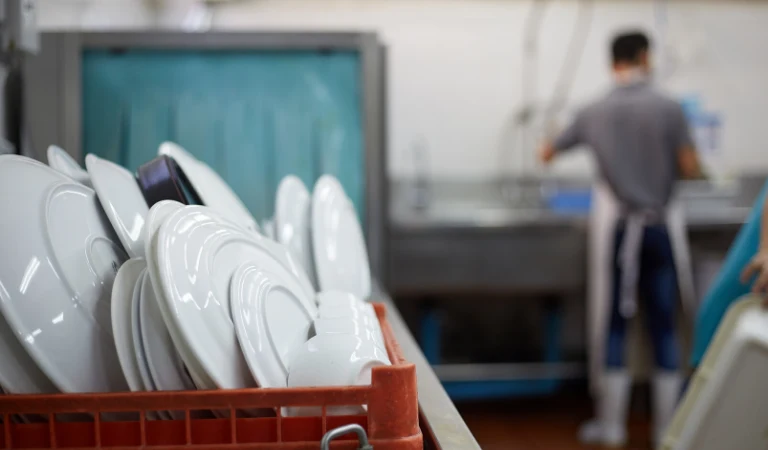
The dishmachine had been beeping all morning.
The AM dishwasher tried to get the Big Boss to come take a look, but she was buried in everything else happening in the kitchen. Finally, about an hour into lunch, the dishwasher had enough of the noise and flipped the alert switch to OFF.
Problem solved.
Hours later, the lunch rush finally slowed. There was a shift change. The new staff started prepping for dinner while the AM crew cleaned up and got ready to leave. And the whole time, the machine kept running. Racks went in dirty and came out clean. Plates looked good. Glasses were clear. Everything seemed to be working exactly the way it was supposed to.
At 4:00 PM, the night dishwasher took over the station and started getting ready for his shift. He sprayed down and squeegeed the dish run, emptied and refilled the machine, got detergent refills ready, and made sure there was backup sanitizer on top of the machine.
While he was setting up, he saw the sanitizer dispenser blinking. A second later, he found the alert switch sitting on OFF.
“Did you turn this off?”
The AM dishwasher shrugged. “Yeah. I told the Big Boss about it. It wouldn’t shut up, so I turned it off for a while.”
The AM dishwasher flipped the alert back to ON, and the machine immediately started screaming again—an obnoxious beeping that rang through the kitchen.
Soon, the Big Boss, the PM dishwasher, and a line cook with his phone out and a Google search on the screen discovered three things in rapid succession: everything looked fine, there was plenty of detergent and sanitizer in the autodispensers, and nobody had any idea what was wrong with the damn thing.
So now there was a new problem. Were the dishes actually sanitized, or were they just warm and wet And how long had that been going on?

What Makes Sanitizer Work?
Here is the annoying thing about sanitizer: it’s more finicky than it has any right to be. It’s only going to make food-contact surfaces truly safe if you follow all the nit-picky rules it has about temperature, concentration, contact time, water hardness, and pH.
That is a mouthful, so instead of trying to memorize five disconnected terms, think about four questions: How hot? How strong? How long? How pure? Those four questions will get you back to everything that controls whether a chemical sanitizer actually works.
How Hot?
Temperature matters because chemical sanitizers are designed to work within specific temperature ranges. My students regularly assume hotter water is better because hot water is always better, right?
Not necessarily. A lot of chemical sanitizers are designed to work in cool or room-temperature water. Make the water too hot, and you may actually be using the sanitizer incorrectly. Read the instructions.
How Strong?
Concentration means how much sanitizer we have in proportion to how much water we have. Too weak, and it may not reduce pathogens enough—or at all. Too strong, and you may be leaving excess chemical behind or damaging equipment.
We measure sanitizer concentration in parts per million, or ppm. Do not worry about this one: all you need to know is that ppm tells you how weak or strong your sanitizer solution is and that you can measure concentration using the correct test strips or test kit.
How Long?
Contact time means the sanitizer has to stay in contact with the surface long enough to do its job. If the required contact time is 30 seconds and you remove it after five, you did not somehow complete a 30-second sanitation process.
How Pure?
This is where water hardness and pH come in. Those sound science-y and chemistry-heavy because they are. The good news is that most restaurants use a vendor to supply their cleaning and sanitizing supplies, and the pros will run the tests so you don’t have to.
The only thing you need to remember for the test is that the pH and mineral load—the hardness—of your building’s water can have a huge effect on whether your sanitizer is working or not.

Warewashing: Same Job, Two Ways to Do It
Everything we have talked about still applies. Plates, pans, utensils, and equipment have to end up clean and sanitized. You can do that by hand or by machine.
By Hand: The Three-Compartment Sink
Sometimes your expensive, fancy dishwasher is broken. Sometimes what you need to wash won’t fit inside the expensive, fancy dishwasher, no matter how hard you try to jam it in there. Looks like you’re going to have to use a three-compartment sink to get your stuff clean and sanitized.
Food-safety exams treat this simple task with the same technical precision used to design helicopter parts. It’s not actually that tricky. Here’s how it works:
1. Scrape.
Scrape any bits of food into the trash. Good job.
2. Wash.
Put the thing into the first compartment of your sink. It should be full of soapy water and pretty warm—110°F or hotter. Scrub-a-dub-dub.
3. Rinse.
Dunk that pot or pan or whatever into the second compartment and rinse off the soap.
4. Sanitize.
Now you’ve got an option: you can use a chemical sanitizer, like a quat, or you can use really hot water: 171°F or hotter for at least 30 seconds.
And 171°F is HOT. Give your dish person the proper tools to handle that safely, or they’re going to be crying.
This is why chemical sanitizers are preferred in most operations: the water doesn’t have to remove the skin from the person doing the washing. Most quats call for using room-temperature water, though not all of them do. Read the label.
5. Air-dry.
Do not use a cloth to wipe down freshly sanitized dishes. You’re just giving pathogens another chance to get back onto the surface.
Fine-dining restaurants, wedding caterers, hotels, and plenty of other operations routinely polish glassware, flatware, and place settings before service. That is completely fine. The important distinction is between drying and polishing. Freshly sanitized items still have to air-dry. Do not grab a towel and wipe the water off because you want the glasses or silverware ready faster. Once those items have air-dried, though, they can be polished with a clean, dry cloth to remove fingerprints, haze, and water spots.
The Sanitizer Numbers You Need to Know
There are three chemical sanitizers ServSafe expects you to recognize: chlorine, iodine, and quats.
This section gets dense fast, so before we look at the technical specs, here’s a big-picture overview:
- Chlorine is bleach. It kills nasty buggies the fastest. If you see 50–99 ppm or a 7-second contact time, think chlorine.
- Iodine is the brown stuff the school nurse wiped on your knee that time you fell during recess and scraped your leg. Iodine is also the low-concentration one. If you see 12.5–25 ppm, think iodine. Its contact time is 30 seconds.
- Quats are the sanitizer you’re most likely to see in a working restaurant, usually coming out of an automatic dispensing unit or dropped into the sink as dissolvable tablets. They work with room-temperature water and require 30 seconds or more of contact time to do their job. Different products have their own rules for concentration, water quality, and whatnot, so for quaternary ammonium… whatevers: read the label and follow the instructions.
That is the stuff I want sitting in your head when you walk into the exam.
Now, if you have no personal life and would like to memorize the entire ServSafe chart, here you go:
| Sanitizer | Concentration | Temperature | Contact time | Other condition |
|---|---|---|---|---|
| Chlorine | 50–99 ppm | 100°F+ if pH≤10 OR 75°F+ if pH≤8 | 7 sec+ | pH matters |
| Iodine | 12.5–25 ppm | 68°F+ | 30 sec+ | pH≤5 or manufacturer |
| Quats | Follow manufacturer | 75°F+ | 30 sec+ | hardness ≤500 ppm or manufacturer |
There. Enjoy.
But if that chart evaporates from your brain the second somebody hands you a test, come back to this:
HERE’S WHAT YOU NEED TO REMEMBERChlorine = bleach + fast: 50–99 ppm / 7 seconds.
Iodine = brown + low concentration: 12.5–25 ppm / 30 seconds.
Quats = what you’re most likely to see in a restaurant; read the label and follow the manufacturer’s instructions.
Types of Commercial Dishwashers
Commercial dishwashers get described in two different ways, and this is where the terminology starts sounding more complicated than the machines actually are.
HOW THEY SANITIZE
Let’s start with the first organizational structure: how the machine sanitizes. A high-temperature machine sanitizes with very hot water. A chemical-sanitizing machine uses a chemical sanitizer instead. Then there is the exception: a specific type of dishwasher with different rules called a stationary-rack, single-temperature machine.
Picture the dishwasher you have in your home kitchen. Now imagine that dishwasher has a bigger, more muscular cousin in the commercial world. Looks similar. Works similarly. You load a rack of dishes into the machine, the rack stays put while the cycle runs, and the machine washes and sanitizes at essentially the same temperature.
A common version is the undercounter model used behind bars to wash glasses and in TIKI HUT-style cafés near hotel pools: a little unit built for small spaces and single-rack loads. Knowing what type of dishwasher you have matters because the way the machine washes and sanitizes determines which temperature requirements apply.

HOW THEY WORK
Knowing that single fact—how the machine washes and sanitizes—is only the first half of the challenge. Restaurants ALSO describe dishmachines by what they physically look like and how the dishes move through them.
- The undercounter machine is the TIKI HUT unit we’ve talked about: designed for limited spaces, built to fit under a counter, and usually handling one rack at a time.
- A door-type machine is the larger upright version. You slide a rack in, lower the hood or door, run the cycle, then slide the rack back out.
- A conveyor machine keeps things moving. Racks of dishes travel through the machine on a conveyor from the dirty side to the clean side.
- And in very high-volume operations, you may see a flight-type or continuous-feed machine, where dishes are loaded directly onto a moving belt instead of being placed into individual racks.
You do not need to turn all of those machine designs into another giant memorization project. The important thing is understanding that there are really two different questions:

The Temperatures That Matter
Now that the machines have names, the temperature rules make a lot more sense. A high-temperature machine uses hot water to sanitize. For most of these machines, the final sanitizing rinse has to reach at least 180°F—nine degrees hotter than the 171°F we used to sanitize in the three-compartment sink.
Why hotter? Great question. When you sanitize by hand at 171°F, the item is completely submerged in hot water for at least 30 seconds. Every surface gets continuous contact with that hot water. A dishmachine does not immerse the dishes in a 30-second bath. It sprays blazing-hot water across them. The water hits the surface, runs off, and is replaced by more hot water. That gives the machine much less contact time at any one moment, so it compensates with a higher temperature.
Time and temperature work together.

Longer, sustained contact can do the job at a lower temperature. Shorter contact needs more heat. That gets us to the normal high-temp rule: Most high-temperature machines = 180°F.
Then there is the exception: the stationary-rack, single-temperature machine. That machine only needs 165°F. 165°F should sound familiar. It’s also the FDA’s highest required cooking temperature for food. And once again, the reason is time and temperature. A stationary-rack machine keeps the dishes in place and gives them more sustained exposure to the hot water. Because the exposure is longer, it can accomplish the same sanitizing job at a lower temperature.
More time = less heat. Less time = more heat.
How Do You Know the Dishwasher Is Actually Working?
A dishmachine can turn on, make noise, spray water everywhere, and still not be doing its job correctly.
That is why managers need to keep an eye on three things while the machine is running temperature, water pressure, and sanitizer concentration.
Temperature tells you whether the machine is actually reaching the temperature required for that type of machine. On high-temperature machines, the built-in thermometer measures the water temperature at the manifold. That is just the point where the hot water is being delivered into the machine through the spray system. Fancy word. Simple idea.
Water pressure matters because the water has to spray across the dishes properly. If the pressure is too low, that hot water may not reach every surface the way it is supposed to.
And if you are using a chemical-sanitizing machine, you also have to make sure the sanitizer is actually there and at the correct concentration. An empty chemical jug attached to a perfectly functioning dishwasher is still an empty chemical jug.
Check:
TEMPERATURE — PRESSURE — SANITIZER
If one of those is wrong, stop pretending the dishwasher is working correctly and fix the problem before you keep sending dishes through it.
Proving Your High-Temp Machine Is Doing Its Job
You’re the boss. You swing by the dishpit and glance at the dishwasher’s gauge. Everything seems fine. But how do you KNOW it’s fine?
A high-temperature machine can say 180°F on the display while a clogged spray arm, mineral buildup, bad loading, or some other problem keeps that heat from reaching the surface of the plates the way it should. You need a quick way to verify that the plates and cups and whatnot are actually getting hot enough. Here’s how you do that:
Use a maximum-registering thermometer, or MRT. Put it into a dish rack and send it through a normal cycle with everything else. When it comes out, the thermometer holds onto the highest temperature it reached during the cycle. You can also use heat-sensitive tape. Stick it onto an item, run it through the machine, and the tape permanently changes when it reaches its target temperature.
Both tools are doing the same job: checking what actually happened out there on the ware, not what the machine’s control panel claims happened somewhere inside the plumbing.
The gauge tells you what the machine delivered.
The MRT or tape tells you what the dishes actually experienced.
That is verification.
Protecting Clean and Sanitized Items
Congratulations, boss! You’ve got stacks of perfectly washed and sanitized plates, pots, and pans. None of that is going to be very helpful if you store them on a dirty shelf, too close to the floor, or in a way that risks recontamination. Be smart.
Keep clean dishes, utensils, and equipment at least 6 inches off the floor and store them somewhere clean, dry, and protected from splash, dust, and whatever else is floating around your kitchen. Glasses and cups go upside down. Pretty obvious why. Nobody wants whatever fell out of the ceiling vent settling into their water glass.
Flatware and utensils go handle-up. The goal is to give employees something to grab that is not the part going into somebody’s mouth. Make sure the shelves and drawers you’re putting clean stuff into are clean too. Same goes for the trays and carts you use to move dishes around. There is no prize for sanitizing a stack of plates and then putting them onto a filthy cart.
And if you have clean food-contact surfaces on stationary equipment sitting exposed between uses, cover them with protective plastic or some other shield to keep them safe until you’re ready to use the equipment again.
The rule here is painfully simple:
Once you’ve gotten something clean and sanitized, don’t screw it up.
Closing Side Work

Chef’s Explanation
The silverware is easy. It was clean, sanitized, and completely air-dried before the crew started polishing it. The cloths were clean and dry. Keep going.
The untouched, completely dry wine glasses are fine too. Once glassware has been properly cleaned, sanitized, and air-dried, using a clean, dry cloth to remove water spots or haze is polishing. There is nothing wrong with that.
The glasses they used the cloths to dry are another story.
Those glasses came out of warewashing sanitized, but they never finished air-drying. Then the crew started wiping away the remaining water. The cloths got wet, moved from glass to glass, and started leaving streaks. At that point, we no longer trust the sanitized surface.
Those glasses go back to dish.
At banquet scale, that means back through the dishmachine. You are not going to hand-sanitize hundreds of wine glasses one at a time in a three-compartment sink and somehow create enough rack space for all of them to air-dry.
The bread plates go back too, but for a different reason. If the crew is finding grime or food residue while polishing, those plates were never actually clean. Spraying sanitizer onto leftover soil does not fix that. They need the full warewashing process again.
And now the captain is in trouble. Why? There may not be a good solution.
You cannot just open a few new boxes and call it fixed. New glassware, flatware, and utensils still have to be cleaned and sanitized before they go into service. You cannot manufacture air-drying time. You cannot make rack space appear. You cannot magically create another three hundred properly cleaned, sanitized, dried, and polished pieces of serviceware because somebody needs the ballroom finished.
Maybe the operation has enough backup inventory. Maybe dish can recover part of it in time. Maybe the captain has to change the setup, delay part of the service, or make an ugly phone call.
Maybe she is simply screwed. Food safety has already given her the correct answer. Now she has to manage the consequences.
TL;DR — The Least You Need to Know
• Sanitizer control factors: temperature, concentration, contact time, water hardness, and pH.
• Three-compartment sink: SCRAPE → WASH → RINSE → SANITIZE → AIR-DRY
• 110°F = wash water minimum.
• 171°F for at least 30 seconds = manual hot-water sanitizing.
• 165°F = stationary-rack, single-temperature machine.
• 180°F = most other high-temperature dishmachines.
• Chlorine: 50–99 ppm / 7 seconds
• Iodine: 12.5–25 ppm / 30 seconds
• Quats: follow the manufacturer’s instructions.
• Dishmachine checks: TEMPERATURE — PRESSURE — SANITIZER
• MRT or heat-sensitive tape verifies what the ware experienced.
• Freshly sanitized ware must air-dry before polishing.
Key Terms
Air-dry
Let cleaned and sanitized ware dry on its own. Do not towel-dry freshly sanitized items.
Chemical-sanitizing machine
A commercial dishmachine that uses a chemical sanitizer rather than very hot water for the sanitizing step.
Chlorine
A chemical sanitizer commonly associated with bleach. In this lesson: 50–99 ppm and at least 7 seconds of contact time.
Concentration
The amount of sanitizer in proportion to the amount of water.
Contact time
The amount of time sanitizer must remain in contact with a surface to work properly.
Conveyor machine
A commercial dishmachine that moves racks of dishes through the machine on a conveyor.
Door-type machine
An upright commercial dishmachine where a rack is slid into the machine, the hood or door is lowered, and the cycle runs.
Flight-type / continuous-feed machine
A high-volume dishmachine where dishes are placed directly onto a moving belt rather than into individual racks.
Heat-sensitive tape
Tape that changes when it reaches a target temperature, used to verify what ware actually experienced inside a high-temperature dishmachine.
High-temperature machine
A commercial dishmachine that sanitizes with very hot water.
Iodine
A chemical sanitizer used at a relatively low concentration. In this lesson: 12.5–25 ppm and at least 30 seconds of contact time.
Manifold
The point where hot water is delivered into a dishmachine through the spray system; the built-in thermometer on a high-temperature machine measures water temperature there.
Maximum-registering thermometer (MRT)
A thermometer that records and holds the highest temperature it reaches during a dishmachine cycle.
Parts per million (ppm)
The unit used to describe sanitizer concentration.
pH
A measure of how acidic or alkaline water is. pH can affect how well some sanitizers work.
Polishing
Using a clean, dry cloth on ware that has already been properly cleaned, sanitized, and air-dried to remove fingerprints, haze, or water spots.
Quats / quaternary ammonium compounds
Common restaurant sanitizers. Concentration and other requirements vary by product, so follow the manufacturer’s instructions.
Sanitizing
Reducing pathogens on a cleaned surface to safe levels through heat or approved chemicals.
Stationary-rack, single-temperature machine
A dishmachine in which the rack stays in place and the machine washes and sanitizes at essentially the same temperature. The sanitizing temperature in this lesson is 165°F.
Test strips / test kit
Tools used to check the concentration of a chemical sanitizer.
Three-compartment sink
A manual warewashing setup used to wash, rinse, and sanitize items before they air-dry.
Undercounter machine
A compact commercial dishmachine designed to fit under a counter and usually handle one rack at a time.
Verification
Checking that the system actually worked, not merely assuming it did. For a high-temperature dishmachine, an MRT or heat-sensitive tape verifies what the ware experienced.
Warewashing
The process of cleaning and sanitizing dishes, utensils, equipment, and other food-contact items.
Water hardness
The mineral content of water. Excess hardness can affect how some sanitizers perform.