
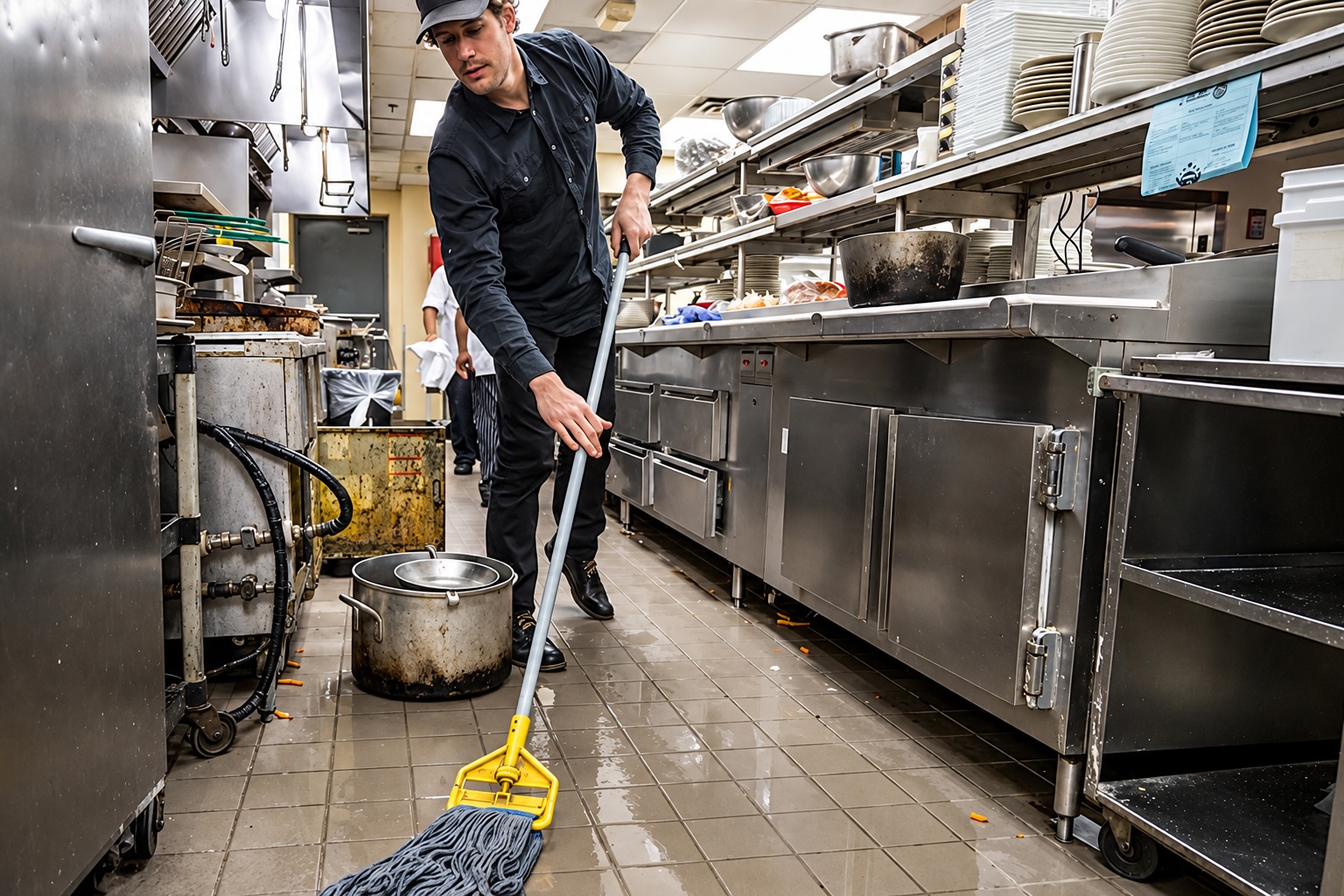
Carlos got his first job at Cafe Italiano when he was 16. He started in Dish, moved to prep after high school, then the line, then was quickly promoted to shift lead, and eventually sous chef. Ten years after his first day, Carlos knew that building better than anybody.
He knew the drain beside Dish tended to slow down if nobody stayed on top of it. He knew grease collected behind one particular screen on the cookline. He knew which corner of the walk-in always seemed to stay damp. He knew when the dishmachine needed to be descaled, when mop heads needed replacing, what needed to be pulled away from the wall every week, and which little crevice would become disgusting if somebody didn’t scrape it clean.
When checking his staff out at the end of each night, he would remind them—good-naturedly and with a little humor—“Hey, before you leave, pull that little panel out and clean behind it.” Another night he’d point toward Dish and say, “Don’t forget that drain. It tends to clog. Hit it with some boiling water and baking soda and it’ll stay working.” The next evening it would be something else. A couple of somethings. Each got extra attention when Carlos worked, and the operation stayed spotless.
His staff had long grown accustomed to the way things were. Carlos was well liked, and he worked his butt off. When he asked somebody to handle something and they weren’t sure what he meant, they would ask, and Carlos would explain—step by step—exactly how to get the job done. Nobody minded, because Carlos wasn’t standing around pointing while everyone else worked. He was right there doing plenty of the dirty work himself.
Eventually, all that drive, experience, and leadership earned Carlos exactly what you’d expect: a major promotion and his own store in the Carolinas. The team threw him a going-away party. There were speeches, hugs, and more than a few people crying before the night was over.

Post-Carlos, the restaurant did not suddenly become dirty. The floors still got mopped. The line still got broken down. Dish still washed the pots, cleaned the sinks, and ran the machine. Everybody kept doing the obvious daily cleaning because everybody already knew those jobs belonged to them.
What disappeared were the maintenance-cleaning tasks. Carlos had been the schedule, the reminder, the trainer, and the guy who noticed when something hadn’t been done and found somebody to do it.
A few months after Carlos left, the restaurant received its first negative health inspection in five years. Chef… well, chef kinda lost his mind.
CHEF: “What the hell happened around here? What happened to the cleaning program?”
He started digging. He had a long conversation with Carlos’ replacement. The new sous had no idea. Then he talked with the rest of the staff, one at a time, and kept getting some version of the same answer: “Carlos did that stuff.”
Except Carlos hadn’t actually done it all. Carlos had BEEN their cleaning program. And these days, Carlos was running a restaurant in the Carolinas. It was probably spotless.
And Cafe Italiano had a serious problem.
Wiping Cloths
We’re going to start off this lesson talking about the single most common cleaning tool in the commercial kitchen: washcloths. You know the ones: tucked into apron strings, floating in red sanitizer buckets, folded neatly on worktables, tossed into a pile on the edge of the line… These wiping cloths are super useful. They can also become an independent pathogen delivery system. They’re damp, frequently warm, and used on all KINDS of things if the cook flopping them around isn’t careful. These guys have their own set of rules to keep them from killing somebody’s grandad.
If you’re using a wet wiping cloth on food-contact surfaces—counters, equipment, or work tables—it needs to live in the proper sanitizer solution between uses.

Not on your shoulder. Not tucked into your apron strings. Not folded neatly beside your cutting board. In the sanitizer bucket.
And if you’re using a wiping cloth around raw meat, poultry, or seafood, keep that cloth separate from the ones being used on other surfaces. A rag that just wiped up raw chicken juice does not get to wander over and start wiping down the cutting board where you’re chopping romaine lettuce.
Dry wiping cloths are different. Those are the clean, dry cloths you might use to polish a plate rim before it goes into the window or wipe a small food spill from tableware.
The important part is that they stay dry and free of visible food debris. Once the cloth is wet, greasy, full of crumbs, or visibly dirty, grab a clean one.
So the distinction is simple:
Cleaning Tools and Dirty Water
Your cleaning tools need a home too. Mops, brushes, brooms, squeegees, buckets, and all the other glamorous equipment that keeps your restaurant from turning into a swamp should be stored in a dedicated area where they can dry properly and stay out of the way of food, clean equipment, and utensils. That area needs good lighting, and tools should be hung up whenever possible instead of left sitting in a wet pile on the floor.
Why hang them up? Because roaches and other pests absolutely LOVE damp mops. It is the perfect combination of safe, warm, moist, and usually a little bit of tasty food—just puddled on the floor waiting for them like a Holiday Inn Express for pests.
Once those tools are dry and stored properly, there is still one more cleaning problem to solve: where do you fill the mop bucket, rinse the mop, and dump all that filthy water when you’re finished? That’s what the service sink is for—the sink for gross jobs. This is where you fill mop buckets, rinse out cleaning tools, and dump dirty mop water.
Here’s the rule: do not dump dirty mop water into the handwashing sink, the prep sink, the three-compartment sink, or the toilet. And do not carry it outside and toss it onto the pavement. Dirty cleaning water belongs in the service sink or an approved floor drain. It’s a simple rule:
Cleaning Chemicals: Useful, Dangerous, and Not Food
Cleaning chemicals are supposed to make the restaurant safer. They can do exactly the opposite if somebody gets sloppy with them.
First rule: use chemicals approved for use in a foodservice operation. Your restaurant is not the place to experiment with whatever industrial solvent somebody found in the maintenance closet. And if you do not need a chemical, do not keep it around. Every extra bottle is one more thing that can leak, spill, get mixed up, or end up somewhere it does not belong.
When you’re using chemicals in the operation, make sure to protect the food first. Move or cover food, utensils, equipment, and other food-contact items so you are not spraying cleaner all over tomorrow’s mise en place. Then, when you’re finished, clean and sanitize the affected food-contact surfaces as required before they go back into service.
Storage matters too. Chemicals need to be kept separate from and below food, equipment, utensils, and linens. Gravity is undefeated. If that bottle leaks, you want the chemical going toward the floor—not down through three shelves of food.
Store chemicals in their original containers. If you transfer some into a smaller working container for use, label that container with the common name of the chemical.
Nobody should have to pick up an unlabeled spray bottle and play: “Is this glass cleaner, sanitizer, degreaser, or something that removes fingerprints permanently?” For studying, the storage rules can be organized into three simple rules:

Safety Data Sheets: Yes, This Is on the Test
For ServSafe, know that the operation needs a Safety Data Sheet, or SDS, for the chemicals on the premises and that employees need to be able to get to those sheets. And if you’re wondering what an OSHA chemical-safety document is doing in the middle of a food-safety course, you’re asking a perfectly reasonable question.
The connection is mostly this: restaurants use a lot of chemicals. Degreasers, delimers, sanitizers, oven cleaners, dishwasher chemicals… and managers are responsible for making sure employees know how to use those chemicals safely and what to do when something goes wrong.
An SDS tells you things like:
- what hazards the chemical presents;
- how to handle and store it safely;
- what PPE may be needed;
- what to do after a spill or accidental exposure;
- and what first aid is required if somebody gets it in their eyes, on their skin, breathes it in, or swallows it.
The sheets also have to be accessible to employees. Not locked in an office. Not buried in somebody’s email. Accessible.
If your utility splashes delimer into his eyes while trying to get the calcium scale off the dishwasher and is spinning in circles screaming in pain, that is NOT the moment you want to discover nobody knows where the SDS binder is stored.
Or if you even have one.
ServSafe may ask about SDS sheets in ways that feel more like workplace-safety trivia than food safety.
Remember these three things:
OSHA requires them.
First-aid information is on them.
If somebody gets exposed to a chemical or there’s a spill, the SDS tells you what to do.
Build a Cleaning Program That Gets Things Done
Here’s something you learn after enough years in the kitchen: if a cleaning job belongs to everybody, it belongs to nobody. If you want the place to stay clean, there is a pretty simple system to making that happen. Here’s an overview before we get into the details:

Ask
Start by asking the people who actually do the work. Your dishwasher knows which drain starts smelling funky first. The cook who breaks down the slicer every night knows exactly where meat and cheese get packed into those weird little crevices. The porter probably knows which corner stays wet and which mop head should have been thrown away three weeks ago.
Take what they say seriously. Incorporate their knowledge and experience. You’d be stupid not to.
Train
Then start training. Don’t hand the new guy a bottle of delimer, point at the dishmachine, and say, “You got this.” Show him what gets taken apart, which chemical gets used, how much, where it goes, what PPE he needs, and what the machine should look like when he’s finished.
Write
Once everybody knows what they’re supposed to be doing, write it down. Somebody has to decide what gets cleaned, who is doing it, when it gets done, and exactly how the job is supposed to be done. And that somebody needs to write it down, laminate it, and post it all over the kitchen. That is your master cleaning schedule.
“Clean the kitchen” is useless. “Dish delimes the dishmachine every Friday after lunch using the manufacturer’s procedure” is an actual instruction somebody can follow.
Manage
And finally, manage the thing. Your staff is great. They are! But they get tired. They forget. Trust but verify is a handy mental hook.
Walk the kitchen. Check the work. Make sure the jobs are actually getting done. If something keeps getting missed, figure out why. If the menu changes, the equipment changes, or you discover some greasy little nightmare hiding behind the fryer every Thursday morning, change the schedule.
CLOSING SIDE WORK

CHEF’S EXPLANATION
A lot went right here. Marcus covered two stations. Then he saw Dish getting murdered and jumped in without being asked. The rest of the crew kept moving. Nobody decided, “Screw it, somebody else can deal with that fryer.” Everybody was trying to get a bad night across the finish line. The culture of Cafe Italiano is excellent.
Here’s the reality: a great cleaning program does not mean every job gets done perfectly every night, no matter how badly the shift goes. That’s a fantasy, on par with servers never nabbing a French fry mid-shift and sous chefs with normal-sized egos. Restaurants are messy. People call out. Equipment breaks. Somebody gets buried. Priorities change.
This is also reality: the fryer was supposed to be cleaned and it wasn’t. But the next morning’s check revealed the problem. The immediate issue could be fixed: the chicken tenders did not sit back there for three days waiting for a roach to find them.
More importantly, the right questions could be asked. What could have easily become a shrugged, mumbled “I did my best” from Marcus became an opportunity to thank him for his initiative while also correcting the error so, on a regular night, it doesn’t happen again.
The problem wasn’t that Marcus helped Dish. The problem was that once the shift changed shape, ownership got fuzzy. Marcus thought somebody else would absorb the fryer. Another cook thought Marcus still owned it. Dish thought Marcus was staying to help close. Everybody had a different version of the plan.
And Dish being pissed makes sense too. He got buried, Marcus helped dig him out, and then Dish still wound up there until 2:00 a.m. But Marcus jumping into the pit during the rush did not automatically make him responsible for closing Dish all night too. That expectation was never actually discussed. Once again, everybody was operating from a different version of the plan.
Please understand: I am not suggesting that on busy nights you can throw away a cleaning-program schedule and timeline, or that a rough shift earns an “I’ll do it tomorrow” attitude. Not at all. This scenario has one goal: to highlight, in a real-world way, how managing a cleaning program is about managing people. And managing people can get messier than a puddle of grease behind a fryer fast.
TL;DR
- A clean restaurant does not stay clean because everybody has good intentions. The operation needs clear rules for wiping cloths, cleaning tools, dirty water, chemicals, and the people responsible for making the whole system happen.
- For wiping cloths, remember the distinction: wet cloths live in sanitizer between uses, cloths used around raw animal foods stay separate, and dry cloths stay dry and clean.
- Cleaning tools need their own storage area where they can dry properly and stay away from food and clean equipment. Dirty mop water belongs in the service sink or an approved floor drain.
- Cleaning chemicals need control too. Use chemicals approved for foodservice, protect food and food-contact items while chemicals are being used, and remember ORIGINAL. BELOW. LABELED. Store chemicals in their original containers, keep them below food and food-contact items, and label working containers with the chemical’s common name.
- The operation also needs accessible Safety Data Sheets (SDS) for its chemicals. SDS sheets provide chemical-safety information, including hazards, handling, PPE, spill response, exposure response, and first aid.
- A cleaning program has to be managed, not merely hoped for. Use ASK → TRAIN → WRITE → MANAGE. Ask the people doing the work, train them correctly, write the jobs into a master cleaning schedule, and manage the system so it keeps working when people, equipment, menus, or conditions change.
- A master cleaning schedule should answer four questions for every job: WHAT? WHO? WHEN? HOW?