
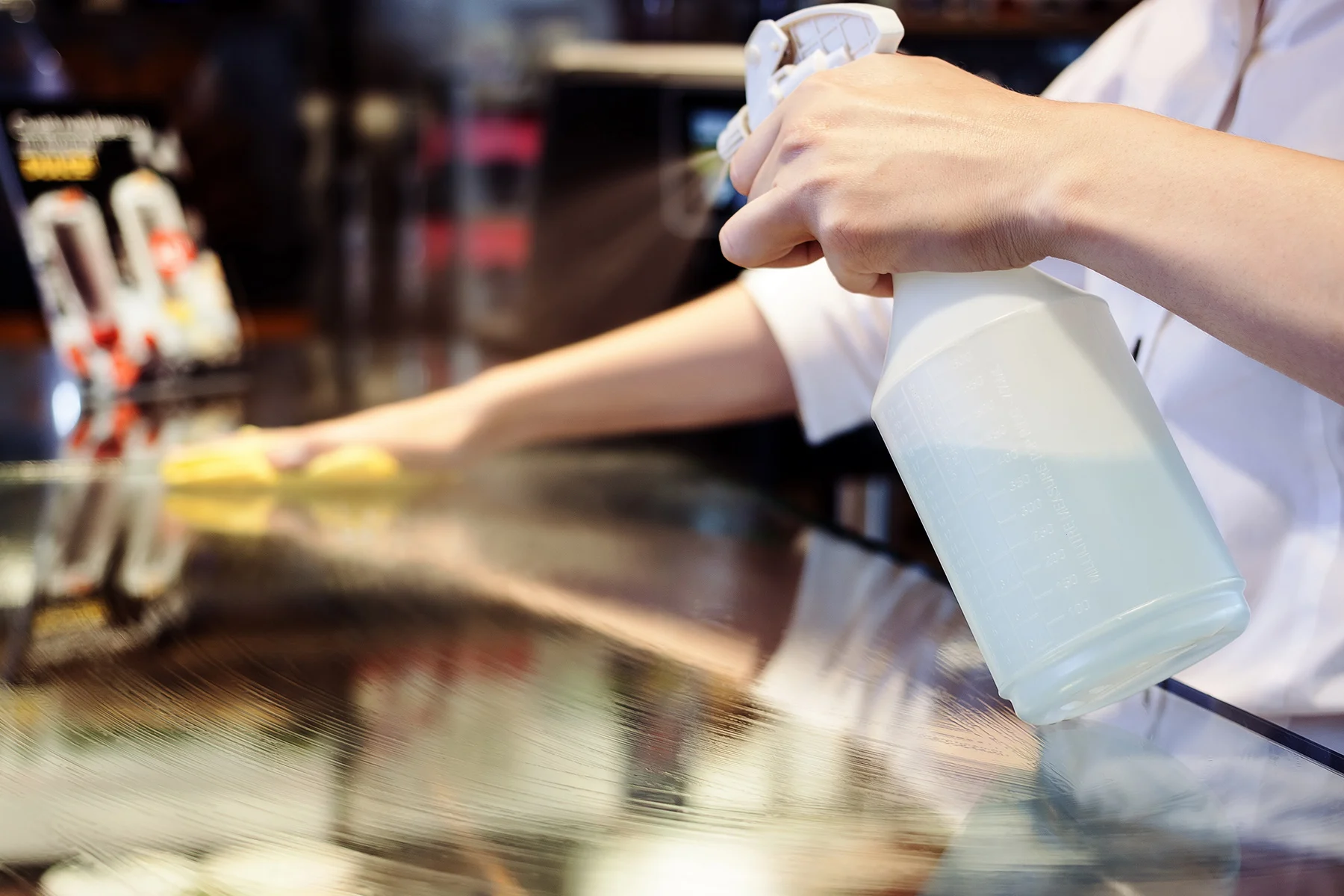
It’s a random day in a random week. A random cook grabs a wiping cloth out of a sanitizer bucket and goes after the mess on his prep table.
There is flour on it. A little chicken juice. Maybe. Some dried sauce from the prep he did earlier in the day. Somehow, there is also a greasy handprint, preserved in the one shiny section of the stainless steel.
He wipes the whole thing down, stands back, and proudly announces: “Sanitized.”
No, my adorable little chefflette, it is not. You made the dirt wet.
A sanitizer is not a magic eraser. You can’t mist it over a greasy work table, wipe it down, and declare victory. You cannot look at a cutting board, see no visible food, and declare it pathogen-free. And you definitely can’t grab whatever nuclear-strength chemical is under the sink and assume that stronger must mean better—or safer.
Professional kitchens handle this as a system. Different surfaces need different treatment. Different contamination problems require different chemicals. Food-contact surfaces have a specific sequence. And sometimes the clock tells you to clean something even when it still looks perfectly fine.
Once you understand the system, most of the individual rules stop feeling random. And that is what we’re after.

Cleaning and Sanitizing Are Two Different Jobs
Soap, detergent, hot water, and scrubbing can remove food, grease, residue, and visible mess. That is cleaning. Cleaning is necessary, and cleaning can leave surfaces looking shiny and new… but shiny and new-looking do not necessarily mean safe.
Consider a cutting board that was just used to dice up a case of chicken. You can put it in a soapy sink, scrub away the grease, give it a good rinse, and leave it to air dry… and you might think, “That cutting board is good to go.”
You might be wrong.
The board can look spotless and still have pathogens on it. You cannot see Salmonella. You cannot smell it. You cannot look at a clean cutting board and decide whether the pathogen level has been reduced enough to make that surface safe for the next job.
That is why a commercial kitchen treats cleaning and sanitizing as two separate jobs. Cleaning removes the food, grease, and residue. Sanitizing reduces the pathogens on that cleaned surface to safe levels.

Cleaners: Four Names You Need to Know
Whatever cleaner you use, ServSafe says it should be stable, noncorrosive, and safe to use.
There are four common types of cleaner you need to recognize:
FOUR CLEANERS
| Cleaner | Main job |
|---|---|
| Detergent | General cleaning and ordinary food residue |
| Degreaser | Grease and oily buildup |
| Delimer | Mineral deposits and scale |
| Abrasive cleaner | Stubborn or baked-on residue that needs friction |
Some of these names are pretty self-explanatory. Degreaser removes grease. Delimer removes lime and mineral scale—the chalky white buildup you might see around a faucet, inside a dishmachine, or on equipment exposed to hard water. Abrasive cleaners help scrub away stubborn, baked-on residue.
The important part is matching the cleaner to the problem. If the inside of the dishmachine is covered in white mineral scale, adding more detergent isn’t going to fix it. You need a delimer. If you’re fighting a layer of grease around the fryer, that’s a job for a degreaser.
For this one, there really isn’t much more to explain. Know the four cleaner types and what each one is designed to remove.
Regular mess? DetergentGrease? DegreaserScale? DelimerBaked-on crud? Abrasive
Food-Contact and Nonfood-Contact Surfaces
Once you know the difference between cleaning and sanitizing, the next question is: does this surface normally touch food?
If the answer is yes, it is a food-contact surface. Cutting boards, knives, prep tables, slicer blades, mixing bowls, pans, utensils, and the inside of food equipment? All food-contact surfaces that need to be cleaned, rinsed, and sanitized.
If the answer is no, it is a nonfood-contact surface. Floors, walls, ceilings, the housing of food equipment—like the base of a mixer or the power knob and control panel of a griddle—hoods, ventilation units, the exterior of ice machines, soda dispensers… they aren’t food-contact surfaces because the things we eat never touch them.
They still have to be cleaned, though. Grease, dust, and food residue can build up and attract pests, but they do not need routine sanitizing. That word routine matters. There are some higher-risk situations where even a nonfood-contact surface may need to be disinfected.
The easiest way to classify the surface is still the obvious question:
Does food touch it?
Sanitizing and Disinfecting Are Not the Same Thing
Here’s an important distinction: sanitizing and disinfecting are wildly different things. Sanitizing reduces pathogens on a surface to safe levels. Disinfecting goes MUCH further. It destroys or irreversibly inactivates bacteria, fungi, and viruses, though not necessarily bacterial spores.
You know that weird smell that seems to permeate a dentist’s office or most veterinary clinics? That smell is often disinfectant. Those environments use much stronger antimicrobial chemicals because they are dealing with a very different level of contamination risk.
Sounds pretty good, doesn’t it? “If it kills more, why don’t we disinfect everything?” you ask.
Stronger isn’t better. If I want to relight the pilot on my stove, I could use a blowtorch. Or I could use a lighter. The blowtorch is certainly stronger… but it is definitely not better.
Disinfectants can leave residues that are not suitable for routine food-contact use, and using disinfectants willy-nilly in a working kitchen adds chemical exposure without giving us a food-safety benefit we actually need.
Routine food-contact work is handled by cleaning and sanitizing. Disinfecting is reserved for situations where sanitizers are not enough to control the pathogen risk.
Here are two common situations when you’re going to need disinfectant in a restaurant:
- contamination with vomit, fecal matter, blood, or another disease-transmitting bodily fluid;
- a foodborne illness outbreak or imminent health hazard.
And this is key: if you’ve got one of these situations going on, disinfection is not limited to food-contact surfaces. If somebody throws up on the bathroom floor, it needs to be disinfected even though food never touched it.
When you do use a disinfectant, be smart about it: use an EPA-registered product, follow the label directions, use the correct concentration, and verify that concentration with the proper test kit or measuring device. If it is used on a food-contact surface, rinse it with potable water afterward unless the label instructions tell you otherwise.

When Somebody Gets Sick in the Restaurant
Most spills in a restaurant are annoying. Vomit, diarrhea, blood, and other potentially infectious bodily fluids are different.
If somebody throws up in the dining room, this is not a “grab a mop and get it over with” situation. The operation needs a written cleanup procedure, and employees need to know what that procedure says before somebody gets sick.
The exact procedure is going to depend on the operation and the products being used, but the basic idea is the same: contain the mess, protect the person cleaning it up, remove the contamination, disinfect the affected area, and keep anybody else from wandering through it while you’re working.
This is also one of those times when disinfectant comes back into the picture. Ordinary sanitizer is not the right tool for a vomiting or diarrheal event. And remember: the contaminated surface does not have to be a food-contact surface. If somebody gets sick on the bathroom floor, that floor still needs to be handled as a serious contamination event.
The Five-Step Cleaning and Sanitizing Sequence
For a food-contact surface, the basic sequence is:
SCRAPE → WASH → RINSE → SANITIZE → AIR-DRY
This one is worth committing to memory exactly in order.
FIVE-STEP CLEANING AND SANITIZING SEQUENCE
| Step | What happens |
|---|---|
| 1. Scrape | Get food bits and loose debris out of the way. |
| 2. Wash | Use the correct cleaner and enough friction to remove the mess. |
| 3. Rinse | Remove loosened residue and cleaner with clean water. |
| 4. Sanitize | Use heat or chemical sanitizer correctly. |
| 5. Air-dry | Let the item dry without wiping it with a towel. |
Remember what the middle three jobs are doing:
WASH gets the mess off.
RINSE gets the cleaner off.
SANITIZE deals with pathogens.
Do not rinse after sanitizing. Do not towel-dry after sanitizing. Let the sanitized surface air-dry.

Stationary Equipment Uses the Same Logic
A deli slicer, mixer, or other large piece of equipment cannot simply be carried over and dunked into a sink. That does not mean it gets a completely different cleaning system. First, make it safe to work on and make the food-contact surfaces reachable.
Unplug it when required for safe cleaning. Remove the parts designed to come off. Wash, rinse, sanitize, and air-dry those removable parts. Then remove food and residue from the fixed surfaces and wash, rinse, sanitize, and air-dry the food-contact surfaces that stay attached. Reassemble the equipment only after everything is dry.
The important part here is that this is not a new cleaning procedure. The only thing stationary equipment adds is safe access to the surfaces you need to clean.

So When Do I Have to Clean This Thing?
Most cleaning-and-sanitizing rules are triggered in one of two ways: the clock tells you it is time, or something happens that means the surface needs to be cleaned and sanitized again.
Sometimes that means a food-contact surface has been in constant use for four hours. Sometimes it means CIP equipment has reached its daily cleaning schedule. And sometimes there is no clock involved at all—something changed, the task was interrupted, or the surface may have become contaminated.
The easiest way to think about this section is:
four-hour constant use and the daily CIP schedule.
something happened that requires cleaning and sanitizing.
The Four-Hour Rule
Most cleaning-and-sanitizing triggers happen because something was used, changed, interrupted, or contaminated. The four-hour rule is different. Just like single-use gloves have to be changed every four hours when you’re continuously doing the same task, that same four-hour clock shows up again with the food-contact surfaces and equipment you’re using.
Nothing has to look dirty. Nothing has to smell bad. Nobody has to make a mistake. Four hours of constant use is the trigger.
If a food-contact surface or piece of equipment stays in constant use, it has to be cleaned and sanitized at least every four hours. If you’re chopping onions on the same cutting board for five hours, that thing has to be cleaned and sanitized at hour four. If you work at a deli and have been slicing cheese on the same meat slicer for five hours, that thing has to be taken apart, cleaned, sanitized, and put back together at hour four.
So this is one of those rules worth putting directly into memory:
same task: 4 hours.
4 hours.
CIP Follows a Different Clock
Some equipment is designed to be cleaned in place, usually shortened to CIP. Think about the Slurpee machine at your local gas station. That icy goodness is schlepping through internal tubes, valves, and other parts the attendant can’t easily take apart, wash, and put back together. The same is true of McDonald’s shake machines, Dairy Queen soft-serve dispensers… you get the idea. Big machines dispensing food ALL DAY LONG.

CIP equipment like this is designed so cleaning and sanitizing solution can move through those internal food-contact surfaces without somebody having to tear the whole machine apart every four hours.
And this equipment follows a different clock: CIP equipment that holds or dispenses TCS food has to be cleaned and sanitized every day unless the manufacturer says otherwise. For the test, keep the two clocks separate:
Constant use: every 4 hours. CIP equipment: daily unless the manufacturer says otherwise.
Event-Based Triggers
It’s not just TIME that determines when you need to clean and sanitize equipment or tools, there are also some EVENTS which can cause food-contact surfaces to be cleaned and sanitized:
- after use;
- before working with a different type of food;
- after handling different raw TCS fruits and vegetables;
- after a task is interrupted and the items may have become contaminated.
Most of those are straightforward. Here is the one my students tend to get twisted and just a bit weird: you have to clean and sanitize food-contact surfaces when a task is interrupted and the items may have become contaminated.
Suppose you’re chopping onions. Your phone buzzes and you step away for ten minutes. While you’re gone, another cook starts breaking down shrimp right beside your station. When you come back, you do not just grab the knife and keep going.
The rule is not that something did go wrong. The rule is that something might have. Reset the tools and food-contact surfaces before you continue.

Closing Side Work

CHEF’S EXPLANATION
Jenna remembers a real rule. She just remembers it badly.
An interrupted task does not automatically mean every knife, cutting board, utensil, and work surface has to be dragged back through the cleaning system. The trigger is an interruption when the items may have become contaminated. Marco stepped away, but nobody touched his station, nothing spilled on it, and nothing happened that gave us a reason to think the knife, board, onions, or work surface had become unsafe. Nothing is happening in the kitchen that might have affected his station—everyone is either on break or away. He washed his hands before coming back. He can keep working.
Jenna’s disinfectant idea comes from the same mistake. She is treating more aggressive as if it automatically means more food-safe.
It does not.
Disinfecting is a different tool for a different level of contamination risk. Routine food-contact work is handled with cleaning and sanitizing. Disinfectant comes into play when the situation actually calls for disinfection—things like vomit, fecal matter, blood, other disease-transmitting bodily fluids, a foodborne illness outbreak, or another serious contamination event.
Nothing remotely like that happened at Marco’s station. Food-safety rules are not points you earn by doing more of them. You do the thing the situation actually requires.
Jenna knows the words. What she does not understand yet is where the rules begin and end.
TL;DR – The Least You Need to Know
- Cleaning removes food, grease, dirt, and residue. Sanitizing reduces pathogens on a cleaned surface to safe levels.
- Know the four cleaners:
- Detergent → ordinary residue
- Degreaser → grease
- Delimer → mineral scale
- Abrasive cleaner → stubborn buildup
- Food-contact surfaces must be cleaned, rinsed, and sanitized. Nonfood-contact surfaces normally only need cleaning.
- Disinfecting is for higher-risk contamination such as vomit, fecal matter, blood, outbreaks, and imminent health hazards.
- Food-contact surfaces follow: SCRAPE → WASH → RINSE → SANITIZE → AIR-DRY
- Clean and sanitize food-contact surfaces after use, when changing foods, after different raw TCS fruits and vegetables, and after an interruption when contamination may have occurred.
- Equipment and surfaces in constant use must be cleaned and sanitized at least every 4 hours.
- CIP means Clean In Place. CIP equipment holding or dispensing TCS food is cleaned and sanitized daily unless the manufacturer says otherwise.
KEY TERMS
Cleaning
Removing food, grease, dirt, and other residue from a surface.
Sanitizing
Reducing pathogens on a cleaned surface to safe levels.
Disinfecting
Using a stronger antimicrobial process to destroy or irreversibly inactivate bacteria, fungi, and viruses, though not necessarily bacterial spores.
Food-contact surface
A surface that normally comes into contact with food.
Nonfood-contact surface
A surface that does not normally come into contact with food.
Detergent
A cleaner used for general cleaning and ordinary food residue.
Degreaser
A cleaner designed to remove grease and oily buildup.
Delimer
A cleaner used to remove mineral deposits and scale.
Abrasive cleaner
A cleaner that uses friction to help remove stubborn or baked-on residue.
Air-dry
Allowing a sanitized item or surface to dry without wiping it with a towel.
CIP / Clean In Place
Equipment designed so its internal food-contact surfaces can be cleaned and sanitized without completely disassembling the equipment.
Constant use
Continuous use of food-contact equipment or surfaces; when continuously used, they must be cleaned and sanitized at least every four hours.