
The Hose Nobody Thought About
It’s 4 AM and the overnight cleaning crew is finishing up. Floors are scrubbed, mats are up, and mops are hanging in the utility room. Then, when they are getting ready to leave, one of the workers leaves a hose still connected to the wall hanging in a bucket of dirty mop water. A simple oversight.
Then, sometime between when they leave and the opening shift arrives, water pressure in the building drops.
The dishwasher arrives and fires up the dishmachine, running the last few loads left over from the previous evening’s late-night bar crowd. He smells something. Not smoke. A little burnt. A little chemical.
His first instinct is to blame the dishmachine. He turns it off, takes it apart, puts it back together. Can’t find the issue. He shrugs and keeps running loads of dishes, one after the other after the other.
The real problem is sitting several feet away.
That hose spent the night submerged in dirty cleaning water. When the building lost pressure, some of that nasty water got pulled backward through the hose and into the building’s clean-water supply.
Now the dishmachine is heating it, coating plates, glasses, and silverware with a thin film of cooked-on wastewater.
What happened? Simple: dirty water got somewhere it was never supposed to go. In the process, it created a serious health risk for everyone eating at that restaurant.
This is a water lesson, and we are going to spend the entire time learning how to recognize and prevent this from happening.

First Things First: What Is Potable Water?
Before we talk about how water gets contaminated, we need to establish a simple term: Potable water — water that is safe to drink and safe to use in food.
That is the water coming out of the faucets we depend on. It makes your ice, goes into soups and sauces, rinses produce, and runs through beverage equipment. It supplies handwashing sinks, goes into your dishwasher, and is used to clean and maintain equipment.
In a food operation, potable water is everywhere. If that water becomes contaminated, the problem becomes very serious. The water a restaurant uses touches every single food-contact surface in the establishment — from pans to plates. It MUST stay safe.
Later in this lesson, we will deal with the rules about where you can get your potable water from.
Quick Recall: The Third “Cross-” Term
When we talked about Cross-Contact vs. Cross-Contamination, there was another “cross-” term hanging around the edges of the conversation: cross-connection. These are frequently confused by students taking their first food-safety exam, so it’s worth a quick review: cross-contact has to do with ALLERGENS getting where they aren’t supposed to go. Cross-contamination is about PATHOGENS getting where they aren’t supposed to go.
Now we’re introducing the third sound-alike term: cross-connection — DIRTY WATER getting where it isn’t supposed to go.
Let’s dig in.
Four Different Kinds of Plumbing Words
I want to be very honest with you before we get into it: this section has some terminology that my students struggle to keep straight. This is where all the vocabulary gets ugly, where they start looking at me like I’ve got a grudge and making them study these plumbing terms is how I’m taking revenge.
Cross-connection. Backflow. Backsiphonage. Backpressure. Air gap. Vacuum breaker. Double check valve. RPZ.
Scribblydocious. Funkytown bi-valve. Tubular ankle monitors.
After a while, it all starts sounding the same.
Here’s the good news: we can take all of these unfamiliar terms and organize them into four simple, purpose-driven buckets. Once you know what kind of job each term is doing, you can follow the flow from one concept to the next:
That gives us a much easier way to understand the vocabulary and, hopefully, remember what all these ridiculous plumbing words actually mean.
When memorizing the terms, focus on what they are talking about: the connection, the event, the cause, or the protection. Keep those four jobs separate, and the whole mess gets a lot easier to learn and remember during a test.
CONNECTION: The Pathway
Here’s the official definition: A cross-connection is a physical connection or condition that creates a path between potable water and something contaminated.
This is not as academic as it sounds. Think back to the hose from the opening story. One end is connected to the building’s potable-water system. The other end is sitting in dirty mop water.
That hose has created a path between clean water and something filthy. That path is the cross-connection.
Nothing has to move through it yet. The risk exists because the pathway exists. Other examples might include a hose submerged in a sink, a water outlet positioned where dirty water could reach it, or equipment connected in a way that lets contamination reach the potable-water supply.
Here’s the easiest way to remember it: Cross-connection = the pathway.
EVENT: Backflow
Once a cross-connection exists, something could move through it.
Here’s your second official definition: Backflow is contaminated water moving backward through that connection and into the potable-water system.
Think back to the opening scenario: the submerged hose created the cross-connection. Even if nothing bad happened, the FACT that a hose was in dirty water and connected to the building’s potable-water supply means a cross-connection existed. When the building’s water pressure dropped and dirty mop water traveled backward through the hose and into the clean-water line, that was backflow.
That is the distinction to hold onto:
Cross-connection = the pathway. Backflow = the movement through it.
While backflow tells you what happened, it does not tell you why it happened. That comes next.
CAUSE: Backsiphonage vs. Backpressure
Backflow can happen for two different reasons, and fortunately this is one of the easier distinctions to remember: PULL or PUSH.
Backsiphonage: PULL
Backsiphonage happens when pressure drops on the potable-water side and contaminated water gets pulled backward. Think about drinking through a straw. When you suck on one end, you lower the pressure inside the straw, and liquid moves toward you. Plumbing can do something similar when water pressure suddenly drops.
That might happen because a fire hydrant gets opened nearby, a water main breaks, or some other event causes a sudden loss of pressure. It’s not terribly common — but it’s a lot less rare than we would like.
If a hose is submerged in dirty water when that happens, the plumbing can take a disgusting little sip. Here’s how I want you to remember it: Backsiphonage = PULL.
Backpressure: PUSH
Backpressure happens when something connected to the potable-water system creates enough pressure of its own to push backward into the clean-water line.
The easiest restaurant example is a soda carbonator. It is connected to the water supply and is also connected to a large, pressurized tank of CO₂. That means the soda machine is creating pressure of its own on the system.
Normally, water travels from the building into the carbonator, where it gets mixed with CO₂. But if the pressure inside the soda system becomes stronger than the pressure of the incoming water, it can push CO₂ and carbonated water backward toward the potable-water line.
That is backpressure: something on the equipment side is pushing back harder than the clean-water supply is pushing forward.
This matters because CO₂ backing into the water lines can cause all KINDS of problems. Check with your high school chemistry teacher if you don’t believe me.
The same basic problem can happen with other pressurized equipment, including pumps inside some combi ovens and boilers used in steam equipment.
Here’s the easiest way to remember it: Backpressure = PUSH.
Both backpressure and backsiphonage cause the same event — backflow. The difference is what made the contamination move backward.
PROTECTION: Break the Connection
Now we know the pathway, the event, and the two things that can cause it. The last question is: how do we break that connection or interrupt the path before contaminated water gets into the potable-water system?
There are two broad answers: AIR GAP or BACKFLOW PREVENTION DEVICE. We’re going to tackle each one separately.
Air Gap: No Connection, No Problem
An air gap is exactly what it sounds like: open air between the water outlet and whatever could contaminate it. Picture a faucet over a sink. The faucet ends above the flood rim — the highest edge of the sink before water would spill over — with empty space between the outlet and the sink below.
That empty space matters. If dirty water fills the sink, the water can’t magically hover into the open air, climb into the faucet, and push its way into the supply. No physical connection means no pathway for backflow.
That is why the easiest way to remember an air gap is:
Air gap = a gap of air between dirty and clean water.
A correctly designed and installed sink will usually have two air gaps. The first you can easily see: it is the space between the faucet and the flood rim. The other is underneath the sink, between the end of the sink’s drainpipe and the floor drain it empties into.
Different location, same idea: open air keeps dirty water from getting a direct road back into clean plumbing.
Once that makes sense, here is the official measurement: the air gap must be at least twice the diameter of the water-supply opening and never less than 1 inch. If you’ve got a 4-inch pipe, that means you need an 8-inch air gap. Teensy, tiny little pipe? At least 1 inch.
So if you remember nothing else, remember this: No connection. No road back.
When an Air Gap Isn’t Practical
Sometimes equipment has to stay physically connected to the water supply, so you cannot solve the problem with open air. That is when we use a backflow prevention device.
ServSafe expects you to recognize three names:
- vacuum breaker
- double check valve
- reduced pressure zone backflow preventer — RPZ
Each of these three random vocabulary words has the same basic job: PROTECTION.
Vacuum Breaker: Stop the Pull
Remember backsiphonage? Backsiphonage = PULL.
A vacuum breaker protects against backsiphonage by breaking that suction. If pressure drops and the plumbing tries to pull water backward, the vacuum breaker lets air into the line and interrupts the pull.
That gives us another easy pairing:
Backsiphonage = PULL. Vacuum breaker = stops the PULL.
Double Check Valve and RPZ: When More Protection is Needed
A double check valve uses two check valves in series to help stop water from flowing backward. Do you need to know how it works? NOPE. Just know that double check valves are good at stopping backflow.
An RPZ, or reduced pressure zone backflow preventer, provides even stronger mechanical protection where a higher level of protection is required.
You do not need to become a plumber and explain every spring and valve inside these things. You just need to know what family they belong to and what they are there to do:
They protect the potable-water supply from backflow when an air gap is not the answer.

One Problem, Four Different Parts
Now let’s put the whole thing together using one situation: that hose from the beginning story? It’s still sitting in dirty water while connected to the building’s potable-water supply.
CONNECTION: The hose creates a pathway between clean water and contamination. That is the cross-connection.
EVENT: Something happens that lets the contaminated water travel backward through that connection. That is backflow.
CAUSE: If a drop in water pressure pulls the contamination backward, that is backsiphonage. If pressure from restaurant equipment on the contaminated side pushes it backward, that is backpressure.
PROTECTION: An air gap or an approved backflow prevention device keeps the contamination from getting into the potable-water system in the first place.
Same problem. Four different questions. Connection. Event. Cause. Protection.

WASTEWATER: A Different Problem
Reset your brain. We’re branching to an entirely different issue.
So far, we have been asking one question: how do we keep dirty water OUT of clean water? That’s an important question, but there is a second issue that is just as important: where does the dirty water go when we are done with it?
Wastewater must ultimately be disposed of through an approved sewage system.
Do not throw service sinks, mop sinks, and floor drains into the same mental pile as backsiphonage, backpressure, and vacuum breakers. Those concepts were about protecting potable water. The coming section is about getting rid of wastewater safely.
The Sink for Gross Jobs
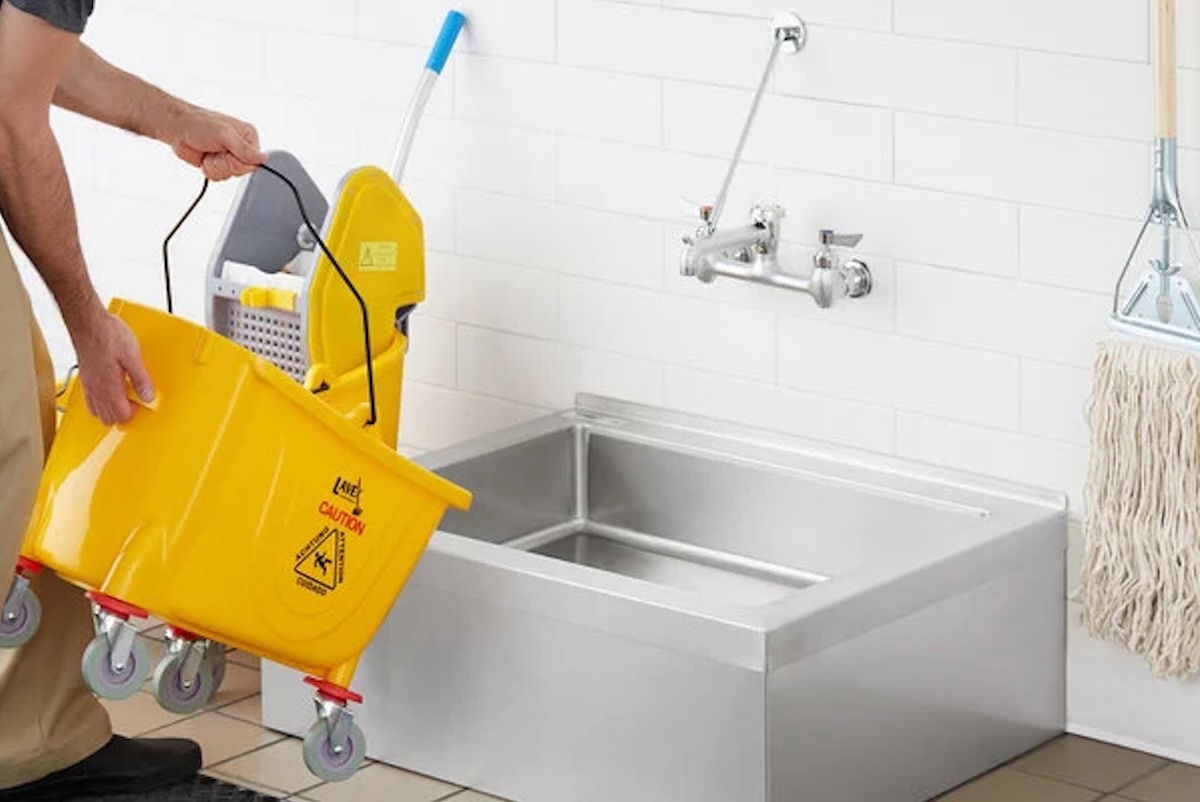
A service sink, sometimes called a mop sink or utility sink, is the commercial-kitchen equivalent of that big square sink some families have in their laundry rooms, next to the washing machine. Or maybe their home utility sink is in the garage — a big, often plastic monstrosity built for dirty jobs like rinsing out paint brushes or washing a smallish dog.
At home, that’s the sink where you dump nasty mop water, rinse out crusty refrigerator drawers, or empty the aquarium after the fish have spent a week turning the water into swamp soup.
You would never grab Grandma’s apples, rinse them in that sink, slice them up, and hand the old lady a snack. Why? That sink is gross.
Restaurants have a similar thing that has the same purpose: the utility/service sink. A service sink is where employees can dump floor water, clean mops, rinse cleaning equipment, and dispose of similar liquid waste.
It is not a handwashing sink. It is not a prep sink. It is not a three-compartment sink. You actually CAN’T do any of those things at that sink without getting in trouble with the health inspector.
It is the dirty-job sink.
Sometimes the Utility Sink Is Built Into the Floor
Not every restaurant has a waist-high utility sink. Some operations have basically the same thing, except their dirty-job sink is built into the floor.
Picture a shallow, waterproof square or rectangular bay with a small raised curb around the edge and a drain in the bottom. It looks a little like a shallow bathtub for dirty mops, installed at floor level, often in a chemical storage room or near other utility equipment. Workers can roll a mop bucket right up to it, dump the dirty water, and clean the mop without lifting anything.
They’re convenient, but that low, wet cleaning area can create its own sanitation and pest-control challenges. We’ll deal with those when we get to pest control.
For now, here is the official term for the built-in utility sink: a curbed cleaning facility with a floor drain.
It sounds complicated, but it’s really not. A curbed cleaning facility with a floor drain is nothing more fancy than a utility sink built into the floor. Different shape. Same dirty job.

And No, the Toilet Doesn’t Count
And don’t think you can just roll your bucket of greasy floor soap into the bathroom and dump it down a toilet.
I know why you want to do it. The toilet gets rid of dirty water. Your mop bucket is FULL of dirty water. What’s the issue?
Toilets and urinals are designed for human waste, not for dumping buckets of dirty cleaning water. Pouring mop water into them can splash contaminated water around the restroom and onto nearby surfaces. It also completely defeats the reason the operation has a dedicated service sink or curbed cleaning facility in the first place.
The rule is simple: use the utility sink or curbed floor thingy whose name I already forgot.
Not the toilet. Not the urinal. That’s nasty.
HANDWASHING STATIONS
Time for another mental reset! You’ve learned about dirty water moving in the wrong direction and what sink to dump your dirty water in. Now we get to talk about how to set up handwashing stations.
This part is a little easier. There are really three questions: How many handwashing sinks do you need? Where can you put them? And what has to be at every station?
And when we talk about placement, there are really three different questions hiding inside that one idea: which areas need a handwashing sink, how far that sink can be from the work, and how close is too close to clean food or equipment.
How Many Handwashing Sinks Do You Need?
There is not one magic number that works for every restaurant.
ServSafe expects handwashing stations in or directly next to restrooms, and in areas used for food prep, service, and dishwashing. So in a small restaurant where those are four distinct areas, you are already looking at at least four handwashing stations.
That is not a magic restaurant-wide number. It is a useful way to remember the four areas you need to think about. A larger operation with multiple prep rooms, multiple cooklines, separate beverage stations, banquet areas, or other spread-out workspaces may need more.
Then there is the distance question. A handwashing sink also has to be close enough to the work area it serves. A useful plan-review standard is within about 25 feet.
That means putting one hand sink somewhere in the general neighborhood does not necessarily solve the problem. If employees have to hike halfway across the kitchen every time they need to wash their hands, that sink is not very convenient.
So remember: RIGHT AREA + CLOSE ENOUGH TO ACTUALLY USE.
Don’t Put Them Too Close to Clean Food or Clean Equipment
Now we have the opposite problem.
Think about what happens when somebody actually washes their hands: water splashes, soap splashes, and whatever was on those hands can splash too.
That means a handwashing sink should not be positioned where that splash can land on:
- exposed food
- clean dishes
- clean utensils
- food-contact surfaces
- single-service items
If the sink has to be close to one of those areas, you need protection. That might mean more physical separation, a splash guard or barrier, or moving the clean items out of the splash zone.
A useful way to picture the splash zone is about 2 feet around the sink. That is not a universal Food Code measurement. It is a practical way to visualize how far splash can reach when deciding whether you need more separation or a splash guard.
The basic idea is simple:
Make the hand sink easy for workers to get to during their shift WITHOUT letting the hand sink contaminate everything beside it.
What Every Handwashing Station Needs: The 4+1
When setting up a handwashing station, there are four things you ALWAYS need, and one you only SOMETIMES need.
Every station needs four things:
- Hot- and cold-running water through a mixing valve or combination faucet, capable of providing water at least 85°F
- Soap
- A way to dry your hands
- A handwashing sign
Then comes the +1:
If your workers are using paper towels to dry their hands — and not one of those nifty air-blower thingies — you will also need a trash can. That should make perfect sense: you only need the trash can when washing and drying hands is actually going to create trash.
That’s the whole system:
WATER + SOAP + DRYING + SIGN + TRASH IF USING PAPER TOWELS
If one of those required pieces is missing, the station is not properly set up for employees to use.

Helpful, But Not Part of the 4+1
There was a time when having a visible clock or timer and a fingernail brush were considered necessary for a proper handwashing-sink setup. Neither is required now, although both can make proper handwashing easier. A clock with a second hand is helpful for knowing how long to scrub, and a fingernail brush can help when somebody has chicken goo packed under their nails.
Be familiar with these aids, but do NOT mentally add them to the 4+1. They are not required according to the exam or the FDA Food Code.
POTABLE WATER SOURCES
Way back at the beginning, we kept this simple: potable water is water that is safe to drink and safe to use in food. Now we need to answer the second question: where is a restaurant actually allowed to get that potable water?
There are four useful source categories, and fortunately they fit into another pretty clean memory path:
PIPE • PRIVATE SOURCE • PACKAGED • DELIVERED
PIPE
This is the obvious one: an approved public water system. For most restaurants, that means municipal water coming into the building through the plumbing system.
PRIVATE SOURCE
Some operations use an approved private water source instead. The most common example is a private well. That does not mean somebody dug a hole behind the walk-in and declared the water artisanal. A private source has to be approved, properly maintained, and tested as required by state and local rules to make sure what you’re sucking out of the ground is safe.
PACKAGED
Potable water can also come in approved closed containers. The easiest example is commercially bottled drinking water. Approved portable potable-water containers can also be used in situations where that is appropriate — and isn’t that the sentence from hell?
Look, it’s not that complicated: your restaurant’s water is compromised, so somebody runs to the grocery store and cleans out their entire stock of gallon jugs of drinking water.
That’s PACKAGED.
DELIVERED
Potable water can also be brought to an operation in an approved water transport vehicle or tank.
The important part is that the equipment used to transport and store the water has to keep that water potable. You cannot drag over Uncle Ronnie’s landscaping tank, rinse out whatever was in there last week, and declare yourself the municipal water department.
So remember: Potable tells you whether the water is safe. Approved source tells you whether the restaurant is allowed to get the water that way.

Grease Traps
Grease can create plumbing problems too. When warm fats, oils, and grease are rinsed down the drain, they solidify as they cool and build up inside drain lines, eventually restricting or even blocking the flow of wastewater. This is too big a problem to be fixed with a gallon of Drain-o.
That is why many restaurant and foodservice operations use a grease trap or similar grease-interception system. Its job is to catch grease before too much of it makes its way into the plumbing.
If your operation has one, it needs to be installed correctly and cleaned regularly. Let enough grease build up inside it and eventually wastewater can stop moving the way it is supposed to — or start moving back toward places where you definitely do not want to see it.
You do not need to know how to size, install, or repair a grease trap. Just know what it is there to do: keep grease from clogging the wastewater system.
THE MANAGER’S JOB: Take a Swing Through the Facility
Now that we know where the water can come from, let’s take a swing through the facility and look at every place water is used or comes out of the wall — preferably before the health inspector does it for us. The goal is not to become a plumber. The goal is to follow the water through the operation and notice the kinds of problems we just spent all this time learning about.
Start at the obvious places: faucets, hose bibbs, pre-rinse hoses, dishmachines, beverage equipment, ice machines, prep sinks, service sinks, handwashing stations, and any other equipment connected to the potable-water supply.
As you move through the building, the first thing you’re looking for is a cross-connection. Is a hose sitting in a bucket? Is the end submerged in a sink? Is a water outlet sitting below the flood rim? Did somebody rig up some home-grown plumbing arrangement because the correct setup was inconvenient?
In other words, ask yourself: Can clean water touch something dirty here?
Then look at what is protecting the connection. Is there a proper air gap? Does the equipment have the vacuum breaker, double check valve, RPZ, or other backflow protection it is supposed to have?
And actually look at the vacuum breakers. Don’t just notice that one exists and keep walking. Is it clean and in good repair, or is it rusted, corroded, crusted with mineral buildup, cracked, leaking, or visually ready to fall apart? If a vacuum breaker looks like it is on its last legs, put in the repair or replacement call before the health inspector shows up and writes it on the report for you. That visual check does not replace the required periodic testing of backflow prevention devices. Those devices must also be checked by a trained and certified technician, and that work needs to be documented.
That is Active Managerial Control in practice: know what you can inspect yourself, know what requires a qualified technician, and make sure both actually happen.
Keep walking and follow the dirty water too. Find the service sink or floor-level curbed cleaning facility. Can employees actually get to it? Does the drain work? Are people dumping mop water where it belongs, or has somebody decided the nearest toilet is close enough because walking another fifteen feet felt like a personal attack?
Dirty water needs a proper destination. Make sure employees have one and actually use it.
Then hit the handwashing stations. Run the 4+1 at each one: hot- and cold-running water capable of producing at least 85°F, soap, a drying method, a handwashing sign, and a trash can if paper towels are used. But don’t stop at the sink itself. Look around it. Is the station blocked? Is somebody storing utensils in it? Can handwashing splash reach exposed food, clean dishes, utensils, or food-contact surfaces? If so, fix the placement, add a splash guard or barrier, or move the clean items out of the splash zone.
And don’t forget the paperwork.
If a certified technician tests a backflow prevention device, keep the documentation. If plumbing equipment is repaired or replaced, keep the service records. If there is a water interruption, contamination problem, boil-water notice, or other event that affects the safety of the operation’s water, document what happened and what was done about it.
A manager’s job is not just to notice that the plumbing is working today. You also need to be able to show that required equipment has been maintained, tested, and repaired when necessary.
Nobody enjoys filing plumbing paperwork. The health inspector enjoys missing paperwork even less.
That is the whole walk. Follow the water. Look for the connection. Check the protection. See where the dirty water goes. Make sure the hand sinks work. The health inspector is going to look at all of it eventually. You might as well get there first.
Closing Side Work
In the Weeds: We Cleaned it First

CHEF’S EXPLANATION
The health inspector probably would have started with the obvious question:
“What about your other handwashing sinks?”
Remember, this restaurant must have other handwashing stations. They wouldn’t have been permitted to be in operation if they didn’t! They may not be twenty feet from the cookline. They may be inconvenient. The cooks may have to walk farther than they normally would.
But they were AVAILABLE.
And even if they hadn’t been, the utility sink still wasn’t an acceptable substitute. Cleaning and sanitizing a service or utility sink does not turn it into an approved handwashing station.
We can’t know for certain why he didn’t realize it… but here’s a good guess: our chef’s brain was so focused on keeping the workflow efficient that his thinking silently and without fanfare turned inconvenient into unavailable.
Those are not the same thing.
Until the broken sink is repaired, the crew should use the nearest working handwashing stations that are actually approved for the job. If that slows the line down or forces the manager to change how the kitchen is operating for a few hours, then that is the problem the manager has to solve.
Then there is the mop water.
That dirty cleaning water is supposed to go into the operation’s approved sewage system through the service sink, utility sink, or curbed cleaning facility designed for that job. Dumping it behind the dumpster means you are putting greasy, chemical-laden wastewater directly onto the ground instead.
Now you have created another sanitation problem outside the building: contaminated runoff, odors, possible pest attraction, and dirty water going somewhere it was never meant to go.
The chef had the right priorities. Handwashing mattered. The kitchen still had to function. The mop water still had to go somewhere.
He just let efficiency make the decisions for him
TL;DR What You Actually Need to Remember
- If clean water gets connected to something dirty, that is a cross-connection. If contaminated water actually moves backward through that connection, that is backflow.
- Backflow happens because of either backsiphonage — PULL or backpressure — PUSH. The system is protected with an air gap or a backflow prevention device.
- Dirty cleaning water goes into an approved sewage system through a service/mop/utility sink or curbed cleaning facility — not a toilet, urinal, or the ground outside.
- Handwashing sinks must be in the right places, close enough to use, and set up with the 4+1: hot + cold water at 85°F+ + soap + drying + sign + trash can if paper towels are used.
- Potable water must come from an approved source: PIPE • PRIVATE SOURCE • PACKAGED • DELIVERED.
Terms to Remember
- Potable water — water that is safe to drink and safe to use in food.
- Cross-connection — a physical connection or condition that creates a pathway between potable water and something contaminated.
- Backflow — contaminated water moving backward through a connection into the potable-water system.
- Backsiphonage — backflow caused by a drop in pressure that pulls contaminated water backward.
- Backpressure — backflow caused when pressure on the equipment or contaminated side pushes backward against the potable-water supply.
- Air gap — open-air physical separation between a water outlet and a possible source of contamination.
- Flood rim — the highest edge of a sink, basin, or fixture before water would spill over.
- Vacuum breaker — a backflow prevention device that interrupts the suction that can cause backsiphonage.
- Double check valve — a backflow prevention device that uses two check valves in series.
- RPZ — reduced pressure zone backflow preventer; a mechanical device used where a higher level of backflow protection is required.
- Service sink / mop sink / utility sink — a fixture used for dumping cleaning wastewater, cleaning mops, and other dirty maintenance jobs.
- Curbed cleaning facility with a floor drain — a floor-level cleaning fixture used for cleaning mops and disposing of cleaning wastewater.
- Grease trap — a plumbing device that captures fats, oils, and grease before too much enters the wastewater system.
- Approved sewage system — the approved system through which wastewater is disposed.
- Approved water source — a source from which a food operation is permitted to obtain potable water.