
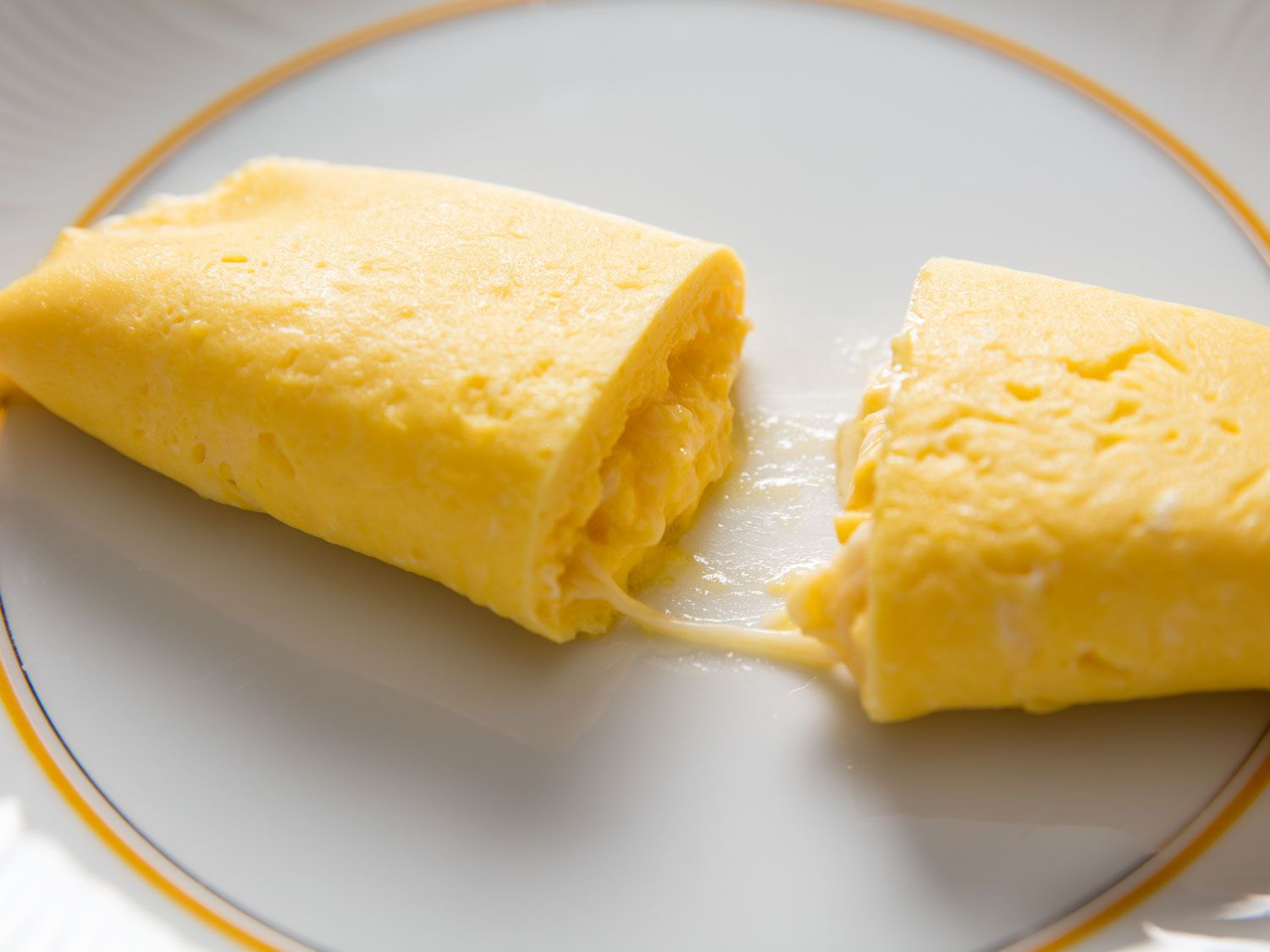
Unlike its American counterpart—which is characterized by a browned, “toothy” exterior and a folded, fluffy interior—the classic French Omelet is an exercise in elegance and restraint. It is smooth, pale (no browning), and has a creamy, custard-like interior known as the baveuse (bah-VUHZ) – which literally means “drooling.”
Get this one right, and you’ll have your family begging you to make them breakfast. Every day.

The Omelet “Test”
Historically, the French omelet was the standard entrance exam for young chefs in Parisian kitchens. The Chef de Cuisine wouldn’t ask to see your resume; they would hand you a pan and three eggs.
The Head Chef chose an omelette of all things because, in a matter of minutes, it could show them everything they needed to know about the cook. Did they make an egg-splattered mess or keep things clean? Were they wasteful, or did they scrape every last bit of egg into the pan? Did he handle the pan correctly, seasoning the traditional carbon steel to give it a perfect nonstick surface? Was he quick, deft, efficient? And, after everything, did he produce that textbook almond-shaped package? Was it baveuse?
The legendary chef Fernand Point used cooking a French omelet for years as his final evaluation for potential staff. If a cook could pull it off, Chef Point would say the man or woman had “a soul for the kitchen.” If not… well, they weren’t getting a job. Let’s leave it at that.

The Science of the “Baveuse
The secret to the French omelet lies in the physics of agitation. By constantly stirring the eggs while they cook over high heat, you are breaking up the protein networks as they form. This prevents the proteins from bonding too tightly, which would otherwise squeeze out moisture and create a rubbery texture.
Key Scientific Principles:
- Protein Denaturation: Heat causes the coiled proteins in the egg to unfold.
- Mechanical Shearing: Stirring (agitation) prevents these unfolded proteins from cross-linking into a solid mass, creating small “curds” that remain suspended in a liquid-egg matrix.
- Emulsification: The butter in the pan and the fats in the yolk work together to create a rich, silky mouthfeel.
The Technique: Step-by-Step

Preparation: Use 3 large eggs, lightly beaten until no streaks of white remain. In a classic French Omelet, seasoning is done JUST BEFORE cooking.
Modern chefs are starting to argue this point (but that argument is beyond the scope of a culinary 2 lesson!)
“Is my pan at the right temperature?” Let’s talk Heat Flux
To master the French Omelet, you must manage “Heat Flux”—the movement of energy from the pan to the egg.
- The Test: Flick a tiny drop of whisked egg into the butter. If it sits still, the pan is too cold. If it turns brown in three seconds, it’s too hot.
- The Sweet Spot: The egg should sizzle gently and turn opaque (white/yellow) within 2 seconds without any browning. This tells you the butter’s water has evaporated, but the milk solids haven’t burned yet.
The Pan: Use a non-stick or well-seasoned carbon steel pan. Heat over medium-high heat with 1/2 tablespoon of unsalted butter until the foaming subsides but before it browns.
Agitation: Pour the eggs in and immediately begin shaking the pan back and forth while stirring vigorously with a plastic fork or high-heat spatula.


The Set: Once the eggs are 75% set—looking like creamy, wet curds—stop stirring. Use the spatula to smooth the eggs into an even layer. Think of this like making a scrambled eggs pancake. Sorta. Allow it to sit for 5–10 seconds undisturbed to form the “skin.”
The Roll: Tilt the pan and use the spatula to fold the omelet over itself into a cylinder.
The Finish: Slide the omelet to the edge of the pan and flip it onto a warm plate, seam-side down. The final shape should resemble a cigar or a rugby ball. Brush with a “mirror” of melted butter for a professional sheen.

The Chef’s Standard: What Excellence Looks Like
At Level 2, you are not just making breakfast; you are mastering a technique. Your finished omelet should meet these four “Gold Standards”:
- Zero Coloration: The exterior must be a uniform, pale yellow. If you see brown “freckles” or tan spots, your heat management was poor.
- The “Baveuse” Center: When cut open, the center should be moist and custardy, not liquid and raw, but certainly not dry like a sponge.
- Symmetry: It should be a perfect “cigar” or “rugby ball” shape with tucked ends and no visible seams on top.
- The “Sheen”: The final brush of butter should create a mirror-like finish, signifying the dish is ready for immediate service.
Jacque Pepin demonstrates his famous French Omelet method
Classic Variations
The French Omelet is the perfect canvas for subtle flavor additions.
- Omelette aux Fines Herbes: Incorporate 1 tablespoon of minced fresh parsley, chives, chervil, and tarragon into the eggs before cooking. Fun fact: Auguste Escoffier was notoriously picky about his omelet and was known to fly into a rage when a cook just sprinkled minced parsley on top to “make it look pretty.”
- Omelette au Fromage: Add 1 ounce of finely grated Gruyère or Parmesan just before the rolling process begins. For a modern twist, a line of creamy goat cheese can be placed in the center.

Recipe
French Omelet
Ingredients
- 3 fresh eggs
- ½ teaspoon cold water
- 2 tablespoons unsalted butter divided
- pinch kosher salt
- pinch white pepper
- 1 teaspoon Parsley minced fine
Instructions
- Whisk eggs, salt, and water together in a mixing bowl. Whisk until mixture is very liquid and whites are completely blended in, 1 or 2 minutes.
- Heat 1 1/2 tablespoons butter in an 8-inch non-stick skillet over medium-high heat. As soon as butter melts and before it starts to sizzle, pour in the whisked eggs. Stir in a circular pattern with a heat-proof spatula, lifting and "scrambling" eggs, shaking pan to keep leveling out the mixture, and scraping down the sides. Continue stirring until shaking the pan no longer levels the eggs.
- Reduce heat to low. Using the spatula, smooth the surface of the eggs to move runny eggs to less runny spots, working toward an even thickness. As soon as surface is wet but not runny, remove from heat. Allow to rest for one minute.
- Starting at the handle side of the pan, use the spatula to begin rolling the omelette into a cylinder shape, about 3 rolls until omelette is about 2 inches from opposite side of pan. Use spatula to fold the last flap of egg over the top of the cylinder leaving the seam side up. Add cubes of the remaining 1/2 tablespoon butter to pan. Gently push the butter as it melts under the omelette.
- Slide omelette to edge of pan. Flip onto a plate with the seam side down. Even out the shape, if necessary. You can tuck in the ends, if you like. Brush surface with a bit more butter. Sprinkle very lightly with white pepper and minced parsley.
Troubleshooting Your Less-than-Perfect Omelet
If your results aren’t “Luxury” yet, check these common technical errors:
| Problem | Technical Cause | The Fix |
| Rubbery Texture | Over-coagulation / high heat. | Stir faster; remove 10s earlier. |
| Holes/Tears | Poor mechanical shearing. | Use vigorous circular motions. |
| Omelet Sticks | Surface tension / cold pan. | Season pan; wait for the “foaming” cue. |
| Visible Seam | Loose roll / flat pan angle. | Tilt pan 45°; let gravity assist the roll. |


SIDE QUEST: Why Add water to the recipe?
In culinary science, adding a small amount of liquid to eggs is a common technique, but the choice of liquid (water vs. dairy) changes the mechanical outcome of the dish. In the context of a French omelet, here is the technical breakdown:
1. Steam Expansion (The “Lift”)
When water is whisked into eggs, it remains suspended in the mixture. As soon as the eggs hit the hot pan, that water reaches its boiling point (212*F) and converts into steam. This gas expands rapidly, creating tiny pockets within the egg protein matrix. This provides a “lift” that makes the omelet lighter and more pillowy without the need for heavy fats.
2. Protein Coagulation Control
Egg proteins (primarily ovalbumin in the whites) begin to bond and solidify (coagulate) as they heat up.
- The Problem: If they bond too quickly or too tightly, they squeeze out moisture, resulting in a rubbery texture.
- The Solution: Water acts as a buffer. It dilutes the proteins slightly, physically distancing them so they take longer to find each other and bond. This results in a more tender curd that is harder to overcook.
3. Why Water instead of Milk?
While milk or cream adds richness, they are often avoided in a classique French omelet for two scientific reasons:
- The “Toughness” Factor: Milk contains its own proteins (casein) and sugars (lactose). Some chefs and food scientists argue these extra solids can bond with the egg proteins, creating a denser, “tougher” structure rather than the delicate, clean finish of a water-based omelet.
- Color Purity: Milk contains solids that can brown (the Maillard reaction) more quickly than plain water. Since the hallmark of a French omelet is a pale, un-browned exterior, water is the safer bet for maintaining that uniform yellow color.
Now you know!
Sidebar: The Seltzer Secret
Some modern chefs substitute seltzer or sparkling water for plain water. The pre-existing CO2 bubbles provide a greater initial “head start” for expansion than pure water, leading to an exceptionally airy baveuse center.
Napoleon and the Giant Omelet
There is a famous legend involving Napoleon Bonaparte and the town of Bessières.
- The Story: While traveling with his army, Napoleon ate an omelet prepared by a local innkeeper. He was so impressed that he ordered the townspeople to gather every egg in the village to make one massive omelet for his entire army the next day.
- The Legacy: To this day, the town of Bessières (and its sister cities, including Abbeville, Louisiana) holds an annual festival where they cook a 5,000-egg omelet in a giant skillet.
