
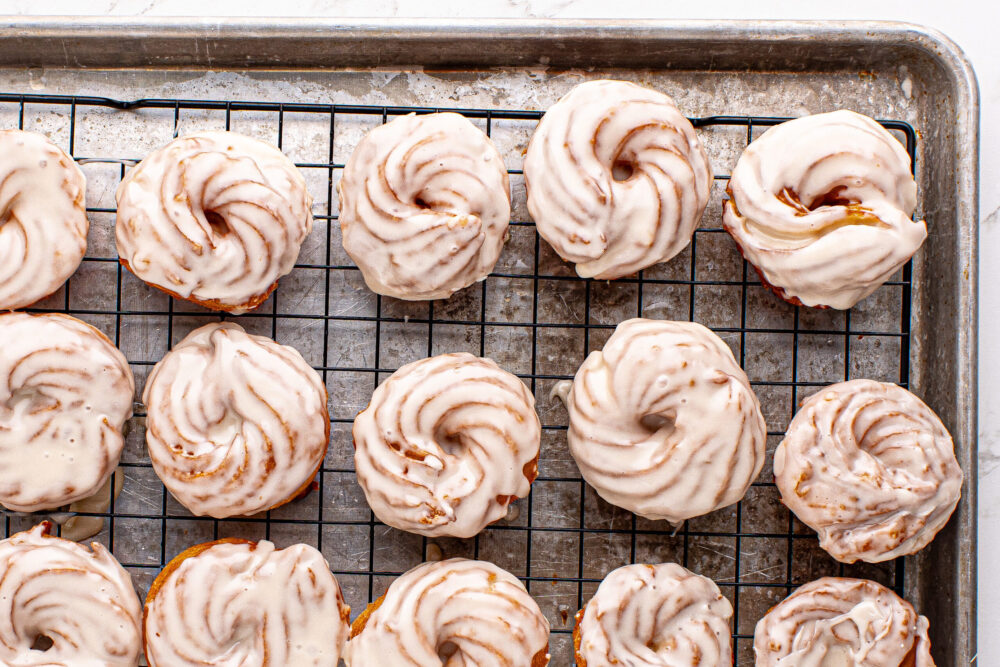
While we traditionally associate pâte à choux with the dry, hollow shells of eclairs and profiteroles, the French Cruller offers a masterclass in how the same chemical principles adapt to a different heat transfer medium: deep frying.
Unlike yeast or cake donuts, the cruller relies entirely on physical leavening. When the hydrated dough hits 350°F (180°C) oil, the transition of water to steam is nearly instantaneous. Because oil is a more efficient thermal conductor than air, the expansion is more aggressive than in an oven, resulting in the cruller’s signature airy, “honeycombed” interior.
The Evolution of the French Cruller: A Weird Culinary History
While the name suggests a direct Parisian lineage, the French Cruller is actually a culinary hybrid—a marriage of Dutch geometry and French pastry technique.
1. Etymology and Origins: The Dutch “Cruller”
The word “cruller” is derived from the early modern Dutch word kruller, meaning “to curl.” Originally, Dutch crullers (or krule) were simple, twisted pieces of yeast-leavened or chemically leavened dough, deep-fried until crisp. These were common in the Netherlands and Northern Germany before being brought to North America (specifically the Hudson Valley and New Amsterdam) by Dutch settlers in the 17th and 18th centuries.
2. The French Adaptation: The “Choux” Connection
The “French” prefix was applied when pastry chefs began substituting the traditional heavy, bready dough with pâte à choux.
This transition was significant because it moved the pastry from the realm of rustic “fried dough” into the category of high patisserie. The invention of pâte à choux is traditionally credited to Chef Pantanelli (a chef for Catherine de’ Medici) in the 1540s, but it wasn’t until the 18th and 19th centuries, under masters like Marie-Antoine Carême, that choux was refined into the stable, versatile medium we use today.
By applying the choux method to the Dutch ring shape, bakers created a donut that was leavened entirely by steam rather than yeast, resulting in the hollow, honeycombed interior that defines the modern French Cruller.
3. Professional Proliferation: The 20th Century
The French Cruller became a staple of the North American bakery landscape in the mid-20th century. Its popularity was driven by its unique texture—light and “eggy”—which provided a sophisticated alternative to the denser cake donuts and chewy yeasted rings found in most shops.
In a professional setting, the cruller became a benchmark for a baker’s skill with a piping bag. The fluted, “tractor-tire” ridges are not merely decorative; they increase the surface area of the pastry, allowing for more even heat distribution in the oil and providing more “nooks” to trap the glaze.
4. The Contemporary Cruller
Today, the French Cruller is regarded as one of the most technically demanding donuts to produce. Because it relies on the delicate balance of moisture and protein (physical leavening), it is highly susceptible to humidity and temperature fluctuations. While many commercial chains have moved toward pre-mixed “cruller bases,” artisanal pastry shops continue to utilize the traditional stovetop panade method to achieve the superior flavor of real butter and fresh eggs.
Technical Significance: The French Cruller remains the primary example of a fried choux, serving as a cousin to the Spanish churro and the French beignet d’Amiens, but standing alone in its requirement for a light, glazed, and perfectly circular form.

The Technical Challenges of Fried Choux
Incorporating crullers into your repertoire requires a shift in how you manage the dough’s structural integrity:
- The Elasticity of the “Drop”: High-quality cruller recipes (like the one from Bigger Bolder Baking) often utilize a slightly higher egg-to-flour ratio. The extra lecithin and protein from the eggs provide the elasticity needed for the ring to expand rapidly without shattering.
- The Parchment Manifold: Because choux is a “paste” rather than a “dough,” it lacks the gluten structure to be handled by hand. To maintain a perfect toroid shape, you must pipe the rings onto individual parchment squares. Dropping the paper directly into the oil allows the steam to release the bond between the pastry and the paper, ensuring the intricate ridges from your star tip remain intact.
- Controlled Dehydration: While an eclair is baked until the interior is dry to support a heavy filling, a cruller is pulled from the oil while the center remains slightly custardy. This moisture, combined with the lemon zest usually found in the batter, creates a tender, melt-in-the-mouth contrast to the shattering exterior glaze.
- Frying Cruellers is different!
- Visual Marker: Unlike yeast donuts that float and brown evenly, crullers will develop deep “cracks” in the ridges as they expand in the oil.
- The Technical Signal: Do not flip the cruller until these cracks themselves begin to show a golden-brown hue. Flipping too early traps steam inside, which will lead to a raw, doughy center and eventual collapse once the donut is removed from the heat.
- Piping Tips: Professionals often specify an Open Star Tip (like Ateco #826–828) rather than a closed star.
- Technical Reason: An open star tip creates deeper valleys between the ridges, which increases the surface area for the oil to hit, leading to a crisper exterior and better glaze retention.
Learn by watching? Here’s a good preview of the process
Quick Comparison: Bake vs. Fry
| Feature | Oven-Baked Choux | Deep-Fried Choux (Cruller) |
| Primary Goal | Dehydration & Structural Rigidity | Rapid Expansion & Tenderness |
| Interior Texture | Dry, hollow, and crisp | Moist, webbed, and custard-like |
| Shape Retention | Relies on starch gelatinization | Relies on immediate protein coagulation |
| Best Finishing | Heavy creams and ganaches | Thin, translucent sugar glazes |
Chef’s Note: If you find your crullers are deflating after frying, it is likely a sign of under-cooking or a weak “panade” (the initial flour-water-butter cook). Ensure you develop a strong starch film on the bottom of your saucepan during the initial cook to provide the structural foundation needed to withstand the intensity of the deep fryer.
Why these ingredients work
| Component | Quantity | Technical Rationale |
| Whole Milk | 115g | Provides lactose for Maillard browning and fat for a tender crumb. |
| Water | 115g | Provides the necessary solvent for steam generation without excessive browning. |
| Unsalted Butter | 115g | Shortens gluten strands and provides richness. |
| Granulated Sugar | 12g | Enhances flavor and promotes crust color. |
| Fine Sea Salt | 5g | Tightens gluten and balances sweetness. |
| Bread Flour | 180g | High protein content is required for structural stability during rapid steam expansion. |
| Large Eggs (Room Temp) | 200g (≈ 4) | Primary emulsifier and structural protein source. |
| Large Egg White | 30g (≈ 1) | Increases protein-to-fat ratio to ensure a crisp, non-collapsing shell. |
| Vanilla Extract | 5g | Standard aromatic component. |
Recipe
French Cruller
Ingredients
- 115 g Whole milk
- 115 g Water
- 115 g Unsalted butter
- 12 g Granulated sugar
- 5 g Fine sea salt
- 180 g Unbleached bread flour
- 200 g Large eggs room temperature
- 30 g Large egg white
- 5 g Pure vanilla extract
- Neutral oil for frying as needed
Instructions
The Panade
- In a heavy-bottomed saucepan, combine the milk, water, butter, sugar, and salt. Bring to a full rolling boil over medium-high heat.
- Add the bread flour all at once. Reduce heat to medium and stir vigorously with a stiff heat-resistant spatula.
- Continue cooking for 2–3 minutes, actively “mashing” the dough against the bottom and sides of the pan. This step is critical for proper starch gelatinization. Stop when a thin, translucent film forms on the bottom of the pan and the dough pulls away cleanly into a cohesive ball.
Paste Development
- Transfer the hot panade to the bowl of a stand mixer fitted with the paddle attachment. Mix on low speed for 1–2 minutes to release steam until the dough reaches approximately 125*F.
- With the mixer on medium-low, incorporate the eggs and egg white one at a time. Ensure each addition is fully emulsified and the paste is smooth before adding the next.
- Add the vanilla extract during the final seconds of mixing. The finished paste should be glossy and form a stable “V” peak when the paddle is lifted.
Piping
- Prepare a piping bag with a large open star tip (Ateco #826 or #827).
- Cut individual 4” squares of parchment paper. Lightly coat each square with a mist of oil to ensure a clean release.
- Pipe 3” rings onto the squares. For the most defined ridges, maintain consistent pressure and ensure the ends of the ring overlap securely.
- Bench Rest: For optimal ridge definition, allow the piped rings to chill for 30–60 minutes. This hydrates the starch molecules and stabilizes the fats.
Frying
- Heat oil in a heavy fryer or Dutch oven to a stable 365*F
- Carefully place 2–3 crullers into the oil, parchment side up. After 30 seconds, use tongs to peel away the parchment as the steam releases the bond.
- Fry for 4–5 minutes per side. Total fry time should be 8–10 minutes. A longer fry at a slightly lower temperature ensures the interior is sufficiently dehydrated to prevent post-fry collapse.
- Remove with a slotted spoon and transfer immediately to a wire cooling rack.
Finishing & Glazing
- Allow crullers to cool for 5 minutes before glazing.
- Submerge the top half of the warm pastry into a thin vanilla or citrus glaze.
- Return to the wire rack, allowing the glaze to “shatter” and set as the pastry finishes cooling.
Notes
TROUBLESHOOTING GUIDE
| Symptom | Cause | Correction |
| Deflating/Collapsing | Insufficient dehydration or weak protein structure. | Increase fry time or switch to high-protein Bread Flour. |
| Loss of Ridges | Paste was too warm when piped or oil was too cool. | Ensure the 30–60 min bench rest/chill is completed. |
| Oily/Greasy Mouthfeel | Oil temperature dropped below 350°F. | Fry fewer units at a time to maintain thermal mass. |
| Dense/No Hollow Center | Panade was undercooked or flour added to non-boiling liquid. | Ensure liquid is at a rolling boil before adding flour. |