
Fermentation, food safety, and the science of setting your mouth on fire
Every year, a student asks me if they can bring some hot sauce from home to “taste with their friends.” I watch, amused, as within ten minutes or so, they’re red-faced, sweating, laughing so hard they can barely breathe — egging each other on to see who taps out first.
You’ve probably done this yourself, or watched it happen to someone else. Maybe you were the one who couldn’t stop laughing while your eyes watered.
Here’s what you probably didn’t realize in that moment: you weren’t just testing how tough you are. You were living real chemistry. A compound in that pepper tricked your own nervous system into thinking you were actually burning — and your brain fired back with its own natural painkillers to deal with it. That’s not a joke. That happened inside your actual body.
By the end of this unit, you’re not just going to survive a hot pepper — you’re going to understand exactly what happened to you in that moment. And then you’re going to ferment, season, and bottle your own hot sauce from scratch.
Level 1 — Before You Start Making Hot Sauce, You Must Know How To:
- Handle raw peppers safely — gloves, hand-washing, and keeping capsaicin away from your eyes, contacts, and skin
- Set the right brine level for a safe, effective ferment
- Manage an active fermentation correctly — keeping everything submerged, stirring on schedule, watching the temperature
- Boil and bottle a finished sauce the right way — correct pH, correct boil time, every time
- Balance heat with real flavor, not just make something hot
Level 2 — By the Time We’re Done, You Must Understand WHY:
- The chemistry of capsaicin, and why it affects your body the way it does
- How lacto-fermentation actually works, at the microbial level, in two stages
- Why botulism is a real risk in bottled hot sauce — and exactly how pH and heat neutralize it
- The history and science behind why these techniques exist in the first place
- How professionals actually evaluate hot sauce quality, using real metrics instead of just “is it hot”
2. Background & History
Hot sauce isn’t one thing — it’s a whole category with wildly different styles depending on where it’s from and how it’s made. Two of the most popular hot sauces in the world make a great case study in just how different “hot sauce” can be.
| Tabasco | Gochujang | |
|---|---|---|
| Origin | 1868, Avery Island, Louisiana — still the same family, six generations later | Korea, with a history stretching back centuries |
| Base ingredients | Just three: tabasco peppers, salt, vinegar | Fermented soybean (meju), glutinous rice, chili powder, salt |
| Fermentation | One long, continuous ferment — up to 3 years in oak barrels | Two separate ferments — the soybean base, then the finished paste |
| Texture | Thin | Thick |
How Long Have We Been Using Peppers to Make Food Spicy, and Why?
Longer than you’d guess. Chili peppers are one of the oldest cultivated crops in the Americas — archaeologists have traced their domestication back roughly 6,000 to 10,000 years, and 2,000-year-old pottery from southern Mexico still carries traces of capsicum, used for spicy beverages (possibly the first hot sauces) and as a table condiment. By the height of the Aztec empire, chilies weren’t a novelty — they were just how food tasted.
And it gets stranger than “condiment.” Aztec and Maya cultures rubbed chilies on wounds as medicine, traded them like a form of currency, and — this is real — warriors burned chili smoke as a weapon, using the fumes to disorient enemies in combat. Even the burn itself has a bizarre origin: capsaicin appears to have evolved specifically to stop mammals from eating the plant, since mammals chew up and destroy the seeds inside. Birds, on the other hand, can’t taste capsaicin at all — so they eat the peppers whole and spread the seeds intact. The reason your mouth is on fire right now is that, evolutionarily speaking, the pepper was never trying to please you in the first place.
Chilies didn’t reach Europe until Christopher Columbus brought them back in 1493 — landing, by coincidence, in the middle of a continent already obsessed with a completely unrelated plant: black pepper, which was so valuable in medieval Europe that it was sometimes used as currency.
Myth Check: Did People Use Spice to Cover Up Rotten Meat? You’ve probably heard this one: medieval cooks supposedly loaded their food with spice to hide the taste of meat that had gone bad. It’s false — and food historians have been debunking it for years. Here’s the actual math: in early 14th-century Europe, a pound of black pepper cost about the same as an entire pig. Anyone wealthy enough to afford enough spice to disguise spoiled meat could obviously afford fresh meat instead. It never made economic sense, and no amount of spice can actually make tainted meat safe to eat anyway — masking a smell doesn’t kill what’s making the meat dangerous. (Worth noting: this myth is usually told about Old World spices like pepper and cloves, not New World chilies — hot peppers didn’t even exist in Europe yet when this story is supposed to have happened.)
Two Paths to the Same Flavor: One Long Ferment vs. Two Short Ones
Fermented hot sauces generally take one of two paths, and Tabasco and gochujang are the two best-known examples of each.
Tabasco doesn’t do anything fancy. It just waits. Edmund McIlhenny founded the company in 1868 on Avery Island, Louisiana, and the same family — now six generations later — still makes it the same way: crushed tabasco peppers and salt are packed into white oak barrels and left to ferment and age continuously for up to three years before vinegar is ever added. One mash, one long, patient ferment, no second stage.
Gochujang cheats the system — it ferments twice. First, soybeans are boiled, mashed, shaped into blocks called meju, and left to ferment on their own. Only after that first ferment is complete does the meju get ground into powder and combined with glutinous rice, red chili powder, and salt — and that mixture ferments again, traditionally for 6 to 18 months, in clay jars called onggi set outdoors: uncovered during the day for sun exposure, covered again at night. Two ingredients, fermented separately, then combined and fermented once more. It’s one of the most popular hot sauces on Earth right now, and it earned that popularity the slow way.
Same basic idea — microbes, salt, and time turning something simple into something complex — but two completely different paths to get there.
How Fermentation Actually Works: The Two Stages
Fermented hot sauces get their depth of flavor from lacto-fermentation — the same basic process behind traditional dill pickles, kimchi, and real sauerkraut. It’s about as simple as fermentation gets: just salt, vegetables, and water, no canning equipment required. Naturally occurring Lactobacillus bacteria convert sugars in the vegetables into lactic acid. Fruits and vegetables already carry the bacteria and yeast they need to do this themselves, which is why this process is sometimes called wild fermentation — you’re not adding anything exotic, just giving what’s already there the right conditions. This happens in two stages:
- Stage one: vegetables are submerged in a brine salty enough to kill off harmful bacteria. Lactobacillus survives this stage — it’s built for salt tolerance. That same salt also hardens the pectins in the vegetables, which is why a good ferment stays crisp instead of turning mushy.
- Stage two: the surviving Lactobacillus converts sugars into lactic acid, creating an acidic environment that preserves the vegetables and produces that distinctive tangy flavor. Some Lactobacillus strains have real health benefits beyond flavor, too — certain strains support digestion and immune function.
One thing to expect while it’s happening: fermentation produces carbon dioxide as a byproduct. If you’re fermenting in a sealed container, that gas has to go somewhere — which is exactly why proper fermentation setups use an airlock or a lid you burp regularly, rather than sealing things up tight and walking away. Skipping this isn’t just a flavor risk: enough built-up pressure in a fully sealed container can genuinely cause it to burst. This is also why the recipe includes a little sugar in the fermentation blend — it’s not strictly required (peppers already carry natural sugars), but it gives the bacteria something to work with right away, and it makes those first few days of visible bubbling noticeably more dramatic.
Fermented ≠ Canned
Important distinction: fermenting is not the same thing as canning. A fermented food isn’t sterilized or shelf-stable on its own — it’s still a living, active product, generally good for a couple of months while its flavor keeps developing and turning more acidic over time. Canning, by contrast, sterilizes food to make it stable for six months to a year or longer. That’s exactly why the recipe in this unit doesn’t stop at fermentation — the final boil is what takes an already-delicious ferment and actually makes it shelf-stable, the same way canning does.
This is also why fermented and cooked (unfermented) hot sauces taste so different: fermentation mellows a pepper’s heat while building complexity — including genuine umami notes that unfermented sauces just don’t develop. Unfermented hot sauces, usually just peppers, salt, and vinegar, skip all of that waiting and tend to taste hotter and more straightforward by comparison. Neither one is “better” — a fermented sauce is often the better choice to make a plain dish sing, while an unfermented sauce is faster to make and delivers a bigger, more immediate punch of heat. Interestingly, you often can’t tell which is which just by looking at the bottle.
TYPES OF HOT PEPPERS USED TO MAKE HOT SAUCE
Most hot sauces are built from a small handful of pepper varieties. Some of the most common:
- Habanero — used in about half of the 25 most popular commercial hot sauces
- Tabasco — the pepper the brand is named for
- Carolina Reaper — currently the hottest pepper in the world
- Jalapeño — the base for most “green” hot sauces
- Chipotle (smoked jalapeño) — the base for BBQ-style hot sauces
- Ghost Pepper (bhut jolokia)
- Trinidad Scorpion
- Serrano, Scotch Bonnet, and Cayenne — common supporting players
3. The Science of Capsaicin: Why It’s Hot (and Why It’s Addictive)
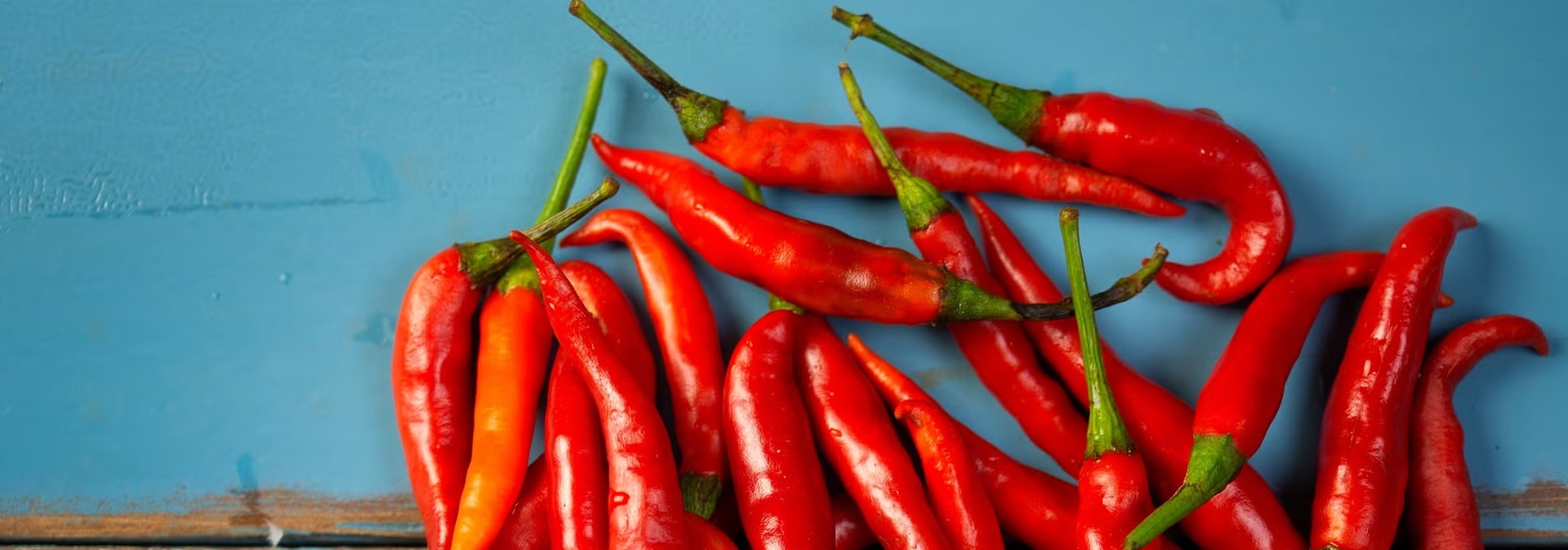
The heat in a chili pepper comes from a compound called capsaicin. Capsaicin binds to the same nerve receptors your body uses to sense real heat and abrasion — which is why your brain reads a hot pepper as “this is literally burning me,” even though nothing is actually on fire, and despite the burn, capsaicin doesn’t actually cause any real tissue damage.
Not every part of the pepper is equally hot. The white membrane inside a pepper holds the most capsaicin by far; the flesh has much less. The seeds themselves contain none — they just pick up heat from sitting next to the membrane. Even so, most recipes have you remove both seeds and membrane anyway: leftover seed pieces can add real bitterness once blended and make the finished sauce grainier and thicker than you want — not just less hot.
In response to that false alarm, your brain releases endorphins — your body’s natural version of morphine. That’s the “buzz” hot sauce lovers chase, and it’s the same chemical family responsible for a runner’s high. Like any drug, your tolerance builds over time (your receptors gradually become less sensitive to it), which is exactly why people who love spicy food keep reaching for hotter and hotter peppers.
Here’s the genuinely surprising part: capsaicin is technically toxic in high enough doses — but no pepper on Earth, not even the hottest ones, contains anywhere near enough to actually hurt you. That same inflammatory property is exactly why it’s the active ingredient in pepper spray (roughly 2,000,000 SHU) and bear deterrent spray: at a concentrated dose, it forces the eyes shut and incapacitates whatever it’s sprayed at. Same chemical, wildly different dose, wildly different outcome. And if you want a truly absurd number: a synthetic capsaicin relative called resiniferatoxin rates at roughly 16 billion SHU — a thousand times hotter than pure capsaicin itself.
And the reason dairy actually works to cool a burn isn’t a folk remedy — it’s chemistry. Milk contains a protein called casein, which surrounds the fatty capsaicin molecules and washes them off the receptors in your mouth. Water can’t do that; capsaicin repels it.
The Scoville Scale
Capsaicin is measured on the Scoville Scale, expressed in Scoville Heat Units (SHU). It was created in 1912 by Wilbur L. Scoville (1865–1942), a pharmacist working at the Parke-Davis pharmaceutical company, using what’s now called the Scoville Organoleptic Test: a panel of five tasters would dilute a pepper extract with sugar water, drop by drop, until the heat was no longer detectable — the number of drops needed became the pepper’s SHU rating. That method was subjective and inconsistent, so it’s since been replaced by High-Performance Liquid Chromatography (HPLC), which reads the actual chemical fingerprint of capsaicin in a pepper for a precise, repeatable measurement.
Here’s what that scale actually looks like in practice, ladder-style — and worth noting, bell peppers aren’t just mild, they’re the only member of the entire Capsicum family that contains no capsaicin at all:
| Pepper (or sauce) | Approx. SHU |
|---|---|
| Bell pepper | 0 |
| Jalapeño | 2,500 – 8,000 |
| Serrano | 10,000 – 23,000 |
| Tabasco sauce (bottled) | 30,000 – 50,000 |
| Habanero | 100,000 – 350,000 |
| Ghost Pepper | ~1,000,000 |
| Carolina Reaper | 1.4 – 2.2 million |
| Pure capsaicin | 16,000,000 |
Notice the jump from a jalapeño to a habanero — roughly 40x hotter, and that’s still nowhere near the top of the scale. A pepper’s heat isn’t fixed, either — growing temperature, hours of sunlight, moisture, soil chemistry, and fertilizer all affect how much capsaicin a given pepper develops, which is why every chart you’ll ever see gives a range instead of one exact number.
4. Avoiding Mistakes: Handling Peppers Safely
This section is specifically about handling the peppers themselves — not bottling safety, which gets its own full section coming up. Capsaicin is genuinely persistent stuff, and an hour of prepping peppers in class is more than enough time for it to end up somewhere you really didn’t intend.
| Not This | This |
|---|---|
| Assuming gloves make you invincible | Gloves dramatically reduce risk, but thin gloves can still let capsaicin through after enough contact time, and it’s easy to smear residue on your wrists, forearms, or clothing while you work. An hour of steady pepper prep adds up. |
| Taking gloves off and calling it done | Wash your hands with soap immediately after removing gloves. Capsaicin can transfer to glove exteriors and then to your hands the moment you peel them off. |
| Touching, adjusting, or removing contact lenses after handling peppers | This is one of the worst mistakes you can make, and it happens constantly. Even a trace of capsaicin on your fingers can turn your contacts into a genuine emergency. Wash and dry your hands thoroughly — more than once — before you go anywhere near your eyes. |
| Using the bathroom without washing up first | Say no more. This is a real, common, and completely avoidable mistake that will teach you a painful lesson exactly once. Wash your hands — thoroughly, with soap, more than once — before you touch anything else, especially yourself. |
| Rubbing your eyes after cutting peppers | Wear gloves when handling hot peppers, and thoroughly wash any knives or boards that touched them — capsaicin transfers easily to anything it touches. |
| Drinking water to cool a capsaicin burn | Capsaicin is oil-like and repels water, so water barely helps. Cold milk, yogurt, or sour cream work because capsaicin is soluble in dairy fat — and, to a lesser extent, so is a cold alcoholic beverage. |
5. Food Safety & Process: Don’t Kill Grandma
Everything in this section exists because fermented, bottled hot sauce creates exactly the conditions one particular bacteria loves. Understand this section and you’ll never make anyone sick. Skip it, and you might.
What Is Botulism, Actually?
Botulism is an illness that causes varying degrees of paralysis, caused by a toxin produced by the bacteria Clostridium botulinum. Here’s the unsettling part: this bacteria is practically everywhere. Anything that’s ever touched soil almost certainly carries its spores — including the peppers, garlic, and onions sitting on your cutting board right now.
Most of the time, it’s dormant and harmless. It only becomes dangerous when it finds exactly the right conditions to grow: an anaerobic (oxygen-free) environment that isn’t too acidic, isn’t too salty, isn’t too crowded with competing bacteria, and is sitting at a warm temperature. A bottled hot sauce — sealed, low-oxygen — is precisely that kind of environment if you don’t control the other variables. Worth clearing up one persistent rumor directly: hot peppers themselves don’t give you botulism. Improperly processed low-acid canned or bottled foods can.
One more thing worth knowing: C. botulinum exists in two forms. The vegetative (active) form is fragile — boiling destroys it. The spore form is a different story: it’s built to survive, and it will survive being boiled. That’s exactly why pH matters just as much as heat. Boiling kills the active bacteria; keeping the sauce below pH 4.6 is what stops any surviving spores from ever waking up and growing in the first place. You need both steps, because neither one alone covers the whole problem.
There’s also a subtler risk worth understanding: hot sauce has what food scientists call high water activity — meaning there’s enough available moisture in it that, if a pathogen were present, it could potentially grow. That’s exactly why pH and heat are non-negotiable rather than nice-to-haves; water activity alone won’t stop anything dangerous.
How Fermentation Fights Back: Competitive Exclusion
Here’s the good news: fermenting your peppers doesn’t just add flavor, it actively defends against botulism. Scientists call it competitive exclusion. As beneficial bacteria (like the Lactobacillus from earlier) ferment the mixture, they acidify it — a condition C. botulinum hates. Salt in the ferment does the same job, suppressing C. botulinum‘s ability to grow while giving the beneficial bacteria room to take over. The good guys crowd out the bad guys before they ever get a foothold.
Cooked vs. Fermented Hot Sauce, From a Safety Angle
You already know how cooked and fermented sauces differ in flavor from the Background & History section above — but there’s a safety-relevant detail worth adding here: cooking a fermented hot sauce stops the fermentation process entirely and makes it shelf-stable, as long as it’s brought to a full boil for at least 10 minutes first. That’s exactly the final step in the recipe you’re about to make: the ferment builds the flavor, and the boil is what makes it safe to bottle and keep.
Making Hot Sauce Shelf Stable
Two non-negotiable steps stand between a hot sauce that’s safe to bottle and one that isn’t:
- pH below 4.6. Clostridium botulinum cannot grow in an environment that acidic. Vinegar is what gets you there — and you should actually test it, not assume.
- A full boil (212°F), for at least 10 minutes. This destroys active C. botulinum cells, along with Salmonella and E. coli, before bottling.
Skip either step, and you’re not just risking a bad batch — you’re risking someone’s health. Do both, and a bottled hot sauce is genuinely, reliably safe.
One more real-world detail: if you ever plan to actually sell a hot sauce — at a farmers market, a school fundraiser, or a store — most places require the recipe to be reviewed by a food safety specialist, the product to be pH-tested, and (for retail sales beyond direct-to-customer) production in a licensed commercial kitchen. Making a safe sauce and legally selling one are two different bars to clear.
A few practical numbers worth knowing: aim for a brine that’s roughly 2–5% salt by weight (recipes vary; measure with a kitchen scale rather than guessing by volume), and use non-iodized salt (kosher or sea salt) — the iodine in table salt can interfere with the beneficial bacteria you’re relying on. Fermentation works best in a 65–75°F range; too cold and it slows to a crawl, too warm and it can turn overly sour or spoil faster. And if you’re using tap water, let it sit uncovered overnight first — chlorine is specifically designed to kill bacteria, including the beneficial kind you actually want.
6. Real Mistakes We’ve Made
Everything above is theory. Here’s what actually happens when that theory gets ignored — three real stories from real batches, and the lesson each one taught.
The Year the Mold Won
One year, we made hot sauce by the gallon — and lost the entire batch to mold growing right on top of it. Here’s what actually happened, and why.
Fermentation only stays safe and clean while the solids — the chopped peppers, onion, garlic — stay fully submerged under the brine. As fermentation produces CO2, and as solids naturally lose density, pieces can float up and poke above the liquid’s surface. The moment that happens, that little exposed patch stops being the airless environment Lactobacillus needs and starts being exactly the kind of oxygen-rich surface where airborne mold spores and wild yeasts love to land and grow. Everything underneath the brine line stays protected. Anything sticking up above it doesn’t.
The bigger the batch, the harder this gets. In a small jar, one weight or a folded cabbage leaf keeps everything down easily. Spread across gallons, it takes real, deliberate effort to make sure every last piece across a much larger surface area stays pinned below the liquid the entire time — and if even a few pieces slip up, that’s all it takes.
Not all surface growth is the same, though. A thin white film (kahm yeast) is common and usually harmless — skim it off and the ferment underneath is typically fine. But if what’s growing is pink, green, or black, or if anything smells rotten instead of pleasantly sour, that’s a discard-immediately situation, no exceptions. And at the scale of a whole batch you can’t fully inspect piece by piece, the safe call is often to throw the entire thing out rather than gamble on which kind of growth you’re looking at. When in doubt, don’t risk it.
The fix going forward: use an actual fermentation weight (or an improvised one — a water-filled zip-top bag, a clean plate, a whole cabbage leaf) to hold every last piece below the brine line for the entire fermentation, no exceptions, no matter how big the batch gets.
The Year We Forgot to Stir
Notice the recipe calls for stirring once a day during the first ferment, and once every three days during the second. That’s not a suggestion — skip it, and you get uneven fermentation: some pockets of the mash ferment faster than others, salt and acid don’t distribute evenly through the batch, and you end up with a sauce that tastes wildly inconsistent from one spoonful to the next, if it ferments safely at all. One year, that’s exactly what happened, and the batches had to be thrown out. Stirring isn’t busywork — it’s what keeps the whole batch fermenting as one consistent product instead of a dozen slightly different ones happening in the same container.
The Year We Confused Heat With Flavor
One year, we made a batch using a wild blend of pepper varieties instead of sticking mostly to Fresnos. It was significantly hotter — and the flavor was genuinely off-putting. It didn’t sell, and most of it ended up thrown out.
Heat is easy to add. Heat is not the same thing as flavor, and a hot sauce that’s just hot without being balanced, layered, or interesting is a hot sauce nobody wants a second bottle of. This is exactly why “Spice Level” and “Complexity” are two separate metrics in the Quality Indicators section coming up — judge for both, every time, or you’ll end up with a batch nobody wants to finish.
7. Quality Indicators: How We Judge a Hot Sauce
Professionals don’t just say “I like it” or “I don’t.” They use a hedonic scale — a scientific tool, usually numbered 1 to 10, used to rate how much pleasure a food produces. It’s the same kind of tool used in marketing research to find out what people actually prefer, not just what they say they prefer.
For hot sauce specifically, we judge on six metrics:
- Viscosity — thick vs. watery
- Color — bright vs. dull
- Smell/Aroma — appealing and mouthwatering vs. vinegary or boring
- Spice Level — layered heat vs. simply “hot” or overwhelming
- Complexity — real depth of flavor vs. one-note
- Overall — love it vs. meh
Put It to the Test: The Blind Taste Test
All six of those metrics stop being theoretical the day we line up five bottles of popular hot sauce, strip off the labels, and make you actually judge them. Here’s how it works, and why it’s more structured than “just try it.”
The Rules
- The Drop Rule. No pouring straight from the bottle, no massive spoonfuls. One or two drops on a chip or cracker, every time. This isn’t about being stingy — it’s what keeps five sauces from turning into one very bad afternoon.
- Wash before you touch anything else. Gloves if you’ve got them, and a mandatory soap-and-water wash the second the tasting’s done. You already know what happens if hot sauce fingers meet your eyes or nose — this is that rule again, for real, in the moment.
- The Opt-Out Clause. Nobody has to swallow every sauce. Evaluate the color, aroma, and texture, use a spit cup, or sit a heat level out entirely if it’s too much. By the way… some people are naturally less tolerant of spice than others. If you hate hot things, you can sit this one out. And don’t let anyone try and bully you into burning your mouth! Peer pressure is a real thing, and only massive turd-nozzles make fun of someone with a more sensitive palate.
The Scorecard
You’ll score sauces #1 through #5 across these categories. The first three are the same metrics you already know — just applied to a real bottle instead of a definition on a page:
- Appearance — color, clarity, seed flecks (your Color metric, in practice)
- Texture/Mouthfeel — smooth, chunky, thin, syrupy (your Viscosity metric)
- Heat Level — rate it 1 to 10 (your Spice Level metric, made concrete)
- Primary Flavor Note — is this sauce fundamentally sour, sweet, salty, smoky, or fruity? This is where Complexity starts: can you name what’s actually driving the flavor, or is “hot” the only thing you’ve got?
- Culinary Pairings — name one specific dish this sauce would actually make better (grilled white fish, fatty pork, fried appetizers). This is the real test of Overall: a sauce you can’t imagine using is a sauce that failed, no matter how it scored everywhere else.
8. The Process, in Three Stages
Strip away all the science and every fermented hot sauce — including the one you’re about to make — comes down to the same three stages:
- Start fermentation — combine your vegetables with enough salt to create a brine, and let the natural bacteria take over.
- Add ingredients, continue fermentation — introduce anything that shouldn’t ferment for the full duration (like sugar or additional vegetables), and let the process keep going.
- Strain (maybe), season, and bottle — purée or strain depending on the texture you want, acidify and heat-treat for safety, then bottle.
RECIPE

Chef Bates’ Fermented Hot Sauce
Ingredients
Fermentation Blend
- 1 pound Fresno Chilies
- 4 ounces Habanero Chilies
- 5-10 cloves crushed garlic 1-2 oz
- 1 large onion roughly chopped (8 oz)
- 1 large carrot peeled and roughly chopped (10 oz)
- 2 T salt 1.3 oz
- 1 T sugar 2.27 oz
- JUST enough distilled water to cover
Acid Blend
- 1 ½ cup distilled white vinegar 12 fl oz/ 12.65 oz
- 1 – 1 ½ teaspoon garlic powder 0.11 oz
- 1- 1 ½ teaspoon cayenne 0.08 oz
- 1 – 1 ½ teaspoon white pepper 0.08 oz
Instructions
First Ferment
- Roughly chop chilies, onion and garlic. Transfer to a nonreactive container, add just enough water to submerge vegetables, add salt, then cover with a lid fitted with a fermentation vacuum airlock. Place in a dark area, and let stand at room temperature for 7 days to ferment. Stir once each day.
Second Ferment
- Stir in carrots and sugar and loosely attach lid. Let chile mixture stand at room temperature for 21 additional days, stirring once every three days.
- Put all ingredients into a blender and purée until very smooth. Taste. The heat should be smooth with a hint of sweetness on the finish. If it tastes “sharp,” return to the container for another week of fermentation.
Acidification and Bottling
- Transfer mixture to a non-reactive saucepan over medium high heat. Bring to 180*F and hold at that sterilization temperature for at least 10 minutes. Add acid blend and return to 180*F for an additional 10 minutes.
- Remove from the heat and allow to steep until mixture comes to room temperature. Taste and season with more salt, garlic, or cayenne pepper if necessary. Add distilled water to desired consistency.
- Let age at least 2 weeks before bottling in heat sterilized bottles. Can be stored at room temperature, unopened for 6 months, in the refrigerator for up to a year.
Key Vocabulary
| Term | What It Means |
|---|---|
| Capsaicin | The vanilloid compound in chili peppers that binds to heat/abrasion receptors and causes the burning sensation — and the endorphin release that follows it. |
| Scoville Heat Units (SHU) | The measurement of a pepper’s capsaicin concentration, on a scale from 0 to 16,000,000 (pure capsaicin). |
| Lacto-fermentation | The process by which naturally occurring Lactobacillus bacteria convert sugars into lactic acid, preserving food and producing a tangy flavor. |
| Lactobacillus | The “good” bacteria responsible for lacto-fermentation — salt-tolerant, and able to out-compete harmful bacteria like C. botulinum. |
| Clostridium botulinum | The bacteria responsible for botulism. Common in soil, dormant until it finds an anaerobic, low-acid, low-salt, warm environment to grow in. |
| Competitive exclusion | The principle by which beneficial bacteria out-compete and suppress harmful bacteria during fermentation. |
| Hedonic scale | A 1–10 rating scale used to measure how much pleasure a food produces — a real tool used in professional food and marketing research. |
Sidebar: Smoke It First. One year, we smoked the chilies before they ever hit the brine — and it was one of the best batches we’ve made. Think about how a chipotle is just a smoked jalapeño: the smoke doesn’t just sit on the surface, it works its way into the flesh, adding real depth (compounds like guaiacol and other phenolics, the same family responsible for that classic barbecue flavor) before fermentation even starts building its own complexity on top. Smoke first, then ferment, and you get two layers of flavor development instead of one. Worth doing again.
9. Go Deeper
The business side. Once you can make a great hot sauce, the next question is: how do you actually sell it? That comes down to three elements of marketing:
- Product-service mix — making a product people want, at a price they’re willing to pay
- Presentation mix — labels, appearance of the product, appearance of the sales staff
- Communication mix — flyers, posters, social media posts, and everything else that gets the word out
Going all the way back to the seed. Wekiva Culinary has previously run an entire hot sauce project from seed to bottle — literally. Using an indoor aeroponic tower garden, students grew their own peppers, herbs, and microgreens without soil at all, then used a refractometer (the same tool a professional kitchen uses to measure sugar content) to test their peppers for capsaicin and sugar levels before a single one hit the fermentation crock. Along the way, the project compared how much water and energy an aeroponic system uses against traditional soil-based farming — the same sustainability question every serious food producer eventually has to answer. The peppers that came out of that garden became the hot sauce that got bottled, labeled, and sold at the Apopka Farmers Market by the students who grew it.
That’s the real arc of this unit, if you want to see it all the way through: grow it, test it, ferment it, bottle it, sell it.