
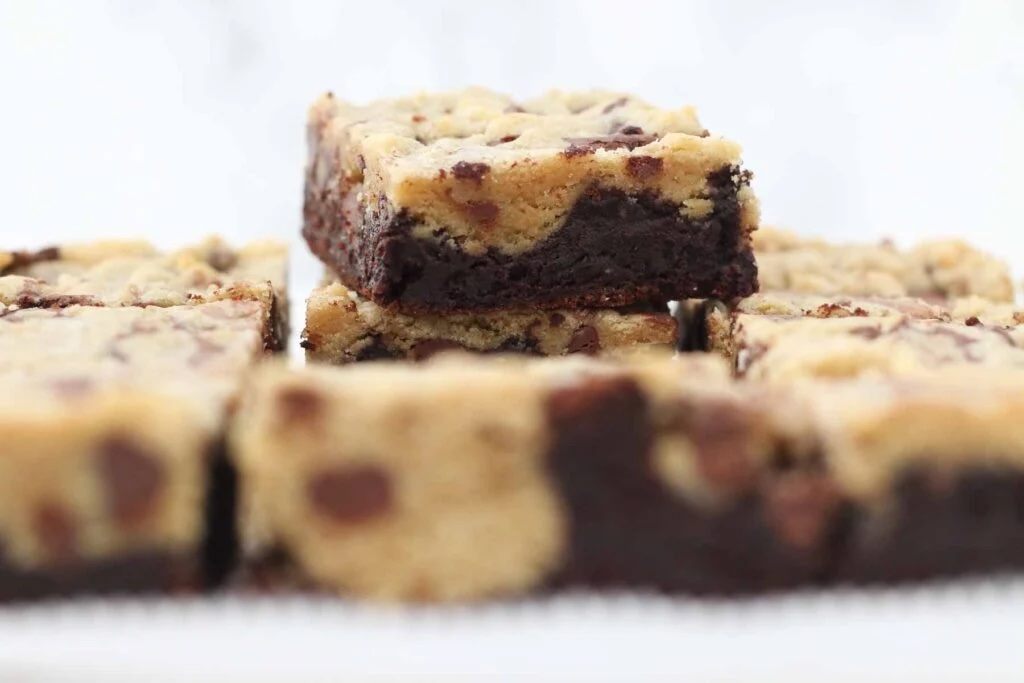
In the professional kitchen, a dessert is often much MORE than a sum of its parts; it is a series of solved technical problems. The Brookie—a hybrid of a chocolate chip cookie and a fudge brownie—is a prime example of a complex thermodynamic puzzle. To achieve professional results, a chef must bridge the gap between two opposing “ideal” states: the brownie (a high-moisture, slow-setting matrix) and the cookie topping (a high-fat, fast-setting structure).
The challenge lies in managing the “conflict of interest” within a high-volume environment. By manipulating lipid chemistry, protein structures, and heat transfer, we can force these two opposing forces into a perfect, synergistic bake that is as scientifically sound as it is delicious.
First, a little history: From “Marble Squares” to Social Media Icons
The journey to the modern Brookie follows a fascinating trajectory through culinary history, evolving from home-kitchen improvisation to viral food engineering.
- The “Marble Square” Origins (Pre-1980s): Long before the catchy portmanteau existed, community cookbooks featured “Marble Squares.” These were functional, home-baked solutions created by dolloping and swirling cookie dough into brownie batter.
- The Commercial Codification (1980s–2000s): The transition to the “layered” structure we use today gained momentum as commercial brands looked for hybrid products. This era formalized the dessert, with the “Brookie” name eventually being trademarked as the market matured.
- The “Hybrid Food” Craze (2010s–Present): Riding the wave of the “Cronut” era ushered in by celebrity pastry chef Dominique Ansel, the Brookie exploded on social media. Its high-contrast visual—dark, fudgy chocolate beneath a golden, textured crust—made it an Instagram icon, leading to extreme variations like the “Slutty Brownie,” which interlocks the two layers with a lattice of sandwich cookies.
The modern Brookie succeeds where early “swirled” versions failed by utilizing the layered method. In this configuration, the cookie topping acts as a thermal insulator for the brownie base, allowing the two distinct batters to reach their peak textures simultaneously.

The Engineering Challenge: Navigating the “Sludge Line”
Here is the core challenge of the Brookie: we’ve got to find a solution to a fundamental thermodynamic contradiction, a civil war of sorts. We have to navigate the extremes of moisture retention in the base and surface dehydration on the top. In other words, we’ve got to set the brownie (without burning the cookie).
If the heat transfer is mismanaged, you are left with a nasty “sludge line”—a layer of raw, dense brownie batter trapped beneath a burnt cookie crust. To succeed, you must manipulate the specific heat capacity of your ingredients and the convection airflow of the oven to ensure the brownie reaches its sweet spot: 180°F. This is the set-point… the exact moment the cookie achieves optimal Maillard browning.
Before looking at the recipe, lets investigate the four steps (or PHASES) when we might screw things up – and how to get it right the first time!
Phase I: Molecular Foundation & Emulsification
Instruction: Cream the butter and sugars for 5–8 minutes until light and fluffy, then incorporate eggs in three distinct stages.
The Science: This step is about creating a stable fat-in-water emulsion. Butter consists of approximately 80% fat and 15% water; by beating it with sugar, you are mechanically forcing air into the fat while the water begins to dissolve the sugar crystals. The eggs act as a powerful emulsifier via lecithin found in the yolks, which bonds the fat and water together. Using 100% butter is a critical engineering choice: because butter has a relatively low melting point (90-95*F), the dough begins to “flow” almost immediately upon entering the oven, ensuring the cookies spread and merge into a unified layer before the proteins set.

Phase II: Structural Reinforcement & pH Manipulation
Instruction: Sift the All-Purpose (AP) flour, salt, and baking soda. Mix on low speed until just combined.
The Science: We utilize All-Purpose flour (10–12% protein) because it provides the gluten “tensile strength” necessary to support heavy inclusions like chocolate chips and walnuts while floating atop a wet brownie base. The addition of Baking Soda (sodium bicarbonate) is a chemical intervention. It reacts with the acidic molasses in the brown sugar to release CO2, but more importantly, it raises the pH of the dough. A higher pH weakens gluten slightly and speeds up the Maillard Reaction, allowing the cookie to brown deeply even at the lower temperatures required by the brownie base.
Intermission: The Hygroscopic Tug-of-War
Before we arrange the layers in Phase III, we have to account for a hidden force at work: Hygroscopy.
In food science, hygroscopy is the ability of a substance (like sugar and cocoa powder) to attract and hold water. In a Brookie, you have two different batter systems competing for moisture. Because the brownie base is packed with sugar and cocoa—both of which are intense “water-seekers”—it actually tries to “pull” moisture out of the cookie dough above it. If we don’t manage this “Moisture Migration,” the water pools at the meeting point of the two layers, resulting in the dreaded Sludge Line. We solve this in the next phase by manipulating the geometry of the bake to ensure the heat sets the proteins before the moisture can travel too far.
Phase III: Geometry and Thermal Distance
Instruction: Spread the brownie batter into parchment-lined sheet pans. Use a #24 scoop to portion the dough, then manually flatten each scoop into a 1/2-inch disk.
The Science: This is a lesson in conductive heat transfer. By transforming a sphere (the scoop) into a disk, you are drastically reducing the “thermal distance” the heat must travel to reach the center of the dough. In a convection oven, the low vertical walls of a sheet pan allow the high-velocity air to strike these disks directly. This ensures the cookie layer begins to dehydrate and brown at a rate that matches the internal temperature rise of the brownie beneath it.

Phase IV: Thermal Mass Management
Instruction: Bake at 325*F for 22–28 minutes.
The Science: We utilize a “low and slow” approach to manage the thermal mass of the full-size sheet pan. Because the brownie base is dense, wet, and heavy, it requires significant energy to reach its coagulation point (180-190*F). If the oven were set to a standard cookie temperature (375*F), the exterior of the cookie would scorch before the brownie could finish its phase change from liquid batter to solid fudge. The 325*F setting allows for a gradual, even migration of heat through the entire vertical stack of the dessert.

TL:DR
Engineering Specs
- Target Internal Temp: 180*F (Brownie Coagulation)
- Lipid Melting Point: 90-95*F (Butter)
- Convection Delta: 325*F (Bake Temp) vs. 375*F (Standard Cookie Temp)
- The “Sludge Line” Tolerance: 0mm (Goal: Seamless Thermal Gradient)
Quality Control Audit: Troubleshooting the “Sludge Line”
- The Symptom: A visible grey/wet line between the brownie and cookie.
- The Engineering Failure: Incomplete heat transfer or excessive thermal distance (cookie was not flattened enough).
- The Symptom: Cookie edges are dark brown, but the brownie center is “soupy.”
- The Engineering Failure: Oven temp was too high 350*F+, causing surface dehydration before the core could reach 180*F.
RECIPES
Brookie (Small Batch Recipe)
Ingredients
The Cookie Topping (100% Butter Formula)
- 125 g Unsalted Butter Softened
- 100 g Granulated White Sugar
- 100 g Brown Sugar
- 3 g Salt
- 90 g Eggs approx. 2 eggs
- 4 g Vanilla Extract
- 250 g All-Purpose Flour
- 3 g Baking Soda
- 250 g Chocolate Chips
- 100 g Chopped Walnuts optional
The Brownie Base
- 1 Box Betty Crocker Brownie Mix 16.3 oz
- 2 Tablespoons Water
- 1/2 Cup Vegetable Oil
- 2 Eggs
Instructions
The Brownie Base
- Mix: Combine 1 box of Betty Crocker Brownie Mix with the water, oil, and eggs in a medium bowl until well blended.
Sift & Cream
- Sift together the All-Purpose flour, salt, and baking soda.
- In a stand mixer with a paddle attachment, cream the 125 g of butter and sugars at moderate speed for 5-8 minutes until light and fluffy.
Emulsify & Incorporate
- Combine eggs and vanilla; add to the mixer in stages, scraping the bowl thoroughly after each.
- Add the dry ingredients on low speed in thirds. Fold in the chocolate chips and walnuts manually.
Sheet Pan Assembly
- Line one half-size sheet pan with parchment paper. Spray corners and sides of pan AND the parchment lightly with pan spray.
- Spread the prepared brownie batter equally into the pan. Spread it to within 1/2-inch of the edges.
- Use a #24 scoop to portion cookie balls, flatten each into a 1/2 inch disc, then position them evenly over the brownie batter in a 5 x 5 grid (25 total).
The Convection Bake
- Preheat convection oven to 325°F.
- Bake for 22-28 minutes.
- Note: If the cookies reach a deep golden brown before the 22-minute mark, loosely tent with foil for the final 5 minutes.
Finishing & Yield
- The brookies are done when the cookie layer is golden brown and the brownie base jiggles slightly in the center when the pan is moved.
- Allow to cool completely on a wire rack in the pan. For the cleanest cuts, chill the pan briefly in the reach-in.
Master Sheet-Pan Brookie Formula
Ingredients
The Cookie Topping (100% Butter Formula)
- 750 g Unsalted Butter Softened
- 600 g Granulated White Sugar
- 600 g Brown Sugar
- 20 g Salt
- 550 g Eggs approx. 10–11 eggs
- 25 g Vanilla Extract
- 1.5 kg All-Purpose Flour
- 20 g Baking Soda
- 1.5 kg Chocolate Chips
- 600 g Chopped Walnuts optional
The Brownie Base
- 2 Boxes Betty Crocker Hershey’s Triple Chocolate Fudge Brownie Mix 10 lbs
- Additions: Prepare according to package instructions oil, water, and eggs.
Instructions
The Brownie Base
- Mix: 2 Boxes (10 lbs total) Betty Crocker Hershey’s Triple Chocolate Fudge Brownie Mix.
- Additions: Prepare according to package instructions using the required water, oil, and eggs.
Sheet-Pan Preparation & Baking Instructions
Sift & Cream
- Sift together the All-Purpose flour, salt, and baking soda.
- In a stand mixer with a paddle attachment, cream the 750 g of butter and sugars at moderate speed for 5–8 minutes until light and fluffy.
Emulsify & Incorporate
- Combine eggs and vanilla; add to the mixer in three stages, scraping the bowl thoroughly after each.
- Add the dry ingredients on low speed in thirds. Fold in the chocolate chips and walnuts manually.
Sheet Pan Assembly
- Line three full-size sheet pans with parchment paper. This is essential for lifting the finished product out for clean cutting. Spray corners and sides of pan AND the parchment lightly with pan spray.
- Divide the prepared brownie batter equally among the three pans. Spread it to within 1/2-inch of the edges.
- Use a #24 scoop to portion 50 cookie balls, flatten each into a 1/2 inch disc, then position them evenly over the brownie batter in 5 rows of 10.
The Convection Bake
- Preheat convection oven to 325*F
- Bake for 22–28 minutes.
- Note: If the cookies reach a deep golden brown before the 22-minute mark, loosely tent with foil for the final 5 minutes.
Finishing & Yield
- The brookies are done when the cookie layer is golden brown and the brownie base jiggles slightly in the center when the pan is moved.
- Allow to cool completely on a wire rack in the pan. For the cleanest cuts, chill the pans briefly in the reach-in.
Notes
Visual Check: It is much easier for students to see the “merge” happening during the bake.
Cleaning: Parchment-lined sheet pans are much faster to clean than deep-set hotel pans.
Side Quest: Save Your Frozen Brownies From Tasting Like Garlicky Poo
Think of your brownie’s high fat content—the butter and cocoa butter—as a group of overly friendly molecular sponges. In the culinary world, we call this Lipid Absorption, but in the freezer, it’s a full-blown security breach. Fats are highly attractive to Volatile Organic Compounds (VOCs). If you leave your brownies uncovered, they aren’t just sitting there; they are actively “handshaking” every other odor and free-roaming flavor in the freezer.
Bad News: Your freezer is currently harboring a rogue gallery of “off-flavors”:
- That half-bag of frozen pearl onions from Thanksgiving 2024.
- The lingering ghost of a garlicky pizza box.
- The distinct, metallic “industrial” scent of the freezer’s own plastic lining.
The Stakes: Without an airtight seal, those aromatic compounds will dissolve directly into the fats of your brownie. If you skip this step, your high-end, triple-chocolate masterpiece will undergo an unwanted transformation into a Garlic-Infused Plastic-Puck™.
Quest Reward: A brownie that actually tastes like chocolate instead of a frozen onion. Wrap it tight, or face the consequences.
Pro Tip: If you must store brownies for later, use the “Double Wrap Technique.” Wrap tightly in plastic to stop moisture migration (sublimation), then wrap in heavy-duty aluminum foil. Aluminum is a superior gas barrier that keeps the “Freezer Funk” (VOCs) out much better than plastic alone.
Who is Dominique Ansel? (And Why You Should Care)
The transition from the “Marble Square” home-bakers of the 1980s to the viral “Slutty Brownie” of the 2010s proved that the public has an insatiable appetite for hybrid desserts, but it took a specialized type of chef to turn these mashups into a legitimate culinary discipline. This is where the story of Dominique Ansel becomes the ultimate case study for any aspiring pastry professional.

Dominique Ansel is a world-renowned pastry architect whose career is defined by the rigorous application of Michelin-starred engineering to modern pastry innovation. After serving as the International Pastry Executive Chef at Fauchon in Paris and the Executive Pastry Chef at the three-Michelin-starred Daniel in New York, Ansel opened his Soho bakery in 2011 with a philosophy rooted in technical mastery. He rose to global prominence through the creation of the Cronut®, a croissant-donut hybrid that required two months of intensive R&D to develop a proprietary dough capable of withstanding the thermal shock of deep-frying without collapsing or absorbing excess oil.
Beyond viral sensations, Ansel is a benchmark for professional consistency and structural problem-solving in the kitchen. His “Cookie Shot” demonstrated a sophisticated understanding of water activity by utilizing a tempered chocolate moisture barrier to prevent liquid from degrading the cookie’s crumb. Whether executing his signature DKA (Dominique’s Kouign Amann) or developing shelf-stable “edible containers,” Ansel treats every pastry as a series of solved chemical and thermodynamic puzzles. For aspiring chefs, his success serves as proof that elite technical precision is the only sustainable bridge between creative imagination and commercial success.
He didn’t get famous by accident; he got famous because he’s a pastry engineer who knows how to turn “weird” ideas into world-class icons. Here is why his journey matters to your future career.

1. He Turned “Gimmicks” into Gold
In the food industry, people often look down on “hybrid” foods like the Brookie or the Cronut, calling them gimmicks. Ansel proved them wrong. He took “trashy” concepts—like eating a chocolate chip cookie with a glass of milk—and used high-level French technique to turn them into luxury experiences.
The Takeaway: It doesn’t matter if you’re making a 5-tier wedding cake or a grilled cheese; if you apply extreme technical precision, you can make people take any food seriously.
2. He is the King of the “What If?”
Ansel’s success comes from asking questions that other chefs were too afraid (or too lazy) to answer.
- “What if a croissant was a donut?” (The Cronut)
- “What if a cookie was a shot glass?” (The Cookie Shot)
- “What if a marshmallow was frozen and torched to order?” (The Frozen S’more)
The Takeaway: Innovation starts with a “What if?” But it only survives if you have the skills to back it up. Ansel spent two months and dozens of failed batches perfecting the Cronut dough before he ever sold one.
3. He Built a Global Brand on Consistency
If you go to a Dominique Ansel Bakery in New York, Tokyo, or Hong Kong, the DKA (his signature caramelized croissant) will taste exactly the same. Everywhere his products are sold… they are EXACTLY the same. How does he do it? The “WIP” Lifestyle: Every single morning, Ansel does “Work in Progress” tastings. He isn’t just the “ideas guy”—he is the quality control officer. He treats his kitchen like a high-performance laboratory.
4. He Proved That “Science = Success”
Ansel is famous because he understands things like Water Activity and Molecular Barriers on a DEEP level.
The Takeaway: The better you understand the science of your ingredients, the more “impossible” things you can create. Science isn’t just for textbooks; it’s the secret sauce that makes a chef a millionaire.
The Bottom Line
Dominique Ansel didn’t just change the way we eat dessert; he changed what it means to be a modern pastry chef. He is proof that if you combine a wild imagination with a “scientist” mindset, you can build an empire out of flour, butter, and sugar.
Terms you should know in this post
- Conductive Heat Transfer: The movement of heat through direct contact (from the hot metal pan into the brownie batter).
- Hygroscopy: The ability of a substance (like sugar or cocoa) to chemically attract and hold onto water molecules.
- Lecithin: A natural fat-like substance found in egg yolks that acts as an emulsifier, holding the water and fat together so the batter doesn’t “break.”
- Lipid Absorption: The process where fats (lipids) soak up smells and flavors from the air around them (like that “Garlicky Poo” freezer smell).
- Maillard Reaction: A complex chemical reaction between amino acids and reducing sugars that gives browned food its distinctive flavor and dark color. It usually starts around 285°F (140°C).
- Moisture Migration: The physical movement of water from an area of high water activity to an area of low water activity (moving from the brownie to the cookie).
- pH Manipulation: Changing the acidity or alkalinity of a food. Adding baking soda (alkaline) raises the pH, which speeds up browning.
- Specific Heat Capacity: The amount of heat energy required to raise the temperature of a substance by one degree. Denser brownies have a higher capacity than aerated cookies.
- Thermal Distance: The physical distance heat must travel from the outside of a food to reach the very center. Flattening cookie scoops reduces this distance.
- Volatile Organic Compounds (VOCs): Tiny molecules that travel through the air and create smells. These are what “handshake” with the fats in your brownies in the freezer.
- Water Activity (aW): A measurement of the “free” or “unbound” water in food that is available for chemical reactions or moisture movement.