
Estimated reading time: ~18 minutes
Why Should I Care?
In 1959, NASA scientists and engineers began working with Pillsbury and U.S. Army food researchers on a problem nobody had ever really faced before: how do you make food safe enough to send into space?
At the time, food manufacturers relied heavily on their own quality-control systems and on testing samples of finished products. You could pull a few packages from a batch, test them, find nothing wrong, and still have no way to prove that every other package was safe.

For NASA, that wasn’t good enough.
If an astronaut got sick halfway to the Moon, there was no hospital around the corner, no replacement crew, and no next truck bringing a fresh meal. NASA wanted a level of food safety the industry’s normal testing methods couldn’t reliably give them.
NASA needed a different approach, and that need brought together an unlikely team: NASA engineers, U.S. Army food scientists, and Pillsbury.
Instead of waiting until the food was finished and asking only, “Is it safe?” they started working backward through the process. Where could a hazard enter? Where could it be stopped? What could they measure or observe to know the control had worked?
That thinking became the foundation of HACCP — Hazard Analysis and Critical Control Points.

About a decade later, Pillsbury got a brutal reminder that this kind of approach to food safety was just as important back on Earth. In 1971, glass fragments were discovered in one of its products, a wheat cereal commonly fed to babies. It was a terrifying find, and it made the case for preventing hazards instead of just discovering them after the fact.
Pillsbury’s leadership pushed to bring the preventive methods developed through the space program into its regular food operations. Within days of the recall, Pillsbury also presented the HACCP concept to the food industry at the first National Conference on Food Protection.
I think this strange path — astronaut food → glass in baby cereal → modern food safety — teaches us more about HACCP than the acronym ever could. It makes the purpose of HACCP clear: don’t wait until something dangerous is already in the finished food you’re selling and hope somebody catches it before your customers eat it.
Find the point where you can stop the hazard, and control it there.
Quick Recall
We spent a good bit of time talking about Food Safety Management Systems and how they give an operation the overall structure to run safely day to day: trained people, active managerial control, procedures, monitoring, corrective action, and documentation.
HACCP fits inside that larger system, but it has a narrower job. Instead of looking at the whole operation, HACCP follows a particular food or process and asks where a significant hazard could occur, where control is absolutely necessary, and how the operation will know that control actually happened.
In other words, a Food Safety Management System is a huge parking garage, and a HACCP plan is a car parked inside it. Maybe a really big car that does one thing really well… but a single car nonetheless.
HACCP Isn’t Always Required — And That’s Worth Knowing Up Front
HACCP thinking is useful almost anywhere. Thinking through food-safety hazards in advance is always a smart idea. A formally submitted HACCP plan? That is a different matter.
Most ordinary restaurant operations following standard food-safety practices don’t actually write HACCP plans. Simply cooking, cooling, holding, and serving TCS food doesn’t require them to. A formal HACCP plan is required only in certain situations — including when a variance is required and for certain reduced-oxygen-packaging operations that can be conducted without a variance.
But required and useful aren’t the same thing.
A regular restaurant can still benefit from HACCP thinking, and some large, very risk-averse companies use it routinely whether they have to or not. I’m friends with a couple of Walt Disney World chefs, and I was surprised to learn how extensively Disney has used HACCP in its food operations for years. At that point, it stops feeling like a special regulatory exercise and starts looking like what it really is: a disciplined way to keep problems from sneaking up on you.
The point? HACCP isn’t only something you build because the health department makes you. It’s a way to control risk before risk gets a chance to control you.
Appetizer: What HACCP Is Actually Doing
Forget the official HACCP vocabulary for a minute. We’ll get to that soon enough.
For now, picture a pan of chicken moving through your kitchen. It gets received, stored, prepped, cooked, held, cooled, reheated, and served. HACCP follows that food through the operation and asks seven pretty ordinary questions.
- What could go wrong along the way?
The chicken could arrive too warm. Raw juices could get onto ready-to-eat food during prep. It might not cook hot enough. It could cool too slowly. Start by looking at the trip the food takes and asking where something dangerous could happen. - Along the flow of food, where do we actually have control — where could we stop the problem before it becomes a problem?
Maybe it’s when the food is received. Maybe it’s during prep, cooking, cooling, or holding. HACCP looks for the points where the kitchen can actually step in and stop the problem, and says: “Nope. This stops here.” - How do we know whether we’re okay or not?
Maybe it’s a temperature. Maybe it’s a time. Maybe it’s some other measurement we can check. Whatever it is, HACCP gives us a clear line and says: “This is okay.” And sometimes, just as importantly: “This is really NOT okay.” - Who’s checking, and when?
Somebody actually has to take the temperature, check the time, or look at the equipment. Who is doing it? What are they using? When are they checking? How often? A thermometer hanging politely on the wall isn’t accomplishing much. - What happens if the check is wrong?
If the chicken isn’t at the required temperature, the kitchen should already know what happens next. If the cooler isn’t cold enough, somebody should know what to do. If the food is taking too long to cool, there should already be an answer for that too. Nobody should need to hold an emergency committee meeting over a pot of soup during dinner service. - How is the boss going to make sure everybody is doing this stuff right?
Somebody has to look over cooks’ shoulders while they’re taking temperatures, make sure the sanitizer strips are actually being used, review the checks, and notice when the same problem keeps coming back. If the same cooler is too warm three times in one week, eventually the answer probably isn’t, “Kevin forgot again.” - Did we do it?
HACCP has us write down what actually happened: what was checked, what the temperature or time was, who checked it, and what happened if something was wrong. Your boss’s memory is weird. Three weeks from now, “I’m pretty sure we checked it” isn’t going to help much.
That’s HACCP in plain ol’ everyday language: work clothes, so-to-speak: follow the food, figure out what could go wrong, decide where you can stop it, know where the line is, check it, deal with problems, make sure the system is being followed, and keep track of what actually happened.
Now let’s put these concepts in a suit and tie and get comfortable with the official, textbook language.
Main Course: The Seven HACCP Principles
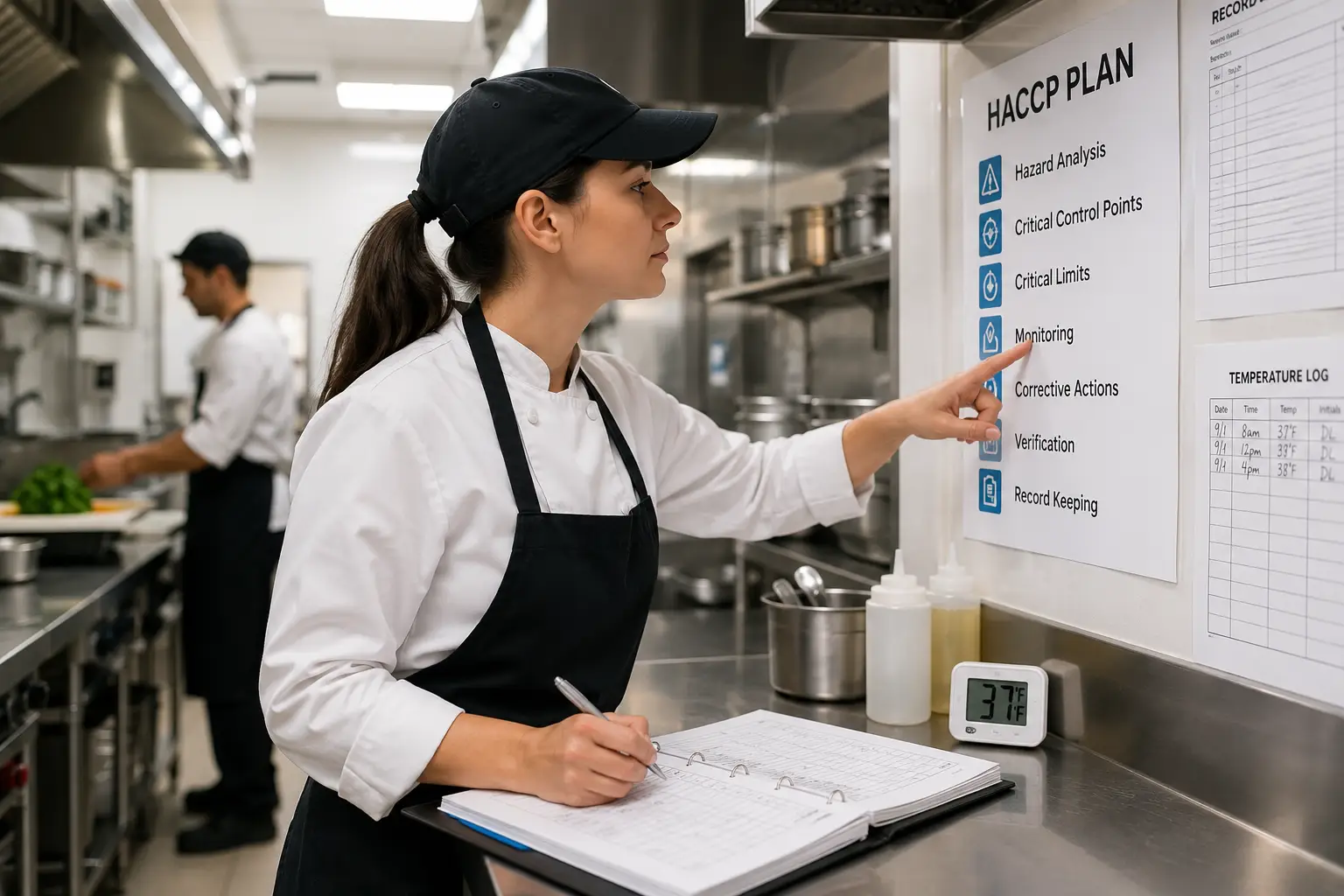
To help you see the shape of how HACCP works, I’ve organized the 7 concepts into two “buckets.” The first three principles are in the first “bucket” and revolve around how you build the plan: what could go wrong, where do we control it, and what defines success? The last four are in the second “bucket” and have to do with how you run and prove the plan: check it, fix it when it slips, verify that the system is working, and prove the whole thing did its job (and record your success or failure along the way).
Here are the official names and textbook definitions you’ll be tested on, the “dress clothes” version of the everyday ideas you just learned:
1–3 Build the Plan
What could go wrong along the way?
In Dress ClothesConduct a Hazard Analysis
Look at the entire flow of food and identify the significant biological, chemical, and physical hazards that require control.
Along the flow of food, where do we actually have control — where could we stop the problem before it becomes a problem?
In Dress ClothesDetermine Critical Control Points (CCPs)
Identify the specific steps in the flow of food where control is essential to prevent, eliminate, or reduce those significant hazards to acceptable levels.
How do we know whether we’re okay or not?
In Dress ClothesEstablish Critical Limits
Set the exact measurable boundary that must be met at each CCP to keep the significant hazard under control.
4–7 Run & Prove the Plan
Who’s checking, and when?
In Dress ClothesEstablish Monitoring Procedures
Decide what gets checked, how it gets checked, who checks it, and how often so you know whether each critical limit is being met.
What happens if the check is wrong?
In Dress ClothesIdentify Corrective Actions
Decide in advance what happens when a check shows that a critical limit was not met.
Who is making sure the system is being followed?
In Dress ClothesVerify That the System Works
Confirm that the HACCP plan is being followed and that the system is still working the way it should.
Can we prove we used the plan?
In Dress ClothesEstablish Procedures for Record Keeping and Documentation
Decide what records will be kept to show that the plan was followed, checks were completed, problems were handled, and the system was reviewed.
BUCKET #1: Hazard, CCP, and Critical Limit
The first three HACCP principles are easy to mix together because they all describe the same problem from different angles. The easiest way to keep them straight is to follow one hazard through the flow of food and watch what happens to it.
Take raw chicken. The hazard is the thing that could hurt somebody — in this case, a pathogen that might be present in or on the chicken. HACCP then asks where, along the flow of food, the kitchen has a real chance to stop that hazard. If the cooking step is essential to controlling it, that step becomes a Critical Control Point, or CCP.
But simply identifying the cooking step isn’t enough. The kitchen still needs a clear way to know whether the hazard was actually controlled. That’s where the critical limit comes in. It gives the CCP a measurable line: the required cooking temperature and time that separate “this is okay” from “this is really NOT okay.”
So the three ideas work together:
The hazard is the problem. The CCP is where we stop it. The critical limit tells us whether we succeeded.
Cooling works the same way. If pathogen growth during cooling is the hazard, then the cooling step may be the CCP, and the required time-and-temperature limits tell us whether that cooling process stayed under control.
Once you see the relationship, the vocabulary gets a lot less mysterious. HACCP isn’t throwing three unrelated definitions at you. It is asking three connected questions: What can hurt someone? Where can we stop it? How do we know we did?
BUCKET #2: Monitoring vs. Verification, Corrective Action, Plan Changes, and Records
Monitoring vs. Verification
Monitoring and verification both involve checking things, which is exactly why students mix them up. The difference is what you’re checking.
Imagine a cook is responsible for checking the temperature of a hot-holding unit every hour. At noon, the cook takes the temperature, gets a safe reading, and writes it down. At 1:00, the cook checks again. That is monitoring: carrying out the planned check — what gets checked, how it gets checked, who checks it, and how often.
Verification steps back from the individual reading and looks at the system around it. A manager might review the week’s temperature logs, watch to make sure the cook is actually taking the readings correctly, check that the thermometer is calibrated, or notice that the same piece of equipment keeps drifting out of range.
Think of the flea bath as the control you’ve put in place. Running your fingers through the dog’s fur every evening looking for hoppy, jumpy, bitey bugs is monitoring: Are the fleas under control?
Verification happens when you step back and look at those checks over time. Have you been checking when you’re supposed to? Are you still finding fleas? Is the weekly bath actually working?
So the easiest way to separate them is this:
Monitoring asks, “How are we checking?” Verification asks, “Did we check — and did our checks work?”
A cook may do the monitoring and a manager may do the verification, but don’t hang the definitions on job titles. The important difference is the job each check is doing.

Corrective Action
Remember the flea bath?
You’ve already decided that if you keep finding fleas after the weekly bath, the next step is a trip to the vet for flea medication. You don’t wait until your dog is scratching himself bald at 10:30 on a Sunday night to start debating your options. You already know what you’re going to do if the first control fails.
That’s corrective action.
HACCP does the same thing in the kitchen. If the temperature is wrong, the food takes too long to cool, or some other critical limit is missed, the response should already be written into the plan. The kitchen shouldn’t be inventing an answer while tickets are hanging and everybody is arguing over what “probably” happened.
The idea is simple: decide what you’ll do when the control fails before the control fails.
What If the Plan Itself Changes?
Remember your puppy? Good news: he doesn’t have fleas anymore.
But what happens if you get a cat?
Now the situation has changed. Maybe the same routine still works. Maybe it doesn’t. Either way, you have to stop and ask whether the plan you built for one situation still fits the one you have now.
HACCP works the same way. A new piece of equipment, a new supplier, or a new menu item can change the process after the plan is already written. Verification isn’t only about checking today’s numbers. It also asks whether the plan still matches how the operation actually works.
A HACCP plan isn’t built once and mounted on the wall forever. If the process changes, the plan may need to change with it.
Records: Can We Prove We Used the Plan?
Three weeks after a bad Saturday lunch, nobody is going to remember exactly what happened at 12:30. Shifts blend together, and the more chaotic ones get forgotten — not quite on purpose, but not entirely by accident either.
If prompted, the cook will “remember” checking the soup. The manager will vaguely recall somebody saying something about the temperature. Somebody else will say something about “the thermometer acting weird that day.” Everyone will be absolutely confident they did the right thing.
Human memory gets very confident right around the moment it becomes completely useless.
That is why HACCP keeps records. If the log shows what was checked, what the reading was, when it was checked, and what the kitchen did when something went wrong, nobody has to reconstruct the afternoon from everybody’s increasingly creative memories.
The plan tells you what you are supposed to do. The records show what actually happened.

Dessert: HACCP in Action
By now you know the pieces — what can go wrong, where to stop it, and what the limits are. This lesson added what happens when a check fails, who makes sure the system’s actually working, and how you prove it afterward.
Now we put all that into motion.
This reality is on full display in this lesson’s IN THE WEEDS scenario, a snapshot of a busy restaurant on a Saturday lunch, doing their best to follow the HACCP plan they’ve already built for making, heating, holding, and serving their specialty soup. The kitchen’s HACCP plan says the specialty soup must stay at 135°F or above, and the cook checks it once every hour. At 11:30 a.m., the soup was 142°F.
An hour later, the cook checks it again.

Chef’s Explanation: The Seven Principles Were All There
That scene probably didn’t feel like seven HACCP principles, lined up, one after the other. Good. It wasn’t supposed to. The kitchen was just trying to survive lunch. But underneath all that noise, the entire HACCP plan was doing its job.
1. Hazard Analysis — What could go wrong?
Long before lunch started, somebody identified the hazard: if the soup isn’t kept hot enough, pathogens can grow and the food can become unsafe.
2. Critical Control Point — Where do we stop it?
The operation decided that hot holding was one of the places where control mattered. Once that soup was in the well waiting to be served, the kitchen had to keep it under control.
3. Critical Limit — Where is the line?
The plan set that line at 135°F or above. At 142°F, the soup was okay. At 128°F, it wasn’t.
4. Monitoring — Who is checking, and when?
The cook was taking the scheduled temperature checks. That’s why there was an 11:30 reading, and that’s why the kitchen caught the 128°F reading at 12:30 instead of discovering the problem three hours later.
5. Corrective Action — What happens when the check fails?
The plan had already answered that question: pull the soup. Because the hourly checks gave the kitchen a known time window, the plan also told them what could happen next — rapidly reheat it to 165°F for 15 seconds within two hours or discard it.
Notice what did not happen: nobody stood there during the press and push of a busy lunch trying to decide what they should do.
The decision had already been made.
6. Verification — Who is making sure the system is being followed?
Later, management can review the log, confirm the checks happened when they were supposed to, make sure the measuring tools were accurate, and look for patterns — like the same soup well failing again and again.
7. Recordkeeping — Can we prove we used the plan?
The cook checked the previous entry and then recorded what happened next. Three weeks later, nobody has to remember whether the soup was probably okay or whether somebody thinks the thermometer was acting weird.
The log tells them.
That’s what HACCP looks like when it’s actually working. The seven principles don’t politely take turns. Some of the work happened when the plan was written. Some happened before the rush. Some of that work happened while the printer was screaming, servers were scurrying, and line cooks were balancing a mild state of panic with an adrenaline high.
But all seven were there.
TL;DR: The Least You Need to Know
- HACCP finds where a significant hazard can be controlled before it reaches the customer.
- Principles 1–3 build the plan. Principles 4–7 run it and prove it worked.
- Hazard = the problem. CCP = where control matters. Critical limit = the measurable line.
- Monitoring = how we check.
- Verification = did we check — and did our checks work?
- Corrective action = decide what happens when a limit is missed before it happens.
- Records = proof of what actually happened.
Key Terms to Know
- HACCP (Hazard Analysis and Critical Control Points) — a systematic approach to identifying, evaluating, and controlling significant food-safety hazards.
- Hazard Analysis — examining a process to identify potential biological, chemical, and physical hazards and determine which are significant enough to require control.
- Critical Control Point (CCP) — a step in a process where control is essential to prevent, eliminate, or reduce a significant food-safety hazard to an acceptable level.
- Critical Limit — the measurable boundary or condition that must be met at a CCP to keep the identified hazard under control.
- Monitoring — the planned check used to determine whether a CCP is under control, performed continuously or at a defined frequency.
- Corrective Action — the pre-planned response taken when monitoring shows that a critical limit has not been met.
- Verification — activities used to confirm that the HACCP plan is valid, is being followed, and continues to work as intended.
- Recordkeeping / Documentation — the HACCP plan and the monitoring, corrective-action, verification, and supporting records used to show what actually happened.
- Variance — approval from a regulatory authority allowing an operation to deviate from a standard food-safety requirement under specified conditions.
