
The Last Few Feet
The chicken was cooked to the right temperature. The sauce was cooled correctly. The vegetables were reheated safely. Everything was held at the right temperature, and the kitchen did exactly what it was supposed to do.
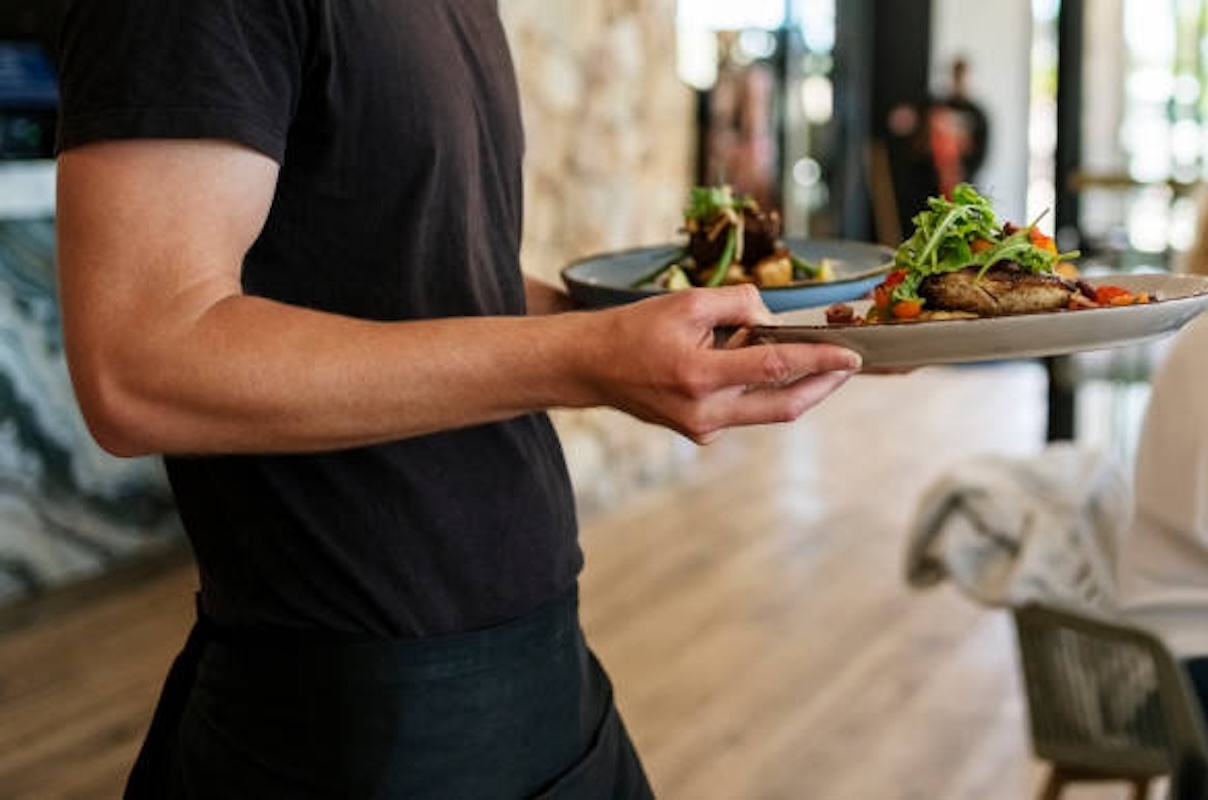
Then the food runner picked up the plate to take it to the guest, and that dirty thumb left a bacteria party on the rim.
Food safety doesn’t end when the food leaves the kitchen.
A restaurant’s food that was prepared, cooked, plated, garnished and picked up for delivery to the guest still has a couple risks ahead of it. There is not another kill step coming. Clean plates and silverware are leaving the dish area and headed to the dining room in the hands of backwaiters, bussers, and waitstaff. Food is leaving the building in catering carriers. Customers are touching things. Used dishes are coming back. And in some cases, we have to worry about vending machines full of food we’ve made, cold-holding our products at three in the morning with nobody around to notice that the power’s out and things have gone very, very wrong.
And here’s the part cooks sometimes forget: the people responsible for keeping all of this safe aren’t necessarily cooks. A server may never touch a raw chicken breast or turn on a stove during their entire shift, but they can still take perfectly safe food and contaminate it during the ten-minute trip to the guests’ table.
The last few feet count.
Waiter, Can I Get a Spoon?
A guest drops their spoon on the floor and asks the server, “Can I get a clean spoon?” The server grabs one from the service station and brings it over. The spoon came out of the dish machine clean and sanitized. It looks spotless, but the guest is still making a gamble.
What was that server doing thirty seconds ago?
Servers spend their entire shift moving back and forth between clean and dirty. They clear plates covered with partially eaten food and spit, pick up used forks, glasses, and napkins. They touch menus, chairs, POS screens, check presenters, bus tubs, garbage, and dirty tables. They go to the bathroom. They grab a quick snack in the corner. They check their phones. Then they turn around and handle clean plates, glasses, silverware, bread baskets, garnishes, and food.
That’s why servers need to wash their hands so often even though they’re not cooking anything. Handwashing isn’t determined by whether you’re cooking. It’s determined by what you just touched and what you’re about to touch next.
Think about what you’re actually doing when you set a table. That fork is about to go into somebody’s mouth, and that water glass is about to touch their lips. If you handle those surfaces with dirty hands, you’re essentially sticking the dirtiest part of your body into your guest’s mouth.
Washing your hands doesn’t give you permission to grab clean tableware wherever you want, either. Once something has been cleaned and sanitized, your job is to keep it that way until the guest uses it. Pick up flatware by the handles, not by the parts that will touch the guest’s food or mouth. Hold glasses by the base, stem, or lower part of the glass, not by the rim. Handle plates without putting your fingers on the food-contact surface.
And all of this gets even more important when the thing you’re touching isn’t a plate or a fork — it’s the food itself. Ready-to-eat food should not be handled with bare hands. If there’s no cooking step left to kill whatever you put on that lemon wedge, sandwich, dinner roll, or garnish, use the right barrier for the job: gloves, tongs, deli tissue, a spatula, or another suitable utensil.
Remember, gloves aren’t magic hands. If you touch something dirty with them and go right back to handling ready-to-eat food, you’ve accomplished exactly the same thing you would have with dirty bare hands — except now you’re wearing plastic.

Ice Is Food
In a lot of restaurants and foodservice locations, ice is invisible. People reach into it, bury things in it, leave the scoop wherever it’s convenient, or grab a drinking glass when they can’t find the scoop and shovel out what they need. These people aren’t bad or disgusting, but what they’re doing is like using somebody’s salad bowl to scoop out a serving of mac-and-cheese. Ice is food, and we’ve got to treat it that way.
Always handle ice with an ice scoop or tongs, never with your hands or a drinking glass. Using a glass is especially dangerous because it can chip or break in the ice, leaving pieces that are extremely difficult to see.
The scoop itself can contaminate the ice too. Think about which part everybody touches all shift: the handle. If somebody buries the scoop in the ice, they’ve just buried the most-handled part of it right along with the cubes that are about to go into somebody’s Coke. If the scoop is stored in the ice, the handle has to stay above the ice and out of contact with it.
The scoop can also be kept in an approved clean, protected location between uses, but here’s what you can’t do: lay it on top of the ice machine or a nearby counter. That’s nasty. Who knows how much dust and grease-laden grime is on that scoop now? The next time somebody plunges it into the ice bin, all of that goes in with it.
Treat the ice bin like you would any other container of ready-to-eat food. Keep your hands out of it, use the right utensil, and protect it from contamination.
The Ladle Doesn’t Get a Free Pass Either
The ice scoop is just one serving utensil. The same basic problem follows the ladles, tongs, spoons, and spatulas we’re using everywhere else.
Start with the obvious one: don’t bounce one serving utensil from food to food. The tongs sitting with the grilled chicken belong with the grilled chicken. The spoon in the mashed potatoes belongs with the mashed potatoes. Besides making a mess, moving utensils between foods gives contamination — including allergens — a ride from one dish to another.
Serving utensils also have to stay clean during service. Clean and sanitize them whenever you change tasks or there’s a chance they’ve been contaminated. If the same utensil is being used continuously with TCS food, clean and sanitize it at least every four hours.
Where you leave the utensil matters too. If it stays in the food, keep the handle up and out of the food. Don’t leave it lying on some questionable counter between uses, and don’t bury the handle in the mashed potatoes where everybody’s dirty hands have been grabbing it.
Some operations keep scoops under running water — you’ve probably seen this at your local ice-cream shop or high-end, fancy-dancy coffee house. You can put the scoops under their own little waterfall or in hot water at 135°F or above — like a little utensil jacuzzi. However you do it, the goal is the same: keep the part going back into the food clean.
Nobody Sat There. It’s Still Clean, Right?
Restaurants set tables before guests arrive because setting every fork, knife, spoon, and glass during the dinner rush would be ridiculous. The problem is that once you put all that beautifully clean, sanitized tableware out in the dining room, the dining room starts happening around it.
Let’s say you set a four-top for four guests, but only two people show up. For the next hour, those two empty place settings sit six inches away while the guests eat dinner. They’re talking over them, reaching across them, moving things around the table, maybe coughing or sneezing. Their kid may have been playing with one of the spoons for twenty minutes. You don’t know.
This is why restaurants either protect tableware that’s set out ahead of time — wrap it, cover it, turn glasses upside down to protect the rims — or deal with exposed settings when the guests arrive. If exposed place settings aren’t removed when the guests are seated, they get treated like they’re dirty — even if no one actually used them to eat. They get a one-way ticket to the dish machine to be cleaned and sanitized before another guest can use them.
It doesn’t matter that nobody sat in those chairs. You can’t look at a fork after dinner and determine whether the guy sitting next to it coughed all over it, and if you’re the next guest, you probably don’t want to find out.
Nobody Touched It. It’s Still Safe, Right?
A table finishes dinner and leaves behind half a basket of breadsticks. They look perfect. Nobody took a bite out of them. Nobody dumped marinara on them. Based on the still perfectly folded napkin over the top, nobody even reached into the basket.
Great. Send them to the next table?
Absolutely not.
Once loose food has been served to a guest, we no longer control what happened to it. That bread basket spent forty-five minutes in the middle of a table while people ate, talked, coughed, sneezed, wiped their mouths, handled dirty silverware, and reached back and forth across dinner.
Olive Garden bread basket? More like a bowl of toilet torpedoes.
Maybe six-year-old Aaron licked every single one while his parents were arguing over how many margaritas they were going to let Grandma Mimi order during dinner. We don’t know, and that’s the point. “Nobody touched it” is not a food-safety control. Once that loose food has been served to a customer, don’t bring it back and serve it to somebody else.
But there are exceptions for food that never lost its protection. Here’s the visual that helped me remember: you know the little syrup pitchers and tiny half-and-half cups they leave on the table at IHOP? That’s food, and it can stay on the table from guest to guest all day long. It doesn’t ever have to be replaced with fresh because the food itself was protected from contamination. The same idea applies to an unopened packet of crackers or an individual sealed condiment packet. Nobody has had access to the food inside, so it’s still protected.
That’s the difference. The question isn’t whether the food looks untouched. The question is whether it stayed protected.

Can You Fill This Up for Me?
Customers bring their own containers everywhere now. Refillable coffee mugs, water bottles, takeout containers — and increasingly, restaurants are encouraging them to do it.
That’s great for reducing waste. It also means a container that’s been in somebody’s car, backpack, cup holder, kitchen sink, or mouth may be coming back across the counter and getting awfully close to our food and equipment.
And that’s where we have a problem. The problem isn’t simply that the container belongs to the customer. The problem is letting whatever is on that container travel backward into our food or onto the equipment we’re going to use for everybody else.
A customer walks in and hands you their reusable cup. Food safety regulations say the cup needs to be inspected by the employee handling the refill. They give it a once-over and shrug. “Looks clean enough.” Great.

But how is that employee supposed to look at a cup and magically KNOW it’s clean and pathogen-free?
They can’t.
Maybe it came straight out of the dishwasher that morning. Maybe it’s been rolling around the floor of their car since Tuesday. Maybe they were drinking from it five minutes ago. Maybe their dog licked the inside of it in the parking lot. From your side of the counter, all four cups can look exactly the same.
That’s why a returnable container can’t just be accepted because somebody looks at it and says, “Looks clean to me.” It has to be designed for repeated use, employees have to inspect it before it’s refilled, and when cleaning and sanitizing are required, that has to happen before the refill. Then the refill itself has to be done without letting the customer’s container contaminate our food, equipment, or food-contact surfaces.
That’s what’s at stake. One questionable cup isn’t just a problem for the person who owns it. If we let contamination from that cup reach our food or equipment, we’ve given one customer’s germs a way into everybody else’s order.
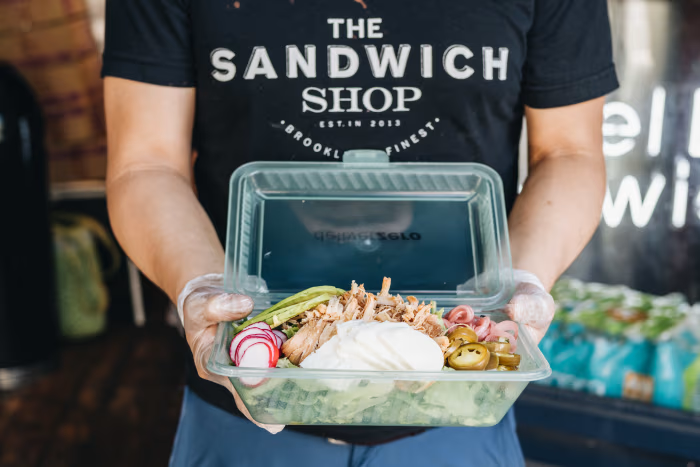
So far, we’ve been looking at what happens when food and equipment cross the boundary between the kitchen and the customer.
Now let’s make that boundary a few miles wide.
OFF-SITE SERVICE
When the Food Leaves the Building
Catering changes something we usually take for granted in a restaurant: the person who prepared and packaged the food is very rarely the person who unpacks it, puts it on a platter or chafer, and serves it.
Imagine you’re catering a wedding for 180 people. At 10:30 in the morning, cooks at your restaurant are filling hotel pans with chicken, vegetables, rice, and sauces. They’re wrapping pans, packing insulated carriers, labeling containers, and getting everything ready to load into a van.
Forty-five minutes later, that van may be pulling up behind a hotel. The employees unloading it weren’t standing in the kitchen when the food was prepared. They may have no idea what’s inside a particular carrier, when it was packed, whether something is ready to serve, whether it needs to be reheated, or what needs to happen to it next.
In the restaurant, a lot of that information travels informally. You can hold up a pan and yell across the kitchen, “Chef, what do you want me to do with this?” Off-site, the cook who knows the answer may be twenty miles away.

And information isn’t the only thing we lose when food leaves the building. Back at the restaurant, we have refrigerators keeping cold TCS food at 41°F or below and hot-holding equipment keeping hot TCS food at 135°F or above. We have handwashing sinks, safe running water, clean equipment, garbage cans, storage areas, and a kitchen designed to keep raw food away from ready-to-eat food.
Put dinner in the back of a van and drive away, and most of the time, you’re leaving all that behind.
That’s the challenge of off-site service: the food has to leave the restaurant with all the same guardrails against contamination intact. And figuring out how we’re going to do that starts before we pack a single pan.
Before You Pack a Single Pan
Before the first pan ever leaves the restaurant, somebody needs to have scoped out the destination and made the call: can this spot actually support the food we’re planning to serve?
That’s a bigger question than it sounds. “The venue” could mean a hotel ballroom with a banquet kitchen — or a wedding tent in somebody’s backyard. We can’t assume the things we take for granted in our own kitchen will be waiting for us when we arrive.
Can the staff actually wash their hands? That means enough handwashing capacity with safe running water, soap, and a way to dry their hands, located close enough to where they’re working that people will actually use it. Do we have enough refrigeration to keep cold TCS food at 41°F or below and enough hot-holding equipment to keep hot TCS food at 135°F or above for the number of people we’re feeding? Do we have enough clean utensils, gloves, containers, and food-contact equipment to get through service without improvising halfway through dinner?
And what’s happening around the food? At an outdoor event, flies, ants, wind, rain, mud, leaves, and ninety-five-degree heat can suddenly become part of the food-safety plan. Food and clean equipment need protected storage, and garbage needs somewhere to go away from food preparation, storage, and service.
You can’t discover an hour before the reception starts that the only handwashing sink is across the parking lot, you brought four chafers for six pans of hot food, or there isn’t anywhere protected to store the clean serving equipment.
Off-site service doesn’t lower our concerns for food safety. It actually heightens them, because we have to build many of the protections our own kitchen normally provides for us.
Once we know the location can support safe service, we can start figuring out how to get dinner there.
Packing the Food for the Trip
A catering van isn’t a refrigerator, a hot box, or a storage room. It’s transportation. If we’re going to put food in the back of one and drive it across town, we have to bring food protection from our kitchen along for the ride.
That starts with the containers. Food should travel in insulated, food-grade containers designed to keep it from mixing, leaking, or spilling. A hotel pan wrapped in foil and shoved into the back seat of somebody’s Honda isn’t catering equipment.

And temperature control doesn’t change because the food’s on wheels. Hot TCS food still needs to stay at 135°F or above, and cold TCS food still needs to stay at 41°F or below for the entire trip. Insulated carriers help us maintain those temperatures during the trip, but don’t confuse insulation with refrigeration or active hot holding. A carrier slows temperature change; it doesn’t magically keep cold food cold or hot food hot.
The same separation rules we’ve used throughout the kitchen travel with us too. Raw animal foods can’t leak onto ready-to-eat foods just because everything is packed tightly into the same van. Food needs to stay covered and protected, and chemicals, used linen, or unsanitized food-contact surfaces — anything at all that could contaminate it — need to be kept far away.
Then there’s labeling. Food being transported for off-site service needs to be labeled with the food name, use-by date and time, and reheating and service instructions. Remember the employee opening that carrier at the hotel wasn’t necessarily in the kitchen when we packed it. “Chicken — use by 5:00 PM — reheat for hot holding to 165°F for 15 seconds” tells them considerably more than a mystery hotel pan wrapped in foil with “chicken” scrawled across the top in black Sharpie.
We’re not labeling it because somebody in an office loves labels. We’re passing instructions from the cook who knows the food to the employee who has to safely take over twenty miles away.

Getting It There Isn’t the Finish Line
The carriers are packed, the labels are on, and everything is ready to go. Now we have to get the food there without undoing all that work.
Start with the vehicle. The inside of a catering van needs to be clean. That sounds obvious until you’ve seen one used to haul dirty Cambros, boxes, extension cords, cleaning supplies, bags of used linen, garbage from yesterday’s event, and tonight’s dinner all in the same cargo area. If we’re transporting food in there, the vehicle needs to be as clean as your kitchen — it’s an essential PART of our food-protection system.
Load everything so the food stays protected during the trip, then get it to the venue.
When the van arrives, don’t assume the insulated carriers did their job just because the lids stayed closed. Check the food’s internal temperature as soon as you arrive. Hot TCS food still needs to be at 135°F or above, and cold TCS food still needs to be at 41°F or below. The thermometer tells you whether the system actually worked.
Only then are we ready to unload, follow the instructions that traveled with the food, and move everything into the safe service environment we planned before we ever left the restaurant.
Off-site service makes food safety harder because we’ve taken the food away from the controlled kitchen that normally surrounds it.
Vending takes that problem one step further: now we take away the employee too.

VENDING: The Restaurant With No Workers
Years ago, food vending was a lot less impressive than it is today. Just a decade or so back in time, you could buy plain little sandwiches, sitting in one of these weird, spinning dispensers, usually tucked into some sad corner of a hospital, meant to feed people overnight after the cafeteria closed.

All that’s changed.
Now you can walk through an airport and find vending machines selling complete meals — salads, bowls, sandwiches, breakfast, desserts, and other foods that aren’t much different from what you’d buy at any other restaurant.
As vending has grown more sophisticated, the food-safety guidance around it has gotten tighter and more specific.
This is a niche area of food-safety training, but it’s important. Pay attention. I want you to think of a vending machine full of meals as a tiny restaurant — with nobody working it. We make the food in our kitchen, package it correctly, transport it to the machine, load it in, and walk away. At three o’clock in the morning, that machine is selling our food while every employee who prepared it is home asleep.
A lot of what follows will be very familiar: cold TCS food needs to stay at 41°F or below, and hot TCS food needs to stay at 135°F or above. Refrigerated ready-to-eat TCS food that requires date marking still requires date marking. The food still has to be protected from contamination.

And somebody still has to check on the food. Vending-machine operators need to check product shelf life every day. If a product’s expiration or use-by date has passed, throw it out. Refrigerated ready-to-eat TCS food prepared in-house doesn’t get extra life because we put it in a machine, either — the same seven-day date-marking rule still applies.
What changes is who’s there to notice when something goes wrong.
If the walk-in starts getting warm at 2:00 in the afternoon, somebody may notice. An alarm may go off. A cook walks inside. A manager checks a thermometer. There are people around who can recognize the problem and do something about it.
Many modern machines are connected and can be monitored from a distance. But whether somebody is watching from across town or nobody is watching at all, a vending machine holding TCS food needs an automatic control that stops it from vending if a power failure, mechanical problem, or another failure prevents it from maintaining safe food temperatures.
The machine is doing the job an employee would normally do: recognizing that temperature control has failed and keeping the next customer from buying the food anyway.

The Weird 30 / 120 Rule
Now we get to one of those rules you’re probably never going to use unless you actually work with vending machines — but it’s exactly weird enough to show up on a food-safety exam.
Every time somebody opens a vending machine to fill it, service it, or restock it, they’re interfering with the little temperature-controlled environment inside. The door is open. Warm air gets into a refrigerated machine. Heat escapes from a hot machine. Then we close everything back up and the equipment has to recover.
The rules give the machine time to do that.
For a refrigerated vending machine, the air inside cannot stay above 41°F for more than 30 minutes after the machine is filled, serviced, or restocked.
For a hot-holding vending machine, the air inside cannot stay below 135°F for more than 120 minutes after the machine is filled, serviced, or restocked.
Notice what we’re measuring here: the air temperature inside the machine. This isn’t another rule telling you that a turkey sandwich can sit above 41°F for thirty minutes or that hot food gets two hours below 135°F. We’ve already learned what happens when food itself falls out of safe holding temperature.
This is about the machine recovering after somebody opened it and worked inside it.
So don’t add 30 and 120 to the giant pile of unrelated food-temperature clocks in your head. Ask what happened first:
Did somebody just fill, service, or restock a vending machine?
If yes, you’re looking at a vending-machine recovery rule.

The Package Is PART of the Safety System
There’s one more vending-machine detail worth knowing. If you’re selling fresh fruit with an edible peel — an apple, for example — wash it and wrap it before it goes into the machine. The customer is going to eat the outside, so that outside needs to be clean and protected too.
There’s one last vending rule that’s a little strange until you understand what the package is actually doing.
TCS food sold through a vending machine has to stay in the package it was placed in when it was prepared at the food establishment or food processing plant.
At first, that can sound unnecessarily specific. Why can’t we take food out of one perfectly good container and put it into another perfectly good container before loading the machine?
Because the package isn’t just something that holds the food. It’s part of the food-safety system.
Once food has been safely prepared and packaged, that package protects it from everything outside: hands, dirty surfaces, other foods, and other sources of contamination. Depending on the product, the package may also keep important information attached to the food — what it is, what’s in it, allergens, dates, and information that can help identify it if there’s ever a recall.
Open that package and transfer the food into something else, and you’ve broken that protection. Now somebody has to handle the food again. New utensils and containers may be involved. The outside of the original package may get close to the exposed food. Information that belonged with the food can get separated from it. We’ve taken something that was already safely protected and created another opportunity for something to go wrong.
And remember where this food is headed: an unattended vending machine.
So don’t create an unnecessary new food-preparation step at the end of the process. Prepare it. Package it. Transport it. Load it. Sell it in the package that was protecting it from the beginning.
The package isn’t just a container. It’s one of the controls keeping that food safe.

Chef’s Explanation
These guys remember an impressive number of food-safety rules. Unfortunately, they have absolutely no idea which ones apply.
Start with the packing job. “Chicken goes on the bottom” is a storage rule for raw animal foods. We store raw animal foods below ready-to-eat food and arrange them according to their required minimum cooking temperatures because we’re protecting other food from raw juices and cross-contamination.
This chicken is already cooked. The potato salad didn’t need protection from raw chicken juice. What it needed was protection from heat.
They packed 38°F potato salad in the same insulated carrier as hot chicken. The potato salad warmed to 57°F, while one pan of chicken dropped to 127°F. They were so busy preventing a cross-contamination problem that didn’t exist that they created two temperature-control problems that absolutely do.
Now the times matter. The label tells us the potato salad was 38°F at 4:15 PM, and it’s only 5:00 PM now. We know it has been above 41°F for less than 45 minutes, so there is still time for corrective action. Get the potato salad back to 41°F or below quickly using a safe cooling method.
The chicken needs corrective action too. Hot TCS food needs to stay at 135°F or above. This pan is at 127°F, but once again, the label gives us the information we need: only 45 minutes have passed since everything was packed. We’re still inside the corrective-action window you learned during holding. Pull the chicken, rapidly reheat it to 165°F for 15 seconds using proper reheating equipment, then return it to hot holding at 135°F or above. If it had been out of temperature for more than 2 hours — or we didn’t know how long — we’d discard it.
So Captain is right about exactly one thing: time matters. He’s just using the wrong damn clock.
Being “well under four hours” doesn’t make either food safe. The four-hour TPHC rule isn’t a general grace period for food that accidentally falls out of temperature. Time as a Public Health Control is a deliberate procedure in which time replaces temperature control. Nobody started a TPHC clock on this food.
And no, don’t solve the potato-salad problem by putting it over the ice you’re using for drinks. Ice is food. Once you use that ice as part of your cooling setup, don’t turn around and serve it in somebody’s Coke.
The label and the thermometer are what keep this from becoming a guessing game. The label tells the server where the food started and when, and the thermometer tells her where it ended up after the trip. That’s exactly why those controls have to travel with the food when the kitchen doesn’t.
The captain remembered a lot of rules. The server understood what they were for.
Closing Side Work
It’s the end of service. Before you clock out, make these calls.
1. A server clears a table and finds an unopened packet of crackers beside a half-full bread basket. What can be served again?
The sealed crackers can be re-served because the food remained protected. The loose bread cannot. Once loose food has been served to a guest, we no longer control what happened to it.
2. A four-top was preset for four guests. Only two guests sat down and ate. The two unused place settings remained exposed on the table through the entire meal. What happens to them?
Send them to the dish area to be cleaned and sanitized before they’re used again. “Nobody sat there” doesn’t prove they stayed protected.
3. You’re stocking an outdoor catering station and discover the nearest handwashing sink is across the parking lot. Dinner starts in twenty minutes. What’s the problem?
The problem happened before the van ever left the restaurant. Somebody should have confirmed that the site had usable handwashing capacity where the staff would actually be working. You don’t want to discover what your catering site is missing twenty minutes before 180 hungry wedding guests show up.
4. A refrigerated vending machine reads 46°F fifteen minutes after being restocked. Do you automatically discard the food?
No. First figure out what you’re measuring. This is the air inside a vending machine recovering after it was restocked. A refrigerated machine gets up to 30 minutes to bring that air back to 41°F or below. That’s not permission for a turkey sandwich to wander around above 41°F for thirty minutes.
5. A hot-food vending machine has been below 135°F for 90 minutes after restocking. Which number matters: 2 hours, 4 hours, or 120 minutes?
120 minutes. Somebody just restocked a vending machine, so you’re looking at the machine’s recovery rule — not reheating, ordinary hot holding, or TPHC. Figure out what process you’re dealing with before you grab a number.
6. A customer asks you to refill a reusable cup. What’s the real food-safety concern?
Don’t let whatever came in on that customer’s cup hitch a ride backward into your food or equipment. Inspect it, clean and sanitize it when required, and refill it without turning one customer’s questionable cup into everybody else’s problem.
TL;DR: The Least You Need to Know
By the time food reaches service, we’ve already done most of the hard work. Don’t screw it up in the last few feet.
- Handle clean plates, glasses, and flatware by the parts that won’t touch food or the guest’s mouth, and don’t handle ready-to-eat food with bare hands.
- Ice is food. Keep your hands and drinking glasses out of it, use the right scoop, and keep the dirty handle away from the ice.
- Keep serving utensils with the food they belong to, keep the handles clean, and clean and sanitize utensils used continuously with TCS food at least every four hours.
- Once loose food has been served to a customer, don’t serve it to somebody else. Food that remained protected — like an unopened package — is different.
- Don’t let a customer’s reusable container become a highway for contamination back into your operation.
- Catering doesn’t suspend the temperature rules. Hot TCS food stays at 135°F or above; cold TCS food stays at 41°F or below. Plan the site, protect and label the food during the trip, and check temperatures when you arrive.
- An insulated carrier slows temperature change. It isn’t a refrigerator or an actively heated hot box.
- Check vending-machine product shelf life daily. Expired food gets thrown out, and the normal seven-day date-marking limit still applies to refrigerated ready-to-eat TCS food prepared in-house.
- A vending machine holding TCS food needs a control that stops it from selling food when safe temperature control fails.
- Remember the weird vending recovery numbers: 30 minutes for refrigerated machines; 120 minutes for hot-holding machines. Those numbers apply to the air inside the machine after filling, servicing, or restocking, not to the food itself.
- Fresh fruit with an edible peel, like an apple, must be washed and wrapped before it goes into a vending machine.
- TCS food sold through a vending machine stays in the package it was placed in when it was prepared.
The whole lesson comes down to this: food safety has to survive every handoff between the kitchen and the customer.
Key Terms
Bare-hand contact — Touching ready-to-eat food directly with bare hands instead of using gloves, tongs, deli tissue, a spatula, or another suitable barrier.
Preset tableware — Plates, glasses, flatware, or other tableware placed on a table before guests are seated. If it isn’t kept protected, exposed tableware may need to be cleaned and sanitized before another guest uses it.
Re-serving — Serving food to another customer after it has already been served to someone else. Loose food generally cannot be re-served; food that remained protected may be allowed.
Returnable container — A reusable container that comes from the customer side of the operation and may be refilled only under controls that prevent it from contaminating food or equipment.
Off-site service — Food prepared in one location and transported somewhere else for service, such as a catered wedding or outdoor event.
Vending-machine automatic shutoff — A control that stops a vending machine from selling TCS food when a power, mechanical, or other failure prevents safe temperature control.
Vending-machine recovery period — The limited time allowed for the air inside a vending machine to return to safe temperature after the machine has been filled, serviced, or restocked: 30 minutes for refrigerated machines and 120 minutes for hot-holding machines.