
Imagine a sixteen-year-old who just got his driver’s license. He’s not a maniac — he’s a pretty good kid. He passed driver’s ed. He knows what a stop sign means, knows the speed limit, knows he shouldn’t be playing with his phone, and knows exactly where both hands are supposed to be on the steering wheel.
Put Dad in the passenger seat and he drives great. Dad can take the keys, take away the freedom that came with them, and make life pretty unpleasant if he doesn’t. The kid knows that, so he pays attention.
Put a police car behind our young driver and somehow he gets even better. Full stop at every stop sign. Turn signal long before it’s needed. Speed limit? He’s going five miles under. And his phone might as well be locked in a safe.
Finally, let him drive around by himself for a bit. He’s still basically a good kid, but the music gets louder. Maybe he glances at a text. Maybe that full stop becomes a rolling stop when nobody else is around. He drives when he’s tired, even when he knows he probably shouldn’t. He snacks on Chick-fil-A, one hand on the wheel, the other buried in a greasy white bag, hunting for that last waffle fry.
To the teen driver, none of it feels reckless in the moment. That’s the point. The rules haven’t disappeared, and he hasn’t forgotten how to drive. They’ve just started bending a little because nobody is sitting beside him making sure they don’t.

Now put four of his friends in the car. Everybody’s laughing their asses off. Somebody’s changing the music. Somebody’s yelling from the back seat. The energy is high, everybody is feeding off everybody else, and maybe there’s just a little showing off mixed in. Suddenly the exact same kid who drove like a driving instructor with Dad beside him and a cop behind him is doing things he absolutely knows he shouldn’t be doing.
His training didn’t disappear. The law didn’t change. He still knows the right answer. What changed was everything around him — what his friends were doing, what they were encouraging, and how far away the possibility that he was making a bad decision felt in the moment.
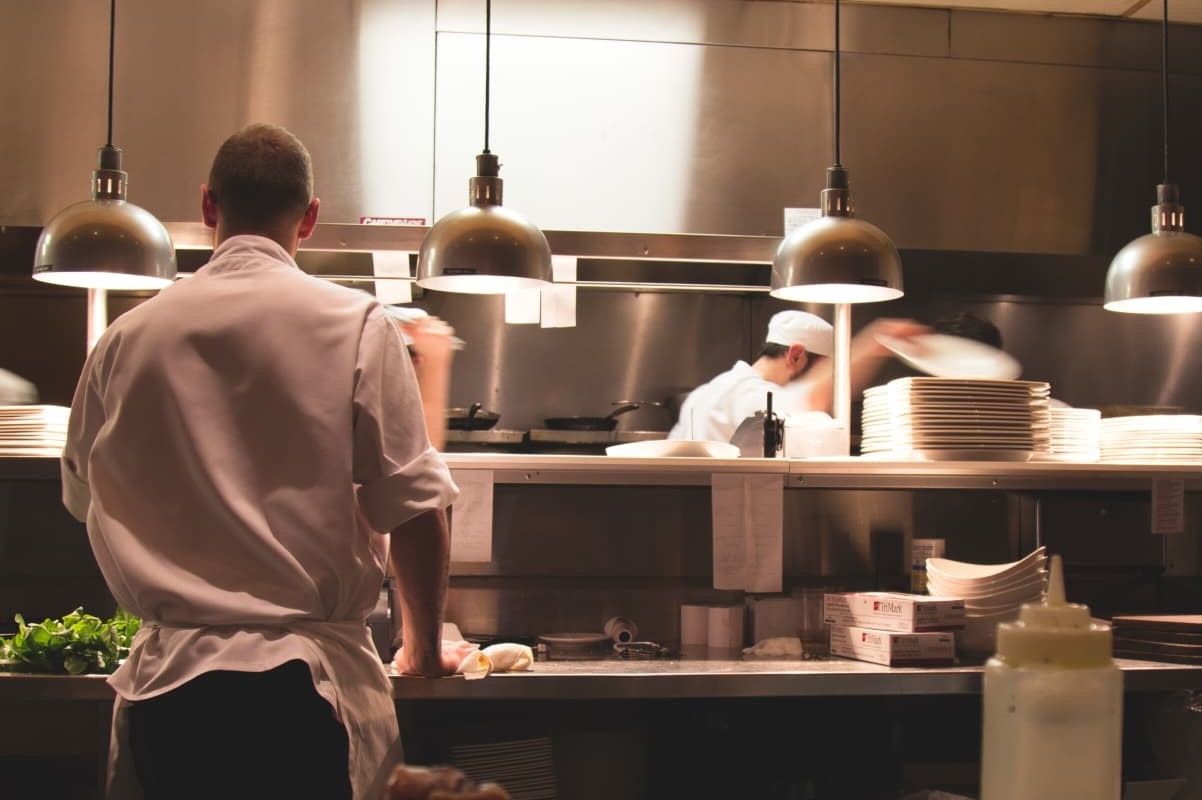
A restaurant kitchen works the same way. A cook may know exactly when to wash their hands, when to change gloves, how to rotate the walk-in, how to mix sanitizer, and what temperature the chicken needs to hit. Put Chef next to them and they can do everything perfectly. Put the health inspector in the kitchen and suddenly everybody is Food Safety Employee of the Year.
The real test comes Friday night at 7:45, when the printer hasn’t stopped in twenty minutes, Chef is buried at the pass, three people called out, and everybody around that cook is saying, “Just go. We’ll fix it later.”
That is when you find out what your food safety culture actually is.

Knowing the Rules Isn’t Enough
That is Food Safety Culture: what foodhandlers in an operation actually do when no one is looking over their shoulder, when the pressure is high, and when the consequences of taking a shortcut feel a very long way away.
Cooks aren’t children, even though training people to work safely can occasionally make it feel that way. And I’m not suggesting managers should treat their employees like teenagers — even though in many kitchens, workers actually ARE teenagers.
The driving story works because it shows how much behavior can change depending on supervision, pressure, consequences, and the people around you. And it demonstrates something else important: a restaurant cannot be run by the food safety boss standing over every employee’s shoulder every shift, every day.
So we have to be honest about the problem: it isn’t enough for your cooks to know the rules, and it isn’t enough for everybody to have good intentions. You need a system that makes safe behavior possible and consistent, and somebody has to keep that system working while the restaurant is actually running.
That is where Food Safety Culture, the Food Safety Management System, and Active Managerial Control start to separate.
Three Things Happening at Once
Food safety exams love their acronyms, and here’s a couple more for you:
- Food Safety Management System becomes FSMS in the rest of this course — and on the exam.
- Active Managerial Control becomes AMC — like the movie theater chain.
- Food Safety Culture? It’s not an acronym. It stays written out. No real reason. It just does.
The easiest way to separate the three is to imagine a dirty meat slicer.
If a cook sees that slicer and automatically thinks, “Gotta clean the slicer,” because that’s simply what people do in this kitchen, you’re looking at Food Safety Culture.
The FSMS answers a more specific question: How is this supposed to work? Who cleans the slicer? When? With what procedure? Who was trained? How do we know the task happened?
AMC asks: Is the system actually working? The manager notices the slicer is dirty, makes sure it gets cleaned correctly, figures out why the procedure failed, deals with the immediate problem, and changes whatever needs changing so the same failure becomes less likely tomorrow. Those things overlap constantly, but they are not the same thing.

Think of It Like a Stage Production
If this is all starting to feel like a pile of management words tossed into a blender and set to frappé, you’re not wrong. It does. Here’s how I like to think of these things: as a big stage production.
Before the curtain ever goes up, a ridiculous amount of stuff has to already be working. There needs to be a stage, of course. Work lights would be good. The sound system has to turn on and the microphones need to function. Costumes need to fit the actors. Props have to be ready to go. People have to practice their lines, and somebody has to know how rehearsals work, where everything belongs, and what happens backstage. Nobody bought a ticket to watch any of that. It would be boring. And vaguely stupid. But without it, there isn’t much of a show. Those are your Prerequisite Programs: all the basic stuff that has to be in place and working before the curtain goes up.
Now imagine the production itself. Hundreds of things have to happen in the right order. Somebody enters from stage left. A light changes. There’s a spotlight. Music starts, then ends, then starts again. A set moves. There has to be an organized plan for ALL of it: who does what, when they do it, how it’s supposed to happen, what gets checked, and what happens when something goes wrong. That’s your Food Safety Management System — FSMS.
But here’s the problem with a beautiful production book: it can’t run the show. Somebody has to actually be there, production book in hand, watching it all happen. That’s the stage manager. Their job is to call cues, watch what’s going on, deal with something when it goes wrong, get somebody back to the mark they’re supposed to be standing on when the spotlight hits, and adjust on the fly when reality decides it doesn’t particularly care what the production book said was supposed to happen. That’s Active Managerial Control — AMC. The FSMS says how the show is supposed to work. AMC is somebody actively making sure it actually works.
Then there’s the cast and crew themselves. Do they show up prepared? Do they check their costumes, props, and equipment? Do they help somebody who misses a line or a mark? Do they speak up when something looks wrong? Do they handle problems before the stage manager ever has to say a word? Or maybe you’ve got a lazy crew: everybody cuts corners, hides mistakes, leaves problems for the next person, and only becomes professional when the producer walks into the room. Whichever crew you’ve got — that’s your culture. In a restaurant, we call it Food Safety Culture. It’s not another book or another checklist. It’s what this group of people has learned and accepted as normal.
Now suppose one scene includes open flame. This show sets the lead actress on fire. Twice. Pyrotechnics! You’re probably not handling that with “Eh, everybody knows what they’re doing.” That particular part of the show gets a serious plan. What could go wrong? Where do we have to control it? What limits matter? Who checks them? What happens if something isn’t right? Where is the fire extinguisher? That’s where HACCP fits. HACCP isn’t the whole production. It’s a formal way of dealing with particular hazards that need tighter control inside the larger operation.
So if all these terms start bleeding together, come back to the theater: Prerequisite Programs are the stuff you need before the show can work. FSMS is how the show is supposed to run. AMC is somebody actually running it. Food Safety Culture is how the cast and crew behave when they’re doing it. HACCP is the special plan when screwing it up could get somebody hurt.

Culture Is What Becomes Normal
If a cook at your restaurant looks at a dirty meat slicer and thinks, “Gotta clean the slicer,” because that is simply what cooks DO in this kitchen, in this circumstance, at this time, you have one kind of culture.
If another cook sees the dirty slicer and doesn’t think anything at all, just goes about his shift, you have another. If somebody else yells, “Somebody better get on that slicer,” and then goes right back to their job without making sure anything actually happens, that’s another version still. And if another cook thinks, “Chef is off tonight, we’re busy, I’ll get to it later if I have time,” you’re moving in a worse direction.
The real problem, though, is when everybody working that shift sees all of those responses and treats them as completely normal. At that point, you don’t just have one cook making a bad decision or one task that got missed. You have a culture — and it isn’t one you should be proud of.
In plain English, Food Safety Culture answers one enormous question:
How do we do things around here?
People pay very close attention to what an operation rewards, ignores, and tolerates. Usually they pay more attention to those things than they do to whatever somebody printed in the employee handbook.
Every operation already has a culture. You don’t get to say, “We’re still building ours.” The moment people begin working together, patterns develop. Employees figure out which rules matter, which ones only matter when Chef is around, who can get away with what, and whether speaking up creates a solution or just makes their own shift worse.
One of the best examples of organizational culture anywhere is probably Walt Disney World. They have thousands upon thousands of people doing completely different jobs, but Disney spends an enormous amount of effort teaching all of them how people who work there are supposed to act. You’re not simply an employee; you’re a Cast Member. How you talk to guests, how you behave, what you do when you see trash on the ground, even how you can cut your hair and the kind of makeup or tattoos you can show — all of that gets taught, reinforced, and indoctrinated into your very soul until those values start to feel normal.
Restaurants do the same thing whether they intend to or not. The only question is what they’re teaching.
That’s why the old management saying “culture eats policies for breakfast” has survived as long as it has. A beautiful written policy loses every time if the actual kitchen culture tells employees that nobody really expects them to follow it.
Passing an Inspection Isn’t the Same Thing
An operation can pass an inspection and still have a weak food-safety culture. An inspection is a snapshot. Culture is what happens during all the hours when nobody with a clipboard is standing in the kitchen.
Remember our sixteen-year-old driver with the police car behind him? The fact that he drove perfectly for six blocks doesn’t tell you how he normally drives. The same applies here.
ServSafe identifies eleven elements involved in building a strong Food Safety Culture. The terminology is dense, and there isn’t a clever trick that eliminates the need to learn it. Understand what each one is trying to accomplish first; then memorize the official headings.
Eleven Elements of a Strong Food Safety Culture
Culture Can’t Run the Kitchen by Itself
Culture matters enormously, but culture by itself cannot tell fifty employees exactly how every food-safety task is supposed to happen.
Imagine hiring fifty people and giving them one instruction: “Be safe.” Great. What sanitizer concentration are they supposed to use? Who checks the walk-in? How often? What happens when a delivery arrives warm? Where is recalled food stored? Who trains a new cook? How is a slicer broken down? Who records a corrective action?
Without a system, you have fifty people improvising. That system is the Food Safety Management System — FSMS.
Officially, an FSMS is the specific set of actions taken by management and employees throughout the flow of food to control risks and hazards that can lead to foodborne illness. In kitchen language, it is the organized way the operation makes food safety happen: policies, procedures, training, monitoring, corrective action, records, and the people responsible for all of it.
The point is not to create paperwork for the sake of paperwork. The point is to make safe food handling the normal, consistent way the operation works — no matter who is on the schedule, what shift they’re working, or how busy the kitchen gets.
The Food Code takes this one step further: in places where the newer requirement has been adopted, the FSMS isn’t supposed to exist only in the manager’s head. It has to be written down, maintained, actually used while the operation is open, and available when the regulatory authority asks to see it.
There is a transition period because, shockingly enough, thousands of restaurants do not all change their management systems Tuesday morning because somebody published new language in a government document.
A regulatory authority can also decide that an establishment poses little enough foodborne-illness risk, based on what and how much food it prepares, that the full written-system requirement is unnecessary. The restaurant does not get to look around, decide it seems pretty safe, and exempt itself.
The larger idea is much easier than the regulatory language makes it sound. An FSMS is like the official rule book for a game: it takes food safety out of the category of things we hope everybody remembers and moves it into the category of this is how the food-safety game is played.
Before You Can Play the Game
Of course, handing somebody the official rule book doesn’t help very much if there isn’t a field, a ball, goals, or players. An FSMS works the same way.
Before the larger management system can function, certain basic programs already need to exist. ServSafe calls these Prerequisite Programs. In more working-man language, this is the stuff you need in place first.
If you don’t have a working handwashing program, your cleaning system exists only in somebody’s imagination. If employees have never been trained, the refrigerator hasn’t been maintained since the Bush administration, and your pest-control plan consists of yelling “Holy Cheeseballs, that’s a big roach,” you have more fundamental problems than designing a sophisticated management system.
Eight Prerequisite Programs
These programs don’t replace the FSMS; they support it. A beautifully designed management system cannot rescue an operation whose basic programs don’t work.
Somebody Still Has to Run the Game
You’ve actually been doing part of this since Course Intro & Regulatory Foundations, where you first met the Person in Charge and the idea that management has to actively watch things like handwashing, staff illness, cook temperatures, who is allowed in food areas, and whether safe procedures are being followed.
Now that job gets its formal name: Active Managerial Control — AMC.
The FDA’s official language is dry: AMC is the purposeful incorporation of specific actions or procedures by management to gain control over foodborne-illness risk factors. Kitchen translation: AMC is management actively making the food-safety system work while the operation is running.
Suppose you find a sanitizer bucket that is testing too weak. The immediate job is obvious: fix it. But active management doesn’t stop with making one new bucket.
Why was it weak? Did somebody mix it incorrectly? Is the dispenser failing? Was the employee never trained? Did the test strips run out? Did everybody know the dispenser has been acting strange for three weeks and simply decide this was normal?
A manager who remixes the bucket and walks away has corrected one bucket. A manager who figures out why the bucket became wrong in the first place has started managing the system.
ServSafe organizes AMC around six activities:
Six Active Managerial Control Activities
Notice where those six activities end: reevaluate the program. The cycle does not stop because you fixed today’s problem.
AMC has to be proactive, reactive, and adaptive. What does that mean? Simple: do your best to prevent the problem before it happens, deal with it when it happens anyway, and then figure out what needs to change so you don’t keep having the same damn problem over and over again.
If you’re not making your kitchen safer every time there’s a problem, you are not actively managing it. You’re babysitting crazy people.

So What Are We Actually Trying to Control?
So if AMC is management actively keeping the food-safety system working, what exactly are we trying to keep from going wrong?
The FDA gives us five major foodborne-illness risk factors. Think of them as the usual suspects.
Five Major Foodborne-Illness Risk Factors
Look at those five. You’ve been fighting these same five problems all along: bad suppliers, bad cooking, bad holding temperatures, contaminated equipment, and bad personal hygiene.
AMC isn’t another unrelated set of food-safety rules dropped on top of all that. It is the management work of making sure those rules are actually controlling these five recurring ways operations make people sick.
When you’re managing food safety, keep asking: Where could one of these risk factors show up? How would I know? And what am I going to do before somebody gets sick?
The FDA’s Five Big Moves
If the five risk factors are the usual suspects, the FDA’s five Public Health Interventions are the big management moves used to keep those suspects from causing trouble.
Don’t be intimidated by the names. They’re really fancied-up versions of things you’ve already learned. But you do need to recognize the official terms, because ServSafe can put one of these phrases in a question and make something you completely understand sound like it came from a congressional hearing.
Five Public Health Interventions
Here’s the part you need to keep straight: the five risk factors describe where food safety commonly goes wrong; the five Public Health Interventions describe major ways management controls those failures. Students new to food safety have a habit of confusing these two lists – here’s a comparative chart that will hopefully help.

Where HACCP Fits
One more piece belongs in this picture: HACCP, which stands for Hazard Analysis Critical Control Point. Notice there is no “and” hiding in the official name.
HACCP is a formal, systematic way to identify significant hazards in a process, establish controls at the places that matter most, monitor those controls, and respond when something goes wrong. HACCP deserves more than a drive-by explanation in the middle of an already crowded lesson and we will spend considerable time untangling it later on in this series. For now, the relationship is what matters:
System ≠ Management ≠ Method
FSMS is the system. AMC is management actively making that system work. HACCP is one formal method that can be built into that system to identify and control specific hazards.
If the FSMS is the official rule book for the food-safety game, HACCP is a detailed game plan built around particular hazard points. That’s enough HACCP to keep the pieces in the right buckets for now.
Closing Side Work
What You Actually Need to Remember
This lesson has a lot of vocabulary because ServSafe occasionally decides to dump the whole silverware drawer onto the table at once. There isn’t a shortcut around learning it. The best we can do is make sure you understand what each means and how they relate to one another:
- Food Safety Culture = what becomes normal: what people actually do, what managers tolerate, what the crew expects, and how employees behave when nobody is standing beside them.
- Prerequisite Programs = the basic systems that need to work before the larger management system has much chance of succeeding.
- FSMS = the organized food-safety system: policies, procedures, training, monitoring, and the other actions used to control risks throughout the operation.
- AMC = management actively making that system work by finding risk, monitoring what matters, correcting problems, overseeing people, training them, and reevaluating the program.
- Five Risk Factors = the usual ways food safety goes wrong.
- Five Public Health Interventions = major management strategies for controlling those failures.
- HACCP = one formal hazard-control method that can operate inside the larger system.

Chef’s Explanation
You tell your sous chef that Maria stays home. She vomited last night, she has not been free of the symptom long enough to return to work under the normal rule, and “she seems fine now” is not a management standard.
Could there be a noninfectious reason she threw up — a migraine, motion sickness, a medication reaction? Sure. But nothing in this scenario tells us that happened, and we don’t get to invent an explanation because we’re short-staffed.
So the immediate decision isn’t particularly complicated: Maria doesn’t work tonight. Maria, though, is actually the easy part. The bigger problem is standing in front of you holding the phone.
Your restaurant may have a beautiful written employee-illness policy. Everybody may have signed it. Your sous chef may even be able to explain the rule perfectly if the health inspector asks. But every time an employee reports illness and management responds with “Are you really sick?”, “We’re already short,” “Don’t screw the team,” or “Take something and get through the shift,” another policy is being taught at exactly the same time:
Keep your mouth shut unless you’re practically dying.
And the line just told you they’ve already learned that policy. That is Food Safety Culture.
The old tough it out attitude has been around kitchens forever. Cuts got taped up. Burns got wrapped. Backs hurt. Feet hurt. You worked tired, sore, hungover, angry, and sometimes half-dead because service was service and somebody had to cook dinner.
There are plenty of things a cook can choose to tough out.
Vomiting and diarrhea are not among them.
The immediate Staff Health Control is keeping Maria out of the operation until she meets the requirements to return. The FSMS should already contain the illness-reporting procedure. But AMC requires more than pointing at the policy and going back to prep.
You now know the sous chef has been undermining that system. He needs to understand the rule and, more importantly, why his behavior is training employees not to report symptoms. The crew needs to hear clearly that reporting illness is part of doing the job correctly, not proof that somebody is weak or abandoning the team.
Fixing Maria’s shift does not fix the bigger problem. Now you have to ask some uncomfortable questions. Has this happened with other employees? Are scheduling practices encouraging people to hide illness? Do employees believe calling out will cost them hours, respect, promotion, or future shifts? Does one manager enforce the policy while another tries to negotiate sick cooks back through the door? Those are system questions.
And yes, Mother’s Day may now be an absolute train wreck. You may have to move people, cut parts of the menu, call somebody else, jump onto sauté yourself, or make whatever other operational adjustment keeps the restaurant functioning without putting a vomiting cook on the line.
Maybe your mother spends Mother’s Day wondering why you’re late.
Too bad.
That’s what makes this a real food-safety decision. Doing the right thing when it is easy tells your staff almost nothing. Culture is what your staff learns from the decision you make when doing the right thing costs you something.
Key Terms to Know
- Food Safety Culture — the shared values, expectations, attitudes, and behaviors that shape what employees actually do about food safety.
- Food Safety Management System (FSMS) — the organized system of actions, policies, procedures, training, and monitoring used by management and employees to control food-safety risks throughout the flow of food.
- Active Managerial Control (AMC) — management’s purposeful, ongoing work of controlling foodborne-illness risk factors by finding risks, monitoring operations, correcting problems, overseeing and training staff, and reevaluating the system.
- Prerequisite Programs — the basic food-safety programs that must function as the foundation of the larger FSMS.
- FDA Public Health Interventions — the five major management interventions identified by the FDA: Demonstration of Knowledge, Staff Health Controls, Controlling Hands as a Vehicle of Contamination, Time and Temperature Parameters for Controlling Pathogens, and Consumer Advisories.
- HACCP — Hazard Analysis Critical Control Point — a formal, systematic method for identifying and controlling significant food-safety hazards.