
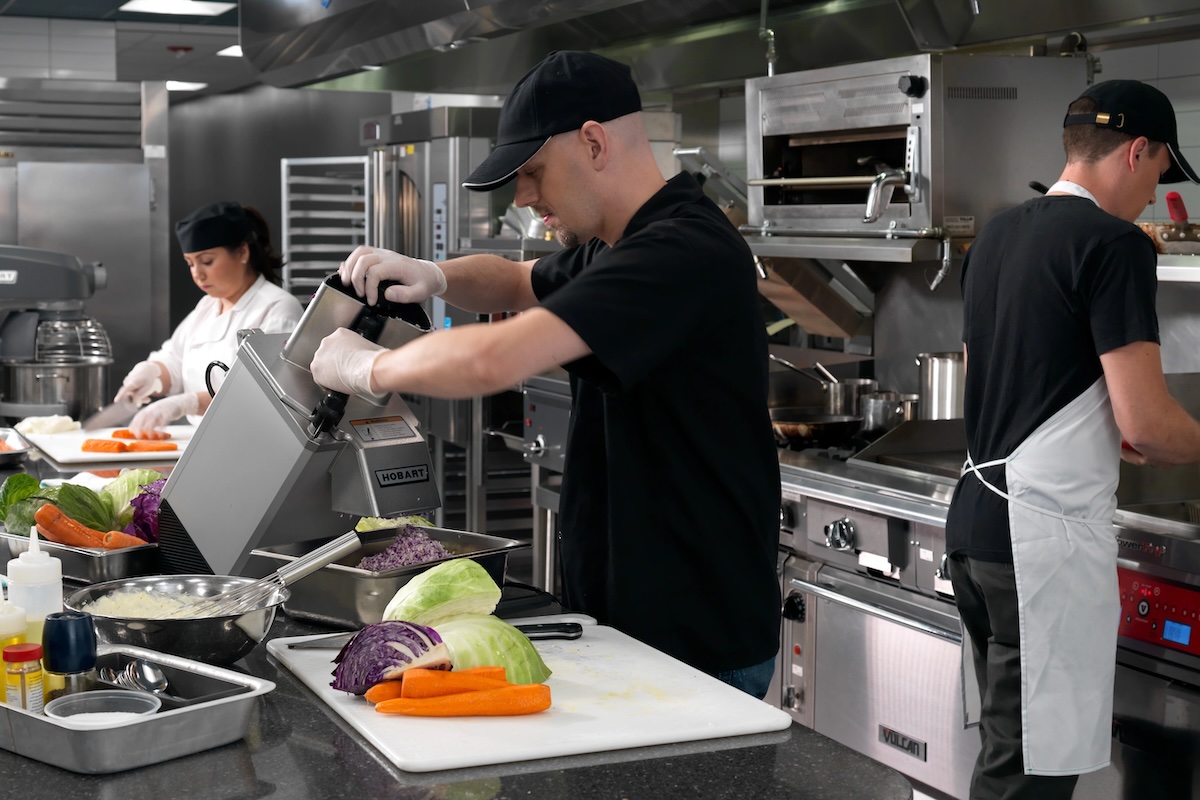
Prep is where cooks get themselves into trouble because almost everything you’re doing feels normal. Boring, even.
You’re just getting ready for service. Chopping onions. Setting chicken on the worktable while you trim it. Giving your lettuce a quick rinse. Somebody cracks three dozen eggs into a cambro for brunch. The shrimp needs to thaw, there’s a batch of hollandaise left to make, and you’re not even running late. You’re on time. Mostly.
None of this feels particularly dangerous. Hell, it doesn’t even feel important! Meanwhile, food is coming out of refrigeration, moving across worktables, getting handled, cut, washed, mixed, portioned, and put back away. Raw food and ready-to-eat food are sharing the same kitchen, and some of what you’re preparing won’t have a cooking step later to bail you out.
That’s prep. The trick isn’t just knowing the rules. It’s getting the work done without letting the food go sideways while you’re doing it.
Thawing: The Outside Doesn’t Wait for the Inside
The Four Approved Thawing Methods
Take a five-pound bag of frozen shrimp out of the freezer at 7 a.m. and leave it on the prep counter for lunch. By 11, the shrimp in the middle may still be icy while the shrimp around the outside have been soft and warming for hours. That’s why counter thawing doesn’t work. The outside doesn’t wait for the center.
| Method | What You Need to Know |
|---|---|
| Refrigerator “Slacking” |
Thaw at 41°F or below. This is the easiest method to control, but a large frozen case can take several days to thaw completely. Somebody has to plan ahead. |
| Running Water | Use running water at 70°F or below with enough flow to wash loose food particles down the drain. The food cannot remain above 41°F for more than 4 hours total. |
| Microwave | You can thaw food in a microwave only when it will be cooked immediately afterward. |
| As Part of Cooking | Some foods can go directly from frozen into the cooking process as long as they reach their required safe internal temperature. |

Slacking Takes Planning
In kitchens, you’ll often hear refrigerator thawing called slacking. From a food-safety standpoint, it’s about as easy as thawing gets: put frozen food under refrigeration at 41°F or below and let time do the work.
The problem is the time part.
A solid case of chicken can take days to thaw all the way through. I’ve seen frozen cases take three or four days before the center finally gives up. Moving tomorrow’s chicken from the freezer to the walk-in tonight doesn’t guarantee you’re going to have usable chicken tomorrow morning.
That’s why good prep lists look ahead. If Thursday’s banquet needs three cases of chicken, somebody needs to be thinking about that chicken on Monday.
The safest thawing method doesn’t help much if you remember it three days too late.
Running Water Means Running
A sink full of cold water isn’t the running-water method. The water actually has to flow at 70°F or below, with enough movement to carry loose food particles down the drain.
Filling a sink with cold tap water, dropping in a bag of chicken, and walking away doesn’t become safe because the water started cold. Give it a little while and you’ve got chicken sitting in chicken-temperature water.
That’s standing-water thawing with better marketing.


Microwave Thawing Means Cook It Right Now
Microwaves don’t thaw food evenly. One part can still be frozen while another part is already warm or even starting to cook. That’s why microwave thawing is only allowed when cooking follows immediately.
And immediately means immediately.
If you’re using the microwave to thaw chicken, when that microwave stops, you open the door, take out the chicken, and cook it right now. You don’t put it in the walk-in for dinner. You don’t leave it on the prep table while you finish something else. You don’t microwave-thaw three more batches so they’re all ready to cook later.
Microwave → food comes out → cooking starts.
If you’re not ready to cook it yet, don’t use the microwave to thaw it.
BTW: Don’t Chemically Fake the Food
Food additives aren’t automatically a problem. Plenty of perfectly legitimate foods contain them. But only additives approved by the regulatory authority can be used, and they have to be used within the legal limits.
What you can’t do is use additives to make food look better than it really is — for example, adding something to old produce to make it look fresh again. And here another oddball rule ServSafe likes: you cannot add sulfites to fresh fruits and vegetables that will be eaten raw. You also can’t add sulfites to food just to make it look fresher or better than it actually is.
Present Food Honestly
ServSafe calls this presenting food honestly, and the idea is pretty simple: don’t make food look like something it isn’t. Don’t use additives, colored wrapping, deceptive lighting, or some other trick to hide discoloration or make food appear fresher than it really is. And if the food isn’t being presented honestly, don’t sell it.
This is the actual ServSafe meaning of presenting food honestly: the customer should see the food for what it really is – warts and all.
Why Is So Much Food Vacuum-Packed Anyway?
You’ll see reduced-oxygen packaging everywhere once you start looking for it: steaks sealed tight against plastic, fish fillets in individual pouches, deli meats, cheeses, and all kinds of refrigerated products designed to last longer than they would sitting around exposed to normal air.
Manufacturers do this for a reason.
Oxygen can work against food quality. It contributes to oxidation, affects color and flavor, and gives some spoilage organisms an environment they like. Reducing the oxygen around a product can help protect quality, extend useful shelf life, reduce waste, and make products easier to ship and store.
The larger category is called Reduced-Oxygen Packaging (ROP).
Vacuum packaging is one type. Air is pulled out and the package is sealed tightly around the food.
Modified Atmosphere Packaging (MAP) works differently. Instead of simply sucking out the air, the manufacturer changes the mixture of gases surrounding the food.
Both methods can be great for quality and shelf life. But changing the atmosphere around food can also change the food-safety hazards you need to think about. Low-oxygen conditions can favor organisms that don’t need much oxygen to cause trouble, including Clostridium botulinum.
That’s why the package isn’t just garbage you peel off before prep. Sometimes how the food is packaged changes how you need to handle it.
ROP Fish Gets Special Treatment
Reduced-oxygen-packaged fish has a specific freezing and thawing rule. The fish must be frozen before, during, or immediately after packaging, and the package must be labeled to keep it frozen until use.
When you’re ready to thaw it:
- Remove it from the reduced-oxygen package before thawing it under refrigeration.
- If you’re using the running-water method, remove it from the package before or immediately after thawing.
That’s the food-safety rule.
Now add some kitchen sense. If you’ve got a delicate fillet, don’t strip it naked and blast the flesh directly under the faucet just because running water is an approved thawing method. Protect the product while following the rule. Depending on the product and package, that may mean choosing refrigerator thawing instead.
You’ll also see vacuum-packed meat opened and exposed to air before cooking so its color can bloom. That’s mostly a quality and appearance issue. Opening ROP fish for safe thawing is about controlling a food-safety hazard.Same-looking action. Different reason.

“Prep in Small Batches” — Here’s What That Actually Means
Food-safety books love saying things like prepare food in small batches.
Fine. How small?
Let’s say you’ve got a 40-pound case of chicken to trim and portion. Don’t dump all 40 pounds onto your prep table and leave most of it sitting there while you work your way through the pile.
Break the case into four batches of about 10 pounds each. Three batches stay in the walk-in. Bring out the first ten pounds, trim it, portion it, pan it, and get it back under temperature control. Then pull the next ten.
That’s how you actually do the rule.
Ten pounds isn’t some magic ServSafe number. If you’re fast, your workable batch might be larger. If you’re learning and it takes you forever to trim chicken, yours should probably be smaller. The point is that most of the food stays cold while you work on the amount you can reasonably handle.
The same rule applies when the prep is finished. Don’t build a mountain of completed pans at the end of the table because you’re planning to put everything away at once. Finish a batch and get it back under refrigeration.
Before any of this starts, your cutting board, knives, containers, utensils, equipment, and work surfaces should already be cleaned and sanitized. You’re trying to control two things at once: time-temperature abuse and cross-contamination.
That’s prep in a nutshell.
Wash the Damn Lettuce
Produce gets a weird pass in kitchens because it looks clean.
A head of lettuce doesn’t have chicken juice dripping off it. A tomato doesn’t smell dangerous. Cilantro looks like something somebody picked five minutes ago, so cooks give it a quick splash under the faucet and figure they’ve done their civic duty.
Then you get something like the 2026 Cyclospora outbreak linked to iceberg lettuce from Mexico, including lettuce served at Taco Bell. More than 10,000 illnesses were reported.

Cyclospora is a microscopic parasite that can spread when food or water is contaminated with fecal matter.
Yes. Poop.
And one of the things Cyclospora is particularly good at producing is prolonged, frequent diarrhea. Not “my stomach feels a little weird.” We’re talking about the kind of diarrhea that makes you start reconsidering every decision you’ve made since breakfast.
That’s what we’re trying to keep off the plate.
Fresh produce can carry pathogens, and a lot of it is going directly to somebody’s table. There’s no cooking step coming later to make up for a lousy washing job. If you’re serving it raw, washing may be the last food-safety control that food gets.
HERE ARE THE RULES: IGNORE THEM AT YOUR PERIL
Keep produce away from surfaces that have touched raw meat, seafood, or poultry. Wash it thoroughly under running water before cutting it, cooking it, or mixing it with other ingredients. The wash water should be a little warmer than the produce, and leafy greens like lettuce and spinach need to be pulled apart so the water can actually reach the leaves instead of giving the outside of the head a ceremonial shower and declaring victory.
If you’re soaking produce or holding it in standing water or an ice-water slurry, don’t dump different kinds of produce—or several batches of the same produce—into the same dirty bath. If one batch brought contamination with it, you’ve just given it a ride to everything else in the sink.
If your operation uses approved chemicals for washing produce, follow the manufacturer’s directions and regulatory requirements.
And remember what happens once you put a knife through certain produce. Cut melons, cut tomatoes, and cut leafy greens are TCS foods and need to stay at 41°F or below.
“It’s a vegetable” isn’t a food-safety plan.
NOTE: Operations serving high-risk populations should also keep raw seed sprouts off the menu.
Pooled Eggs: It’s Just a Bunch of Cracked Eggs
Pooled eggs sounds like something you need a textbook to understand.
You don’t. You crack a whole bunch of shell eggs into the same container so they’re ready to use later.
That’s pooled eggs.
Breakfast cooks do it because cracking eggs to order when you’ve got 60 covers coming through the door is a great way to hate your life by 9:15. The problem is what happens when one bad egg joins the pool.
Shell eggs can carry Salmonella. It can be on the outside of the shell or, less commonly, already inside the egg. Crack eggs one at a time into individual dishes and a contaminated egg is mostly a one-dish problem. Crack two dozen eggs together and that boundary disappears. If one egg brings Salmonella into the container, you’ve potentially mixed it throughout the entire batch.
Now every omelet, order of scrambled eggs, or other dish made from that pool can carry the same risk.
That’s why pooled eggs need some respect. Cook them promptly or keep them at 41°F or below. Once you’ve combined those eggs, the whole batch is TCS food and the clock applies to all of it. Clean and sanitize the container before starting another batch so residue from the first pool doesn’t contaminate the next one.
For operations that mainly serve high-risk populations, pooled shell eggs must be pasteurized. Pasteurized eggs or egg products may also be required for other preparations where the eggs won’t receive enough cooking to make ordinary shell eggs safe (like mayonnaise, caesar dressing, or mousse).
Pooling eggs isn’t inherently the problem. It’s useful, practical prep.
Forgetting that the pool of future omelets—that yellow soup in the cambro—is still raw egg? THAT’S the problem.
Protein Salads Don’t Get a New Birthday
Chicken salad, tuna salad, egg salad, pasta salad, and potato salad have a well-earned reputation for making people sick when they’re handled badly.
Think about what goes into one of them. The chicken may have been cooked, cooled, stored for a couple of days, chopped, mixed with several other ingredients, portioned, and then served cold. Every step adds handling, and there’s usually no cooking step at the end to clean up anybody’s mistakes.
Only use leftover TCS ingredients if they were cooked, held, cooled, and stored safely in the first place. Don’t use leftover TCS food that has been held for more than seven days. And recall Safe Storage: mixing an older ingredient into something fresh does not give the old ingredient a new birthday.
If Monday’s chicken goes into Wednesday’s chicken salad, it’s still Monday’s chicken.
The mayonnaise doesn’t reset the clock, and Wednesday doesn’t start a new seven-day countdown. The oldest TCS ingredient sets the date for the finished salad.
That’s exactly why date marking is so important. When somebody scrapes an old label off a container because “we just made this salad today,” they’ve lost the history of the oldest TCS ingredient in the pan.
Protein salads are where sloppy cooling, dirty hands, bad date marking, and “it still smells fine” can all meet each other in one hotel pan.
Not a great reunion.
Ice Is Food. And the Ice Machine Makes Food.
Ice gets treated like kitchen equipment because it’s cold and hard and comes out of a machine. If it’s going into food or a guest’s drink, it’s food. Which means that big stainless box chugging away in the corner is making ready-to-eat food all day long.
The problem with ice machines is that we stop seeing them.
The fryer gets your attention. The oven gets your attention. The ice machine quietly makes ice until the day it doesn’t. Half the time, that’s the first time anybody has paid attention to the damn thing in weeks. Meanwhile, moisture, slime, mold, mineral buildup, and other crud can collect inside a machine that isn’t properly inspected, cleaned, and maintained.
Keep the ice machine on your radar. Regularly inspect the areas you can see for buildup or contamination, and clean and sanitize the machine according to the manufacturer’s instructions and your operation’s cleaning schedule. If something inside looks dirty, don’t keep serving the ice because the cubes themselves look okay.
Serving dirty ice isn’t just gross. It’s dangerous.
Once the ice leaves the machine, treat it like any other ready-to-eat food. Use clean and sanitized containers and scoops, and store the scoop somewhere clean and protected instead of burying it handle-first in the ice where everybody’s hands have been.
Don’t scoop ice with your hands, and don’t use a drinking glass as a scoop. If that glass breaks inside a full ice bin, you’re not picking out the pieces you can see and calling it good. You’re dumping and cleaning the whole thing because you have no idea where the glass went.
BY THE WAY… ice only gets one job. If you filled a hotel pan with ice to keep cocktail shrimp cold on the way to an event, that ice did its job. It’s finished. Don’t scoop it into iced tea later on. It’s been sitting under freakin’ shrimp.
That’s nasty.
Can you believe we need to say this? Follow the Package Cooking Instructions
Some commercially packaged food is sold with cooking instructions from the manufacturer. If the manufacturer says the product must be cooked for food safety, follow those instructions before serving it or using it in other food. Don’t assume that something is ready to eat just because it came out of a sealed package. Some packaged foods are fully cooked. Others aren’t.
Read the package and follow the manufacturer’s cooking instructions. Holy crap. I can’t believe I had to lose 8 minutes of my life typing what is essentially “read the box.” I did, so you better read the damn box.

What Would You Say? Here’s the right answer:
Cook: “Chef, I can’t thaw it in warm water. I’ll run it under cold water and pull the breasts as they thaw. If that’s not fast enough, we can defrost them one at a time in the microwave and cook them right away. Otherwise, we’re going to have to 86 chicken for a while.”
That’s the call.
Warm water isn’t an approved thawing method. Peeling away the outside pieces as they soften doesn’t change that. Now you’re depending on speed and guesswork to control how warm each piece gets while the center is still frozen.
Running water at 70°F or below gives you one approved option. Microwave thawing gives you another—but remember the rule you just learned: if a breast comes out of that microwave thawed, it gets cooked right now.
If neither option can safely keep up with service, you’re going to run out of chicken for a while.
That’s going to make people unhappy. The sous isn’t trying to poison anybody. He’s trying to save lunch, avoid 86’ing a popular item, and fix a prep mistake somebody made days ago.
And that’s worth remembering, because sometimes kitchen managers make the wrong call too. They get buried. The line is getting crushed. Something didn’t get prepped. The fastest solution starts looking pretty damn reasonable.
You don’t need to pick a fight with your boss. Tell them what you can’t safely do, give them the safe options, and keep moving.
But the title on somebody’s jacket doesn’t change what happens to the food.
YOUR BOSS TELLING YOU TO DO THE WRONG THING DOESN’T MAGICALLY MAKE THE FOOD SAFE.
TLDR: The Least You Need To Know
- There are four approved thawing methods: refrigerator, running water, microwave followed immediately by cooking, and thawing as part of cooking.
- Refrigerator thawing—commonly called slacking in kitchens—happens at 41°F or below, and large frozen cases can take several days to thaw completely.
- Running-water thawing uses water at 70°F or below, and food cannot remain above 41°F for more than 4 hours total.
- Never thaw food on the counter, in standing water, or under warm or hot water.
- If you thaw food in a microwave, cook it immediately. If you’re not ready to cook it, don’t microwave-thaw it.
- Reduced-Oxygen Packaging (ROP) limits the oxygen around food. Vacuum packaging and Modified Atmosphere Packaging (MAP) are the two forms you’ll commonly see. Reducing oxygen can extend shelf life and protect food quality, but it can also create conditions where dangerous bacteria such as Clostridium botulinum can grow. That’s why ROP foods can have special handling and thawing rules.
- ROP fish labeled to remain frozen until use must be removed from the package before refrigerator thawing, or before or immediately after running-water thawing.
- During prep, work in manageable batches. Keep most of the food refrigerated while you work on what you can actually handle.
- Produce needs a real wash. Use water a little warmer than the produce, and don’t turn a sink or ice slurry into one giant communal produce bath.
- Keep cut melons, cut tomatoes, and cut leafy greens at 41°F or below.
- Pooled eggs are a bunch of shell eggs cracked together. Cook them promptly or keep them at 41°F or below. Operations mainly serving high-risk populations must use pasteurized eggs for pooled eggs.
- Leftover TCS ingredients used in salads must still be within their seven-day limit. A fresh batch doesn’t reset an old date.
- Treat ice as food and the ice machine as food-producing equipment. Inspect and clean the machine regularly, and never reuse ice that has already been used to keep food cold.
Key Terms to Know
- Slacking — gradually thawing frozen food under refrigeration so it stays under temperature control.
- Reduced-Oxygen Packaging (ROP) — packaging methods that reduce the amount of oxygen surrounding food. ROP includes vacuum packaging and modified atmosphere packaging.
- Vacuum Packaging — a type of ROP in which air is removed before the package is sealed.
- Modified Atmosphere Packaging (MAP) — a type of ROP in which the gases surrounding the food are changed from normal air.
- Clostridium botulinum — a dangerous bacterium that can grow and produce toxin under certain conditions, including low-oxygen environments.
- Pooled Eggs — multiple shell eggs cracked open and combined in one container for later use.
- High-Risk Population — people who are more likely to become seriously ill from foodborne illness, including young children, older adults, and people with weakened immune systems.