
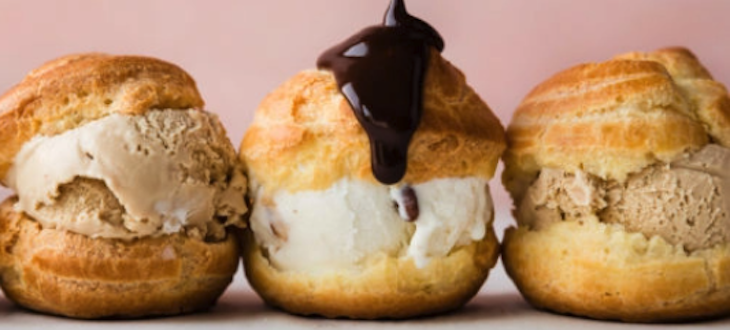
Today, we are dipping our culinary toesies into high-level pastry work with Pâte à Choux. While the name sounds like a relic of stuffy French “haute cuisine,” mastering this technique is FOUNDATIONAL. Get this right, and your eclairs are going to sing. Get it wrong… sadness. Just enormous sadness. For the pastry chef, Choux is a mechanical leavening system, a technique that relies on precise thermodynamics and protein manipulation rather than chemical powders or biological yeast. Before we get into the science, though, a quick look backwards:

The Historical Evolution
The history of Pâte à Choux is a timeline of culinary refinement, evolving from a crude “hot dough” into the sophisticated engineering marvel we use today. This journey was driven by three major eras of innovation:
1. The Renaissance Origins (1540s)
The story begins in the Florentine court of Catherine de’ Medici. When she moved to France to marry King Henry II, she brought her head pastry chef, Pantarelli. He developed a “hot-pressed” dough—essentially a mixture of flour and water cooked over a fire—which he used to create a signature cake called pâte à Pantanelli. At this stage, the dough was far heavier and lacked the hollow, airy “puff” we recognize today.
2. The Era of the “Popelin”
As the recipe migrated through French kitchens, it evolved into pâte à popelin. During this period, the dough was used to create small, molded cakes called popelins. The technique was referred to as pâte à chaud (literally “hot pastry”) because the dough had to be dried over a flame to reach the proper consistency. This is the linguistic ancestor of the modern name, “Choux.”

3. The Carême Transformation (18th & 19th Century)
The breakthrough occurred when Avice, a master pâtissier, and his legendary apprentice, Marie-Antoine Carême, revolutionized the formulation. Carême—the “King of Chefs and the Chef of Kings”—is the architect who realized that by precisely balancing the egg-to-flour ratio and refining the baking process, the dough could be transformed into a structural medium.
He was the first to realize its potential for “culinary architecture,” using it to build towering Croquembouches and delicate éclairs. He officially renamed it Pâte à Choux (Cabbage Paste) because the small, irregular puffs of dough, once baked, resembled tiny heads of cabbage (choux in French).


To elevate this for your Junior Chefs, we should categorize these variations by technical application. This demonstrates that Pâte à Choux isn’t just a recipe, but a versatile “mother dough” that behaves differently based on the cooking medium (dry heat, wet heat, or fat).

A Million Different Pâte à Choux: Global Varieties
Pâte à Choux (or something REALLY similar) spans global cuisines. By altering the cooking medium—dry heat, convection in fat, or hydraulic poaching—you can EASILY transform a single base paste into a diverse range of professional applications.
1. The Classical Standard (Dry Heat / Baking)
In traditional pastry work, the objective is to create a hollow, structural vessel with a crisp exterior and a dry, aerated interior.
- Éclairs & Profiteroles: These are the benchmark for choux mastery. They utilize a high-heat initial bake to trigger rapid steam expansion, followed by a secondary “drying phase” at a lower temperature to solidify the protein walls.
- Paris-Brest: A ring-shaped pastry topped with flaked almonds, traditionally created to commemorate a bicycle race. This application requires extreme precision in piping and consistent hydration to ensure the ring expands uniformly without rupturing.
- Gâteau Saint-Honoré: One of the most complex classical constructions, it utilizes a shortcrust base bordered by choux puffs dipped in hard-crack caramel. This preparation tests a chef’s ability to manage multiple sugar temperatures and structural assembly.
2. Fried Variations (Convection in Fat)
When Choux is introduced to hot oil 375*F, the steam expansion is nearly instantaneous, resulting in a unique texture that is crisp on the outside and custard-like on the inside.
- Churros: Popular in Spain and Mexico, these often utilize a water-heavy formulation for maximum crunch. The star-shaped nozzle is a functional requirement; it increases surface area to ensure the dough “sets” quickly and cooks through.
- French Crullers: Unlike standard yeast-leavened donuts, these are fried rings of choux. A successful cruller is characterized by an intricate internal “webbing,” which serves as the gold standard for egg-emulsion mastery.
- Beignets de Seringue: While many beignets are yeast-based, this “soufflé-style” version uses deep-fried choux to create a hollow, melt-in-the-mouth texture that is significantly lighter than traditional doughs.
Want to learn how to fry up a French Crueller? Let’s go on a deep dive!
3. Savory Engineering (The Inclusion Method)
Because the paste is flavor-neutral, it is an excellent carrier for savory ingredients. These variations require the dough to maintain structural integrity while supporting the weight of added fats and solids.
- Gougères: Originating in Burgundy, France, these are made by folding high-fat cheeses like Gruyère or Comté into the finished paste. The challenge is maintaining the emulsion and “lift” despite the added lipid weight.
- Pommes Dauphine: A technical side dish where Pâte à Choux is folded into seasoned mashed potatoes in a 1:1 ratio and deep-fried. The choux acts as a leavening agent for the potato, creating a “cloud” that is aerated and crispy.

Engineering the Rise: Thermodynamics and Molecular Structure
To master Pâte à Choux, think of the “paste” as a high-performance membrane, a pressurized vessel designed to expand and then solidify. In other words, we’ve got to do more than just practice a particular recipe – we’ve got to understand the science that makes it work.
1. Starch Gelatinization & The Amylose Matrix
When you “dump” the flour into the boiling liquid, you are triggering starch gelatinization. As the temperature exceeds 150°F, the starch granules (specifically amylose and amylopectin) absorb the surrounding water, swell, and eventually rupture. This releases a “gel” that links together, creating a reinforced structural matrix. This matrix is what provides the viscosity needed to trap steam later in the process. It’s the same thing that happens when we thicken a sauce with a roux – starch granules start exploding and gelatinize (thicken) the whole thing.
In the context of pâte à choux, a panade is a cooked paste created by the rapid gelatinization of flour in a boiling liquid, designed to function as a structural base that can be dehydrated to maximize egg absorption for steam leavening.
2. The Dehydration Phase (Engineered Capacity)
During the “panade” stage, we continue to apply heat until a film forms on the saucepan. This is a deliberate dehydration step. By evaporating a specific percentage of the initial water, we are creating a “suction effect” – a structural vacuum that allows us to fold in a higher volume of eggs without the paste becoming too gloopy and wet to work with. The technical term for this “suction effect” is osmotic potential. Remember that term. It’ll come up later.
3. Protein Emulsification & Elasticity
This is where that osmotic potential pays off; because the starch matrix is thirsty for moisture, it ‘pulls’ the eggs into the structure, allowing for a much more stable and heavy emulsion than a standard batter. By dehydrating the dough, we’ve create a dense network of starch that is ready to absorb a LOT of egg. These eggs introduce two critical components:
- Lecithin (from the yolk): A powerful emulsifier that binds the fats (butter) and the liquids (water/milk) into a stable, satin-like emulsion.
- Albumen (from the whites): These proteins provide the elasticity. As the paddle works the paste, we are creating a network of folded proteins that can stretch significantly without tearing—essential for the “inflation” phase.
4. The Thermodynamic Phase Change
Once in the oven, the physics of latent heat takes over.
- The Expansion: As the internal temperature of the paste hits 212°F (100°C), the water molecules undergo a phase change from liquid to gas (steam). This gas expands rapidly, exerting internal pressure against our elastic starch-and-protein matrix. Because the exterior is set with a light crust, the steam is trapped, forcing the pastry to inflate like a balloon.
- The Setting (Coagulation): As the temperature continues to rise, the egg proteins reach their denaturation point. They uncoil and then re-bond (coagulate), transforming from a flexible film into a rigid, permanent wall. This “locks” the pastry in its expanded state, creating the hollow center we require for filling.
Ultimately, mastering Pâte à Choux requires you to stop viewing it as a recipe and start managing it as a sequence of thermodynamic events. By precisely controlling the hydration of the starch matrix during the panade stage and carefully managing the egg emulsion, you are essentially building a high-pressure steam engine. The success of your pastry hinges on the delicate balance between the internal pressure of the expanding water vapor and the structural integrity of the denaturing egg proteins. When these variables are aligned, the result is a perfectly hollow, golden-brown vessel—a testament to the intersection of classical technique and rigorous culinary physics.

Tips, Tricks, and Hacks to Making it Right the First Time
To get a consistent, professional-grade Pâte à Choux, you have to treat it like a laboratory experiment. Because this is a mechanical leavening process, small deviations in temperature or hydration can lead to a failure in the “puff.”
1. The “Panade” Dehydration (The Film Test)
When you add the flour to the boiling liquid, you aren’t just mixing; you are gelatinizing starch.
- The Goal: You must cook the dough over medium-high heat while stirring constantly for at least 2 minutes.
- The Tell – Sight: Look for a thin, floury film (the “fond”) to form on the bottom of the saucepan. This is your visual cue that you’ve evaporated enough water to make room for the maximum amount of eggs.
- The Tell – Sound: Simultaneously, listen for a slight sizzling sound and look for the aroma to shift from ‘raw flour’ to a ‘toasty, cooked cereal’ scent.
- The Tell – Movement: At this point, the dough should have moved from a loose slurry to a singular, cohesive ‘ball’ that follows your spoon around the pan. If it’s still sticking to the sides (other than the ‘fond’), it hasn’t reached full gelatinization.
These three indicators are your confirmation that you successfully reached the gelatinization point and removed enough moisture to move forward. Remember: the drier the dough, the more egg you can fit in, the better the rise.
2. The Cooling Phase (Thermal Management)
Never add eggs to a panade that is straight off the burner.
- The Risk: If the dough is over 145°F, you will scramble the eggs (protein coagulation) before they can emulsify.
- The Fix: Transfer the dough to your stand mixer and run the paddle on medium for 1–2 minutes. Once the steam stops billowing, touch the side of the mixer bowl; it should be warm but comfortable enough to hold your palm against for 10 seconds (approx. 140°F). If the bowl is warm but not hot to the touch, you are safe to begin the emulsion.
3. The Emulsion (The “V” Test)
In a professional kitchen, we never trust the “egg count” in a recipe. Flour humidity and the exact size of your eggs vary a LOT. Make Pate a Choux in a humid state like Florida, and you will probably be making some SERIOUS alterations to the recipe on the fly.
- The Technique: Whisk your eggs in a separate bowl and add them in small increments.
- The Point of No Return: When adding your final bit of egg, switch to a slow drizzle. You are looking for the ‘Point of No Return’ where the dough transitions from stiff and matte to a satin sheen and passes the ‘V-test,’ the point where the dough falls slowly and leaves a smooth, triangular “V” hanging from the blade stop. If it breaks off in jagged clumps, it needs more egg. If it passes the test, STOP ADDING EGG IMMEDIATELY—over-hydration cannot be reversed.
- PRO TIP: Some pastry chefs prefer the ‘Trench Test.’ Here’s how you do it: Drag a finger through the bowl of dough; the sides of the ‘trench’ should stay upright but the edges should slightly slump inward. If the trench collapses instantly, you’ve gone too far.
4. Controlled Expansion (The Water Mist)
Professional ovens often have steam injection, but you can replicate this.
- The Hack: Lightly mist your parchment paper with a spray bottle before piping, or flick some water onto the tray.
- The Science: This localized humidity keeps the exterior “skin” of the choux flexible for a few extra minutes. This prevents the shell from setting too early, allowing the internal steam to push the puff to its maximum volume.
5. The No-Peek Protocol (Thermodynamics)
This is the most common point of failure for student chefs.
- The Rule: Do not open the oven door during the first 20 minutes of baking.
- The Consequence: Opening the door causes a sudden drop in ambient temperature. This causes the internal steam to condense back into water. Since the egg proteins haven’t fully “set” yet, the shell will collapse under its own weight, and it cannot be re-puffed.
6. The Exhaust Vent (Structural Drying)
Even if they look golden, choux can be “doughy” inside, which leads to sogginess later.
- The Fix: In the last 5 minutes of baking, use a toothpick or a small paring knife to poke a tiny hole in the side or bottom of each puff. This allows the residual steam to escape.
- The Result: This dries out the interior “webbing,” creating a crisp, structural shell that is perfect for holding heavy fillings like some delicious Mustang Creamery gelato.
TL:DR – Want an advanced video guide?
7. Troubleshooting Cheat Sheet
| Issue | Likely Cause | Professional Adjustment |
| Flat/No Rise | Liquid didn’t boil or door opened too early. | Ensure a rolling boil before adding flour; keep the door shut. |
| Cracked Surface | Oven temp too high or lack of humidity. | Use the water mist trick; check oven calibration. |
| Soggy/Deflated | Underbaked or not vented. | Bake until deep golden; poke a vent hole to release steam. |
| Greasy/Oily | Butter/Liquid separated during the panade. | Emulsify more vigorously; ensure flour is added all at once. |

DON’T PANIC (YET) – We can fix this!
| Scenario | The “Fix” |
| “My dough is soup.” | Cook a small “half-batch” of dry panade (no eggs) and slowly beat the runny dough into it until the “V” is achieved. |
| “I see yellow streaks.” | Your emulsion is breaking because the eggs were added too fast or the dough was too hot. Increase mixer speed for 30 seconds to force the bond. |
| “They look done but are soft.” | Immediately return them to the oven, poke a vent hole in the side, and bake for 5 more minutes at 325°F to exhaust the steam. |

Deep Dive: The Maillard Reaction vs. Caramelization
To achieve a professional, “bakery-case” finish, we utilize a 50/50 split of water and milk in the recipe —not just for richness, but to fuel two distinct chemical reactions: Caramelization and the Maillard Reaction.
Caramelization: The Sweet Simplicity
Caramelization is the relatively straightforward oxidation of sugar. When the sucrose we add to the dough is hit with high heat, the molecules break down and reform into new compounds.
- The Threshold: This process generally requires high temperatures, typically starting around 320°F.
- The Result: It provides sweetness and a “candy-like” gloss, but it lacks the savory depth required for a high-end pastry shell.
The Maillard Reaction: The “Flavor Engine”
The Maillard Reaction is a far more sophisticated chemical symphony. It isn’t just sugar breaking down; it is a complex reaction between amino acids (from the milk and egg proteins) and reducing sugars (like the lactose in the milk).
- The Thermodynamic Advantage: While caramelization needs extreme heat, the Maillard Reaction begins much earlier, at approximately 285°F.
- The 212°F Paradox: This is a critical piece of culinary engineering. It allows us to develop deep, savory aromatics on the exterior crust even while the interior of the puff remains pinned at 212°F (the boiling point of water) during the steam-expansion phase.
By including milk in our paste, we are intentionally “loading” the dough with the proteins and lactose necessary to trigger the Maillard Reaction. This produces the “nutty,” “toasted,” and “savory” aromatic profile that water-only recipes simply cannot achieve.

RECIPES

Profiteroles/ Cream Puffs
Ingredients
- 1/2 cup unsalted butter cut into 8 pieces,
- 1/2 cup water
- 1/2 cup 2% or whole milk
- 1/4 teaspoon salt
- 2 teaspoons granulated sugar
- 1 cup all-purpose flour spooned & leveled
- 4 large eggs beaten
For Egg wash
- 1 egg beaten
- 1 Tablespoon milk or water
Instructions
Cook the Pate a Choux
- Combine the butter, water, milk, salt, and granulated sugar together in a medium saucepan over medium heat. Stir until the butter has melted. Bring mixture to a simmer. Once simmering, reduce heat to low and add the flour all at once. Stir until the flour is completely incorporated and a thick dough clumps into a ball. Mash the dough ball against the bottom and sides of the pan for 1 minute, which gently cooks the flour. Remove from heat and transfer to the bowl of a stand mixer fitted with a paddle attachment. Allow to cool down for a few minutes before adding the eggs in the next step.


Add Eggs to the Pate a Choux
- With the mixer running on low speed, slowly add the eggs in 3-4 separate additions mixing for 30 seconds between each. The mixture will look curdled at first, but will begin to come together as the mixer runs. Pour in the final addition of beaten eggs very slowly. Stop adding when the choux pastry has reached the desired texture: shiny, thick, and smooth with a pipeable consistency. It is normal to have a few teaspoons of beaten egg behind, which can be used with the egg wash.


Bake the Pate a choux
- For cream puff and profiterole shells: Preheat oven to 400°F. Line two half sheet panswith parchment paper. Lightly brush the parchment with water, which creates a humid environment for the pastry shells allowing them to puff up without drying out or burning.

- Transfer choux pastry dough to a piping bag fitted with a round tip. Pipe 2-inch mounds about 3 inches apart. Using a water moistened finger, smooth down the peaks and lightly brush each with egg wash.

- Bake for 20 minutes then, without opening, reduce oven to 350°F (177°C) and continue to bake for 10-15 more minutes until golden brown. Do not open the oven as the pastries cook, as cool air will prevent them from properly puffing up. Remove from the oven and transfer to a cooling rack. Allow to cool completely before filling.

- Split open pastries and fill with pastry cream, jam, a combination of these, or your favorite filling. You can also poke a hole in the pastries and pipe the filling inside. Drizzle with a thin chocolate ganache if desired

- Cover and store leftover filled pastries in the refrigerator for up to 3 days. Cover and store unfilled pastries at room temperature for 1 day, in the refrigerator for 5 days, or freeze for up to 3 months. Thaw in the refrigerator before filling and serving.


Gougères
Ingredients
- 1/2 cup water
- 1/2 cup milk
- 1 stick 4 ounces unsalted butter, cut into tablespoons
- Large pinch of coarse salt
- 1 cup all-purpose flour
- 4 large eggs
- 3 1/2 ounces shredded Gruyère cheese 1 cup, plus more for sprinkling
- Freshly ground pepper
- Freshly grated nutmeg
Instructions
- Preheat the oven to 400°. Line 2 half sheets with parchment paper. In a medium saucepan, combine the water, milk, butter and salt and bring to a boil. Add the flour and stir it in with a rubber spatula until a smooth dough forms; stir over low heat until it dries out and pulls away from the pan, about 2 minutes.
- Scrape the dough into a bowl; let cool for 1 minute. Beat the eggs into the dough, 1 at a time, beating thoroughly between each one. Add the cheese and a pinch each of pepper and nutmeg.
- Transfer the dough to a pastry bag fitted with a 1/2-inch round tip and pipe tablespoon-size mounds onto the baking sheets, 2 inches apart. Sprinkle with cheese and bake for 22 minutes, or until puffed and golden brown. Serve hot, or let cool and refrigerate or freeze. Reheat in a 350° oven until piping hot.
Notes
Gougères freeze well. After baking, allow them to cool completely. Spread the gougères out on a baking sheet, cover the sheet with plastic wrap and freeze them until they are firm. Then store them in sturdy plastic bags for several months.
Chocolate Eclair
Ingredients
Panade
- 125 g Whole Milk
- 125 g Water
- 115 g Unsalted Butter
- 150 g All-Purpose Flour sifted
- 250 g Large Eggs approx. 4–5 eggs, whisked
- 5 g Granulated Sugar
- 3 g Kosher Salt
Bittersweet Ganache Glaze
- 150 g Bittersweet Chocolate 60% cacao
- 150 g Heavy Cream
- 20 g Light Corn Syrup
Instructions
Panade (Base dough)
- Combine milk, water, butter, sugar, and salt in a heavy-bottomed saucepan and bring to a full rolling boil.
- Remove from heat briefly and add all flour at once, stirring vigorously with a stiff spatula.
- Return to medium-high heat and cook for at least 2 minutes. Watch for the fond (a thin, floury film) to form on the bottom of the pan and the aroma to shift from raw flour to a toasty scent.
Emulsion
- Transfer the panade to a stand mixer with a paddle attachment and beat on medium for 1–2 minutes to release steam.
- Once the bowl is warm but comfortable to the touch (approx. 140°F), begin adding eggs in small increments.
- Stop adding eggs once the dough achieves a satin sheen and passes the V-Test (falls slowly to form a smooth triangle) or the Trench Test (a finger-dragged path stays upright but the edges slightly slump).
Pipe and Bake
- Lightly mist your parchment paper with water to create localized humidity.
- Pipe 4-inch cylinders at a 90-degree angle; use a damp finger to tap down any sharp peaks.
- Bake at 400°F for 15–20 minutes to trigger the steam rise. Do not open the oven door during this phase, or the shells will collapse.
- Reduce heat to 350°F and bake for another 10–15 minutes until deep amber.
- Exhaust: Use a toothpick to poke a small hole in the side of each shell. Return them to the turned-off oven for 5 minutes to dry the internal “webbing”.
Glaze
- Bring cream and corn syrup to a simmer; pour over chopped chocolate.
- Let sit for 2 minutes, then whisk from the center until a glossy emulsion forms.
- Dip the tops of fully cooled éclairs into the warm ganache.
Notes
Auditory Check: The bottom should sound hollow when tapped.
Commercial Stability: The shell should be bone-dry and crisp enough to support filling for 15 minutes without losing structural integrity.