
Food Safety First
Because eggs and mayonnaise are high-protein, high-moisture TCS foods, they must stay out of the Danger Zone (41°F–135°F) to prevent Salmonella growth.
- Cooling: Immediately move eggs from boiling water to an ice bath. They must reach 41°F before you begin the filling process.
- Ready-to-Eat (RTE) Standards: Once peeled, eggs are RTE foods. Single-use gloves must be worn during peeling, slicing, and piping to prevent bare-hand contact.
- The 4-Hour Rule: For catering or buffet service, any eggs held without temperature control must be discarded after 4 hours.
- Service Tip: Always display platters over a bed of ice to keep the product at a safe 41°F or lower.
A Little Background
The roots of the modern-day deviled egg can be traced back to ancient Rome, where boiled eggs were served with spicy sauces as a first course. The Romans actually had a saying, “ab ova usque ad mala” which literally means “from eggs to apples,” meaning from the beginning of a meal to the end.

The mashing of yolks to create a stuffing for the eggs was first seen in the 13th century in Spain. By the 15th century, deviled eggs, closer to what we know them as, were commonly found across Europe. It wasn’t until the 18th and 19th centuries when the word ‘deviling’ became widely used to describe the process of making a food spicy. And, many cultures still use other words “mimosa eggs,” “dressed eggs,” “salad eggs,” and “stuffed eggs” to avoid associating this appetizer with Satan.
Not so much the Americans. We still think of them as being “deviled,” like Devil’s Food Cake, because… Well, they are just so freakin’ bad for you. The name? It stuck. Nothing has much changed since then. We are still making them for family get-togethers and for Thanksgiving dinners and after bad break-ups. Even the recipe remains unchanged.
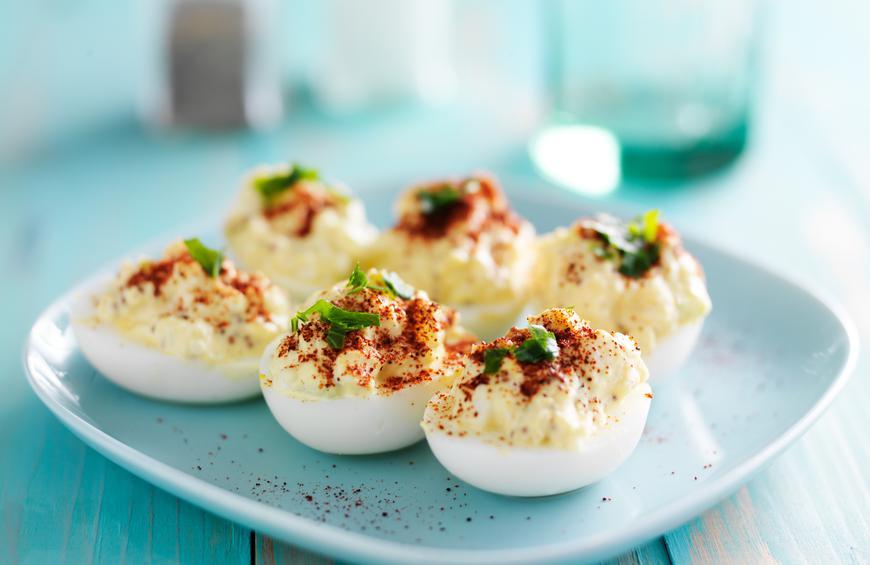
You hard-cook some eggs, scoop out the yolks, mash it up with mayonnaise, add some standard seasonings, spoon the whole mess back in, then sprinkle the plate with Smoked Paprika.
Couldn’t be easier.
Restaurant Quality Deviled Eggs
For us chef-types, we take all of this a bit further: we whip the eggs till they’re creamy, add some interesting and unexpected ingredients, use a piping bag with a star tip (to make it purty), and garnish the whole thing with edible flowers or caviar or something.
Same appetizer… just fancy.

Examples
- The “Everything” Smoked Salmon Egg A sophisticated take on classic brunch flavors, featuring a rich cream cheese-yolk emulsion topped with cold-smoked salmon, “everything” bagel seasoning, and fresh dill.
- Truffled Mushroom & Chive An earthy, vegetarian variation that incorporates white truffle oil and minced sautéed shallots into the filling, garnished with porcini powder and precisely cut chive batons.
- The “Elote” Street Corn Egg A global fusion variation inspired by Mexican street corn, using a lime and cumin-spiced filling topped with charred corn kernels, crumbled Cotija cheese, and a dusting of chili-lime seasoning.
- Sriracha-Ginger with Candied Bacon A bold study in sweet, salty, and spicy profiles, utilizing rice wine vinegar, fresh ginger, and Sriracha in the yolk base, crowned with a shard of cayenne-brown sugar glazed bacon.
- Pesto & Crispy Prosciutto A Mediterranean-style variation that uses a vibrant basil pesto to create a green-hued filling, finished with a crisp shard of oven-dehydrated prosciutto for salt and texture.
The Science Behind the Perfect Deviled Egg: Thermodynamics & Chemistry
While deviled eggs are a staple of American comfort food, executing them to a professional standard requires an understanding of the science happening inside the shell. For a chef, “close enough” isn’t the goal—precision is.
1. The Thermodynamics of the “Green Ring”
Have you ever peeled an egg only to find a grey-green coating around the yolk? In a professional kitchen, this is considered a technical flaw.
This happens because of a chemical reaction between iron in the yolk and sulfur in the white. When the egg is heated for too long or at too high a temperature, these elements combine to form ferrous sulfide.
- The Fix: Control your variables. Use the “Boil and Carry-over” method (removing the pot from the heat once it reaches a boil) to ensure the internal temperature of the egg white never climbs above 158*F – high enough to trigger that sulfur reaction.

2. Thermal Shock & The “Clean Peel”
The difference between a smooth, beautiful egg white and one that looks like it was “attacked” is often decided in the first thirty seconds after cooking.
- The Science: An egg shell is porous, and underneath it lies a thin membrane. By moving the eggs immediately from boiling water into an Ice Bath, you create thermal shock. This causes the egg to contract slightly away from the shell and creates a small pocket of steam between the membrane and the white.
- Chef’s Tip: This makes the membrane lose its grip on the white, allowing the shell to slide off in large, clean pieces.

3. Emulsification: The Secret to a Silky Filling
The yolk of a hard-cooked egg is essentially a collection of denatured protein clumps and fats (lipids). To get that signature “velvet” mouthfeel, we are creating a cold emulsion.
- Lipid Interaction: When you mash the yolks and slowly incorporate mayonnaise, the lecithin (an emulsifier) in the egg yolks helps bind the added fats from the mayo into a stable, creamy structure.
- Pro-Level Texture: For the smoothest possible filling, don’t just use a fork. Pass your dry yolks through a tamis (fine-mesh drum sieve) before adding your wet ingredients. This breaks down lipid crystallization and ensures there are zero lumps when you go to pipe the filling.

Hard-Boiled vs. Hard-Cooked
The difference is temperature control.
- Hard-Boiled (212*f): Eggs are subjected to violent, rolling bubbles. This creates rubbery whites from over-coagulated proteins and the unsightly green ring caused by the iron-sulfur reaction at high heat.
- Hard-Cooked (180-190*F): Eggs are simmered gently or cooked using “carry-over” heat. This results in tender, creamy whites and vibrant yellow yolks because the temperature stays below the threshold that triggers the sulfur reaction.
Chef’s Rule: Boiling is an accident; cooking is a choice. Always hard-cook for professional results.

Peeling “Secrets”
Getting a perfectly smooth, “craters-free” egg white is a badge of honor in a professional kitchen. Here is a list of technical tips to ensure a clean peel every time:
1. Age Matters (The pH Factor)
- Use “Older” Eggs: Fresh-off-the-farm eggs are delicious, but they are a nightmare to peel. As an egg ages, the pH of the white increases, which causes the inner membrane to bond less tightly to the protein. For deviled eggs, use eggs that have been in the fridge for 7–10 days.
2. The “Hot Start” Method
- Thermal Shock: Instead of starting eggs in cold water, lower them carefully into water that is already at a gentle boil. This “shocks” the membrane, causing it to pull away from the shell immediately.
- Note: Lower the heat to a simmer before dropping them in to prevent the shells from cracking on the bottom of the pot.
3. The Vinegar & Salt Myth vs. Reality
- Vinegar in the Water: Adding a splash of white vinegar won’t necessarily make the egg easier to peel, but if a shell does crack, the acid helps the escaping egg white coagulate faster, “plugging” the leak.
- Salt: Heavy salting increases the boiling point of the water slightly, but its main benefit is similar to vinegar—aiding in quick protein coagulation.
4. The 15-Minute Ice Bath
- We already talked about this one. Scorll up and read again if you missed it.
5. The “Full Surface” Crack
- Gently Shatter: Don’t just crack the egg in one spot. Tap it on a flat surface and roll it gently under your palm until the entire shell looks like a “mosaic.”
- The Air Cell: Always start peeling from the wider end of the egg. This is where the air cell is located, giving you an easy “entry point” to get under the membrane.
6. Peel Under Water
- Hydraulic Assistance: Peel the eggs under a thin stream of cool running water or submerged in the ice bath. The water acts as a lubricant, getting between the membrane and the white to help the shell slide off without tearing the “skin” of the egg.
7. The Professional Shortcut (The Jar Method)
- For Volume: If you have to peel a dozen eggs quickly, place three or four in a small plastic container or glass jar with an inch of water. Close the lid and shake vigorously but carefully. The water cushions the eggs while the collisions shatter the shells simultaneously.
Let’s cook!

How to Make Hard-Cooked Eggs
Instructions
Boil method for Hard-cooked eggs:
- Place eggs in a pot.

- Cover with at least 1 inch of cold, salted water.
- Bring to a boil over medium-high heat.
- Cover, remove from heat, and set aside for 10-12 minutes; 8-10 for medium eggs and 12-14 for Jumbo.
- Drain, cool in ice water, and peel.


Alternative 1: Simmer method for medium-firm cooked eggs:
- Bring a pot of salted water to a boil over high heat.
- Reduce the heat to low, then carefully lower eggs into water with a spoon or ladle.
- Cook 7 to 8 minutes.
- Drain, cool in ice water, and peel.
Alternative 2: Simmer method for soft-cooked eggs:
- Bring a pot of salted water to a boil over high heat.
- Reduce the heat to low, then carefully lower eggs into water with a spoon or ladle.
- Cook 4 to 5 minutes.
- Drain, cool in ice water, and peel.

Deviled Eggs
Ingredients
- 6 hard-cooked eggs
- 1/4 cup mayonnaise
- 1/8 teaspoon salt
- 1 teaspoon white vinegar
- 1 teaspoon Grey Poupon or dijon mustard
- Splash worcestershire
- Smoked Spanish paprika or finely sliced green onions for garnish
Instructions
- Start by cutting the eggs in half lengthwise, then carefully slipping the yolks out of the whites. Make sure not to break the whites because they will be the container that holds the filling.
- Once you have removed all of the yolks and placed them into a bowl, thoroughly mix with mayonnaise until the yolks have broken down.
- Season with a little salt—but not pepper. Instead, add a dash of hot sauce or pinch of White Pepper.
- Stir in mustard, vinegar, and a small dash of Worcestershire
- Garnish with paprika or finely sliced green onion