
In seventeenth-century Mexico, a bishop tried to stop women from drinking chocolate while he was holding services in his church. And they killed him. Maybe.
Here’s the story: around 1625 or so, there were these wealthy women in Chiapas, Mexico, not far from Guatemala, who had developed a habit of having servants bring them cups of chocolate during religious services, sometimes accompanied by snacks. The bishop found the interruptions intolerable. He ordered the practice stopped and threatened them with excommunication (for my non-Catholic friends, that means quit it, or the Church is cutting you off). Some of the women simply abandoned the cathedral and attended churches where the clergy were less concerned about their refreshments. Others were less nice about it. The bishop died, and rumors spread that angry parishioners had poisoned him with a cup of hot chocolate.
Thomas Gage, an English traveler and former Dominican friar, described the scandal in a book published in 1648. Nobody knows whether the bishop was murdered. Gage was a colorful storyteller whose account deserves some skepticism, but his tale has survived for nearly four hundred years. What’s more, Gage believed it and stopped drinking cups of chocolate offered by the local women.
WHERE CHOCOLATE BEGAN
Chocolate’s story begins more than 5,000 years ago in the Amazon rainforest of South America. The Great Pyramid of Giza hadn’t been built, Stonehenge was still centuries away from becoming the famous stone monument we know today, and Moses wouldn’t lead the Israelites out of Egypt for another two thousand years. Meanwhile, people living in what is now Ecuador were already cultivating cacao.
Here’s the funny part: we don’t know what they were doing with it. Grinding it into a food, making a beverage, hollowing out the pods and making ancient maracas? Your guess is as good as anyone’s. I think they were eating the sweet, juicy pulp that surrounds the beans, rather than the seeds themselves. Whatever those first preparations were, people valued cacao enough to keep using it, growing it, and carrying it with them.
Cacao didn’t remain in the Amazon. As people moved north, they carried the plant—and the knowledge of how to use it—through the tropical regions of the Americas.
And that was a long trip. The humid forests of Ecuador are thousands of miles from the great Mayan cities in Guatemala, Belize, and southern Mexico. Cacao could thrive in some of those tropical regions, but not everywhere. That helped make it valuable. People traded it, served it at important social and ceremonial occasions, and built parts of their food culture around it. By the time the Mayan Empire was in power, cacao had become far more than an interesting tropical fruit: it was part of trade, part of hospitality, part of ceremony, and part of daily life for the people wealthy enough to enjoy it.

THE MAYA: CHOCOLATE WITH A LITTLE SHOWMANSHIP
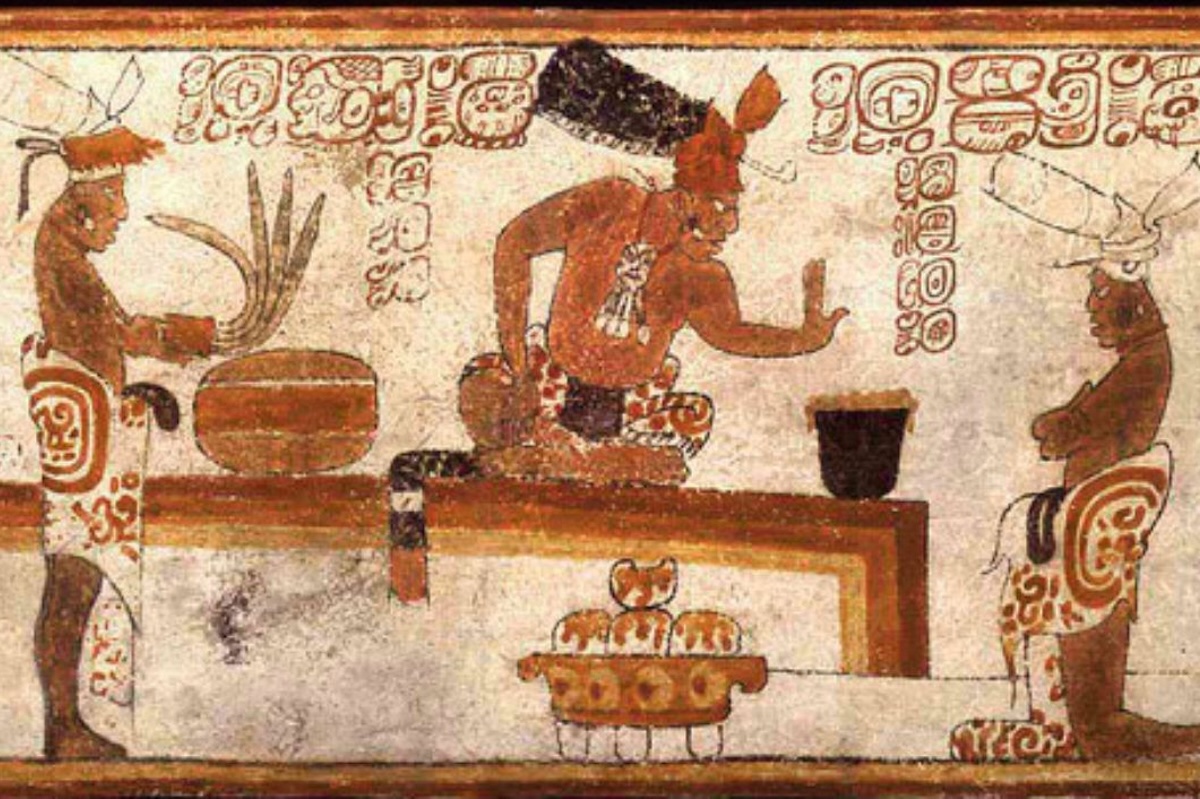
If you asked your Maya mom to make you a cup of chocolate, there’s a good chance you’d be grossed out. We don’t know exactly what went into every recipe, but we do know it wasn’t sweet. There was no sugar, no milk, and certainly no marshmallows. Instead, you’d get a bitter drink made from ground cacao and water, often flavored with chile peppers. Depending on the recipe, your mom might also throw in some ground corn, flowers, or other ingredients. Some versions were spicy, others thick and earthy, and none tasted much like the hot chocolate you know today.
The Maya were serious about serving chocolate, too. They prized a thick layer of foam on top of the drink – a quality still important in Mexican chocolaterías. To make it, the Mayans poured the chocolate back and forth between vessels, sometimes from several feet above.
And speaking of cups, some Maya drinking vessels were beautifully decorated pottery, painted with elaborate scenes and sometimes marked with writing identifying their contents or owners, and in at least a few cases, buried with their owners. I love my Starbucks travel mug, but I’m not taking it with me to the grave.
The Mayans did.

WHEN CHOCOLATE WAS MONEY
Jump forward a century or so. The Mexica, commonly called the Aztecs, are in power. Their capital, Tenochtitlan, stands on an island in a lake, with enormous markets all around, merchants selling everything from food and pottery to fine textiles and precious stones. Among the goods changing hands were cacao beans, and often, what you were spending to buy that other stuff? ALSO cacao beans.
And there were counterfeiters, dishonest traders who hollowed out cacao beans and filled the empty shells with fake beans made from ground avocado pits, wax, or dough. Others roasted undersized beans in hot ashes or coated them with clay to make them look bigger and more valuable.
Some of the most desirable cacao came from Soconusco, a warm, tropical region along the Pacific coast of what is now southern Mexico, near Guatemala. The Mexica controlled this distant territory and demanded cacao among the tribute its communities had to provide. Getting those beans to the capital involved long journeys by merchants and porters, who carried goods across a landscape without horses or wagons.
For the rulers of Tenochtitlan, control of the cacao-producing regions was a major source of their power – not just giving the royal household a steady supply of the beans. When Spanish soldiers arrived in central Mexico in the early sixteenth century, they found an advanced network of growers, merchants, tribute collectors, and consumers, and that sparked chocolate’s transatlantic journey to Europe.

CHOCOLATE CROSSES THE ATLANTIC
When the Spanish arrived in Mexico in the early sixteenth century, they weren’t coming to discover interesting new foods. They were coming for land, wealth, and power, and they were prepared to kill to get them. The conquest of the Mexica Empire was bloody. Warfare, massacres, forced labor, and diseases brought from Europe devastated Indigenous communities. The Spanish seized control of territories and trade networks that had taken generations to build, including the enormously valuable cacao trade.
The Spanish didn’t invent chocolate or teach the people of Mexico how to make it. Indigenous cooks had already spent centuries cultivating cacao, developing recipes, and perfecting the preparation of chocolate drinks. The conquerors learned from those same people, often while stripping them of their land, their freedom, and their wealth. Cacao became another American commodity that Spanish colonizers could control, ship across the Atlantic, and sell for a profit.
And Europe developed quite a taste for it. Once chocolate reached Spain, wealthy drinkers began adapting it to their preferences. They added sugar, cinnamon, and other spices, and eventually chocolate became fashionable in royal courts and wealthy households across Europe. Sugar was especially important because it softened cacao’s natural bitterness and helped turn chocolate into the sweet drink Europeans came to love. But there was an ugly connection between those two ingredients that rarely appeared on the fancy cups and serving trays.
Much of the sugar came from plantations in the Caribbean and South America, where enslaved Africans were forced to cut cane under brutal conditions. Sugar production was dangerous, exhausting work. The cane had to be harvested and crushed, and its juice boiled down in enormous, blisteringly hot kettles. Plantation owners accumulated fortunes while the people doing the labor faced violence, deprivation, and death. The demand for sugar helped drive the Atlantic slave trade, which forcibly transported millions of Africans across the ocean.
Cacao production became entangled in the same system. Indigenous people were forced to work for colonial landowners, and enslaved Africans labored on cacao plantations in places such as Venezuela and the Caribbean. Workers cultivated the trees, harvested the pods, and prepared the beans for shipment while plantation owners and European merchants collected the profits. The two ingredients Europeans were combining to make chocolate sweeter—cacao and sugar—were both being produced through systems of slavery and exploitation.
Back in Europe, the people drinking that chocolate were developing some elaborate habits. Chocolate became fashionable enough to inspire expensive serving vessels, specialized equipment, and entire businesses devoted to preparing it. Wealthy customers could have their chocolate sweetened and flavored to order. Physicians prescribed it for various complaints, while others warned that too much might encourage indulgence. The Catholic Church even argued over whether drinking chocolate violated the rules of fasting, which brings us back to the bishop in Chiapas and his disastrous attempt to separate people from their refreshments.
By the seventeenth and eighteenth centuries, chocolate houses had opened in European cities. In England, customers gathered to drink chocolate, conduct business, discuss politics, gamble, and trade gossip. These establishments could attract wealthy and powerful patrons, although some earned reputations for considerably less respectable activities. Chocolate was becoming an important part of European social life, even as the plantations supplying its ingredients continued to depend on enslaved labor.
The contrast is difficult to ignore. In one part of the world, wealthy customers were debating the proper way to serve chocolate and commissioning beautiful porcelain cups to drink it from. Across the Atlantic, people were being enslaved, beaten, bought, and sold to produce the cacao and sugar that filled those cups. Both experiences belonged to the same chocolate industry.

EUROPE TURNS CHOCOLATE INTO CANDY
Let’s turn away from the horrors associated with how chocolate was acquired and turn for a moment to the more pleasant part of chocolate’s history: how the solid cakes and tablets that were broken apart and mixed into beverages turned into a luxury candy.
During the nineteenth century, new equipment transformed the chocolate business. In 1828, a Dutch chocolate maker named Coenraad van Houten developed a hydraulic press that could squeeze much of the cocoa butter out of ground cacao, leaving behind a solid cake that could be ground into cocoa powder. Chocolate makers could now work with cocoa butter and cocoa solids separately, adjusting their proportions to create new products. In 1847, the British company J. S. Fry & Sons introduced one of the first recognizable eating chocolate bars, made by combining cocoa powder, cocoa butter, and sugar.
Over in Switzerland, a chocolate maker named Daniel Peter was trying to figure out how to put milk into chocolate bars. The problem was that milk contained too much water, which made a mess of the chocolate. Fortunately, his neighbor happened to be Henri Nestlé, who knew a thing or two about condensed milk. Peter used it to help solve the problem, and by the late 1800s, milk chocolate was becoming a commercial success.
Then there’s Rodolphe Lindt, whose chocolate was apparently improved by one of the happiest mistakes in confectionery history. According to the story told by his company, Lindt left a mixing machine running over the weekend in 1879. When he returned, the chocolate had become astonishingly smooth. That extended mixing process, called conching, helped transform chocolate from something relatively coarse and hard into the smooth, melt-in-your-mouth candy we recognize today.


The earliest eating chocolates were still expensive treats, but as factories grew and manufacturing improved, chocolate gradually became less expensive and easier to distribute. Companies could finally reach customers who had once considered it a wild luxury, reserved for the wealthy and the powerful. Competition encouraged manufacturers to develop new products, improve their methods, and experiment with flavors and ingredients.
The growth of industrial chocolate production eventually gave rise to familiar bars, milk chocolate, and the enormous confectionery industry that followed. I’ll get into a bit of that cool story later in the course. For today, understand that what happened in Europe during the eighteenth and nineteenth centuries laid the scientific groundwork for controlling ingredients, particle size, fat, and crystallization. When you start making your own chocolate, you’ll discover that those four things have an enormous influence on whether you produce something smooth and delicious or a gritty, greasy mess.
OAXACA: WHERE CHOCOLATE IS STILL PART OF THE DAY
We’ve gone through a bunch of history, and before I close this section, I want you to learn to make at least one of these time-tested recipes. We don’t know how the truly ancient Ecuadorians ate chocolate, and nobody wants to make the ceremonial bitter water associated with the Maya or the Aztecs. That leaves one of the beauties I discovered on vacation in Oaxaca de Juárez: traditional Mexican hot chocolate.
Walk through one of the markets there, and the aroma of chocolate is difficult to miss. Shops sell freshly ground chocolate, cinnamon, sugar, and tablets used to prepare drinking chocolate at home. In some stores, I watched ingredients being ground together right before they were pressed into tablets or packaged for customers. The shops where chocolate is made and sold are called chocolaterías, while a molino de chocolate is a mill where cacao and other ingredients are ground. When I got home, I was irritated to find I’d missed a visit to Chocolate Mayordomo, established in Oaxaca in 1956, one of the region’s best-known stores, famous for its quality and taste.

Order drinking chocolate in Oaxaca, and you’re going to be offered one of two things: chocolate de agua or chocolate de leche. The first is prepared with water, which allows the cacao flavor to come through without the richness of dairy. I didn’t try that. It sounds and looks… not for me. The second uses milk for a creamier drink. This I drank a lot. And since I’m allergic to chocolate, I swallowed it down with a handful of Benadryl. I didn’t order pan de yema, a rich egg bread. I wish I had. You’re supposed to eat it warm and dip it into the chocolate as you go.
Traditional drinking chocolate is often prepared with a molinillo, a wooden whisk with carved rings near its base. The cook holds the handle between both palms and rubs them rapidly back and forth, spinning the whisk inside the hot chocolate. The agitation disperses the chocolate and incorporates air, creating the frothy head that has been prized in Mesoamerican chocolate-drinking traditions for centuries.
MAKE YOUR OWN MEXICAN HOT CHOCOLATE
To make our own Mexican hot chocolate, we’re going to start with roasted cacao nibs. The granite rollers in our melanger will do the grinding for us, taking the nibs from crunchy little pieces into a thick paste and eventually a fluid chocolate. Then we’ll add sugar, a little bit at a time, followed by cinnamon and vanilla.
You could take a spoonful or so of that freshly ground chocolate straight from the melanger, stir it into a cup of steamed milk or hot water, and make something delicious. But we’re going the traditional route: making Mexican drinking chocolate tablets, much like the ones I saw made in Oaxaca.
While the chocolate is still warm and workable, we’ll portion it into molds and allow it to cool and harden. Later, we’ll break up a tablet (or use a box grater and turn it into shavings) and whisk it into hot milk. Making the tablets also means we can prepare a batch of chocolate now and enjoy it another day, without having to run the grinder every time somebody wants a cup. Don’t expect these tablets to look or taste exactly like the chocolate bars you buy at the grocery store. Traditional Mexican drinking chocolate is a little coarse because it’s made to be mixed into a beverage rather than eaten as a smooth candy. A little texture is normal. What matters is that the cacao, sugar, and spices are properly combined and that the finished chocolate has enough flavor to stand up to the milk.
When it’s time, here’s what you do: heat the milk gently, add pieces of your chocolate tablet, and stir until the chocolate is thoroughly dispersed. Keep the milk below a boil; scorching it or having a chocolatey boil over would be a lousy way to finish something we’ve spent so much time making.

Now comes the fun part. We don’t have a traditional molinillo, so we’re going to use a balloon whisk to create the foam. Whisk the hot chocolate vigorously, working the whisk through the liquid and near the surface to incorporate air. Keep going until you have a generous layer of foam, then pour the chocolate into warm cups, spooning the foam between them. Drink it while it’s hot and freshly whipped, preferably with something good to dip into it. If you’ve got sweet bread, use it. If you’ve got pan de yema, even better.
So how do you know you’ve made it right? Start with the aroma. You should smell chocolate first, with cinnamon and vanilla contributing to it rather than taking over. The drink should have a full cacao flavor, balanced sweetness, and enough body to feel rich without becoming thick and pasty. You may notice a little graininess from the stone-ground chocolate, and that’s perfectly normal for this style. The foam should be visible when you pour it, although it won’t last forever.
Another thing that is unique about Mexican hot chocolate is the full-fat flavor that comes from the released cocoa butter. It should have a rich mouthfeel (not an oil slick—if you’ve got a greasy surface on your hot chocolate that reminds you of Key West after the oil tanker went down… you made a booboo). Otherwise, that richness is why we bothered with all this work. It’s a feature, not a bug. Enjoy it.
Recipe
MEXICAN HOT CHOCOLATE
Ingredients
INGREDIENTS — CHOCOLATE TABLETS
- 500 g roasted cacao nibs picked through, shells and stones removed
- 500 g granulated sugar
- 1 tablespoon ground Ceylon cinnamon canela
- 1½ teaspoons vanilla powder
INGREDIENTS — PER CUP OF HOT CHOCOLATE
- 50 g homemade Mexican drinking chocolate
- 1 cup 240 mL whole milk
Instructions
GET ORGANIZED
- Weigh the cacao nibs, sugar, cinnamon, and vanilla before starting the melanger. Have your molds or parchment-lined tray ready.
- GRIND THE NIBS
- Start the Premier melanger according to the Equipment Guide. Add the roasted nibs a little at a time, allowing the rollers to grind each addition before adding more. Continue until the nibs become a flowing chocolate paste.
ADD THE SUGAR
- Gradually add the sugar while the rollers are turning. Wait until the mixture moves freely before each addition. Continue grinding until the sugar is incorporated and the chocolate is fluid enough to portion, 45 minutes to an hour.
ADD THE FLAVORINGS
- Near the end of grinding, add the cinnamon and vanilla powder. Mix until evenly distributed, then taste and evaluate the flavor.
MAKE THE TABLETS
- While the chocolate is still warm and workable, portion it into approximately 50 g tablets using molds or a parchment-lined tray. Allow the tablets to cool and harden completely.
HEAT THE MILK
- For each serving, heat 1 cup of whole milk in a small saucepan until steaming. Do not boil.
ADD THE CHOCOLATE
- Break or grate a 50 g tablet into the hot milk. Stir over gentle heat until the chocolate is thoroughly dispersed. A little graininess is normal.
CREATE THE FOAM
- Remove from the heat and whisk vigorously with a balloon whisk, working through the liquid and near its surface to incorporate air. Pour into a warm cup and spoon the foam over the top.
TERMS TO KNOW
Cacao
The tropical tree and its seeds, which are used to make chocolate. Cacao originated in South America and spread into Central America and Mexico.
Cacao Nibs
Small pieces of cacao beans after the shells have been removed. Roasted nibs are ground into chocolate mass.
Maya
An Indigenous civilization of Mesoamerica known for cacao-drinking traditions, including bitter, spiced preparations and foamed chocolate.
Mexica (Aztecs)
The people who built an empire centered on Tenochtitlan. Cacao was valued as a drink, tribute, and money.
Nahuatl
The language spoken by the Mexica and other Indigenous communities of Mexico, associated with the origins of the word chocolate.
Tribute
Goods or payments demanded by a ruler or government. Cacao was one of the valuable goods collected by the Mexica.
Cocoa Butter
The natural fat in cacao beans, responsible for much of chocolate’s richness and mouthfeel.
Conching
A process of mechanically working chocolate to improve its texture and flavor, associated with Rodolphe Lindt.
Melanger
A machine with heavy stone rollers that grind cacao nibs and incorporate sugar and other ingredients.
Chocolatería
A shop or café specializing in chocolate, including prepared drinks and drinking chocolate tablets.
Molino de Chocolate
A mill where cacao and ingredients such as sugar and cinnamon are ground into drinking chocolate.
Molinillo
A traditional Mexican wooden whisk spun between the palms to froth drinking chocolate.
Chocolate de Agua
Mexican drinking chocolate made with water.
Chocolate de Leche
Mexican drinking chocolate made with milk.
Chocolate de Mesa
Drinking chocolate, often sold in tablets with cacao, sugar, and cinnamon, for mixing into hot water or milk.
Pan de Yema
A rich Oaxacan egg bread traditionally enjoyed with hot chocolate.
Thomas Gage
English traveler and former Dominican friar who recorded the story of the bishop allegedly poisoned with chocolate.
Juan Francisco de León
Leader of the 1749 Venezuelan rebellion against a Spanish trading company’s control of cacao commerce.
Coenraad van Houten
Dutch chocolate maker associated with the 1828 cocoa press, which helped separate cocoa butter from cocoa solids.
J. S. Fry & Sons
British chocolate company that introduced one of the first recognizable eating chocolate bars in 1847.
Daniel Peter
Swiss chocolate maker who helped develop commercially successful milk chocolate.
Henri Nestlé
Swiss food manufacturer whose work with concentrated milk helped make milk chocolate possible.
Rodolphe Lindt
Swiss chocolate maker associated with the development of conching, which helped produce much smoother chocolate.