
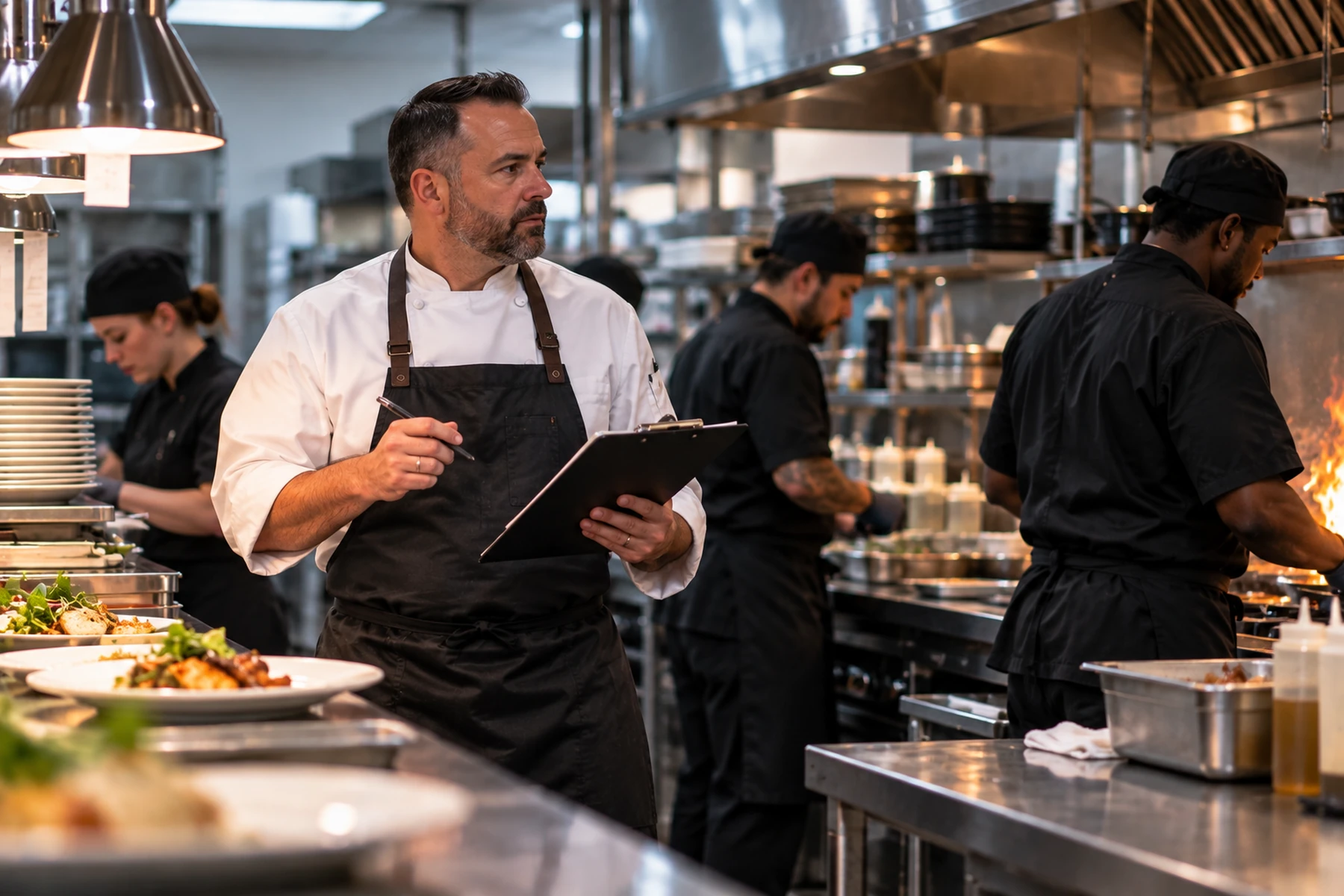
Marcus has been running the kitchen at Bistro Zenith for two years and is especially proud of the restaurant’s signature charcuterie board: a collection of cured meats, pickled vegetables, a rotating cheese selection, all served with their award-winning sourdough baguette. Now he wants to add something new — cold-smoked salmon, cured and smoked in-house the old-fashioned way, meant to last for weeks in the walk-in.
He’s been working on it for days. He’s tested the cure, adjusted the smoke, played with the salt, and finally has it where he wants it. Marcus is a master at making the smoker sing, and this batch is good. Really good.
A few days later, his health inspector drops by while Marcus is testing plating and flavor combinations for the new board. Marcus slices off a piece of salmon and hands it over.
“Try this.”
The inspector takes a bite.
“Mmmmm. That’s delicious.”
Marcus smiles. That’s exactly what he wanted to hear.
The inspector takes another look at the salmon. “Are you going to serve this in the restaurant?”
“Yeah. That’s the plan.”
The inspector takes another bite. “When are you submitting the variance paperwork?”
Marcus’s smile disappears.

Five seconds ago, he was thinking about salt, smoke, texture, plating, and whether the salmon was finally ready for the menu. Now the conversation is about regulatory approval.
That’s the part that can catch even an experienced chef off guard. We spend most of our careers learning how to cook all kinds of foods just right. In this case, Marcus had studied how to cure, smoke, and preserve food. But sometimes knowing how to execute the technique isn’t the only question.
Sometimes the process itself changes the rules.
And before Marcus gets to add a single slice of that salmon to his charcuterie board, he needs to know how the process is changing the rules.
Quick Recall
Two things you already know are about to matter.
First, HACCP looks at a specific food process, identifies where hazards can occur, and builds controls around the points where those hazards have to be managed.
Second, recall how restaurants need to obtain a plan review. Before an operation opens, the regulatory authority reviews more than the building itself. It looks at the equipment, layout, plumbing, menu, and the kind of food operation you are planning to run before giving approval to operate.
Those two ideas are about to come together.
What a Variance Actually Is
Sometimes a kitchen wants to do something the normal food-safety rules were not written for.
When that happens, the operation may have to go to the regulatory authority, explain exactly what it wants to do, show how the food will stay safe, and get approval before putting the process into use. That approval is called a variance.
It does not mean the operation gets to ignore food safety. It means the usual rule does not quite fit the process, so the operator has to prove that the new process will still control the hazard. That is the roadblock Marcus ran into. His salmon is not just being seasoned and cooked for service. He is curing it, cold-smoking it, and using that process to preserve the fish for extended storage. Once preservation becomes part of the process, the ordinary rules are no longer the whole story.
Marcus now has to do more than prove that he can make good salmon. He has to prove that the process he wants to use will keep that salmon safe. And this is where the rules get a little tricky, because not every special process requires the same thing.
The Three-Way Fork
If Marcus wants to put that salmon on his menu, there are a few things he’s going to need to do. First, he has to write a HACCP plan. You already know what that is, and you can probably guess what will be on this one: where the hazards are, what has to be controlled, how he’s going to monitor it, and what happens if something goes wrong.
Then he has to march that HACCP plan down to his health inspector’s office and apply for a variance. The HACCP plan shows how Marcus plans to keep the process safe. The variance gives him approval to actually use it.
But here’s where it gets confusing to us students of the process: not every unusual food or technique requires the same steps. That would be easy, and when you want permission to break the rules, it’s NEVER easy. Sometimes you need a HACCP plan and a variance. Sometimes you need the HACCP plan but no variance. Sometimes you need neither. There are several paths through the bureaucratic forest, and from the dining room they can look an awful lot alike.
Let’s start with the foods and processes that take the full route: HACCP plan + variance.
Processes That Require Both a HACCP Plan and a Variance
These take the full regulatory route. The operation has to show how the process will stay safe and get approval before putting that process into use.
| Process | What that might look like in a restaurant |
|---|---|
| Smoking food for preservation | Cold-smoking salmon in-house so it can be held for several weeks. |
| Curing food | Making house-cured salami for a charcuterie board. |
| Using additives or ingredients specifically to preserve food or make it no longer require time and temperature control for safety | Acidifying house-made pickles so they can be preserved for extended storage. |
| Certain reduced oxygen packaging of TCS food | Vacuum-sealing cooked pork belly for extended refrigerated storage under a process that falls outside the standard ROP rules. |
| Operating a molluscan shellfish display tank | Keeping live oysters, clams, or mussels in a display tank and pulling them to order for raw-bar service. |
| Custom-processing animals for personal use | Breaking down and packaging a hunter’s deer so the hunter can take the meat home. |
| Sprouting seeds or beans in the establishment | Growing mung bean sprouts in-house for use in salads and noodle dishes. |
| Treating juice on-site and packaging it for later sale | Making cucumber-lemon juice in-house, pasteurizing it, bottling it, and selling it later. |
| Any other process the regulatory authority determines needs a variance | The catch-all: the health department decides that something not on this list still needs special review because you’re using a new way to preserve food. |
Those foods don’t have much in common when you look at them on a plate. That’s because the food itself isn’t really the point. What matters is the process and what that process does to the hazard.
A Quick Side Quest: What About Lobster Tanks?
For a long time, ServSafe instructors have taught students that lobsters are crustaceans, and if you keep them alive in a display tank, you need a variance + HACCP plan.
NOPE.
That rule is for molluscan shellfish — oysters, clams, mussels — kept alive in a display tank for service. If a restaurant wants to do that, it needs a HACCP plan showing how the shellfish will be handled safely and a variance allowing the operation to use that process.
Lobsters are different. They’re crustaceans, not mollusks, and simply holding them in a proper lobster tank doesn’t automatically require variance + HACCP.
That doesn’t mean Bob the Bistro Owner can swing by Petco, grab an aquarium, toss in a few lobsters, and park it next to the hostess stand. The tank still has to be proper food-service equipment, kept clean, maintained, and installed so it doesn’t contaminate anything around it. Your local regulator is probably going to have some things to say about how and where it gets installed, and local authorities can always impose stricter rules.
But in general, those creepy-looking lobsters crawling around in a tank create less of this particular food-safety concern than an innocent-looking tray of sprouts growing quietly in the back, which sounds completely backwards until you look at what is happening to the hazard.
Sprouts are basically a pathogen incubator by design. If Salmonella, E. coli, or Listeria is hiding on or inside a seed, sprouting gives it warmth, moisture, nutrients, and time. The restaurant can spend several days growing bacteria right alongside the sprout and then serve the finished product raw, with no cooking step afterward to kill it.
The lobster is doing something very different. It is being held alive until somebody orders it. Then it comes out of the tank and, in most restaurants, goes straight toward one of food safety’s best friends: a serious cooking step.
That’s the takeaway. Stop asking, “Which food looks more dangerous?” and ask, “What is happening to the hazard before the customer eats it?” A few bacteria hiding on a seed can spend days multiplying before that sprout hits a salad. The lobster may be staring back at you from a tank, but we’re not using that tank to grow the hazard — and we’re cooking the lobster before Grandma eats it.
Once you start looking at these processes that way, the food-safety logic stops feeling quite so random.
Reduced-Oxygen Packaging: Where the Paths Cross
Reduced-oxygen packaging is where our nice, clean variance rules get messy. Again. Vacuum bags, sous vide, and packaging foods for cook-chill can lead to three different pathways through the regulatory forest, depending on what the restaurant is actually doing.

Vacuum packaging removes most of the air from around food before sealing it, while sous vide usually means cooking that sealed food gently and precisely in a temperature-controlled water bath.
Marcus wants to sous vide chicken thighs for lunch service. He seals them, cooks them in the bag, chills them, stores them cold, and reheats them the next day. Because he’s following the established sous vide process — cooking them properly, keeping them cold, and serving them here at Zenith — he needs a HACCP plan, but not a variance. Removing the oxygen changes the food-safety problem because Clostridium botulinum can grow in low-oxygen conditions and Listeria monocytogenes can keep growing under refrigeration, so the HACCP plan shows how Marcus will control those hazards.
Now Marcus starts playing around with molecular gastronomy. He vacuum-compresses watermelon and wants to hold it sealed for three days so the texture changes and the rind becomes tender enough to use on a salad. That might turn into a fantastic dish. I don’t know. What I do know is our man Marcus is no longer just using vacuum packaging as a normal prep step. He is using that sealed environment and extended hold time to change the food before service, and that means he needs to stop, call his inspector, and explain exactly what he’s trying to do. He may be back in HACCP plan + variance territory.
Then there is the simpler version. Marcus vacuum-seals chicken with marinade during prep, or packages something briefly because it makes prep easier. That kind of short-term vacuum packaging probably won’t need a HACCP plan or a variance. But you’d better check with your inspector fella before you buy a vacuum sealer and start storing half the walk-in that way just because you think everything looks better in plastic.
So in plain English: sous vide chicken? HACCP plan, no variance. Vacuum-compressed watermelon experiment? Call the inspector — you may be into HACCP + variance territory. Chicken marinating overnight in a vacuum bag? Probably neither.
What matters is not the bag. It’s what’s inside it, how long it’s going to stay there, and why you’re doing it in the first place.

Sometimes It’s Just Dinner
Not every process that looks special actually is. Sometimes Marcus can use the exact same equipment, ingredient, or technique and never need a variance or HACCP plan.
Take smoking. If Marcus smokes chicken wings over applewood because he likes the flavor, then finishes them on the grill and serves them that night, he’s just cooking dinner. The smoker only becomes part of our variance conversation when Marcus is using it to preserve the food and extend its life.
Same thing with acid. Splashing vinegar into a marinade because it tastes good is normal cooking. Using acid specifically to preserve a food or change how that food has to be controlled is a different process with a different set of rules.
Vacuum packaging can work the same way. Marcus can receive steaks, cheeses, or other foods that arrive already vacuum-sealed from an approved supplier without suddenly inheriting the paperwork for the process that created the package. He didn’t vacuum-package the food; he’s simply receiving and storing a product that someone else produced.
That gives us the last path: sometimes the answer really is neither. No variance. No HACCP plan. Just normal food preparation, receiving, and service.
The hard part is that the equipment may look exactly the same. The smoker doesn’t know whether Marcus is preserving salmon for weeks or putting smoke on wings for tonight. The vacuum bag doesn’t know whether it’s part of a sous vide program or just how the steaks arrived from the supplier. What changes the rule is the purpose of the process.
Approval Is Not the Finish Line
Getting the variance approved does not mean Marcus is done. It means the regulatory authority has agreed to let him use that process as long as he actually follows the plan he submitted.
That means the HACCP plan stays alive in the operation. Marcus has to monitor the critical points, keep the required records, follow the corrective actions when something goes wrong, and be able to show the paperwork when the inspector asks for it.
If the approved process says the salmon has to be held within a certain limit, monitored at a certain point, or handled a certain way, Marcus does not get to improvise because service is busy or because “we’ve always done it this way.” The whole reason he got permission to use the process is that he proved how he was going to control it.
So think of the variance as permission with strings attached. The restaurant gets to use the special process, but it also agrees to keep proving that the process is being run the way it was approved.
One More Rule That Changes the Menu
There is one more food-safety rule that belongs here because it works the same way: sometimes the normal option disappears completely depending on who you are serving.
You already know what a highly susceptible population is: Preschool-aged children, older adults, and people with weakened immune systems. In places like childcare centers, hospitals, and nursing homes, violating food safety rules can have much more serious consequences, so the menu rules get tighter too.
A regular restaurant can serve raw or undercooked foods — a rare steak, a soft-cooked egg, sushi, raw oysters, steak tartare — as long as the proper consumer advisory is in place. In a facility serving a highly susceptible population, that escape hatch is gone. You cannot put the warning on the menu, let Grandma decide she likes her sirloin medium-rare, and call the problem solved.
The food has to meet a much stricter rule.
The same idea applies to foods such as raw sprouts and unpasteurized products. In a regular restaurant, those choices may be available. In a highly susceptible population setting, they’re simply off the menu. The lesson here is the same one we have been using all along: before you decide what rule applies, look at the whole situation. The food matters. The process matters. And sometimes, who is eating it matters too.

What You Actually Need to Remember
- Variance = permission to use a process outside the normal rules.
- Some processes need HACCP + variance.
- Some reduced-oxygen processes need HACCP only.
- Short-term vacuum packaging may need neither.
- Smoking for flavor is not the same as smoking for preservation.
- Once approved, follow the plan and keep the records.
- Highly susceptible populations get stricter menu rules. Consumer advisories do not create an exception.
Written approval from the regulatory authority allowing an operation to use a process outside the normal rules.
A food process that requires extra controls because the usual food-safety rules are not enough by themselves.
A written plan showing where hazards can occur in a process and how those hazards will be controlled.
Packaging that removes or greatly reduces the oxygen around food before it is sealed.
Cooking food in a sealed package, usually in a precisely controlled water bath.
Cooking food, sealing it, cooling it, and holding it cold for later service under controlled conditions.
Preserving food with salt, nitrites, nitrates, or similar ingredients.
People at greater risk from foodborne illness, including preschool-aged children, older adults, and people with weakened immune systems.
The menu warning used when a regular food establishment serves certain raw or undercooked animal foods; it does not create an exception for highly susceptible populations.