
There is a Chinese buffet not far from where I live called King Buffet. That place has been there forever, and when I was younger, my mom liked to go there for their All-You-Can-Eat Crab Legs on Friday night—only $29.95.
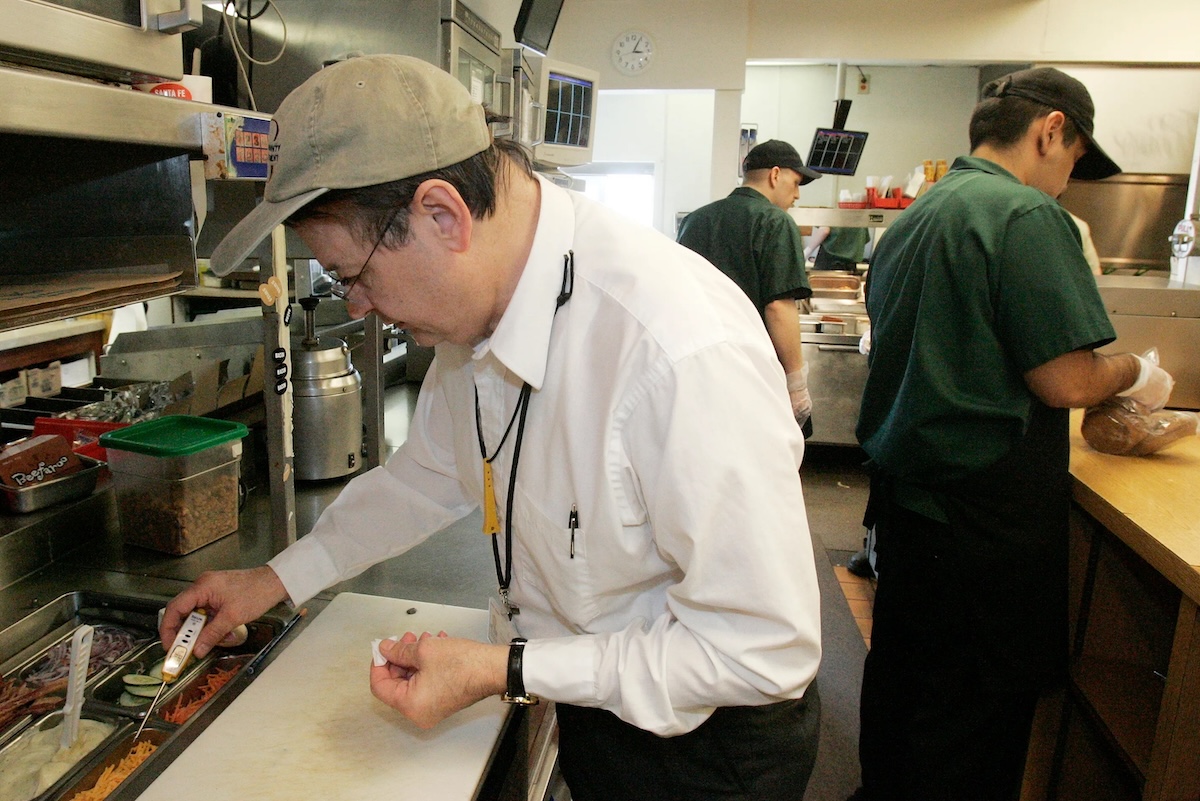
Fast forward a couple decades. I started teaching food safety and noticed King Buffet showing up in the Orlando Sentinel’s restaurant-inspection stories. I got curious and did a little investigating myself.

Holy hell. How is this place still open?
I did not read every inspection report going back twenty years. Who has that kind of time? I could have reread a pretty impressive Stephen King novel. A couple reports from the last few years were enough.
In September 2023, an inspector found dead roaches under the prep sink, raw chicken stored over unwashed produce, and three buckets of raw chicken thawing in standing water next to the mop sink. Equipment, shelving, carts, and parts of the kitchen were covered with grease, food debris, dirt, or slime. The operation did not even have a sanitizer test kit.
Four months later, inspectors came back and wrote 36 violations. Sushi on the buffet was running between 44°F and 49°F. Fish being hot-held was at 116°F. Shell eggs were too warm. Raw chicken was stored over other food, raw beef over pork wontons, and raw salmon intended for sushi did not have the required parasite-destruction documentation.
The physical condition of the kitchen was just as bad. There was heavy grease and food debris under the fryers, walls throughout the kitchen were heavily soiled, and cutting boards were so damaged they were no longer cleanable. The operation had eight employees working with food and no certified food manager on duty.
And somehow, this STILL was not the inspection that closed them.
In January 2026, Florida inspectors walked in again and found approximately 92 rodent droppings. Forty were on top of the dishmachine. Another twenty were on the dishmachine inside an open container being used for rodent bait. More were on top of a freezer, underneath another freezer, and across the dry-storage area.
That inspection also found raw shell eggs stored over cream cheese and other ready-to-eat food, chicken and imitation crab thawing at room temperature by the back door, buckets of noodles and washed vegetables sitting on the walk-in floor. Inspectors also documented damaged floors, dirty equipment, rusty shelving, a gap under an exterior door, food containers being cut apart and reused.
And here is the part that should really bother you: more than a few of these problems were marked Repeat Violation.
They knew it was a problem and just hadn’t fixed it.
Here’s what I want you to take away from this little journey into one Chinese buffet: the people who run King Buffet didn’t wake up one morning and suddenly have ninety-two rodent droppings in their kitchen. The floors didn’t break overnight. The equipment wasn’t clean the day before the inspector pulled into the parking lot, and it didn’t suddenly become filthy while he walked inside. The gap under the door was already there. The bad storage practices were already happening.
People had been walking past those problems every day. The inspector was just the person who finally wrote them down. Do not let that be you. Do not wait for somebody from the state to walk into your kitchen and explain what your own restaurant looks like.
Check it before you become a newspaper story and the next “Chef Bates’ Cautionary Tale.”
Quick Recall
Active Managerial Control means managers do not sit around waiting for food-safety problems to announce themselves. You identify risks, monitor what is happening, correct problems when you find them, and change the system when the same problems keep coming back.
Think of a self-inspection as Active Managerial Control with a clipboard.
You are looking at your own operation before somebody from the regulatory authority does. The goal is not to make yourself feel good about the kitchen. The goal is to find the things your team has stopped seeing, fix them, and make sure they do not become somebody else’s inspection finding.

The Inspection You Control
ServSafe is pretty specific about how a serious self-inspection program should work. First, do them frequently—more often than the regulatory authority inspects you. In Florida, that can mean anywhere from one to four inspections a year, depending on who you serve, what you serve, and how well you have performed in the past. For most Florida restaurants, that means doing a self-inspection about six to eight times a year is a pretty reasonable place to start. Your own management team can handle the self-inspections, or you can hire somebody else to do them—a third-party company—when you want the people hunting for errors to approach the operation with fresh eyes.
Second, stop inventing inspection forms. Get a copy of the form your local regulatory authority uses and build your self-inspection around it. If those are the categories they are going to examine when they walk through the door, those are the categories you should already be checking yourself. That does not mean your goal is to “beat” the inspector—it means you should know what they are going to look at before they look at it.
Start Outside
One thing people forget when they think about food safety inspections: the inspection does not start at the cookline. It can start in the parking lot.
Before you ever walk through the back door, look at the outside of the operation. Is the building in good repair? Are there holes, cracks, or gaps pests can use to get inside? Do exterior doors close and seal properly? Is the dumpster area clean and maintained? Are outdoor garbage containers sitting on a smooth, durable, nonabsorbent surface instead of dirt or gravel?
Look for standing water, overflowing waste, damaged surfaces, pest activity, and anything else outside the building that can become a sanitation problem inside it. ServSafe actually includes exterior grounds as part of a self-inspection. It is easy to forget because most of the food-safety rules we spend our time talking about happen inside the building.
And for goodness sake, if you have an outdoor dining area, inspect it regularly.

What Are You Actually Looking For?
Once you get inside, the inspection widens fast. You are not just looking for dirty equipment or checking a couple refrigerator temperatures. ServSafe expects a self-inspection to look at the whole operation.
Follow the food first. Look at receiving, storage, preparation, cooking, holding, cooling, reheating, and service. Check temperatures along the way, but also look at how food is stored, whether raw and ready-to-eat foods are separated, whether food is protected from contamination, and whether the procedures you built are actually being followed.
Then watch the people. Are employees washing their hands when they should? Are employee-health rules being followed? Are gloves and utensils being used correctly? More importantly, are employees doing what they were trained to do when nobody is standing beside them reminding them?
Keep moving. Check cleaning and sanitizing, plumbing and sewage, waste handling, pest control, and equipment maintenance. Look at whether the equipment still works, whether it can still be cleaned, and whether the building systems supporting the kitchen are doing their jobs.
Then get out of the kitchen and look at the paperwork. Are required records current? Are procedures actually documented? Is the crisis-management plan usable? Is the Food Safety Management System something people follow during every shift, or something sitting in a binder because somebody once said you needed one?
ServSafe breaks the self-inspection into a long list of categories, but they all come back to the same question: Is the operation actually doing what its food-safety system says it does?

The Inspection You Do Not Control
A regulatory inspection has a different purpose from your self-inspection. The inspector is not there to decide whether your kitchen is impressive. They are there to determine whether the operation is meeting minimum food safety standards. That distinction matters. Minimum standards are the floor. They are not the same thing as best practice, company standards, or the level of performance you may expect from your own team.
Most operations serving food to the public are inspected by a regulatory authority. In most cases, inspectors arrive without warning. The point is to see the operation as it actually runs, not after everybody has been given time to straighten the place up and suddenly remember every food-safety rule they have ever learned.
When the inspector arrives, you let them in.
ServSafe is very direct about this. Inspectors have the authority to access the operation, and refusing entry can put the operation’s permit at risk. A lunch rush, a delivery, somebody calling out, or a chef with a migraine does not change that.

Once the inspection is finished, the inspector explains the results. If the jurisdiction uses a score, they will explain that too. This is also when the person in charge should discuss any violations, ask questions about anything they do not understand, and make sure they know how much time they have to correct each problem.
You will receive a copy of the inspection report. Keep it on file. Some jurisdictions also require operations to notify the public when an inspection report becomes available, so the exact process depends on where you operate.
ServSafe gives you the national framework. Your local regulatory authority decides many of the details: how often inspections happen, how violations are classified, whether scores are used, how reports are posted, and what the correction process looks like.
You can absolutely correct problems while the inspector is there. If they point out a bad storage arrangement, move the food. If a sanitizer bucket is wrong, fix it. If something can be corrected safely on the spot, correct it. But you are still getting marked for what the inspector found.
An inspection is not like your mom checking your room before the grandparents arrive for a visit. You do not get to toss everything in the closet, straighten your stained blankets, and call the space “ready.” If the inspector saw the violation, it happened.
Fixing it during the inspection is good management. It shows you responded immediately. And in Florida at least, it will be reported as “Corrected On-Site.” Which is not what you want—but it is much better than the alternative.
Closing Side Work

Chef’s Explanation
This is the last In the Weeds in this course, so I am going to break the fourth wall for a minute. It’s my series, so I get to do that. Here you get to see Chef Bates looking back at himself as he was 30 years ago. It’s a tad uncomfortable, really. I think I was a bit of a jerk. But that arrogant kid teaches something valuable about the whole inspection process that makes the biographical pause worthwhile.
Here it is: Disney had built an excellent self-inspection system. They inspected frequently. They used experienced people who were outside the operation they were examining. Those inspectors looked at the whole restaurant, had enough authority to report what they found, and worked for an organization willing to make those findings matter.
In this excellent system, the young, talented, ambitious Chef Bates was the weak link.
Think about what a self-inspection is supposed to accomplish. It is supposed to uncover problems before the regulatory authority does. It is supposed to give management a clearer view of the operation than the people who walk through it every day can sometimes provide. When it finds something wrong, management is supposed to correct it, figure out why it happened, and keep it from happening again.
I did almost the opposite.
They found problems I had missed, and I argued with the findings. They showed me weaknesses in my operation, and I complained about the standard. Instead of using experienced outside eyes to improve the restaurant, I treated those eyes as the problem.
At that point, it really did not matter how talented I was or how much I knew about food. I was a manager who could be shown a food-safety problem and still spend his energy explaining why everybody else was overreacting. That is a genuine operational risk. And an organization serious enough to build the kind of inspection system Disney had built was entirely reasonable to decide I was not ready for the responsibility they had given me. It took me years to understand that.
A strong self-inspection program needs frequent inspections, a thorough look at the whole operation, people capable of seeing what the regular staff miss, and enough authority to make the findings matter. But none of it works unless the manager is willing to hear what the inspection says.
TL;DR – The Least You Need To Know
- The final ITW demonstrates the management lesson underneath all of this: a strong inspection system still depends on managers who are willing to hear what it finds and act on it.
- Self-inspection is Active Managerial Control with a clipboard.
- ServSafe expects self-inspections to happen frequently and more often than regulatory inspections.
- A strong self-inspection should mirror the regulatory authority’s inspection form.
- Self-inspection should examine the whole operation, including exterior grounds, flow of food, employee practices, sanitation, plumbing/sewage, waste, pests, equipment, documentation, crisis management, and FSMS.
- Regulatory inspectors are checking whether the operation meets minimum food safety standards.
- Inspectors usually arrive without warning.
- Do not refuse entry.
- After inspection, review violations and correction timeframes and keep the inspection report on file.
- Fixing something during the inspection is good management, but the finding still happened.
- In Florida, an item corrected during inspection may be reported as Corrected On-Site.