
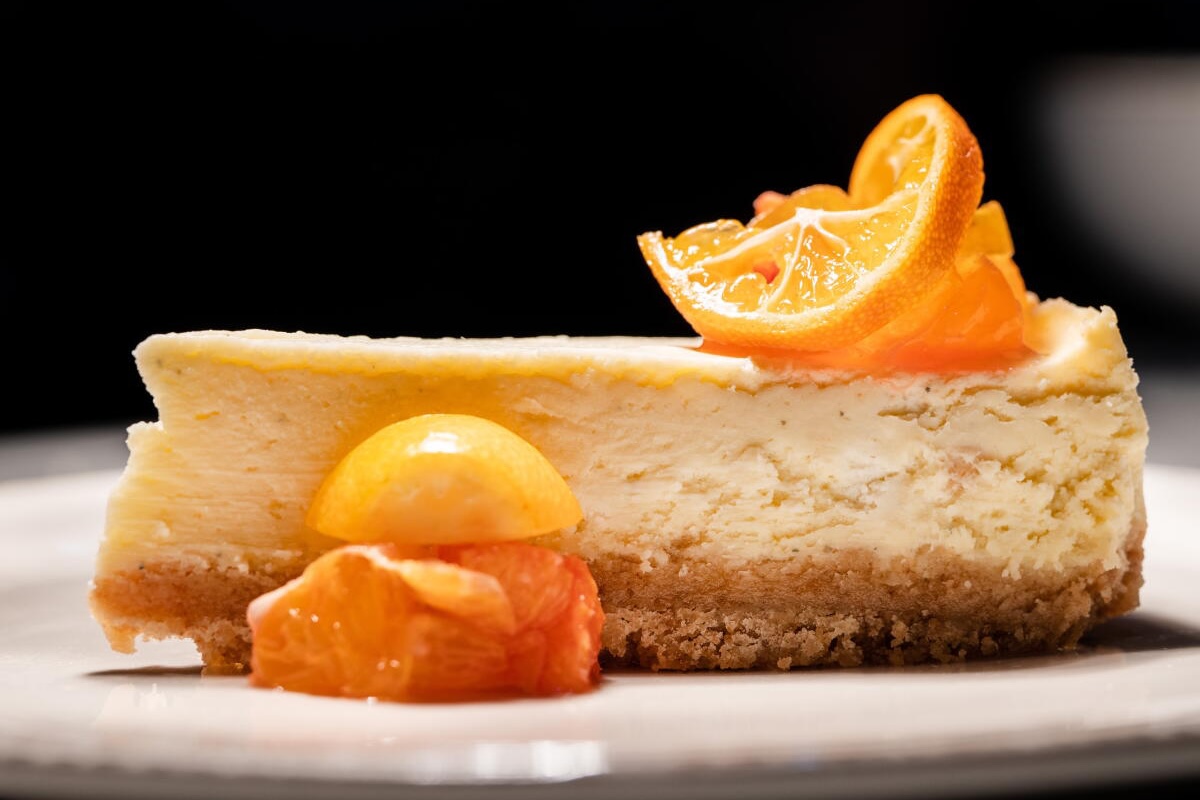
Cheesecake seems simple until you try to decide what cheesecake is supposed to be. Put an Italian ricotta cheesecake, a German Käsekuchen, a Japanese soufflé cheesecake, a towering New York slice, and a collapsed Basque cheesecake on the same table and the family resemblance gets complicated very quickly. The cheese changes. The texture changes. Some have crusts and some do not. Some are deliberately pale, some are browned, and one of the most famous versions in the world looks as though someone left it in the oven too long.
That is exactly what makes cheesecake worth studying. It has survived for centuries not because cooks protected one original recipe, but because they kept adapting the same broad idea to new cheeses, new places, new technologies, and new ideas about what a good dessert should be. Two of its most interesting descendants developed under very different circumstances: New York cheesecake grew gradually through American dairy technology and restaurant culture, while the cheesecake associated with La Viña in San Sebastián emerged from one cook experimenting in one restaurant around the beginning of the 1990s.
Understanding either one requires more than following directions. The ingredients have histories, the formula is a physical system, and the oven changes that system again. By the time the finished cakes reach the table, even the definition of a defect depends on which descendant you intended to make.
A Very Long Family Tree
Claims that somebody “invented cheesecake” should immediately make you suspicious. Cheese-based cakes and pastries have existed in one form or another for thousands of years, and the surviving record is messy enough that a neat origin story usually tells us more about whoever is repeating it than about the food itself.
The Romans give us some unusually good evidence. Cato the Elder recorded several preparations in the second century BCE that combined fresh cheese with ingredients such as flour, eggs, and honey. These foods were not modern cheesecake waiting two thousand years for a springform pan, but the underlying idea is recognizable: fresh cheese can be sweetened, structured, heated, and turned into something very different from the cheese that went in.

That idea moved instead of remaining fixed. Different regions had different dairy animals, cheesemaking traditions, grains, sweeteners, ovens, and ideas about dessert. Some versions lived inside pastry. Some used visible curds. Some were smooth. Some were dense and substantial, while others eventually became light enough to wobble.
Cheesecake follows the cheese. Italian traditions leaned toward ricotta. German and Central European cooks had quark and related curd cheeses. Polish sernik developed through its own fresh-cheese tradition. Japanese soufflé cheesecake eventually took the idea toward whipped egg foam and extraordinary lightness. American cheesecake became deeply attached to cream cheese. Change the cheese and you change the water, fat, protein, acidity, texture, and therefore the cooking problem.

Descendant One: America Industrializes the Cheese
The American branch changes dramatically when fresh cream cheese stops being an inconsistent local luxury and becomes an industrial product. Philadelphia really did have an important nineteenth-century reputation for cream cheese. Fresh cream cheese was delicate, highly perishable, and difficult to move very far before refrigeration. Philadelphia’s surrounding farms and access to wealthy urban customers helped the city become associated with particularly desirable examples of it. That reputation became valuable enough that a New York businessman eventually borrowed it.
William Lawrence operated a cheese factory in Orange County, New York. He had been producing Neufchâtel when a Manhattan grocer asked for something richer. Lawrence added more cream to the formula and in 1875 became the first producer credited with factory-producing what became American cream cheese. In 1880, distributor Alvah Reynolds began marketing the New York product as Philadelphia Cream Cheese, using Philadelphia’s existing reputation for luxury dairy as the sales pitch. The brand worked so well that people are still getting the geography wrong more than a century later.
The joke is good, but the technology behind it matters more. Railroads extended the market for fresh dairy. Factory production made the cheese more predictable. Refrigeration allowed it to travel farther. What had been a fragile regional product became something a bakery or restaurant could buy repeatedly and expect to behave about the same way every time. Cuisine does not develop separately from technology. Sometimes a dish changes because somebody discovers a brilliant technique; sometimes it changes because the railroad arrives, refrigeration becomes practical, or a manufacturer figures out how to sell the same block of cheese in thousands of stores.

So What Makes a Cheesecake New York-Style?
This is where the category gets slippery. There is no single legally protected New York cheesecake formula. Famous examples disagree about the crust, exact dairy, oven strategy, and how much browning belongs on top. Lindy’s famous formula uses a sweet pastry crust rather than graham crackers and begins with an extremely hot oven before dropping to a low temperature. Junior’s complicates the definition again with its famous sponge-cake base.
What holds the style together more convincingly is the formula and eating experience: cream cheese is the dominant dairy, the cake is rich and substantial, the interior is smooth rather than visibly curded, and the slice has enough body to stand tall while remaining creamy. That richness helps explain the appeal. New York cheesecake offers excess with very little apology. A thick slice delivers a tremendous amount of dairy richness in a polished, almost luxurious form.
Restaurant culture turned that physical style into an identity, and several restaurants spent decades helping convince diners that their version was the one worth crossing town—or the country—to eat. Arnold Reuben claimed an important role in developing the style. Lindy’s became another legend, and the rivalry was not entirely polite: one surviving account describes Lindy’s owner Leo Lindemann hiring away Reuben’s pastry chef and having him recreate the cheesecake at Lindy’s. Junior’s later became another New York institution and helped make cheesecake inseparable from Brooklyn restaurant culture.


Two Roads to a Similar Destination
There are at least two legitimate approaches worth knowing. One is the older blast-then-low method represented by formulas such as Lindy’s: strong initial heat develops color and sets the exterior, followed by a much lower oven to finish the center. The other is the modern low-and-slow approach that uses gentler heat and often a water bath to limit the temperature difference between the exterior and center.
The water-bath method developed here uses that second approach because it gives the cook a particularly clear lesson in custard control. The water bath is therefore a technique used to reach the desired texture. It is not what makes the cake New York cheesecake.
Descendant Two: San Sebastián Goes the Other Direction
The second descendant has a radically different history. Instead of trying to reconstruct a style from competing restaurant claims, there is an identifiable bar, an identifiable cook, and a surprisingly recent period of development.
La Viña opened in San Sebastián in 1959 as a family-run bar serving wine and food. Santiago Rivera took over in the late 1980s and spent some of his time experimenting in the kitchen. Around 1990, those experiments produced the cheesecake that began selling by the slice at La Viña during the 1990s and eventually became famous around the world.
The setting matters. La Viña belongs to San Sebastián’s pintxo culture. A pintxo is a small portion of food served in Basque bars, traditionally eaten while moving among several establishments for drinks and bites. La Viña is not a quiet pastry boutique built around one plated dessert; it belongs to an eating culture in which excellent food, social movement, and tightly packed bar service coexist.


The cake itself is remarkably spare: cream cheese, eggs, sugar, heavy cream, and a little flour create the classic structure. There is no crumb crust and no pastry shell. The batter is baked at high heat until the outside develops a dramatically burnished surface while the center remains exceptionally creamy.
The family tree loops back on itself. The San Sebastián cake runs on cream cheese, the same industrial style of fresh cheese American manufacturing helped turn into a global commodity. A product transformed by industrial dairy production crossed borders and eventually became part of a cake that traveled worldwide under an entirely different culinary identity.
Internationally, the name Basque cheesecake usually refers specifically to the style descended from La Viña rather than to every cheesecake eaten anywhere in the Basque Country. It is defined by what it leaves out and what it exaggerates: no separate crust, very high heat, a deeply browned exterior, deliberate wrinkles and settling, and a center that remains dramatically softer than a conventional American restaurant cheesecake.
The cake’s rise from local bar dessert to worldwide template is a much more modern kind of culinary spread. San Sebastián became an international destination for pintxo tourism, bringing travelers directly past the shelves at La Viña. Food writers, chefs, online reviews, travel sites, and social media carried the visual—dark top, parchment, collapsed center—around the world. Copies and adaptations now appear far beyond Spain.
The contrast with New York is useful. New York cheesecake developed slowly enough that several restaurants can plausibly fight over pieces of its history. La Viña’s version has a much shorter and more traceable development story.
Side Quest: The Graham Cracker Has a Very Weird Family History
The graham cracker underneath millions of American cheesecakes carries the name of Sylvester Graham, a nineteenth-century Presbyterian minister and dietary reformer who believed rich foods, meat, alcohol, spices, and other indulgences encouraged physical and moral disorder. His dietary program emphasized plain, minimally processed whole-grain foods and was tied to his broader campaign against sexual excess.

The irony writes itself. The food associated with Graham’s austere reform movement was eventually sweetened, industrialized, marketed as a snack for children, turned into s’mores, crushed with sugar and melted butter, and packed underneath one of the richest desserts in American cooking.
Technically, a graham crust is simply a bound crumb structure. Breaking crackers into fine particles creates more contact points. Melted butter coats and binds the crumbs as it cools, sugar contributes sweetness and browning, and compression converts a pile of crumbs into a coherent base. More pressure is not automatically better; a crust packed with unreasonable force can become hard and greasy instead of pleasantly crisp.
Blind-baking means baking the crust before the filling is added. With cheesecake, that brief bake sets the crumb structure and develops toasted flavor before the wet filling begins moving moisture downward.
Know Your Ingredients
So What the Hell Is Cream Cheese?
Yes, cream cheese is actually cheese. It is a fresh, unripened cheese made from milk and cream. Unlike cheddar, Parmesan, or other aged cheeses, it is intended to remain soft, moist, mild, and spreadable instead of spending months losing moisture and developing the flavors associated with aging.
Its characteristic tang comes largely from lactic acid created during culturing. Bacteria ferment some of the milk sugar, lowering the pH and changing both flavor and protein behavior. The result is not cream pretending to be cheese; it is a real fresh cheese that simply occupies a very different part of the cheese world from a hard aged wheel.

Cream cheese is unusually useful in cheesecake because it brings water, milk proteins, fat, acidity, and body into the batter at once. Modern commercial production also makes those characteristics extremely consistent, which matters anywhere recipes need to perform the same way repeatedly.
Block, Tub, Whipped, and Reduced-Fat
A formula calling for full-fat block cream cheese means exactly that. Spreadable tub products are formulated to remain easy to spread straight from refrigeration and may contain different moisture levels or stabilizers. Whipped cream cheese has air deliberately incorporated into it. Reduced-fat products alter the fat-to-water balance. Those products may all taste like cream cheese on a bagel, but cheesecake is asking more than whether they taste similar: it is asking whether the entire dairy system behaves similarly under heat.
Neufchâtel, Ricotta, and Quark
Neufchâtel is part of the American cream-cheese story because William Lawrence was producing it before developing a richer cheese. Ricotta brings a visibly curded structure, while quark contributes cultured dairy flavor with less of cream cheese’s high-fat density. Those are not failed versions of American cheesecake. They create different targets because the ingredient system itself is different.
Sour Cream, Crème Fraîche, and Heavy Cream
Sour cream and crème fraîche are both cultured cream products, but they do not behave or taste identically. Sour cream usually brings a sharper lactic acidity; crème fraîche generally contains more fat and tastes rounder and less sharply sour. Heavy cream contributes fat and moisture without the same cultured tang. In Basque-style cheesecake, a substantial amount of heavy cream helps create the loose, creamy interior that distinguishes the style.
Swap the cheese, dairy, egg ratio, sugar, starch, chocolate, or pan and you are not making one harmless substitution. You are changing water, fat, protein, acidity, sweetness, viscosity, heat transfer, or several of those things at once. Baking works because the whole formula reaches a useful balance, not because each ingredient performs independently.
Eggs: The Structure Builder
Cream cheese supplies much of cheesecake’s identity, but eggs do a large share of the structural work. Raw egg proteins begin as folded molecules dispersed through water. Heat causes those proteins to unfold and connect into a three-dimensional network. That process is coagulation, and it is what transforms a flowing batter into a custard capable of holding a slice.
| Egg Component | Approximate Coagulation Range |
|---|---|
| Egg white | 144–149°F |
| Egg yolk | 149–158°F |
| Whole egg | 144–158°F |
Those temperatures are ranges rather than switches. Sugar raises the temperature at which egg proteins coagulate, acids can lower it, and starch can add thickening and give a custard more tolerance before the egg network tightens excessively. That is why a sweet dairy custard can remain beautifully creamy even though the plain egg proteins inside it begin coagulating at lower temperatures.
Coagulation and Syneresis
The objective is not to coagulate every egg protein as aggressively as possible. Enough connections need to form to support the cheesecake while plenty of moisture remains trapped inside the network. Keep heating and that network becomes increasingly tight until it begins squeezing out the moisture it had been holding. That release of liquid is syneresis, and it contributes to the weeping, dry, grainy texture of overcooked cheesecake.
What the Starch Is Doing
In cheesecake formulas that contain flour or cornstarch, the starch granules absorb water, swell, and thicken the surrounding liquid through gelatinization. That gives the custard another source of structure and some additional tolerance against excessive tightening of the egg network.
The classic La Viña-style cheesecake contains a small amount of flour. The chocolate-espresso adaptation used here does not. Cocoa powder, cocoa mass, couverture, cream cheese, and eggs create a different solids-and-fat system, so this formula has to be understood on its own terms rather than as the original cake with chocolate simply stirred into it.
Chocolate and Espresso Change More Than Flavor
A chocolate-espresso Basque cheesecake is an adaptation of the La Viña-style idea, not the original La Viña formula. Adding dark couverture introduces cocoa solids, cocoa butter, sugar, and bitterness. Couverture is chocolate formulated with a relatively high proportion of cocoa butter so it melts and flows particularly well. High-fat cocoa powder contributes additional cocoa solids and flavor with more cocoa butter remaining than in lower-fat cocoa powders.
Cocoa mass, also called cacao mass or chocolate liquor, is finely ground cacao in which the cocoa solids and naturally occurring cocoa butter remain together. For this cheesecake, the cocoa mass is made in-house by grinding cacao nibs with additional cocoa butter in a granite melanger for about 24 hours. The added cocoa butter helps this small production batch refine and flow smoothly.
Espresso contributes roasted aromatics and more bitterness. Together, chocolate and coffee alter the flavor, fat, solids, viscosity, and heat behavior of the custard.
The comparison between a classic New York cake and a chocolate-espresso Basque cake is therefore not a controlled experiment in which only the baking method changes. It is a culinary comparison with several variables changing at once. The flavor system is part of the analysis, not something to pretend away.
How It’s Made
Both descendants begin with the same broad problem. Cheese, dairy, sugar, eggs, and sometimes starch need enough heat to become a stable custard without losing the moisture that makes cheesecake worth eating. From there, the techniques diverge because the desired results diverge.

New York: Control the Gradient
The graham crust is blind-baked, the springform is protected against water, and the batter is cooked in a gentler environment so that the exterior does not race too far ahead of the center. The bain-marie, or water bath, buffers the heat reaching the sides and bottom. It slows exterior heating and gives the center more time to catch up.
Basque: Exploit the Gradient
There is no separate crust. The parchment-lined cake is exposed directly to high oven heat so the surface and outer structure cook much faster than the center. The result is the point: dark roasted exterior, stronger textural contrast, wrinkling and settling, and a center that stays much softer.
Building Smooth Batter Without Filling It With Air
Cold cream cheese is stiff enough to create trouble before the oven is ever turned on. When cold cheese is forced together with sugar, dairy, and eggs, small lumps resist incorporation, and the obvious reaction—turning the mixer up and letting it rip—creates the next problem. Cheesecake is not buttercream. The objective is a homogeneous batter, not maximum aeration.
Use properly softened cream cheese and the paddle attachment at low speed. Stop the machine and scrape the sides, paddle, and especially the bottom of the bowl. Once the eggs are added, mix only until they disappear. Excess air expands in the oven, encouraging unnecessary puffing and increasing the amount of contraction the cake must survive during cooling.
A finished batter should be smooth, glossy, and homogeneous. There should be no cream-cheese lumps, egg streaks, dry pockets of cocoa or starch, or unmixed dairy hiding at the bottom. It should look dense and fluid rather than foamy. If a spatula scraped firmly across the bottom brings up the same smooth mixture seen at the surface, the batter is ready.
Why Cheesecake Cracks
Cracking is evidence that the structure experienced more stress than it could handle. Overbaking is the largest culprit. As the egg network tightens and the cheesecake loses moisture, the cake contracts. If the exterior has become significantly firmer than the center, or if the cake is still gripping the pan wall while it shrinks, that stress can split the surface.
Excess air makes the problem worse because a heavily aerated cake rises farther and therefore has farther to fall. Sudden cooling can accelerate contraction before the structure has equalized. The solution is not one magic anti-crack trick; it is managing the entire process so the cake never has to survive unnecessary structural violence.
Why Basque Cheesecake Gets So Dark
High heat attacks the surface quickly. Browning is not a single reaction: Maillard reactions, caramelization, moisture loss, and concentration work together to build color and roasted flavor. In this style, those bitter, caramelized, nutty notes are not damage. They are part of the design.
The cake also rises and settles. Steam and trapped gases expand while hot and contract during cooling while the custard structure relaxes. Some collapse and wrinkling are expected rather than diagnostic of failure.
What Convection Changes
A convection oven uses a fan to move hot air across the food. That movement increases heat transfer at the surface, so browning and moisture loss happen faster than they do in a still-air oven set to the same temperature. Fan speed matters: a low-fan or gentle-convection setting reduces that effect, while stronger convection makes the exterior cook more aggressively.
That matters differently for the two cakes. The water-bath New York method benefits from gentler airflow because the goal is controlled, even heating. The Basque cake intentionally needs aggressive surface development, but convection can still move it from deeply roasted to burnt faster than expected. Oven temperature, fan setting, rack position, pan material, and actual doneness all matter more than blindly copying a clock time.
First Run in a New Oven
One of the first jobs when you join a new kitchen crew is learning how the existing equipment is going to handle your recipes—basically, how that kitchen cooks. That is what happens whenever a proven formula moves into unfamiliar equipment.
The recipe gives a starting point, but the first run shows how aggressively the oven browns, how quickly the center heats, whether one rack cooks differently from another, and how convection changes the surface. Read the food for doneness, record what actually happened, and use those observations to establish the production standard for that kitchen.
Doneness: Read the Cake, Not Just the Clock
A recipe time tells you when to start paying close attention. It does not know the starting temperature of the ingredients, the exact pan material, how many cakes are in the oven, where they are positioned, or how aggressively that particular oven transfers heat.
New York-Style Doneness
The outer portion should look set while the center remains visibly softer. Give the pan a gentle nudge and watch the center. A roughly 2- to 3-inch area should jiggle as one cohesive mass, more like gelatin than liquid moving underneath a skin.
A particularly creamy cheesecake is ready around 150–155°F at the center while the area nearer the edge will be hotter.
Chocolate-Espresso Basque Doneness
Color is less useful because the batter begins dark. Look for a surface that has changed from wet and glossy to set and matte, darker roasted areas around the outside, and a broad custardy movement through the center.
For this formula, use 150–155°F at the center as the working production target. The cake should still have a broad wobble when it leaves the oven. Thick custard movement is expected; raw liquid sloshing freely is not.
The movement matters. A New York-style cheesecake that is perfectly firm from edge to center while still in the oven is probably already past its creamiest endpoint. A Basque cheesecake that still has a broad center wobble may be exactly where it belongs. The same visible characteristic means different things because the target changed.
Tips & Tricks
The most useful cheesecake habits are small ones. Soften cream cheese completely before mixing, keep the mixer on low, scrape the paddle and the bottom of the bowl more often than seems necessary, and stop once the batter is homogeneous. If the finished batter still contains a few stubborn lumps, a fine-mesh sieve does less damage than several more minutes of beating.
For the water-bath cake, build the foil protection before filling the springform and keep every foil seam above the intended waterline. Put the roasting pan and cheesecake into the oven before adding the hot water rather than carrying a pan of near-boiling water across the kitchen.
For the Basque cake, give the parchment plenty of height above the pan and preserve the intended 8-inch-by-3-inch geometry. A wider, shallower pan is not merely a different container; it changes the way heat reaches the center.
Neither cake should be baked until it looks reassuringly solid. The last useful piece of judgment is knowing when to stop touching it.
Troubleshooting
Tips are prevention. Troubleshooting begins after prevention failed. Find the problem that is happening now and make the best rescue move still available; this is not the place for advice about what should have happened earlier.
Problems That Affect Either Style
New York-Style Problems
Basque-Style Problems
Bringing the Dish Together
Baking ends when the pan leaves the oven. Cooking does not. Heat stored in the hotter exterior continues moving inward while the cheesecake cools. At the same time, steam escapes, proteins settle, gases contract, and fats begin changing physical state. Chilling later firms the fat phase and makes both cheesecakes substantially more rigid than they appeared while hot.
That is why cooling is part of the recipe rather than dead time between baking and eating.
Cooling New York-Style Cheesecake
Remove the cake from the water bath when baking is complete, strip away the wet foil, and run a thin knife carefully around the inside edge of the springform so the shrinking custard is not forced to pull against the pan wall.
Cool on a rack for about 2 hours, then refrigerate for at least 6 hours. Overnight chilling gives the cleanest release and slicing.
Cooling Basque-Style Cheesecake
Let the cake stand briefly after baking, then cool in the pan until it reaches room temperature, roughly 1½ to 2 hours depending on the room and pan. Refrigerate overnight before cutting.
Once fully chilled, lift the cake from the solid pan using the parchment overhang. Refrigeration makes the center substantially firmer; tempering the sliced cake before service restores more of the soft custardy texture associated with the style.
Unmolding and Cutting
New York-style cheesecake benefits from a clean, deliberate release because smooth sides support the polished restaurant presentation. Basque-style cheesecake keeps the irregular parchment-shaped exterior produced during baking; trying to polish those sides until they resemble New York cheesecake destroys evidence of the method.
For either cake, use a long sharp knife, warm the blade in hot water, dry it, make one clean cut, wipe, and repeat. Smearing yesterday’s cut across the next slice is not rustic. It is just messy.
Storage and Freezing
Cheesecake belongs under refrigeration once it has cooled. New York-style cheesecake generally freezes well because its dense cream-cheese structure tolerates freezing and thawing better than many fragile custards. Wrap portions tightly to limit freezer burn and odor absorption, then thaw under refrigeration.
Basque cheesecake can also be chilled and stored, but refrigeration noticeably changes the intended soft-center texture. Freezing may preserve the cake, but it also pushes the eating experience farther from the tempered custardy center that made the style famous. Storage convenience and ideal service texture are not always the same goal.
What Does “Good” Mean?
The two descendants finally create a useful problem. A feature that demonstrates success in one style may signal failure in the other. That makes preference a different question from quality.
Description comes first: the surface is dark; the center is soft; the texture is dense; the crust is crisp; the flavor is tangy; the finish is bitter. Those are observations. Quality asks whether those characteristics match the intended product. Preference asks whether you personally enjoy them.
A person can dislike the roasted bitterness of an expertly made Basque cheesecake. Someone can happily eat a New York cheesecake that is technically overbaked. Neither reaction is dishonest; they are simply answers to different questions.
| Characteristic | Water-Bath New York-Style | Basque-Style |
|---|---|---|
| Cream-cheese richness | Central | Central |
| Separate crust | Present in this version | Absent |
| Surface browning | Restrained in this method | Defining |
| Exterior-to-center contrast | Minimized | Deliberately pronounced |
| Wrinkling | Usually unwanted | Characteristic |
| Significant settling | Usually minimized | Expected |
| Interior | Dense, smooth, creamy, relatively even | Soft, custardy, intentionally gradient-driven |
| Primary technical goal | Control the thermal gradient | Exploit the thermal gradient |
Notice what is not in the table: “New York cheesecake never browns.” Historical New York formulas prove otherwise. The comparison is between the specific water-bath expression used here and the Basque method, not between one supposedly authentic cake and one supposedly rebellious cake.
A defect is a failure to achieve the intended characteristics—not simply a characteristic you dislike. When somebody says, “This cheesecake is better,” the useful follow-up is still: better at what?
Finishing the Plate — Optional
Cheesecake does not need decoration merely to prove that somebody owns a squeeze bottle. Start with a clean slice and consider its proportion, placement, negative space, temperature, and the visual character already created by the baking method.
Fresh fruit or a restrained fruit preparation can give a rich New York-style slice useful acidity and freshness. The chocolate-espresso Basque cake already carries chocolate, coffee, caramelized dairy, and bitterness, so additional garnish should support that flavor system rather than bury it. Cocoa, coffee, restrained cream, or carefully chosen fruit can work; a random collection of sauces, berries, powdered sugar, and mint usually communicates that nobody trusted the cheesecake.
A garnish should be edible and intentional. A sauce should improve the bite. If the cake already says enough, leave it alone.

RECIPES
Junior’s-Style New York Cheesecake
Equipment
- Springform Pan, 8 inches
- Foil
- water bath
Ingredients
Graham Cracker Crust
- 170 g graham cracker crumbs
- 71 g unsalted butter melted
- 38 g granulated sugar
Cheesecake Filling
- 680 g full-fat block cream cheese softened
- 264 g granulated sugar
- 24 g cornstarch
- 15 g vanilla extract
- 112 g extra-large whole eggs about 2 eggs
- 151 g heavy cream
Instructions
Prepare the Pan and Crust
- Preheat the convection oven to 325°F.
- Lightly coat the inside of an 8-inch springform pan with pan spray.
- Combine the graham cracker crumbs, melted butter, and sugar until evenly moistened.
- Press the mixture evenly across the bottom of the springform pan.
- Bake for 10 minutes.
- Transfer the pan to a rack and cool completely.
- Wrap the outside of the springform pan securely with heavy-duty aluminum foil, keeping all seams above the expected water line.
Make the Filling
- Fit the mixer with the paddle attachment.
- Combine one-third of the cream cheese with approximately one-third of the sugar and all of the cornstarch.
- Mix on low speed until smooth, scraping the paddle, sides, and bottom of the bowl thoroughly.
- Add the remaining cream cheese in portions, mixing on low and scraping between additions.
- Add the remaining sugar and vanilla. Mix until smooth.
- Add the eggs gradually, mixing only until incorporated.
- Add the heavy cream and mix only until the batter is completely homogeneous.
- Pass the batter through a fine-mesh sieve.
- Pour the filling over the cooled crust and level the surface.
Bake
- Set the oven to 325°F on Gentle Bake.
- Place the cheesecake inside an empty roasting pan.
- Place the roasting pan on the center oven rack.
- Add hot water to the roasting pan until it reaches approximately halfway up the outside of the springform pan.
- Bake for 60 minutes before beginning doneness checks.
- Continue baking until the outside is set and the center 2–3 inches move together as one soft mass when the pan is gently nudged.
- Verify a center temperature of approximately 150–155°F.
- Remove the cheesecake from the water bath and transfer it to a cooling rack.
Cool and Chill
- Cool undisturbed at room temperature for 2 hours.
- Cover loosely.
- Refrigerate for at least 6 hours, preferably overnight.
- Release the springform only after the cheesecake is thoroughly chilled.
Portion
- Warm a long straight-edge knife in hot water.
- Dry the blade completely.
- Cut one slice.
- Clean, warm, and dry the blade between every cut.
Chocolate-Espresso Basque Cheesecake
Equipment
- 8-inch round cake pan with tall parchment liner
- Pan spray, as needed
Ingredients
Cheesecake Base
- 450 g full-fat block cream cheese softened
- 130 g granulated sugar
- 3 g fine salt
- 10 g high-fat cocoa powder
Chocolate-Espresso Ganache
- 70 g 64% dark couverture chocolate
- 100 g house-made cocoa mass
- 240 g heavy cream
- 10 g vanilla bean paste
- 8 g instant espresso powder
Eggs
- 150 g whole egg
- 40 g egg yolk
Instructions
Prepare the Pan
- Preheat the convection oven to 375°F.
- Lightly coat an 8-inch round cake pan with pan spray.
- Crumple and reopen the parchment.
- Line the pan completely, allowing the parchment to extend at least 2 inches above the rim.
- Press the parchment firmly into the bottom and sides of the pan.
Make the Cheesecake Base
- Fit the mixer with the paddle attachment.
- Combine the cream cheese, sugar, salt, and cocoa powder.
- Mix on low speed until completely smooth, scraping the paddle, sides, and bottom of the bowl thoroughly.
Make the Chocolate-Espresso Ganache
- Combine the couverture chocolate and cocoa mass in a heatproof container.
- Heat the heavy cream, vanilla bean paste, and espresso powder until steaming.
- Pour the hot cream mixture over the chocolate and cocoa mass.
- Allow to stand briefly.
- Emulsify with an immersion blender until completely smooth and glossy.
Finish the Batter
- Add the whole eggs and yolks gradually to the cream-cheese mixture, mixing on low speed only until incorporated.
- Add the chocolate-espresso ganache.
- Mix on low only until homogeneous.
- Scrape the bowl thoroughly.
- Pass the batter through a fine-mesh sieve.
- Pour into the prepared pan and level the surface.
Bake
- Bake at 375°F in standard convection.
- Begin checking at 40 minutes.
- Continue baking until the outer portion is fully set, the surface is dry rather than wet and glossy, and darker roasted areas and cracking have developed around the exterior.
- Gently move the pan. A broad section of the center should still wobble like thick custard; it should not slosh like liquid.
- Remove from the oven when the exterior is fully developed and the center retains the intended soft set.
Cool and Chill
- Cool in the pan on a rack at room temperature until no longer warm.
- Refrigerate overnight.
- Remove from the pan only after the cheesecake is thoroughly chilled.
- Peel the parchment away gently.
Portion and Serve
- Cut with a clean, warmed straight-edge knife.
- Clean and dry the blade between slices.
- Allow portions to lose some refrigerator chill before service for a softer, creamier center.
House-Made Cocoa Mass
Ingredients
- 90 g cacao nibs
- 10 g cocoa butter
Instructions
- Add the cacao nibs to the granite melanger and begin grinding.
- Melt the cocoa butter and add it gradually as the nibs begin breaking down.
- Continue grinding for about 24 hours, scraping down the melanger as needed, until the mixture is fluid and noticeably smooth rather than gritty.
- Weigh 100 g for the cheesecake formula.
- If made ahead, hold covered and remelt gently before incorporating into the ganache.

Going Deeper
Philadelphia Cream Cheese — Encyclopedia of Greater Philadelphia
The industrial and marketing history behind American cream cheese and the Philadelphia name.
From San Sebastián to the World — Basque Culture
The history of La Viña, Santiago Rivera, and the cheesecake that emerged there around 1990 before spreading far beyond San Sebastián.
Chocolate Basque Cheesecake — Callebaut
The professional chocolate-espresso formula behind the Basque-style adaptation used here.
Why Did My Cheesecake Crack? — King Arthur Baking
A useful deeper look at cheesecake doneness, internal temperature, overbaking, shrinkage, and cracking.
Terms You Should Know
Study Guide
Long Lineage
Cheesecake is not one recipe invented once. It is a broad family of cheese-based desserts that changed as ingredients, people, technology, and culinary traditions changed.
Cheesecake Follows the Cheese
Ricotta, quark, cream cheese, and other fresh cheeses bring different ratios of moisture, fat, protein, acidity, and texture. Changing the cheese changes the dessert.
New York Descendant
New York-style cheesecake is defined more convincingly by its cream-cheese-dominant formula, richness, height, smooth texture, and substantial creamy slice than by one crust or one baking method.
San Sebastián Descendant
La Viña’s cheesecake developed from Santiago Rivera’s kitchen experiments around 1990 and was being sold by the slice during the 1990s. Its crustless construction, aggressive browning, settling, and soft center became the foundation of the internationally recognized Basque-style cheesecake.
Eggs
Egg proteins coagulate as they heat and create much of cheesecake’s structure. Sugar, acid, starch, and other ingredients change how that structure develops.
Starch
When a cheesecake contains flour or cornstarch, gelatinized starch adds thickening and structural support. The classic La Viña-style cake contains flour; the chocolate-espresso adaptation used here contains no added flour or cornstarch.
Syneresis
When the protein network becomes too tight, it can expel moisture. In cheesecake this appears as weeping and contributes to dry, grainy overcooked texture.
Thermal Gradient
The water-bath New York method tries to reduce the temperature difference between the exterior and center. Basque-style cheesecake deliberately creates a much stronger contrast.
Convection
Moving hot air increases surface heat transfer. Fan speed, oven temperature, rack position, pan material, and oven load all change how quickly a cheesecake browns and heats.
Doneness
Time tells you when to start checking. Surface set, center movement, internal temperature, and intended style tell you when to stop.
New York Technical Goal
The water-bath method controls the thermal gradient so the exterior does not overcook while the center reaches a creamy set.
Basque Technical Goal
High dry heat exploits the thermal gradient, producing a deeply roasted exterior while preserving a much softer center.
Quality
Preference and technical quality are different judgments. A characteristic becomes a defect only when it works against the intended result.
The Big Question
Before calling one cheesecake better than another, ask what each cake was trying to be. Better at what?
