
75 Pounds of Scrambled Eggs
I walked into my first large-scale breakfast service at 4 a.m. The kitchen was quiet — just one other cook and the a.m. sous going over the prep sheets for the day. I wandered around getting my bearings, and that’s when I saw them: enormous stockpots of water, 15 five-pound bags of liquid egg bobbing in the simmering water, steam drifting up to the hood.
I’d cooked breakfast before. A lot of breakfast.
That knowledge was completely useless for what I was looking at.
We were about to serve breakfast to 450 people.
Worse, I didn’t know what to do next.
Where does all that food go while you’re waiting for people to eat it? How do you keep the first batch delicious and still safe while the second, third, and last batches finish? How do you move hundreds of people through a buffet without the food getting too cold, too hot, dried out, overcooked, contaminated, or just plain nasty?
If you’ve never worked in a hotel, resort, banquet kitchen, cafeteria, or other large foodservice operation, you may not have a picture for this world at all.
That’s okay. Let’s build one.
You already know the basic holding temperatures: 135°F or above for hot TCS food; 41°F or below for cold TCS food.
Now let’s talk about what happens during service.

The Dial Lies to You
The steam table says 150°F.
Great.
What’s the food temperature?
Those are not necessarily the same thing.
The temperature displayed on a steam table, hot box, refrigerator, or other holding unit tells you what the equipment is doing. It does not tell you the temperature of the food sitting inside it.
Use a calibrated thermometer to check the actual food.
Held TCS food must be checked at least every 4 hours. But ServSafe also recommends checking it every 2 hours.
Why check twice as often as you’re required to?
Because two hours gives you time to do something about a problem.
Why Two Hours Again?
If you’re thinking, “Didn’t we already do this with cooling?” — yes. We did.
When we learned cooling, we didn’t wait until the food had already blown its deadline before checking whether it was cooling fast enough. We checked earlier, while there was still time to do something about it.
Checking held food every 2 hours gives us exactly the same safety net.
Find that pan of gravy at 128°F during a 2-hour check, and you may still have time to take corrective action. Wait until the 4-hour check to discover the same problem, and that option is gone. Discard it.
Different process. Different rule. Same management strategy.
When the Temperature Check Fails
So you stick a thermometer into the gravy and get 128°F.
Now what?
If the gravy has been below 135°F for 2 hours or less, you may still have time for corrective action. Pull it, reheat it correctly, and return it to hot holding.
If it has been below 135°F for more than 2 hours, discard it.
If 4 hours have passed since the last temperature check, discard it regardless.
And if you don’t know how long it’s been out of temperature, you don’t get to guess your way into the better answer. Discard it.

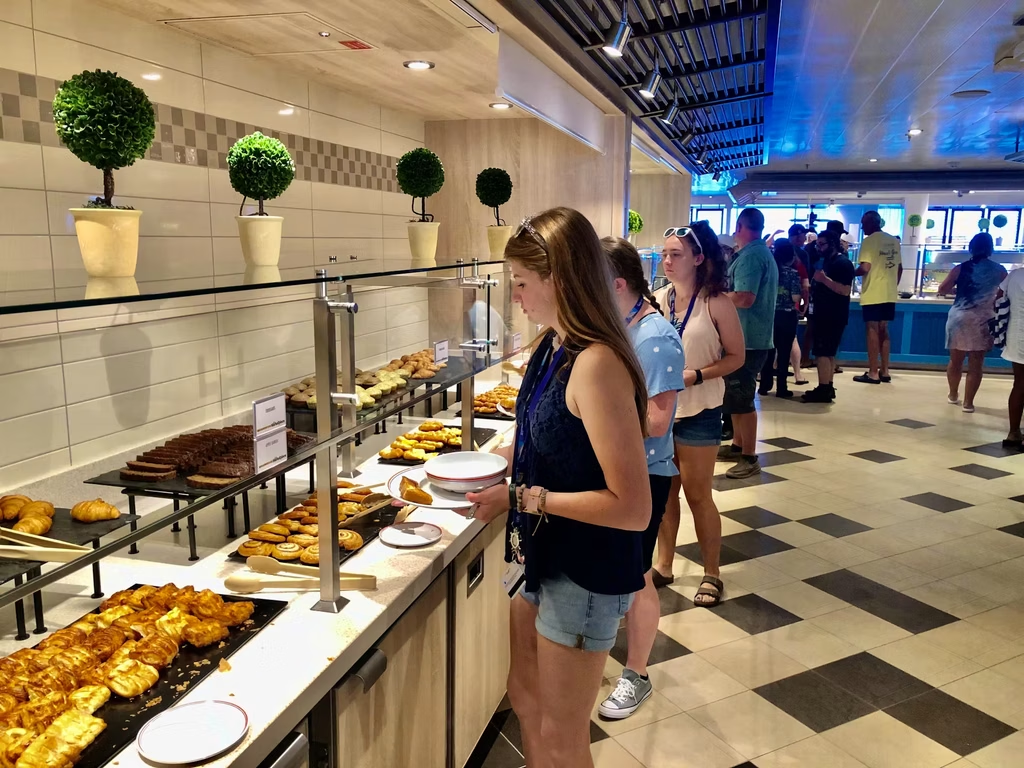
When Guests Serve Themselves
Until now, most of the food-safety controls we’ve talked about have been in the hands of trained foodservice employees.
Then we open a buffet.
Now we’re deliberately putting all that carefully prepared food within reach of hundreds of people who don’t work for us, haven’t taken this course, and may have some truly horrifying ideas about acceptable buffet etiquette — along with a healthy serving of poor manners.
So now we’ve got another job: protect the food from the people serving themselves — and protect those people from each other.
That’s why self-service lines have food shields, serving utensils, clean-plate rules, and employees monitoring what guests are actually doing.
Let’s start with the most obvious piece of protection: the food shield, better known as the sneeze guard.
The Sneeze Guard
The official term is a food shield. Almost everybody in a kitchen calls it a sneeze guard, which tells you exactly why it’s there.
It creates a physical barrier between the guest’s face and the food.
For the exam, remember two numbers: 14 inches up and 7 inches out.
A food shield should be positioned at least 14 inches above the counter and extend at least 7 inches beyond the food.
If those numbers try to switch places in your head, picture the actual buffet. Fourteen inches gives you room to get a plate and serving utensil underneath the guard. Seven inches pushes the protective edge out toward the guest.
The point isn’t to build a glass roof over the buffet. It’s to block the direct path between the guest’s mouth and nose and the food below.
14 up. 7 out.

Give Them Something to Serve With
The sneeze guard protects food from what’s coming out of the guest’s face. Now we need to worry about their hands.
Self-service food needs the appropriate serving utensil — and a separate utensil for each food item. Tongs for the rolls, a spoon for the mashed potatoes, a ladle for the gravy.
The whole point is simple: the guest touches the utensil instead of the food, and the same utensil doesn’t travel from one food to another.

And once you provide that utensil, keep the handle where people can actually grab it without reaching into the food. Don’t leave the spoon buried in the potato salad with the handle marinating alongside everything else.
Keep serving-utensil handles above the top of the food and container, or store the utensil on a clean, sanitized surface when appropriate.
A serving utensil only protects the food if guests can use it without putting their hands where the food is.
New Trip, New Plate
Here’s another buffet rule that sometimes gets mistaken for good manners.
Every time a guest returns to the buffet, they need clean tableware.
Don’t bring the plate you’ve been eating from back to the line and start loading Round Two onto it. That fork has been in your mouth. The plate may have been touched by the fork, your hands, used napkins, or whatever else has happened at the table.
Then you bring it back and hold it underneath the same serving utensils everybody else is using.

No thanks.
Guests returning for additional food must use clean plates and other clean tableware.
You’ll often see signs that say PLEASE USE A CLEAN PLATE FOR EACH TRIP. That’s a useful reminder, but don’t confuse the sign with the food-safety rule. The important part is that the guest actually uses clean tableware when returning for more food.
New trip. New plate.
Replenish It. Don’t Top It Off.
Eventually, a pan on the buffet starts getting low. The kitchen has a fresh batch ready, and somebody has what seems like an efficient idea:
“Just dump the new stuff on top.”
Don’t.
Never refill a pan of food that’s been sitting on the buffet with a fresh batch from the kitchen. Take the old pan away and replace it completely with a new one.
Think about what’s happening if you top it off. The food at the bottom has been sitting through service — exposed to guests, serving utensils, and changing temperatures — and now you’ve buried it underneath a fresh batch.
You haven’t made the old food new. You’ve just mixed two batches with two different histories and made it harder to know what you’re actually serving.
Pull the old pan. Put out the fresh one.
That’s replenishing.
Somebody Still Has to Watch the Line
A sneeze guard, a pair of tongs, and a stack of clean plates don’t make a buffet self-managing.
Self-service areas must be monitored by trained employees.
Guests will use the wrong utensil. They’ll bring dirty plates back for seconds. They’ll reach under the sneeze guard. They’ll pick something up with their fingers, reconsider their life choices, and put it back.
Somebody has to notice.
Monitoring the buffet means watching for contamination problems while they’re happening and correcting them before the next guest comes along.
And don’t confuse this with checking food temperatures. That’s another job you’re doing during service.
Check the food. Watch the guests. You have to do both.

Don’t Forget the Labels
You’ve already seen this breakfast buffet when we learned customer labeling. The cereal dispenser, waffle batter, scrambled eggs, and basket of whole fruit don’t all follow the same labeling rules.
Nothing changes because we’re talking about buffet service now. Bulk self-service food still needs its required labeling information in plain view, and unpackaged food containing major allergens still requires written allergen notification.
Don’t turn “it’s on a buffet” into a new labeling category.
Figure out what kind of food you’re dealing with, then apply the labeling rule you’ve already learned.

We’ve dealt with what can happen when people get to the food. Now let’s go back to what can happen while that food sits through service.
During service, there are two different ways we can control TCS food: keep it under temperature control, or deliberately use time as the control instead.
When the Clock Becomes the Control
Back at our breakfast buffet, the scrambled eggs are sitting in chafing dishes over cans of Sterno.
There’s heat under the pan, and we’re still going to check the food during service. But for the ServSafe rules we’re learning here, treat the chafer as Time as a Public Health Control — TPHC.
That’s a completely different game from powered hot-holding equipment.
In a powered holding cabinet or steam table with temperature controls, temperature is the control. The equipment is supposed to keep the food at 135°F or above, and we check the actual food temperature throughout service to make sure it’s doing its job.
As long as the food stays at 135°F or above, there’s no four-hour food-safety clock ticking. From a safety standpoint, it could stay there indefinitely. Eventually your scrambled eggs may turn into something suitable for patching drywall, but that’s a quality problem, not a holding-time limit.
TPHC flips the whole thing around.
Now time is the control.
Once the food leaves temperature control, the clock starts — and unlike the steam table, that clock has an ending.
But here’s the important part: TPHC is a decision you make before the food goes into service. It is not a rescue plan for food you discover out of temperature later.
For hot TCS food, the rule is straightforward: Start at 135°F or above. Mark the time it leaves temperature control. Serve, sell, or discard it within 4 hours.
And here’s the part that feels wrong after everything we’ve just learned about hot holding: if that food drops below 135°F during those four hours, we’re not going to freak out.
Under TPHC, 135°F is no longer the line that determines whether the food can stay in service. The clock does.
That’s the deal we’ve made. We know the food may spend time in the temperature danger zone. We’ve deliberately allowed for it — and we’re throwing it away when the four hours are up anyway.
Once those 4 hours are up, the food is done.
Not check it and see how it looks.
Not stick a thermometer in it and give it another hour because it’s still 132°F.
Four hours means four hours.

Cold Food Gets More Time — With a Catch
Hot TCS food under TPHC gets 4 hours.
Cold TCS food can be held without temperature control for up to 6 hours — but cold food doesn’t get those extra two hours for free.
It must start at 41°F or below, and it cannot rise above 70°F during those 6 hours.
Picture a bowl of cut melon going onto a breakfast buffet at 38°F.
The clock starts when it comes out of refrigeration. The room starts warming the melon. That’s expected. Under TPHC, it doesn’t have to stay at 41°F or below.
But now you’ve got two limits to watch:
6 hours on the clock.
70°F on the thermometer.
Hit either limit and you’re done.
If that melon reaches 71°F, it doesn’t matter that you’ve only been out there for three hours. The six-hour deal is over. Discard it.
If it stays at or below 70°F, it can remain in service until the six-hour limit. Then it gets served, sold, or discarded.
And just like the hot-food rule, you don’t put the leftovers back in the walk-in and save them for tomorrow. Once you’ve committed that food to TPHC, the clock doesn’t reset because you changed your mind.
So keep the two rules straight:
Hot TPHC: 135°F → 4 hours.
Cold TPHC: 41°F or below → up to 6 hours, but never above 70°F.

The Growing 2 / 4 / 6-Hour Confusion Chart
You’ve got enough 2s, 4s, and 6s floating around now that memorizing the number by itself is officially useless.
Here’s why the number alone won’t save you: a 4-hour temperature check and a 4-hour TPHC limit are two completely different thing. A 4-hour temperature check means you’re using temperature-controlled holding and checking to make sure it’s still working and a 4-hour TPHC limit means you’ve deliberately stopped using temperature as the control. When that clock expires, the food is finished.
This might help – ask yourself: What process am I doing, what starts or defines the clock, and what has to happen before it runs out?

Why Does Four Hours Keep Showing Up?
You’ve probably noticed something by now: four hours keeps showing up in food safety.
That’s not arbitrary.
When TCS food spends time in the temperature danger zone, bacterial populations can grow. FDA scientists have determined that four hours is the food-safety limit we can use to prevent bacterial growth in the food we’re serving from reaching dangerous levels.
That’s why four hours keeps appearing in different rules.
So when you see four hours show up in different rules, don’t assume the rules are interchangeable.
They aren’t.

There’s one last self-service rule you need before we leave the buffet, and it’s an oddball.
Raw Food on a Self-Service Line
Most of the time, customers should not be serving themselves raw, unpackaged meat, poultry, or seafood.
Makes sense. Putting a hotel pan of raw chicken next to the mashed potatoes and handing everybody a pair of tongs would create an impressive number of ways to ruin dinner.
But ServSafe teaches three exceptions.
Ready-to-Eat Raw Food
A buffet can offer ready-to-eat foods such as sushi or raw shellfish for customer self-service.
Raw Portions for Immediate Cooking
Think hot pot. Guests select individual portions of raw meat or seafood and cook them in the simmering broth before eating.
Don’t want to cook your own food? Think Mongolian barbecue buffet. You collect your raw ingredients, hand them to the line cook on duty — along with a nice tip — and he’ll do the cooking for you.
Either way, the idea is the same: raw food, picked by you, cooked and consumed immediately.
Cooking is built into the service.
The Exam-Recognition Oddball
Raw, frozen, shell-on shrimp or lobster may be offered for customer self-service.
Picture a seafood market or self-service seafood display, not a restaurant buffet.
This is one of those questions that earn Food Safety Exam test writers their place in hell. Don’t overthink it. Remember the three things that make the exception work:
Raw. Frozen. Shell-on.

Closing Side Work

Chef’s Explanation
The eggs have to go.
Changing the spoon isn’t enough.
The ketchup isn’t the contamination we’re worried about. It’s the evidence.
That ketchup came from somewhere. The kid was using a plate he’d already been eating from, and now ketchup from that plate is on the serving spoon and in the hotel pan of eggs.
That means the spoon made contact with his used plate and then went back into food that dozens of other people were about to eat.
Scooping out the little streak of ketchup doesn’t undo that.
Discard the eggs. Replace the pan. Replace the serving spoon.
And now you know why new trip, new plate isn’t just buffet etiquette.
A clean plate isn’t there because we care whether the buffet looks nice. It’s there to keep something that’s been at one guest’s table — touched by their hands, their fork, and possibly their mouth — from finding a way back into food everybody else is sharing.
The ketchup just happened to leave us a trail.
Most contamination won’t.
TLDR: THE LEAST YOU NEED TO KNOW
If you remember nothing else from this lesson, remember this:
- Hot TCS food under temperature control stays at 135°F or above. Cold TCS food stays at 41°F or below.
- Check held TCS food at least every 4 hours. Checking every 2 hours gives you time for corrective action if something goes wrong.
- If food has been out of temperature too long — or you don’t know how long — discard it.
- On a buffet, protect food from the guests: food shields, separate serving utensils, clean plates for every return trip, no topping off old pans, and trained employees watching the line.
- TPHC means time is the control. Hot TCS food starts at 135°F or above and gets 4 hours. Cold TCS food starts at 41°F or below and gets up to 6 hours, but it can never rise above 70°F.
- TPHC is a decision made before service. It is not a way to rescue food you discover out of temperature later.
- When the exam throws another 2, 4, or 6 at you, don’t memorize the number by itself. Ask: What process am I doing? What starts or defines the clock? What has to happen before it runs out?
- Most customers should not serve themselves raw, unpackaged meat, poultry, or seafood. Know the three ServSafe exceptions: ready-to-eat raw food; raw portions that will be cooked immediately; and raw, frozen, shell-on shrimp or lobster.
Key Terms
Holding — Keeping prepared food safe while it waits to be served.
Hot holding — Holding hot TCS food at 135°F or above.
Cold holding — Holding cold TCS food at 41°F or below.
Corrective action — The step taken when a food-safety check finds a problem early enough that it can still be safely corrected.
Food shield — A physical barrier that protects displayed food from contamination by customers. Usually called a sneeze guard in the kitchen.
Self-service — A service setup in which customers select or portion food for themselves.
Replenishing — Replacing a nearly empty buffet pan with a fresh pan rather than adding new food on top of old food.
Time as a Public Health Control (TPHC) — A planned method of using time instead of temperature to control the growth of pathogens in TCS food during service.
Hot-food TPHC — Hot TCS food starts at 135°F or above and must be served, sold, or discarded within 4 hours.
Cold-food TPHC — Cold TCS food starts at 41°F or below and may be held for up to 6 hours, as long as it never rises above 70°F.
Temperature-controlled holding — Holding food at its required safe temperature and checking the actual food temperature during service.
Clean-tableware rule — Guests returning to a self-service line for more food must use clean plates and other clean tableware.