
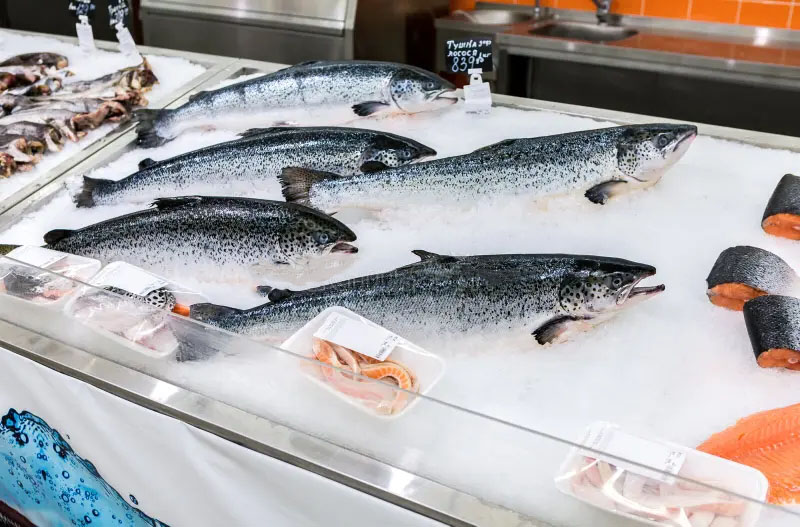
Listen up, future chefs. If you want to master the seafood station, you have to respect the salmon. It’s the “steak of the sea”—versatile, fatty, and high-stakes. One minute it’s a buttery masterpiece; the next, it’s a dry, sad piece of pink cardboard.
Here’s the breakdown on how to treat this fish like the royalty it is.
1. The Lineup: Pick Your Player
Not all salmon are created equal and you’ve got to know what you’re cooking. This is the difference between your salmon becoming a “Chef’s Special” or a “Kitchen Disaster.” In this regard, salmon falls into one of two categories: Atlantic vs. Pacific. There is a HUGE debate over which is better, the ultimate East Coast vs. West Coast rivalry. It’s not just about where they swim; it’s about how you can cook them and what they’ll do to your food cost. Here is a breakdown of the two heavyweights.

Atlantic Salmon: The Reliable “Lab-Grown” Legend
When you see “Atlantic Salmon” on a menu, 99% of the time, it’s farmed. Before you roll your eyes—farmed doesn’t mean bad; it means consistent.
- The Vibe: Think of this as the Wagyu of the sea. Because they are raised in pens and fed a specific diet, they are incredibly fatty and marbled.
- The Look: Thick, light pink to orange flesh with visible white “fat lines” (marbling).
- Culinary Superpower: You almost can’t mess this up. The high fat content keeps it juicy even if you’re a minute late pulling it off the grill. It’s the king of sushi, cold-smoking, and searing.
- The Catch: It’s available year-round. It’s the “Old Faithful” of the kitchen.
Pacific Salmon: The Wild-Child Squad
“Pacific Salmon” isn’t just one fish—it’s a gang of five (King, Sockeye, Coho, Pink, and Chum). These are almost always wild-caught.
- The Vibe: These fish are athletes. They spend their lives swimming thousands of miles against currents. This makes their meat leaner, firmer, and much more “intense.”
- The Look: Usually a much deeper, “stop-sign” red (especially Sockeye). The flesh is tighter and less oily to the touch.
- Culinary Superpower: The flavor is “Salmon 2.0.” It tastes like the ocean—briny, robust, and complex. It’s best for quick searing, cedar-plank grilling, or tartare.
- The Catch: They are seasonal. If you want the good stuff, you wait for the “run” (usually summer). Also, because they are leaner, they go from “perfect” to “dry” in about 30 seconds.
Pro Tip: Fat = “safety net.” More fat (King/Atlantic) means the fish stays moist even if you go 5° over. Lean fish (Sockeye/Coho) will turn into a hockey puck if you get distracted.
The “Cheat Sheet” Comparison
| Species | Flavor Profile | Fat Content | Culinary Application |
| King (Chinook) | Rich, buttery, soft. | Very High | Pan-searing or “low and slow” roasting. |
| Sockeye (Red) | Robust, “salmon-y,” firm. | High | Grilling or quick searing; overcooks easily. |
| Coho (Silver) | Delicate, subtle, lean. | Medium | Poaching or en papillote to preserve moisture. |
| Atlantic (Farmed) | Mild, consistent, fatty. | High | All-purpose; excellent for smoking or curing. |

The “Designer Labels” of Salmon
Aside from the Atlantic v Pacific issue, there are the “Designer Label” Fish. If THESE names are on your menu, your food cost just doubled. Or Tripled.
Here are the elite varieties of salmon chefs flex with:
- Columbia River “Springers”: The first run of the year. They hit the cold spring water at their absolute peak oiliness. Status: The insider’s choice.
- Copper River King (Alaska): The OG celebrity fish. Wild-caught in May/June. It’s packed with massive amounts of omega-3s to survive a brutal glacier-fed swim. Status: The “Wagyu” of the sea.
- Ora King (New Zealand): The only farmed salmon on this list. It’s a specific breed engineered for insane marbling and consistency. Status: The Michelin-star favorite.
- Yukon River King (Alaska): Rarer and fattier than Copper River. These fish swim 2,000 miles, so they are essentially “liquid gold” when cooked. Status: The Unicorn.
- Wester Ross / Loch Duart (Scotland): The high-end Atlantic choice. Hand-fed and slow-grown in cold Scottish waters. Status: The “Gold Standard” for sustainable farming.

2. The “Doneness” Game
Stop guessing. If you’re poking it with your finger and hoping for the best, you’re gambling.
- Rare (110°F): Basically “warmed up” sushi.
- Medium-Rare (115°F – 120°F): The sweet spot. Translucent center that melts in your mouth.
- Medium (125°F – 130°F): The crowd-pleaser. Flaky but still juicy; center is just turning opaque.
- Medium-Well (135°F – 140°F): Firm and fully opaque. Starting to lose that buttery vibe.
- Well-Done (145°F+): You’ve officially made cat food. Don’t do this.
The Lip Test: Take a metal cake tester, poke it into the thickest part for 5 seconds, then touch it to your bottom lip. If it feels cold, it’s raw. If it feels like body temp, you’re at Medium-Rare. If it’s hot, get it off the stove!
Chef’s Tip: Treat wild salmon with “gentle heat.” Remove it from the pan at 120°F and let it coast up to temp. On the other hand, farmed salmon can handle up to 130°F without losing its buttery texture.

3. Culianry Technical Flexes (Don’t Mess This Up)
A couple of basic pointers on pan searing skin-on salmon

- Skin Like Glass: Dry the skin with a paper towel until it’s bone dry. Start skin-side down in a medium low pan.
- Hold it down with a spatula for 30 seconds so it stays flat. If it curls, you lose that even crunch.
- The 90/10 Rule: Do almost all your cooking on the skin side. It protects the meat. Flip it at the very end just to finish the top.
More advanced tip: Let’s brine that fishy!
Brining is an essential professional step to season the fish deeply and prevent the “white gunk” (albumin) from leaking during cooking. Albumin is a protein in salmon that is CRYING because you cooked the fish too fast or too hot. To avoid it, brine your fish for 10 minutes in salt water first. It “relaxes” the proteins so they don’t squeeze out all the juice.
- Wet Brining: A salt concentration of 1% to 2% by weight for 10 to 30 minutes improves moisture retention and prevents albumin from leaking all over the place.
- Dry Curing: Used for Gravlax or smoked preparations. Rub with a mix of kosher salt, sugar, and aromatics, then refrigerate under weight for several days. You know that salmon that comes on bagels? That’s a type of Gravlax. Delicious.
- Confit: A 2-Michelin-star technique where the salmon is slowly cooked in oil at very low temperatures to achieve a “melt-in-your-mouth” texture.

4. Salmon Fabrication: From whole fish to pieces-parts
Before we talk about cutting up your whole salmon, lets talk about WORMS.
The “Invisible” Danger: Parasite Destruction
If you’re serving wild Pacific salmon as tartare, crudo, or “just seared,” you’re playing with fire unless you know the freezing rules.
- The Science: Wild salmon are athletes that eat wild things—including parasites like Anisakis (roundworms).
- The Pro Move: To serve wild salmon raw, it must be “Sushi Grade.” This isn’t just a marketing term; it means the fish was frozen to -4°F for 7 days or -31°F for 15 hours to kill any hitchhikers.
- The Exception: High-end farmed salmon (like Atlantic or Ora King) are usually raised on controlled feed, making them naturally parasite-free and safe to serve raw right off the plane.

Pro Tips: Scaling, “De-Sliming”, and Removing the Lateral Line
You can’t get “glass-crunchy” skin if your salmon is covered in scales and mucus. And you can’t charge top dollar if you leave the “Bloodline,” the dark, muddy-looking strip of meat right against the skin that is officially called the “Lateral Line.” Here’s how to take address both these fabrication steps.
Scale and slime
- The Scale Check: Even “pre-scaled” fish usually have a few stragglers near the fins and belly. Run your hand against the grain; if it feels like sandpaper, get the scaler out. One scale in a customer’s mouth can ruin a $50 entrée.
- The Slime Coat: Salmon have a natural protective slime. Before you cut, use the back of your knife to “squeegee” the skin from tail to head. If you don’t, that slime turns into a gummy, grey film in the pan.
Removing the Lateral Line
- The Vibe: This is high-oxygen muscle used for long-distance swimming. It’s loaded with iron and fat, which gives it a much “fishier,” metallic taste.
- The Technical Flex: In fine dining, we often “Deep Skin” the salmon. This involves taking a slightly thicker cut with the skinning knife to remove that entire grey strip, leaving only the pristine, uniform pink/red flesh. It’s more expensive (lower yield), but the flavor is much more refined.
Now that we have dewormed tonight’s dinner, gotten rid of the scales and slime, and have a pristine cut ready to hit the cutting board, let’s talk fabrication. Filleting a salmon is high-stakes surgery, where every wrong move costs the restaurant money. For a professional, the goal is a high yield (keeping as much meat as possible) and a clean finish.

Breakdown: Mastering the Art of Whole Salmon
When you get a whole fish, you aren’t just “cutting meat”—you’re performing surgery. You start with a HOG (Head-On, Gutted) salmon. Grab your flexible boning knife and get to work:
- The Head & Spine: Follow the bones. If you hear a “zip” sound as your knife glides over the ribs, you’re doing it right. Waste is money; keep your yields high.
- The Pin Bone Hunt: This is the “Zen” moment. Use pliers to pull those 30ish tiny bones out. Pull forward (with the grain) so you don’t tear the flesh into a jagged mess
- The Primal Cuts (The “Money” Map): Once you have a clean side of salmon, you break it down into the cuts that actually hit the plate:
- The Loin (The Center Cut): This is the “Filet Mignon” of the fish. It’s the thickest, most uniform part of the back. This is what you serve to the critic or the big spender. It cooks perfectly even.
- The Belly (The Bacon): The fattiest, richest part of the fish. It’s thin and oily. In a high-end spot, you’ll sear this solo or use it for “Belly Strips.”
- The Tail: It’s the most exercised part of the fish, so it’s leaner and thinner. Don’t try to cook this like a loin—it’ll turn to dust. Instead, dice it for tartare, fold it into a mousse, or make salmon burgers.
- The “Trim”: All the little scraps left on the bones. Use a spoon to scrape the spine (we call this “spoon meat”). This is pure profit—perfect for spicy salmon rolls or dumplings.

Skin: On or Off?
- Skin-On: This is the “Pro Move.” The skin acts as a heat shield, keeping the meat juicy. Plus, if you get it “glass-crunchy,” it’s the best part of the dish.
- Skin-Off: Usually for poaching or curing. If you’re removing the skin, your knife should be flat against the board—if you see grey “bloodline” meat on the skin, you’re doing it right. If you see pink meat on the skin, you’re losing money.
Your Salmon Fabrication Kit: A flexible boning knife (for the spine), a straight-edge slicing knife (for portioning), and heavy-duty fish tweezers (for the pin bones). Get these. Keep them close to your heart (and knife kit).
The Golden Rule of Fabrication: “Respect the animal, respect the knife, and for the love of everything, don’t leave $5 worth of meat on the skeleton.”
Storage: The “Swimming” Position
The very last topic in this post could just as easily gone FIRST. When you buys some salmon, you don’t just toss it in the fridge in the paper or container it was purchased in. You’ve got some work to do because HOW you store your salmon determines its shelf life and texture.
- Gravity Matters: Always store whole fish in a “swimming position” (upright on their bellies) if possible, packed in crushed ice. If they lay on their side, the weight of the guts and bones can bruise the delicate flesh underneath.
- The Perforated Pan: Never let salmon sit in a pool of its own melt-water. It should be in a perforated pan (a “hotel pan” with holes) nested inside a solid pan. The water needs to drain away instantly, or the fish will get waterlogged and start to smell.

Recipes
Salmon en Papillote (Salmon in Parchment)
Ingredients
- 1.5 lbs Salmon cut into 4 pieces
- 1 Small zucchini thinly sliced
- 1 Head fennel thinly sliced
- 1 Lemon thinly sliced
- 1 Frond Fresh Dill
- 1 tbsp Olive oil
- 1 tsp Salt
- 1/2 tsp Pepper
Instructions
- Cut parchment into 4 large ovals 15” by 10” inches. And fold in half.
- On half of each parchment layer on ¼ of the zucchini, ¼ the fennel, 1 piece of salmon, sprinkle with ¼ tsp salt, ¼ pepper, ¼ tsp dill, lemon slices, drizzle with ¼ cup olive oil and a few pieces of fennel fronds. Repeat with the three remaining salmon fillets.
- Close the parchment by folding the other half over the prepared salmon and carefully roll the open edges toward the center.
- Set pouches on a baking sheet and bake on the center rack for 15 minutes.
- Open carefully using a fork and serve.
Notes
- A note on seasonality. May-October is salmon season in the U.S., and that is when you can expect to find the best stuff most widely available.
- Variety. From Coho to King, to super-meaty Copper River salmon, most any variety of wild salmon that looks bright pink and marbled with at least a little fat will be delicious in the salmon in parchment recipe.
- Wild vs farmed. Wild salmon is usually better than farmed—better tasting, better for you, better for the environment. However, responsibly farmed salmon can be a better choice than irresponsibly caught wild salmon.


