
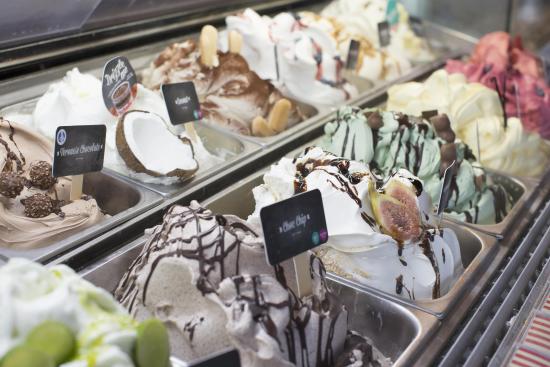
Gelato isn’t just “fancy Italian ice cream,” but a masterclass in the science of texture. Unlike commercial, mass-produced ice cream, gelato thrives on small-batch processing, low butterfat and minimal air. It’s a dense, velvety experience that carries flavor far more intensely on the palate than Bryers ever dreamed of.
For any serious pastry student, mastering this craft is a non-negotiable skill. It forces you to dive deep into the delicate chemistry of sugars, stabilizers, and controlling ice crystal formation. By learning to balance these complex variables, you aren’t just making a cold treat—you’re a wizard, manipulating molecular structures against their will to achieve a perfect, silk-smooth finish. This is why pastry chefs are practically mini gods. They bend atoms to their will.
Before we dive into the process, let’s take a way-too-brief look at Gelato’s fascinating story.
1565: Northern Custard-style Gelato is Born
Gelato got its start in 16th-century Florence, Italy, where the legendary architect and artist Bernardo Buontalenti wasn’t just designing buildings—he was also tinkering with desserts. For a massive Medici banquet, he whipped up what many consider the first true “gelato”: a rich, velvety cold cream made from milk, honey, and egg yolks. This Crema Fiorentina was a game-changer because it moved away from the simple fruit-and-ice sorbets of the past, introducing the dense, custard-like texture that still defines Northern Italian gelato today.

1681: Sicilian Gelato is Born
Fast forward about a hundred years, and the spotlight shifts to a Sicilian chef named Francesco Procopio dei Coltelli. He packed up his grandfather’s rudimentary sorbet machine and headed for Paris with a vision. In 1686, he opened Café Procope, which turned out to be a massive hit and is still open today!

This wasn’t just any café; it became the ultimate hangout spot for the intellectual heavyweights of the Enlightenment—think Voltaire and Benjamin Franklin. Procopio refined the recipes, using high-quality sugar and exotic new flavors like citrus and chocolate. Thanks to him, gelato made the jump from the private dining rooms of the Italian elite to the public squares of Paris, eventually paving the way for the global obsession we see today.
1843: Automation Begins
Across the Atlantic, Nancy Maria Johnson patented the first hand-cranked ice cream freezer. This was a game-changer for texture. Her design used a central paddle (the dasher) to break up ice crystals and incorporate air while freezing. This allowed for a much smoother, more consistent product than the old “pot-freezer” method, where the mix was simply stirred in a bowl surrounded by ice.

1927: The Cattabriga Revolution
Smart people believe that gelato really started with the blacksmith Otello Cattabriga. Before his invention in 1927, making gelato was back-breaking manual labor. You had to stand over a bucket of ice and salt, scraping the sides with a wooden spatula. By hand. For hours.
Cattabriga changed everything when he invented the first automatic batch freezer in Bologna, Italy.

His mechanical genius was a system that mimicked the human “stair-step” motion. Instead of just spinning in a circle like Johnson’s hand cranked machine, Cattabriga’s invention used a mechanical arm that would “detach and spread” the gelato against the walls, perfectly replicating the artisanal spatula technique. Even today, many of the world’s best gelaterias use vertical batch freezers that follow Cattabriga’s original mechanical design to achieve that perfect, dense consistency.

The Cattabriga 9 Quart Vertical Batch Freezer
The company Cattabriga founded still exists today and is known for preserving artisanal traditions through technology. The EFFE series produces a dry, well-textured gelato with the “personal touch” of traditional craftsmanship. And so affordable!
Retail Price $45,000.00
1946: The Carpigiani Era
Following WWII, brothers Bruto and Poerio Carpigiani founded their namesake company. They took Cattabriga’s concepts and industrialized them, creating standardized, hygienic, and high-performance machines. Their work essentially exported the Italian gelato culture to the rest of the world, making the equipment as famous as the dessert itself. You really only need to know about these brothers because I teach my students on a Carpigiani machine that was donated to our program by a generous sponsor. We love it and swear by the Carpigiani line.

TWO STYLES OF GELATO:
NORTHERN AND SICIALIAN
The Great Divide: Sicily vs. Northern Italy

Before making your first batch of gelato, you need to know which regional style you’re aiming for – ’cause they are VERY different.
Bernardo Buontalenti‘s Northern gelato is traditionally a “crema” or custard-based dessert. This style came from the Po Valley and Tuscany regions, areas rich in dairy and poultry, and the gelato from this part of Italy used egg yolks and heavy cream for stabilization. This style of gelato has a dense, velvety texture that feels incredibly rich on the tongue. It’s almost architectural in how it’s served—sculpted with a spatula into high, wavy peaks in a cup or cone.
Travel down to Sicily, and the rules change. The Sicilian gelato created by Francesco Procopio dei Coltelli is heavily influenced by the Arab occupation of the 9th century, which introduced sugar cane, citrus, and the early concept of sherbet. Because dairy was less abundant and eggs were expensive, Sicilians pioneered a starch-based base (using cornstarch or carob flour) rather than eggs. This results in a “stretchy” but lighter mouthfeel that is incredibly refreshing in the Mediterranean heat. If you’re ever in Catania, you’ll see Sicilian Gelato served in a warm brioche bun rather than a cone—it’s the ultimate breakfast of champions.

Recipe Concepts to Master BEFORE Starting your First Recipe
Regardless of whether you’re shooting for the custard-style or the lighter, more delicate Sicilian-style of gelato, there are four technical skills and concepts you need to understand:
- the technical triad,
- sugar as both sweetener and antifreeze agent,
- the use of thickeners and stabilizers, and
- the importance of the “curing” or “aging” period
Gelato vs. Ice Cream: The Technical Triad
The difference between making gelato and ice cream is ALL in how they balance three main levers: fat, air, and temperature.
- Fat: Gelato keeps it lean, usually between 4% and 9% butterfat. Compare that to the 10% to 20% in premium ice cream. Why does this matter? Because fat coats your tongue. Less fat means your taste buds can actually ‘hit’ the flavor molecules—like a high-quality pistachio or a ripe peach—much faster.
- Air: Because we keep the overrun low, the mouthfeel is silky and dense, not fluffy or ‘foamy.’ We control the amount of air introduced to the final product by controlling how fast the gelato machine’s dashers turn
- Temperature: We serve gelato a few degrees warmer—around 10-15*F. This prevents that ‘brain freeze’ numbness and lets the flavors bloom the moment they touch the palate.

Science of the Perfect Scoop: Sweeteners and Anti-freeze
Let’s talk shop about sweeteners. You can’t just dump table sugar (sucrose) into a batch and expect a perfect scoop. This is where PAC (Potere Anti-congelante) and POD (Potere Dolcificante) come in.
- PAC is your ‘anti-freeze’ power.
- POD is how sweet the mix actually tastes.
Here’s why Dextrose is the MVP of the gelato lab: It has a massive PAC of about 190 but a low POD of only 70. By swapping some (or all) of your sucrose for dextrose, you can make your gelato significantly softer and more ‘scoopable’ at sub-zero temperatures without making it cloyingly sweet. It also helps stop lactose from crystallizing, which is how you avoid that gritty, ‘sandy’ texture that ruins a batch.

The Backbone: Thickeners and Stabilizers
Finally, you need a ‘skeleton’ to hold all that water and fat together. Since we aren’t relying on massive amounts of fat or air for structure, we use plant-based hydrocolloids like Locust Bean Gum and Guar Gum. These aren’t ‘chemicals’ to be feared; they are essential tools that bind free water, preventing ice crystals from growing too large. Mastering these stabilizers is what separates a grainy amateur attempt from a world-class, silky artisanal masterpiece.
The Science of Stability: Why Gelato Doesn’t Just Melt
To keep that signature silkiness from turning into a block of ice, we rely on stabilizers—the unsung heroes of the display case. In a professional kitchen, these aren’t just additives; they are functional hydrocolloids that manage water and air within a complex emulsion.
Here’s a few of the most common stabilizers used in high-end gelato production:

- Locust Bean Gum (LBG): Often considered the “gold standard” for artisanal gelato. Derived from carob seeds, this galactomannan requires heat to activate. Once it does, it forms a structured network that’s incredibly effective at preventing ice crystal growth, giving gelato its characteristic “chew.”
- Guar Gum: This is LBG’s cold-soluble cousin. It provides instant viscosity and is often used alongside LBG to build body quickly, though it lacks the sophisticated elastic mouthfeel of its heated counterpart.
- Carrageenan: Extracted from red seaweed, this anionic polymer is all about protein interaction. It binds with milk proteins to prevent “whey-off” (syneresis), ensuring that your gelato doesn’t separate or lose its structure as it sits in the display case.
- Carboxymethyl Cellulose (CMC): Often referred to as a “chemical” or semi-synthetic stabilizer, CMC is a cellulose derivative that is exceptionally hydrophilic. It’s a powerhouse for binding water and preventing heat shock—those tiny ice crystals that form when a freezer door is opened and closed.
- Sodium Alginate: Derived from brown algae, this creates a unique “egg-box” structure when it meets the calcium in milk. It provides a clean, rapid melt-away on the tongue, which is why it’s a favorite for balancing the texture of fruit-based sorbettos.
The Easy Way
There is an EASIER way to make gelato. It requires less gelato knowledge and human effort. You only need buy yourself some prepackaged all-in-one base powder, mix it liquids (milk or water) and flavor ingredients or paste. These all-in-one powders contain all the functional ingredients you need, including sugars, milk powder, stabilizers, emulsifiers, etc. Many well-known brands provide these pre-packaged powders, such as MEC3, Fabbri, AromItalia, and Elenka. They offer specific guidelines and recipes for making gelato with their premix powders. This means you have to adhere to their guidelines and have little room for modifications based on your preferences. You won’t be making true
Regardless of what ingredients you use, regardless of whether you are creating a Northern Custard Gelato or a Southern Sicilian-style frozen treat, the last stage of putting the ingredients together – the thing you must do before putting the mix into the freezer – is arguably the most important: Curing.
Curing – the most important step in making gelato
Imagine you’ve just finished cooking up a perfect batch of gelato base. You are literally DYING to throw it straight into the batch freezer, give it a whirl, and taste your greatness. However, any professional gelataio will tell you that the most important ingredient in a world-class gelato is actually time.
In the industry, we call this the curing or aging phase. It’s a 8-to-24-hour waiting period where the mix sits at a steady 40 °𝐹. While it looks like nothing is happening, on a molecular level, your gelato is undergoing a total transformation.
Let’s walk through the kitchen and look at why this step is the secret to that signature silky texture.
1. Letting the Ingredients “Wake Up”
When you first mix your ingredients, the stabilizers (like carob or guar gum) and milk proteins are essentially in a “dry” state. They need time to fully absorb water—a process called hydration.

Think of it like making a great risotto; you can’t rush the rice absorbing the liquid by adding it faster or boiling it harder. It’s the same with gelato.
If you freeze the mix too early, these stabilizers won’t have formed their protective network. The result? Water molecules stay “free,” and during freezing, they’ll turn into large, crunchy ice crystals. By curing the mix, you ensure that the water is bound up, giving you a smooth, dense body instead of a slushy texture.
2. Preparing Fats for Battle
Gelato is essentially a battle for structural integrity. For the gelato to hold its shape and feel creamy, the fats need to be in the right physical state.
During curing, the liquid milk fats begin to crystallize. If you freeze a mix while the fat is still liquid, those fat globules will simply collapse and clump together, leaving you with a greasy, heavy mouthfeel. By aging the mix, you allow these fats to form a tiny, solid “scaffolding” that can support the air bubbles we’ll fold in later. This is what creates that luxurious, “melt-in-your-mouth” sensation.
3. Molecular “Musical Chairs”
There’s also a subtle dance happening between proteins and emulsifiers. Right after homogenization, proteins are coating the fat globules to keep them stable. But for the gelato to be light and stable, we actually need some of those proteins to step aside.
During the curing phase, emulsifiers slowly displace those proteins. This “weakens” the fat globule surface just enough so that when we churn the gelato, the globules can partially stick together (partial coalescence). This creates a web that traps air perfectly. Without curing, the air bubbles would be unstable, and your gelato would go flat almost immediately.
4. Flavor Marriage
Finally, there’s the taste. Curing is like letting a homemade stew sit overnight; the flavors need time to “marry.” Volatile flavor compounds move through the fats and liquids until they reach equilibrium. This mellows out any “cooked” milk tastes from the pasteurization and makes the primary flavor—be it Sicilian pistachio or Northern dark chocolate—feel more integrated and vibrant.

The Mechanical Heart of Gelato: Batch Freezers vs. Ice Cream Machines
If you’ve ever wondered why gelato has that signature “stretchy,” dense texture while ice cream feels light and airy, the answer isn’t just the ingredients—it’s the machine. In the world of professional pastry, the machine used for gelato is called a Batch Freezer, and it operates quite differently from the high-speed equipment used to make industrial ice cream. To understand this machine in all its delicious glory, let’s take a brief step backwards into history.
The Cattabriga Revolution
Some smart people believe that gelato really started with the blacksmith Otello Cattabriga. Before 1927, making gelato was back-breaking manual labor. You had to stand over a bucket of ice and salt, scraping the sides with a wooden spatula. By hand. For hours.
Cattabriga changed everything when he invented the first automatic batch freezer in Bologna, Italy.
His mechanical genius was a system that mimicked the human “stair-step” motion. Instead of just spinning in a circle, his machine used a mechanical arm that would “detach and spread” the gelato against the walls, perfectly replicating the artisanal spatula technique. Even today, many of the world’s best gelaterias use vertical batch freezers that follow Cattabriga’s original mechanical philosophy to achieve that perfect, dense consistency.
The Cattabriga 9 Quart Vertical Batch Freezer
The company Cattabriga founded still exists today and is known for preserving artisanal traditions through technology. The EFFE series produces a dry, well-textured gelato with the “personal touch” of traditional craftsmanship. And so affordable!
Retail Price $45,000.00
Small Batch Science
While industrial ice cream machines are “continuous freezers” (where the mix goes in one end of a ginormous machine and spits out the other end like a conveyor belt), gelato is made in much (MUCH) smaller, individual batches.
Here’s how it works: inside each gelato machine is the heart: the freezing cylinder. Liquid refrigerant circulates in a “jacket” surrounding the freezing cylinder, pulling heat away from the gelato mix at an incredible rate.
Why is it so important to chill the batch of gelato so quickly?
A fast freeze is the enemy of large ice crystals. The faster the machine can drop the temperature of the mix, the smaller the resulting ice crystals will be. This rapid “pull-down” is why professional machines are significantly more effective than home units; they minimize the time water molecules have to bond together, creating large, grainy structures. It is also why professional machines are WAY more expensive than home units, ranging from 25K for a small gelato batch machine – something in the 3 quart range. Want something bigger? It costs about $65,000 to bring home a modestly sized, 35 quart machine.
The Amazing Dasher
While the walls of the cylinder freeze the mix, the dasher (or agitator) provides the mechanical energy necessary to maintain smoothness.

The Dasher—the internally rotating scraper blade—is what gives gelato a silky smooth mouthfeel. As the mix freezes against the cylinder wall, it forms a thin film of ice. If left alone, this film would act as an insulator, stopping the rest of the mix from freezing. The scraper blades—often spring-loaded to maintain high tension against the wall—constantly shave this film off and fold it back into the center. This “detach and spread” motion ensures that the entire batch is cooled evenly and remains perfectly homogeneous. This happens hundreds of times a minute, ensuring that the ice crystals stay microscopic. If the crystals get too big, you lose that famous smoothness and get a grainy texture instead.
Gross.
Churn Speed and the Air Factor
The biggest mechanical difference between standard ice cream machines and gelato batch freezers is speed (RPM).
- Ice Cream Machines: These use high-speed dashers specifically designed to whip air into the mixture. The air beat into frozen ice cream or gelato is called overrun. Industrial ice cream can be up to 50% or even 100% air—meaning half the container is literally just bubbles.
- Gelato Machines: These churn much more slowly. The goal is to incorporate as little air as possible—usually only about 20% to 30%. Because there’s less air, the gelato is denser, which is why the flavors hit your taste buds so much harder than in fluffy ice cream.
Finishing the Gelato
The process ends with the Extraction Phase. Professional gelato is typically extracted when it reaches a temperature of roughly 16°𝐹 to 19°𝐹. At this stage, only about half of the water in the mix is actually frozen. This creates a highly malleable, semi-solid state that allows the chef to “sculpt” the gelato into the display pan. Fast extraction is vital; if the product stays in the machine too long after the refrigeration cycle ends, the blades will continue to beat the air out of the mixture, resulting in a collapsed, heavy product.
Once extracted from the machine, any swirls or crunchy ingredients you need for the final recipe are folded in to the base, and the mixture is flash frozen. A blast chiller is perfect for this step – this machine can preserve the texture of the gelato and stop it from crystalizing as the product you’ve made goes from just under 20°𝐹 (the extraction temp) to a good storing temperature of 0°𝐹.
Recipes

“Blank Slate” Custard Ice Cream Base
Ingredients
- 300 g Cream 30%
- 400 g Milk 40%
- 50 g Corn or Glucose syrup 5%
- 150 g Sugar 15%
- 100 g Egg yolks 10%
- ¼ tsp xanthan gum
Instructions
Prepare an ice bath.
- Fill a large bowl ⅔ of the way with very cold ice water and place in the refrigerator
Boil the dairy and sugar.
- Put the cream, milk, glucose, and sugar in a medium pan and place over medium high hear. Cook, whisking occasionally, until the mixture comes to a full rolling boil, then remove the pot from the heat.
Temper the yolks and cook the custard
- In a medium bowl, whisk the yolks. Add about 4 oz of the hot dairy mixture into the yolks while whisking so the hot milk doesn’t scramble the eggs. Continue adding hot milk to eggs until everything is combined, then return to the pan and cook, stirring and scraping the bottom of the pan constantly with a spatula to avoid curdling.
Chill
- When the custard starts to thicken (once the temp creatures 180*F) immediately pour the custard into a shallow stainless steel bowl. Nest the hot bowl in the ice bath and stir till it cools down.
- Once the base has chilled and feels cold to the touch (50*F or below), scrape it into a blender. With the engine running, sprinkle the xanthan gum over the surface. When all the powder has all been added, turn the machine to high and run for 60 seconds.
Strain
- Strain the base through a fine-meshed sieve to remove any bits of cooked egg, chalaza, or bits of stabilizer.
Cure
- Transfer the cooled base to the refrigerator and allow to cure for 4 – 24 hours – preferably overnight.
Churn
- Place the base into the bowl of a pre-chilled ice cream maker and churn according to manufacturer's instructions. The ice cream is ready when it thickens to the texture of soft-serve ice cream and holds its shape, typically 15 minutes.
Harden
- To freeze your custard ice cream in the American hard-pack style, immediately transfer it to a container with an airtight lid. Press plastic wrap directly on the surface of the ice cream to prevent ice crystals forming, cover and store in the back of your freezer until it hardens completely, typically 4-10 hours.
Gelato Base (Sicilian-Style)
Ingredients
- 90 grams dextrose
- 0.6 grams guar gum
- 0.6 grams locust bean gum
- 455 grams 2% milk
- 50 grams granulated sugar
- 95 grams nonfat milk powder
- 285 grams heavy cream
Instructions
- Fill a large bowl with ice to use later as an ice bath. Place an empty bowl on top of the ice. Set aside. Place a storage container in the freezer to chill.
- Whisk dextrose, guar gum, and locust bean gum powders in a small mixing bowl.
- Cook milk in a heavy bottom saucepan over medium heat until it reaches 105°F (40°C) on an instant read thermometer. Once it reaches temperature, whisk in granulated sugar and nonfat milk powder. Once dissolved, whisk in dextrose mixture.
- Continue cooking the gelato base over medium heat, stirring often to ensure it doesn’t burn, until it reaches 195°F (90°C) on an instant read thermometer.
- Remove saucepan from heat. Whisk in heavy cream.
- Place a fine mesh strainer over the empty bowl on top of the ice bath. Strain gelato base.
- Chill gelato base until it has stopped steaming. Press plastic wrap against the surface of the gelato (to prevent a skin from forming on top), then cover with plastic wrap and rest in the refrigerator for 24 hours.
- Remove the gelato base from the refrigerator, and whisk to reincorporate. Pour the gelato base into an ice cream maker, and process for about 20–25 minutes or according to the manufacturer's directions. The gelato will be on the soft side.
- Transfer churned gelato into chilled storage container. Place gelato into the freezer to “cure” or harden up for a few hours. To serve, swipe the frozen gelato with a flat paddle. Smash the gelato on the side of the storage container to push out some of the air. Transfer to a serving bowl.
- Store gelato in an airtight container in the freezer for up to 2 weeks.