
Mastering catfish is your bridge from being a “comfort food DIY cook” …to a serious Sous chef. THIS is where the professionals get seperated from the wannabes.
While Catfish is the undisputed king of seafood in the American South, its reach goes far beyond Louisiana Blackened Catfish or being the star of a Mississippi Fish Fry. From the soul food kitchens of the Mississippi Delta to the fiery aromatic curries of Southeast Asia and West Africa, this fish is a culinary allstar.
Why It Deserves a Spot in Your Station
The Flavor Spectrum: Part of the job of a young culinarian is training your palate. Master catfish and you’ll learn to distinguish between the mild, buttery sweetness of farm-raised channel cats and the beefy, robust profile of the blue catfish.
Built Like a Tank: Unlike delicate white fish that crumble if you look at them wrong, catfish has a firm, meaty texture. It can survive “aggressive” heat—we’re talking blackening, high-flame grilling, and deep-frying—without losing its soul (or its shape).
Winning the Food Cost Game: In the real world, margins matter. Catfish is a sustainable, high-yield protein that teaches you how to keep your plate costs down while keeping your quality sky-high.
Modern Fine-dining: Catfish is famously “forgiving” for students practicing moisture control and its roots are in the poor neighborhoods of the south, but in the hands of a pro, it transforms into a sophisticated, modern entrée that commands respect. Even legends like Wolfgang Puck have given it the fine-dining treatment. His famous recipe is listed below.

Whole Sizzling Catfish
Ingredients
- 1 whole Catfish
- 8 slices Fresh ginger; each peeled and cut 1/4-inch thick
- Salt & Black Pepper
- Cornstarch
- 1/2 Lemon, juiced
- 2 Green onions; sliced thin
- 8- 16 cilantro leaves for garnish
- 1 Fresno Chili, sliced thin Red, fully ripe jalapeno
- Peanut oil for deep-frying
Instructions
- Make 4 deep, diagonal slashes (to the bone) on both sides of fish. Insert ginger into the slashes. Refrigerate.
- Season fish lightly with salt and pepper, then dust heavily with cornstarch. Shake off excess. Reserve.
- Fill wok (or fryer large enough to hold fish) with peanut oil. Add enough oil that the entire fish will be covered by 1 inch. Heat until very hot but not smoking – 375-400*F.
- Add fish to wok slowly, letting it swim into the hot oil head first and curving it slightly so the entire fish can fit into the wok. Cook 5 minutes. Test for doneness by inserting the tip of a knife next to the spine to see if the fish is cooked through.
- Remove fish from the oil and let it drain briefly on several layers of paper towels.
- Drizzle fish with lemon juice, then arrange on the platter. Garnish with sliced fresnos, cilantro, and scallions. Serve with Ponzu sauce and rice.
While many people are ABSOLUTELY SURE a catfish tastes “muddy” because of what it eats, they’re wrong. The truth actually lies in the water surrounding it. The culprit isn’t the fish’s diet, but rather two organic compounds—geosmin and methylisoborneol (MIB)—produced by certain blue-green algae. These are the same chemicals that give beets their signature “earthy” flavor, and human palates are incredibly sensitive to geosmin, often detecting its presence at concentrations as low as a few parts per trillion.
Rather than being ingested, these compounds are absorbed directly through the catfish’s skin and gills. Because geosmin and MIB are fat-soluble, they naturally settle into the fish’s fatty tissues, specifically concentrating in the dark strip of meat along the lateral line known as the “mud vein.” To ensure a cleaner flavor, many cooks simply trim away this dark, fatty tissue before preparation, effectively removing the source of the intense, muddy taste.
Side Quest: Catfish
There are over 3,000 types of Catfish in the world, they are found on every continent (except Antarctica), and they inhabit a vast range of environments, from deep freshwater caves to marine habitats. For us American cook-types, it is interesting to note that catfish is the ONLY seafood regulated and inspected by the USDA and requires a very much specialized approach to cook ’em right.

Let’s take a quick look.
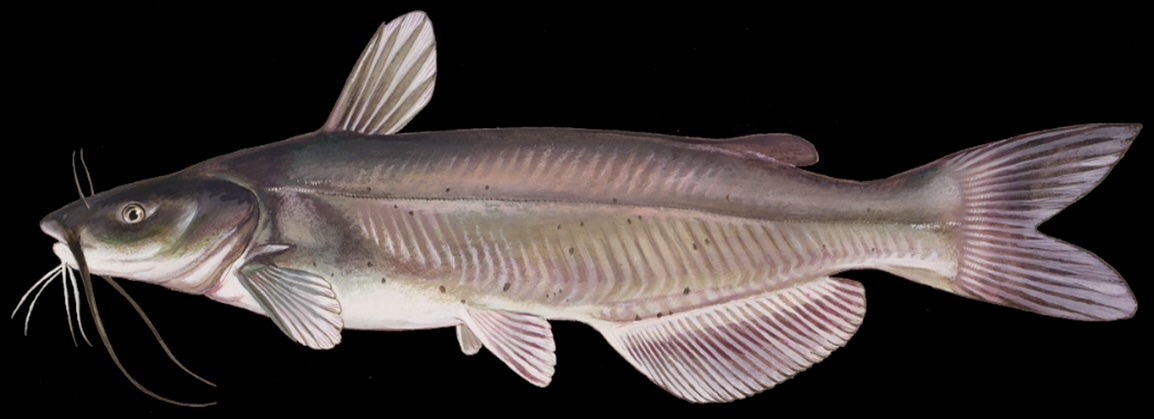
Most catfish are bottom feeders, aquatic vacuum cleaners, eating up all the nasty bits in their environment. Go fishing and catch one of the huge monsters, and you’ll know you caught a catfish by their whisker-like barbels—which are actually super-sensitive taste buds they use to sniff out food in muddy spots. Instead of standard fish scales, they’ve got smooth, slimy skin or even tough bony plates, and you’ve gotta watch out for the sharp, sometimes venomous spines on their fins when you’re prepping them. They range from tiny aquarium janitors to 600-pound monsters like the Mekong Giant. Since they’re oily and have a distinct, earthy flavor, they’re the GOAT for a classic cornmeal fry or a spicy blackened filet.
Varieties
When you’re getting ready to fry up some catfish in the kitchen, you’re going to be buying one of 6 varieties:
- Farm Raised
- Channel Catfish : The industry standard for U.S. aquaculture. It has a mild, sweet flavor and firm texture. These are also known as Willow Cats, Lady Cats, and Speckled Cats
- Hybrid Catfish: A cross between a female Channel and a male Blue catfish. Hybrids are the “super-fish” of the farming industry because they grows significantly faster than a standard Channel cat and are easier for farmers to harvest because they stay at the top of the water column.
- Line Caught
- Blue Catfish: Larger and meatier with a robust, savory profile. Also known as Blues, High-fins, and, Hump-backed Catfish.
- Flathead Catfish: Prized by chefs for a “cleaner” taste because they primarily eat live fish rather than scavenging. Fry up a Flathead, and what you get will be remarkably white, firm, and flaky, often compared to premium whitefish like walleye or crappie. If you don’t live in Louisiana, good luck getting one of these in the store! Restaurants buy up nearly ALL the available supply. Most flatheads come from Louisiana and are locally known as Goujons, Opelousas, and Appaloosas.
- There are two closely related Siluriformes widely available at your local Publix: Basa and Swai. While both these fish look and taste a lot like catfish and are certainly close relatives, they can’t be legally labeled as “catfish.” Why? In 2002, the U.S. Congress passed a law (pushed heavily by the domestic catfish industry) stating that only fish from the family Ictaluridae—which are native to North America—can be legally labeled or marketed as “catfish.” Because Basa and Swai belong to the family Pangasiidae (native to Southeast Asia), they were legally stripped of the name. It was a strategic move to protect the American product from the cheaper, more tasty imports. Even though they are biologically types of catfish, calling them “Vietnamese Catfish” in the U.S. is technically a federal labeling violation. Both Basa and Swai are imported from Vietnam and are milder, more flavorful, and have a significantly more delicate texture.

While you can find line caught Blue and Flathead catfish in specialty stores, nearly ALL the catfish we eat is raised in fish farms.
Cultural and Culinary History
Roots in the American South
For centuries, catfish was a critical food source for Indigenous peoples and later for enslaved Africans. Because catfish are hardy and plentiful in the Mississippi Delta, they became a primary protein for those who had limited access to expensive livestock.
- The Fish Fry Tradition: The “Saturday Night Fish Fry” became a cornerstone of African American communal life. It was more than a meal; it was a social ritual that utilized cornmeal (a cheap, accessible starch) and hot lard to create a portable, high-calorie feast.
- The Great Migration: As Black Southerners moved to Northern cities like Chicago and Detroit, they brought their catfish recipes with them, cementing the fish as a symbol of Southern identity across the entire country.
The 1960s: From Wild to Farmed
Before the 1960s, catfish was strictly a seasonal, wild-caught delicacy. This changed when farmers in Mississippi realized that their flat, clay-based land was perfect for carving out ponds.why do catfish taste bu
- Birth of an Industry: In 1966, the first commercial catfish processing plant opened in Belzoni, Mississippi (now known as the “Catfish Capital of the World”).
- Flavor Consistency: Farming changed the culinary profile of the fish. By switching to a grain-based, floating feed, the “muddy” taste often associated with wild bottom-feeders was replaced by a clean, sweet flavor that appealed to a broader national audience.

The “Blackened” Revolution
In the 1980s, the culinary status of catfish shifted from “poor man’s food” to a trendy restaurant staple, largely thanks to Chef Paul Prudhomme. His blackening technique—searing the fish in a white-hot cast-iron skillet with a heavy coat of spices—captured the national imagination and proved that catfish could hold its own in a professional kitchen.
Modern Sustainability
Today, U.S. farm-raised catfish is recognized as one of the most sustainable seafood choices available.

Recipes
BLACKENED FISH
Imagine a chef in a bustling Louisiana kitchen, sliding a spice-crusted catfish into a white-hot cast-iron skillet. Immediately, a cloud of fragrant smoke billows up, and the fish sizzles violently. To an onlooker, it might look like a disaster—as if the fish is being scorched to a crisp.
But look closer. That dark, dramatic crust isn’t actually burnt fish; it’s a savory “armor” created by a high-heat transformation. Chef Paul Prudhomme created the technique and made it popular. Read on to discover how you do it:

The process begins with a fillet drenched in melted butter and dredged heavily in a blend of paprika, cayenne, garlic, and herbs. When that butter and spice layer hits the intense heat of the cast iron, the spices don’t just cook—they caramelize and toast almost instantly. This creates a deep, mahogany-to-black “bark” that tastes smoky and complex, rather than bitter and acrid like truly charred food.
Underneath that intense exterior, the fish stays protected. The crust acts as a thermal shield, sealing in the natural juices and steaming the meat until it is perfectly tender and flaky. When you take a bite, you get the crunch of the toasted spices followed by the buttery sweetness of the fish—a deliberate culinary balance that is the hallmark of true blackened soul food.
Here’s how you do it:

Blackened Catfish
Ingredients
- 3/4 pound 3 sticks unsalted butter, melted
- 6 8- to 10-ounce Catfish fillets, mudvein removed
SEASONING MIX:
- 1 tablespoon sweet paprika
- 2-1/2 teaspoons salt
- 1 teaspoon onion powder
- 1 teaspoon garlic powder
- 1 teaspoon ground red pepper preferably cayenne
- 3/4 teaspoon white pepper
- 3/4 teaspoon black pepper
- 1/2 teaspoon dried thyme leaves
- 1/2 teaspoon dried oregano leaves
Instructions
- Heat a large cast-iron skillet over very high heat until it is beyond the smoking stage and you see white ash in the skillet bottom (the skillet cannot be too hot for this dish), at least 10 minutes.
- Thoroughly combine seasoning mix ingredients in a small bowl. Dip each fillet in the reserved melted butter so that both sides are well coated; then sprinkle seasoning mix generously and evenly on both sides, patting it in by hand.
- Heat serving plates in a 250-degree oven. Set aside enough melted butter to serve with each portion.
- When the skillet is heated, place the fillets inside without crowding and top each with 1 teaspoon of melted butter. Cook, uncovered, until the underside looks charred, about 2 minutes. Turn the fillets over and again pour 1 teaspoon of butter on top; cook until done, about 2 minutes more. Transfer to warmed plates and repeat with the remaining fish.
- Turn the fillets over and again pour 1 teaspoon of butter on top; cook until done, about 2 minutes more. Transfer to warmed plates and repeat with the remaining fish.
- To serve, place one fillet and a ramekin of butter on each heated serving plate.
FRIED CATFISH
Imagine you’re standing in a professional kitchen in the heart of the Mississippi Delta. The air is thick, not just with the Southern humidity, but with the specific, nutty aroma of cornmeal hitting hot oil. This isn’t just “fish and chips”—this is the soul of Inland Americana.
The Prep: Respect the Texture
First, look at your fillets. They should be firm and white, never gray. Unlike delicate sole or flaky cod, catfish has a meaty, dense grain. Your first job is the “soak.” Many old-school chefs swear by a buttermilk bath. The lactic acid doesn’t just tenderize; it pulls out any residual earthiness, leaving you with a clean, mild profile.

The Dredge: The Golden Armor
Now, let’s talk about the “Midsouth Gold.” You aren’t using a heavy beer batter here. Catfish demands a cornmeal-based dredge. Why? Because cornmeal creates a rugged, craggy crust that stays crunchy even after it’s been sitting on a plate for ten minutes.
- The Secret: Use a 70/30 mix of yellow cornmeal and flour.
- The Seasoning: Don’t be shy. Cayenne, garlic powder, and a heavy hand of black pepper are non-negotiable.
The Fry: The 350° Dance
When you drop that fillet into the fryer (ideally peanut oil or lard if you’re going traditional), listen to the sound. It shouldn’t hiss; it should roar.
- The Float: As the moisture evaporates and the proteins tighten, the fish becomes lighter. When it bobs to the surface like a golden cork, it’s telling you it’s done.
- The Internal: You’re looking for that perfect 145°F, where the meat transitions from translucent to a shimmering, opaque white.
The Presentation: The Holy Trinity
A plate of fried catfish is lonely without its entourage. In a professional setting, you’re looking for the contrast of acid and sugar:
- Hushpuppies: Deep-fried cornmeal balls (the catfish’s best friend).
- Vinegar Slaw: To cut through the richness of the oil.
- Remoulade or Tartar: A creamy, caper-heavy sauce to bridge the gap.
As a chef, your goal is that first bite: the audible crunch of the cornmeal followed by the buttery, steaming flake of the fish. It’s simple, it’s rustic, and if you do it right, it’s the best thing your customers will eat all week.
Buttermilk Fried Catfish
Ingredients
- 1 quart peanut oil
- 1 cup stone-ground cornmeal
- 1 cup all-purpose flour
- 1 teaspoon Old Bay seasoning
- 1/2 teaspoon kosher salt
- 1/4 teaspoon hot smoked paprika
- 1/4 teaspoon freshly ground black pepper
- 6 7- to 9-ounce U.S. farm-raised catfish fillets, rinsed and thoroughly patted dry
- 3/4 cup low-fat buttermilk
Instructions
- Heat the peanut oil in a 5-quart Dutch oven over high heat until it reaches 350ºF on a deep-fry thermometer. Adjust the heat to maintain temperature.
- Whisk the cornmeal and flour together in a shallow dish. Combine the Old Bay, kosher salt, paprika, and pepper in a small bowl. Season the catfish fillets evenly on both sides with the spice mixture. Pour the buttermilk into another shallow dish. Dip each fillet into the buttermilk, flip once to coat both sides, hold over the pan, and allow the excess to drip off. Coat both sides of the fillets in the cornmeal mixture. Set the coated fillets on a wire rack or and let rest for 5 minutes for the cornmeal to hydrate before frying..
- Gently add the fillets, two at a time, to the hot oil, and fry until golden brown, 5 to 6 minutes. Using a spider strainer, carefully remove the fried fillets to a wire rack set over a paper towel-lined half sheet pan. Repeat method with remaining fillets. Arrange the catfish on a serving platter and serve immediately.
Hushpuppies
Picture this: You’ve just pulled a batch of golden, cornmeal-crusted catfish out of the fryer. The platter looks great, but in the world of Southern coastal cooking, it’s incomplete. It’s missing the hushpuppy—the ultimate “scrappy” sidekick that accidentally became a star.
For a culinary student, the hushpuppy is a lesson in resourcefulness. Legend has it (and there are many versions) that these little nuggets were born out of necessity at riverside fish fries. To keep hungry hunting dogs from barking for a share of the catch, cooks would drop bits of leftover cornmeal batter into the hot lard, tossing them to the hounds with a firm, “Hush, puppy!”

The Anatomy of the Perfect Nugget
While they started as dog treats, they’ve evolved into a sophisticated balancing act of texture and flavor. A great hushpuppy isn’t just a ball of fried dough; it’s a study in contrast:
- The Exterior: It should have a rugged, “shaggy” crust that shatters when you bite into it. That crunch comes from the high heat of the oil (350°F–375°F) reacting with the coarse grit of the cornmeal.
- The Interior: This is where the magic happens. Inside that armor, you want a steaming, cake-like center. If it’s dry, you’ve over-mixed; if it’s gummy, your oil wasn’t hot enough. It should be airy, moist, and carry a hint of sweetness to offset the salt of the fish.
The Flavor Profile: Sweet vs. Savory
In the kitchen, you’ll find two warring camps:
- The Purists: They want nothing but cornmeal, buttermilk, and maybe a whisper of grated onion. The onion is key—it doesn’t just add flavor; its moisture creates little steam pockets inside the dough as it fries.
- The Modernists: This is where you get to play. Think of the batter as a vehicle. Fold in fresh jalapeños for a slow burn, roasted corn kernels for texture, or even bits of sharp cheddar that turn into molten pockets of gold.
The Technique: The Two-Spoon Drop
As a student, your challenge is the “drop.” You aren’t aiming for perfect spheres—those look like they came out of a frozen bag. You want organic, irregular shapes. Using two spoons (or a small spring-loaded scoop), you gently “roll” the batter into the oil.
When they hit the fryer, they’ll sink for a second, then bob to the surface, spinning slowly like little planets. When they reach that deep, mahogany brown, you pull them. Toss them immediately into a paper-lined bowl with a pinch of flaky salt.
In the Southern culinary canon, the catfish is the main event, but the hushpuppy is the soul of the plate. It’s humble, it’s historic, and if you master the fry, it’s the thing your guests will keep reaching for long after the fish is gone.

Hushpuppies
Ingredients
- 3/4 cup all-purpose flour
- 3/4 cup fine-grind cornmeal
- 2 teaspoons sugar
- 1 1/2 teaspoons baking powder
- 1 1/2 teaspoons kosher salt
- 1/2 teaspoon garlic powder
- 1/4 teaspoon onion powder
- 1/4 teaspoon freshly ground black pepper
- 4 tablespoons chilled unsalted butter cut into pieces
- 1 large egg beaten to blend
- 1 cup buttermilk
- 1/2 small onion finely chopped
- 1 jalapeño seeded, finely chopped
- Vegetable oil for frying; about 6 cups
Instructions
- Sift flour, cornmeal, sugar, baking powder, salt, garlic powder, onion powder, and pepper into a large bowl to combine. Add butter and work in with a pastry blender or your fingers until mixture resembles coarse meal (the largest butter pieces should be no bigger than a pea).
- Make a well in the center of flour mixture and add egg and buttermilk to well. Gradually incorporate into dry ingredients, mixing from the center out, until a smooth batter forms. Add onion and jalapeño and mix gently just to evenly disperse (be careful not to overmix).
- Pour oil into a large heavy saucepan to come halfway up sides and fit with thermometer. Heat oil over medium-high until thermometer registers 350°F. Using a 1-oz. scoop or a tablespoon and working in 2–3 batches, carefully drop balls of batter into oil and fry, turning often with a spider or a slotted spoon and adjusting heat to maintain temperature, until hushpuppies are puffed and deep golden all over, about 4 minutes. Transfer to paper towels to drain and let cool slightly.